
Amazon moves enough in an ordinary session to make a small position feel slow, and enough after a results announcement to make a large one dangerous. A trader who wants more exposure than their cash allows has historically needed a margin account at a broker, an options approval level, or a spread-betting login in a country that permits one.
A perpetual contract does the same job from a crypto balance. You post margin in USDT, choose a multiplier, and the contract tracks the share price without you owning a share. On BloFin that contract is the AMZNUSDT Perpetual.
The arithmetic is less forgiving than the procedure. At 20x a 3% move in your favor is a 60% gain on the margin you posted. In isolated margin, a smaller move against you closes the position and takes the whole of that margin with it. In cross margin, which the order panel starts on, the position draws on the rest of your futures balance, so it lasts longer and can lose more than the margin you posted.
What is the AMZNUSDT Perpetual?
The AMZNUSDT Perpetual is a contract on BloFin that tracks Amazon's share price, settles in USDT and never expires. You hold it long or short at a multiplier of 1 to 20, post margin against the full value, and pay or receive a funding payment, every eight hours as standard. It conveys no ownership of Amazon.
That last point separates it from the other two ways to hold Amazon in a crypto account. A share bought through a broker makes you a shareholder of the listed company, while tokenized Amazon, which trades on BloFin as AMZNX/USDT Spot, makes you a creditor of the token's issuer.
The perpetual does something else again: it makes you a counterparty to whoever took the other side of your trade, so the token and the perpetual carry different risks even when they track the same price.
Two prices sit at the top of the contract page and they do different jobs. The index price is the reference the contract tracks, and the mark price is what your profit, loss and liquidation are measured against. On September 23, 2026, the contract traded at 253.36 with an index of 253.10 and a mark of 253.33. The gap between them is usually cents wide, and it is the mark, never the last trade, that decides whether a position survives.
Say you open a position and the last trade ticks below your liquidation price for a second. Nothing happens if the mark has not reached it. That distinction exists to stop a thin moment in the order book closing positions that the wider market never moved against.
AMZNUSDT contract specs and leverage tiers
Five published figures shape every AMZNUSDT order. The tick is $0.01, settlement is in USDT, and the smallest position is 0.01 AMZN. The largest single order is 5,000 AMZN on a limit and 500 on a market order, and funding settles every eight hours from 00:00 Hong Kong time (source: AMZN contract details).
The tick constrains the order form more than the strategy, because entries, stops and targets all round to a cent. The minimum matters at the other end. At the September price, 0.01 AMZN is about $2.50 of exposure, so the contract lets you practice at a size where being wrong costs less than lunch.
The sixth figure is the one that surprises people, because leverage comes in tiers. The 20x cap belongs to the first 300 AMZN of position size and steps down from there (source: AMZN position tiers).
Position size | Maintenance margin | Maximum leverage |
|---|---|---|
0 to 300 AMZN | 2.50% (source: AMZN position tiers) | 20x |
300.01 to 1,000 AMZN | 3.33% | 15x |
1,000.01 to 7,000 AMZN | 5.00% | 10x |
7,000.01 to 10,000 AMZN | 10.00% | 5x |
10,000.01 to 30,000 AMZN | 12.50% | 4x |
At the price read on September 23, 2026, 300 AMZN is about $75,000 of exposure, so most first positions sit inside the first tier. The ladder still matters, because the venue states that the leverage available "depends on the number of contracts of your holdings, open orders, and new orders when opening positions" (source: AMZN position tiers). Adding to a winning position can therefore move you into a tier that will not carry the multiplier you started with. Open orders count toward that total even before they fill.
One more published figure belongs here, because it bounds what the contract will accept, whatever you choose. Buy orders cannot be priced more than 3% above the index, and sell orders not more than 3% below it. After a contract's first ten minutes, BloFin can tighten that band using the average premium of the last two minutes, but never widen it (source: AMZN contract details). An order priced outside the band may wait in the book for up to ten minutes, and BloFin cancels it if the price has not come back inside the band by then (source: Price Limit Rules).
How to open your first AMZNUSDT position
Before you start: Create a BloFin account
Two things have to exist before the order panel is any use: a BloFin account, and USDT sitting in the futures wallet rather than the funding one. The USDT arrives through a deposit into the funding account, and you transfer it to the futures wallet from there.
If perpetual contracts themselves are new, how they differ from dated futures is worth twenty minutes before you post margin against one.
Decide three things before you touch the panel: the price at which you are wrong, the loss you will accept, and how long you expect to hold. A leveraged position moves too quickly for those judgments to be formed once it is already open.
Placing your first AMZNUSDT trade
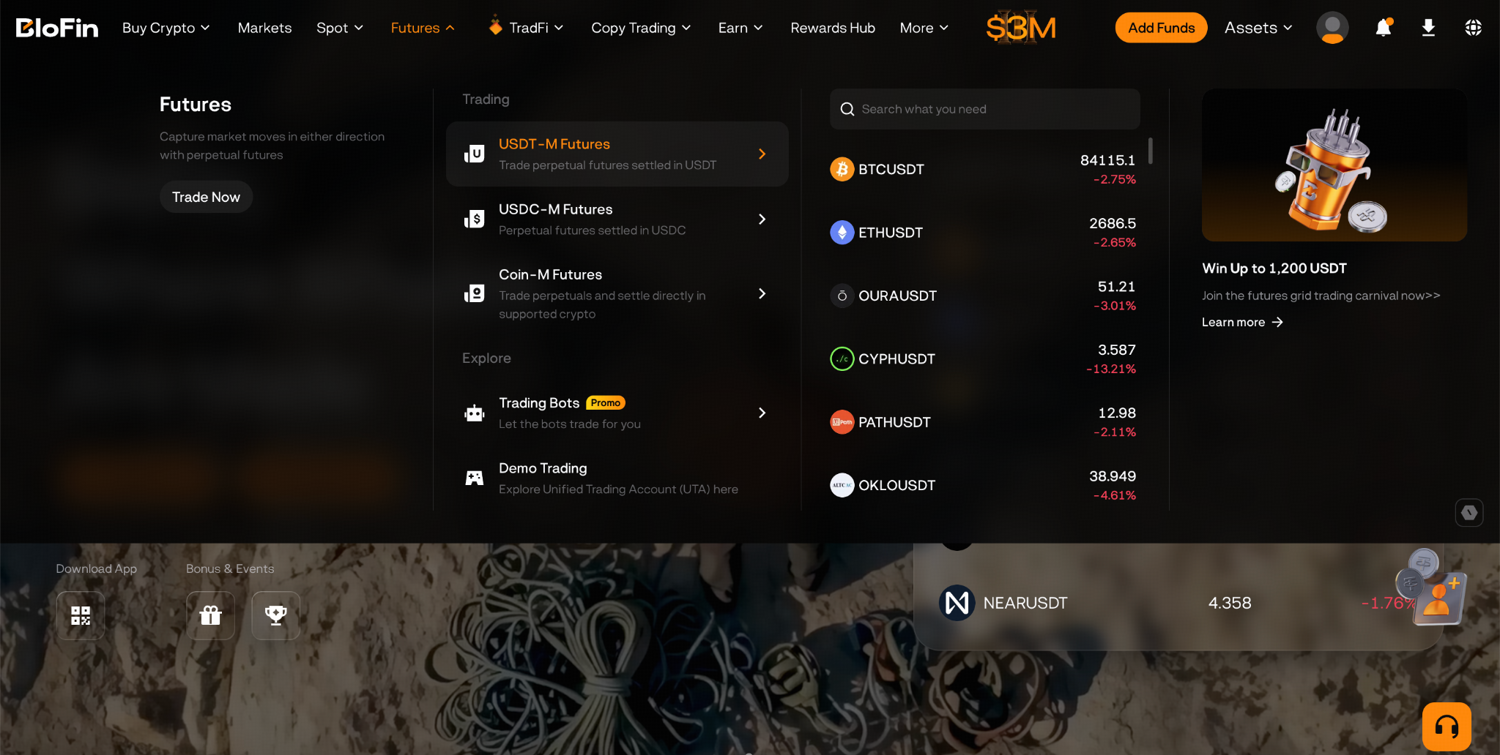
Step 1: Log in to your BloFin account and hover your cursor over the Futures tab. Then, click USDT-M Futures.
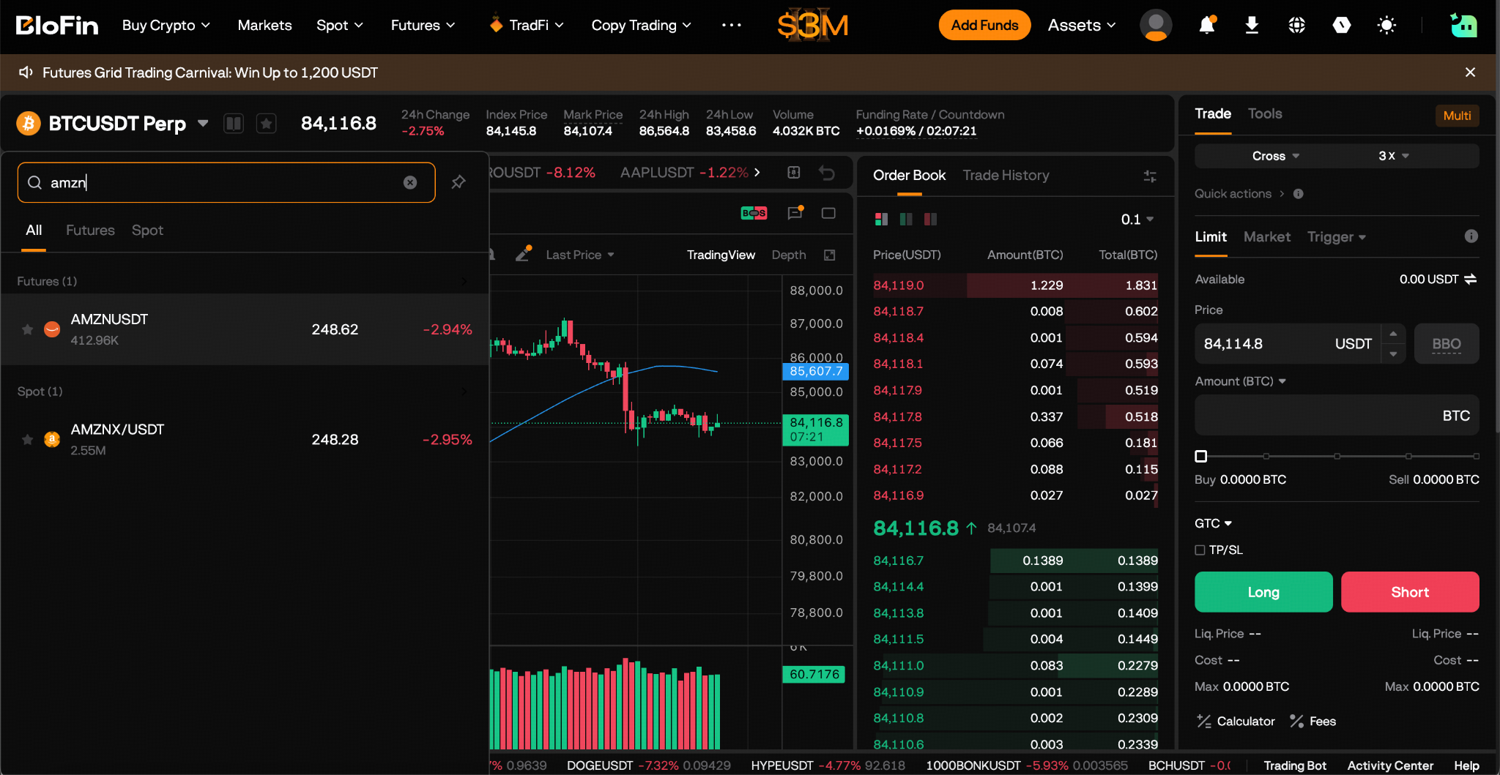
Step 2: Hover your cursor over the pair name at the top left and a pop-up window will appear. Type AMZN in the search bar and select AMZNUSDT Perp from the results.
Step 3: Set the margin mode and the multiplier before you size anything. The control sits above the order form and shows the current setting, which is Cross 3X by default; for a first position, switch it to Isolated at a low multiplier.
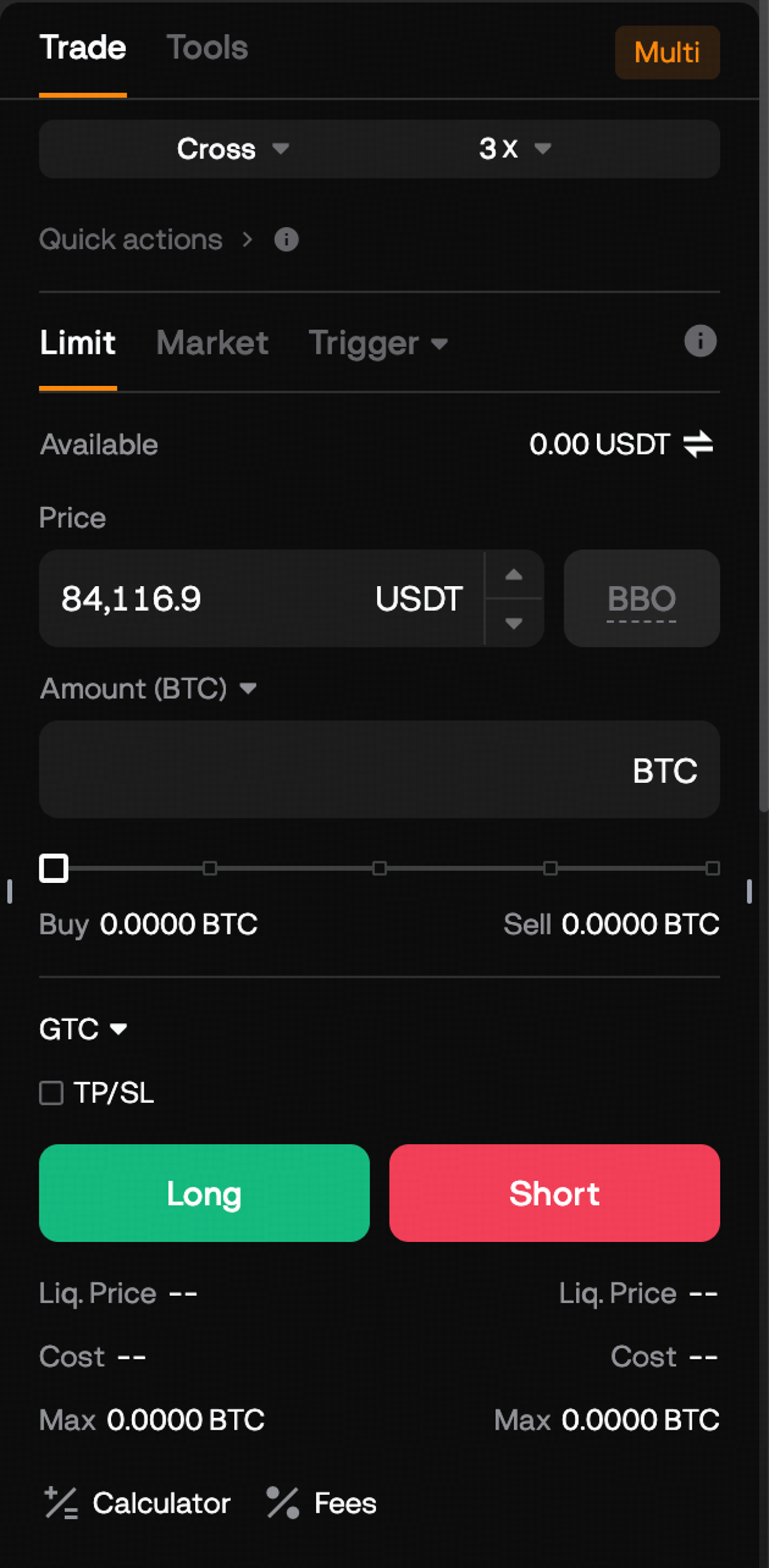
Step 4: Choose the order type. Limit gives you a price and no guarantee of filling; Market gives you a fill and no guarantee of price; Trigger arms an order that appears when the market reaches a level you set.
Step 5: Enter the amount in AMZN. Before you confirm, the calculator under the order form returns the liquidation price for the same order in Isolated margin, an estimate of where the trade ends. Then click Long to open a long position (buy); Short opens a short (sell).
Step 6: Attach TP/SL to the same order that opens the position, not later. A position opened without a stop is a position you have to watch continuously. Amazon's largest move in the fifty sessions to September 23, 2026 opened as an overnight gap after its results, in hours when the contract may refuse a new order.
Once the order fills, the position appears in the Positions tab below the chart, with its liquidation price. To exit a long, place a Sell order for the same amount with the Reduce-only box ticked. Reduce-only restricts an order to shrinking an existing position, so an exit sized a little too large can never open a short by accident.
When AMZNUSDT accepts new positions
The AMZNUSDT contract quotes a price around the clock, which differs from accepting new orders. Outside the stock futures hours BloFin set in April 2026, "stock futures trading may be limited to reduce-only orders" (source: BloFin stock futures trading update). Reduce-only means you can close what you hold, while opening a new position has to wait for the session.
The session matches the Nasdaq trading day, which runs 9:30 a.m. to 4:00 p.m. Eastern (source: Nasdaq market schedule). BloFin sets it at 14:30 to 21:00 UTC in Standard Time and 13:30 to 20:00 UTC during Daylight Saving (source: BloFin stock futures trading update). For the rest of 2026, the session is shut all day on November 26 and December 25 and closes early, at 18:00 UTC, on November 27 and December 24 (source: BloFin stock futures trading update). The same announcement adds that "access to this product may be restricted in certain regions" (source: BloFin stock futures trading update).
Isolated or cross margin
Isolated margin ring-fences the collateral behind a single position, which means the position can lose the amount you assigned to it and nothing beyond that. Cross margin lets a position draw on the whole futures balance, which pushes the liquidation price further away and puts the rest of the balance behind it.
Say you hold $500 in the futures wallet and open $1,000 of Amazon exposure with $100 of margin. Under isolated margin, that $100 is what the position can lose. Under cross margin, the position keeps drawing on the balance as it moves against you, so it survives a deeper move and can take more of the $500 with it when it fails. Safety depends on the trade, not on the mode alone. Isolated caps the damage per trade; cross keeps a position alive through noise that would otherwise close it.
On BloFin, the guidance for a first leveraged stock position is isolated margin at a low multiplier, because it makes the worst case a number you chose rather than a number you discover. BloFin Academy's guide to leverage and liquidation gives the same rule for a single position or a trader still learning: "use isolated". Cross margin comes later, and the only case the same guide makes for it is a hedged portfolio whose positions offset one another.
One asymmetry is worth carrying: cross margin moves the liquidation price away from you, and it does that by widening what the position may consume. A position that survives a move it should have been closed out of is not always the better outcome.
Where an AMZNUSDT position liquidates
Liquidation happens at the maintenance margin, meaning the minimum equity the venue requires you to keep before it closes the position on your behalf. When it does, the margin behind the position is gone. On the first tier of AMZNUSDT that requirement is 2.50% of the position (source: AMZN position tiers).
Say you open $2,000 of Amazon at 20x in isolated margin and post $100. A fall of roughly 2.5% takes about $50 off the position and leaves about $50 of your $100, which is the 2.50% of the position that tier requires you to keep (source: AMZN position tiers). The trade closes near there, not at the 5% the posted margin might suggest. The position is closed at the maintenance line, about halfway to the margin being gone, and the other half goes with it. BloFin's liquidation engine takes the position over at the price where your margin reaches zero and passes any surplus to its insurance fund (source: Forced Liquidation Rules). At 10x on the same first tier, liquidation sits nearer 7.5% away than the 10% the margin suggests, because the 2.5% you must keep comes off the margin you post.
Now put a real Amazon move next to that distance. Amazon announced its second-quarter results on July 30, 2026, and its release scheduled the earnings call for 5:00 p.m. Eastern that day, an hour after the closing bell (source: Amazon Q2 2026 results release). The stock closed that day at $235.50 and opened the next morning at $265.00, finishing July 31 up 15.32% on volume of 129 million shares (source: Stock Analysis AMZN history).
The overnight gap alone is 12.53%. On a 20x position, liquidation sits about 2.5% away. The gap is roughly five times the distance to liquidation, and no regular session ran between the two prices. A short at that multiplier was closed out well before the next regular session opened.
July 31 was the largest single-day move in the fifty sessions to September 23, 2026 by a factor of three. The next largest were 4.58%, −4.57% and 3.97% (source: Stock Analysis AMZN history). Amazon trades quietly through most weeks, and its results announcements are scheduled quarterly. On the most recent of those dates it moved further than a 20x position could survive. The gap formed outside the session, when new orders may be refused, so a hedge could not be opened while it was forming and a stop added after the results was set against a price that had already moved. That is why Step 6 puts the stop on the order that opens the position.
The practical response is to size the position so the gap you can imagine is smaller than the distance to your liquidation price. That is the position sizing arithmetic applied to a stock that gaps. Accept, too, that a stop fixes the level that triggers your exit and not the price you get. In a violent move the price can gap straight through it, so a stop-market order fills at a worse price and a stop-limit order may not fill at all, as BloFin's guide to leverage and liquidation warns.
What the position costs while it is open
Two costs run against an open AMZNUSDT position, and only one of them is a fee. At the Regular tier, futures trading costs 0.0200% as a maker and 0.0600% as a taker, so a round trip crossing the spread both ways is 0.12% of notional.
Funding is the other, and it is the one that adds up the longer you hold. Every settlement in the six days to September 23, 2026 was positive, running between 0.0110% and 0.0391% and averaging 0.0183%. At three settlements a day, that is about 0.0549% a day to a long (source: AMZN funding rate history). On $10,000 of exposure that is roughly $5.49 a day, or about $165 over a month.
Funding moves, and the six days before those ran differently: eighteen settlements averaging 0.0043% with four of them negative, which is nearer $39 a month on the same position (source: AMZN funding rate history). A negative rate pays a long instead of charging one. The rate pending for the next settlement sits on the contract's own market page with its countdown.
The fee side has one lever you control. The maker rate of 0.0200% applies to an order that rests in the book and waits. The taker rate of 0.0600% applies to one that crosses the spread for an immediate fill, so a limit order left to fill costs a third of a market order at the same tier. Those tiers fall with thirty-day volume or with assets held, whichever puts you higher, so a new account pays the Regular rate until its volume or its assets reach the next tier up.
Put the two together for a practical rule of thumb. On a position held for hours, the fees dominate and the funding barely registers. On a position held for weeks at the rate of the six days to September 23, the funding outweighs the fees several times over, so the move you need just to break even grows with every day you hold.
The BloFin fee schedule lists every tier beside its maker and taker rates.
The perpetual against a 2x Amazon ETF
Leveraged Amazon exposure is also available from a brokerage account, through a fund that aims for twice the stock's daily move. GraniteShares runs a 2x long Amazon fund on Nasdaq under the ticker AMZZ, with a net expense ratio of 1.15% and a daily rebalance (source: GraniteShares AMZZ).
The issuer rates its own fund 5 out of 5 for risk and describes it on the same page as "not a buy-and-hold investment", intended for holding periods "often a single trading day" (source: GraniteShares AMZZ).
The reason for that warning is in the fund's own return table. Since its launch in March 2024, AMZZ has returned 10.19% a year at net asset value against 15.19% a year for Amazon itself, on the issuer's table as of September 24, 2026 (source: GraniteShares AMZZ). A fund built to deliver twice the daily move has returned less than the stock since launch. It resets every day, the compounding of those resets works against a holder whenever direction alternates, and the fund's 1.15% expense ratio comes off on top. The issuer states the mechanism plainly: "Leveraged ETFs reset daily; returns over periods longer than one day will differ from 2x the underlying."
AMZNUSDT Perpetual | AMZZ, 2x long Amazon | |
|---|---|---|
Multiplier | 1 to 20, chosen per position | Fixed 2x on the daily move |
Holding cost | Funding every eight hours, paid or received | 1.15% net expense a year, plus daily-reset drag |
Worst case | Liquidation, which takes the margin behind the position | The fund's value, with no forced closure |
When you can open | The American session, possibly reduce-only outside it | Nasdaq hours |
The trade-off is not which is riskier but which risk you prefer. The perpetual can be closed out by the venue, and in a sideways market it costs whatever funding runs against your side. The fund cannot liquidate you, and in a sideways market its daily reset quietly loses ground.
The structures differ underneath as well. The fund reaches its 2x through swap contracts totaling 200% of net assets, collateralized by Treasury bills and cash, and it held $39.47 million in assets on September 22, 2026 (source: GraniteShares AMZZ). The perpetual reaches its multiplier through margin you post directly, which is why one can close your position and the other cannot.
Looking to gain exposure to Amazon? To get started, you'll need to first create a BloFin account, fund your account with cryptocurrency, and navigate to the AMZNX/USDT Spot trading page or AMZNUSDT Perpetual page.
Frequently asked questions
What leverage can I use on Amazon on BloFin?
Up to 20x, and only on the first 300 AMZN of position size (source: AMZN position tiers). The part that catches people out is what a tier boundary does to a position already open. The maintenance requirement climbs with the ladder, from 2.50% to 3.33% above 300 AMZN and 5.00% above 1,000, so adding to a winning position moves its liquidation price closer to the entry on exposure you have already taken. The venue counts holdings, open orders and new orders together when it decides which tier applies.
How much leverage survives an Amazon earnings gap?
Less than the gap alone suggests, because an earnings move can keep going after the open. In isolated margin, what you post has to cover the whole move against you and still leave the 2.50% the first tier requires you to keep (source: AMZN position tiers), charged on the position's value at the new price. After Amazon's results in July 2026 the stock closed at $235.50 on July 30, opened at $265.00 and finished July 31 at $271.58 (source: Stock Analysis AMZN history). A short opened at that July 30 close at about 6x survived the open and was closed out within minutes of it, and only about 5x lasted the session, before fees and funding. A long was on the right side of that gap.
When does funding cost enough to change the trade?
BloFin's own guide to how funding rates work puts 0.01% to 0.03% a settlement in the normal band and 0.03% to 0.08% in the elevated one. It says to shorten the holding period or cut leverage once the carry would eat more than a fifth of the profit target (source: how funding rates work). AMZNUSDT's settlements over the six days to September 23, 2026 straddled the two, averaging inside the normal band with two of them reaching the elevated one (source: AMZN funding rate history). The number to run before a multi-week hold is the carry against your target, not the rate by itself.
Can you short Amazon with leverage on BloFin?
Yes. The same order form opens a short with the Sell button, on the same tiers and the same 20x cap (source: AMZN position tiers). A short receives funding while the rate is positive and pays it when the rate turns negative (source: how funding rates work). At the same multiplier a short is liquidated by a slightly smaller move than a long, because a rising price enlarges the position the maintenance margin is charged on.
Does trading AMZNUSDT make me an Amazon shareholder?
No shareholding attaches to the contract. The April 21 announcement's disclaimer excludes "any dividends, interest, voting rights, shareholder rights, or rights offerings (including but not limited to share splits, spin-offs, or subscription rights)" (source: BloFin stock futures trading update). Amazon has never paid a dividend, so that exclusion costs an Amazon holder less than it would elsewhere, though the four stock splits reach a shareholder and not a contract.
Researched and written by the BloFin Academy editorial team with AI-assisted drafting. All facts independently verified. Primary sources include BloFin's AMZN contract details, position tier and funding rate pages, its fee schedule, its stock futures trading update of April 21, 2026, its Price Limit Rules and Forced Liquidation Rules, BloFin Academy's guides to leverage and liquidation and to funding rates, Amazon's second-quarter 2026 results release, Nasdaq's market schedule, Stock Analysis's AMZN price history and GraniteShares' AMZZ fund page, read on September 24, 2026.
Nothing in this article constitutes financial advice, and nothing in it recommends buying, selling or holding Amazon in any form, or predicts the company's results or share price. The AMZNUSDT Perpetual is a leveraged contract: a move far smaller than the multiple suggests can liquidate a position, a price gap outside the session can pass straight through a stop, and outside the Nasdaq session, at weekends and on holidays BloFin may limit it to reduce-only orders. Funding changes at every settlement and can turn against either side, and in cross margin a losing position can draw on the rest of the futures balance. Past performance does not indicate future results. Do your own research and consider your risk tolerance before you trade on BloFin.