
Tesla is one of the most heavily traded and most volatile names in the market, the kind of stock that can move more in a single session than some companies move in a quarter. For a trader with a strong view on where it is heading, that volatility is the opportunity, and leverage is the tool that turns a modest amount of capital into a position large enough to matter. It is also the tool most likely to end a trading account, because the same multiplier that amplifies a good call amplifies a bad one just as fast.
If you already trade crypto, the mechanics will feel familiar: a perpetual contract, margin, funding, and a liquidation price, all applied to Tesla's share price instead of a token. On BloFin, you trade leveraged Tesla exposure through a Tesla perpetual contract (TSLAUSDT), rather than buying real Tesla stock (TSLA) on a stock exchange. This guide walks through how that works on BloFin, how to size and manage a leveraged Tesla position, and what it costs to hold one, so the leverage ends up working for you rather than against you.
What is a TSLAUSDT Perpetual and how is it different from real Tesla stock in the stock market?
TSLAUSDT Perpetual contracts are derivatives that track the price of Tesla stock without expiry. They allow leverage and make it easy to sell short. Unlike owning Tesla (TSLA) on Nasdaq, trading TSLAUSDT Perps does not grant ownership rights, dividends, or voting privileges.
This contract is settled in USDT, a stablecoin, and trades 24/7 on BloFin’s futures platform, which is why it appeals to crypto-native traders who want to act on Tesla's price outside stock-market hours. The perpetual structure includes funding payments exchanged between longs and shorts to keep the contract price aligned with the underlying Tesla stock price.
One thing to be clear on: this is a different product from tokenized Tesla (TSLAx), which is a tokenized version of the spot share. The perpetual is a leveraged derivative contract of Tesla as the underlying asset, whereas TSLAx is unleveraged price exposure to the token. For the underlying company itself, see the guide to what Tesla stock is, and for the tokenized spot product, see what tokenized Tesla (TSLAx) is.
How leverage works when trading TSLAUSDT Perpetuals on BloFin
When you open a TSLAUSDT Perpetual position on BloFin, you post margin in USDT and receive exposure worth a multiple of that margin. Similar to margin accounts that allow traders to borrow a portion of the purchase price from a broker, leverage on BloFin lets you control more notional value than your deposited capital.
You choose a leverage multiplier when placing the trade, and it should match your risk tolerance and time horizon. For example, 5x leverage means $1,000 of margin controls $5,000 in TSLAUSDT notional. If Tesla’s price rises 5%, your position gains $250, a 25% return on margin before fees and funding rates. Conversely, if the price drops 5%, you lose $250, the same 25%, but in the opposite direction. Losses in leveraged trading can quickly exceed what is suitable for some traders based on their financial situation, so understanding your liquidation price is crucial.
Initial margin is the amount you deposit to open the position. Maintenance margin is the minimum equity you must keep to avoid liquidation. Once your account equity falls below this threshold, BloFin can liquidate your position to protect against further losses.
Going long or short: Expressing your Tesla view with TSLAUSDT leverage
TSLAUSDT Perpetuals let investors go long or short Tesla’s price without owning the stock or borrowing shares from a broker. This flexibility is a key advantage for active traders.
A leveraged long position profits when Tesla’s price rises. For example, using moderate leverage lets you express a bullish view with less capital than buying TSLA outright. A leveraged short position profits when Tesla’s price falls. Shorting TSLAUSDT perps is simpler than traditional stock shorting, which requires margin accounts and borrowing shares.
Consider a 3x leveraged long ahead of a Tesla earnings report. If Tesla rises 4%, you capture roughly 12% on margin. Alternatively, a 2x leveraged short could profit from a price pullback. Both directions reduce the buffer to liquidation, so the focus of your strategy should be disciplined entry, exit, and position sizing.
How to start trading TSLAUSDT Perpetuals with leverage on BloFin
Before you start: Create a BloFin account
Trading the TSLAUSDT Perpetual needs the same two prerequisites as any BloFin market: a verified account and margin in your derivatives wallet. Both are general steps, so this guide links to the dedicated walkthroughs rather than repeating them.
Create and verify your account. Sign up, complete identity verification, and enable two-factor authentication before you deposit. The full walkthrough is in create a BloFin account.
Fund your derivatives wallet. Deposit USDT or another supported stablecoin to serve as margin collateral. The complete deposit process, including networks and test transfers, is in the BloFin deposit guide.
Placing your first TSLAUSDT trade
Once your account is funded, you can proceed to place your first trade.
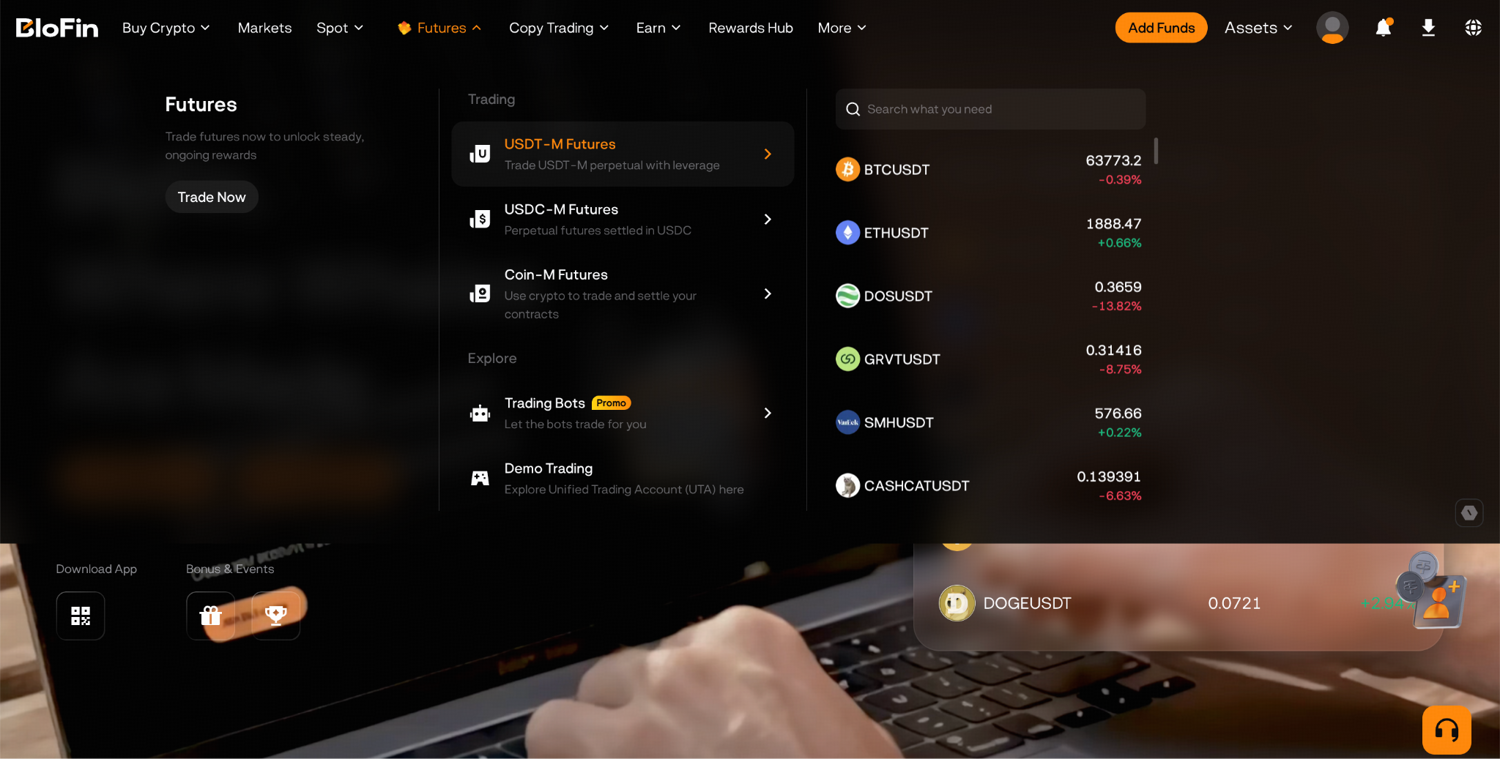
Step 1: On the BloFin homepage, hover your cursor over the Futures tab and click USDT-M Futures.
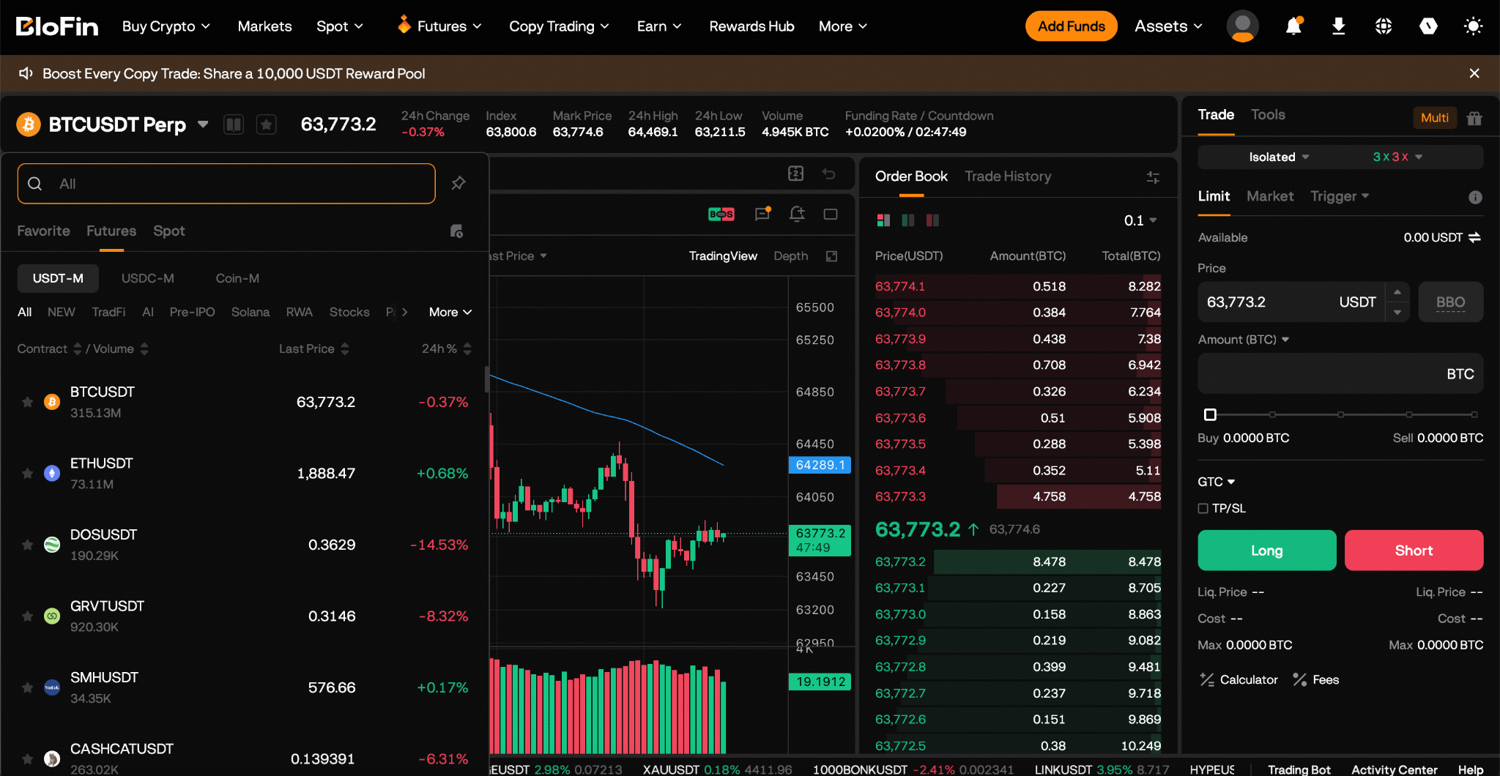
Step 2: Hover your cursor over the BTCUSDT Perpetual pair and a pop-up window will appear. Type TSLA in the search bar.
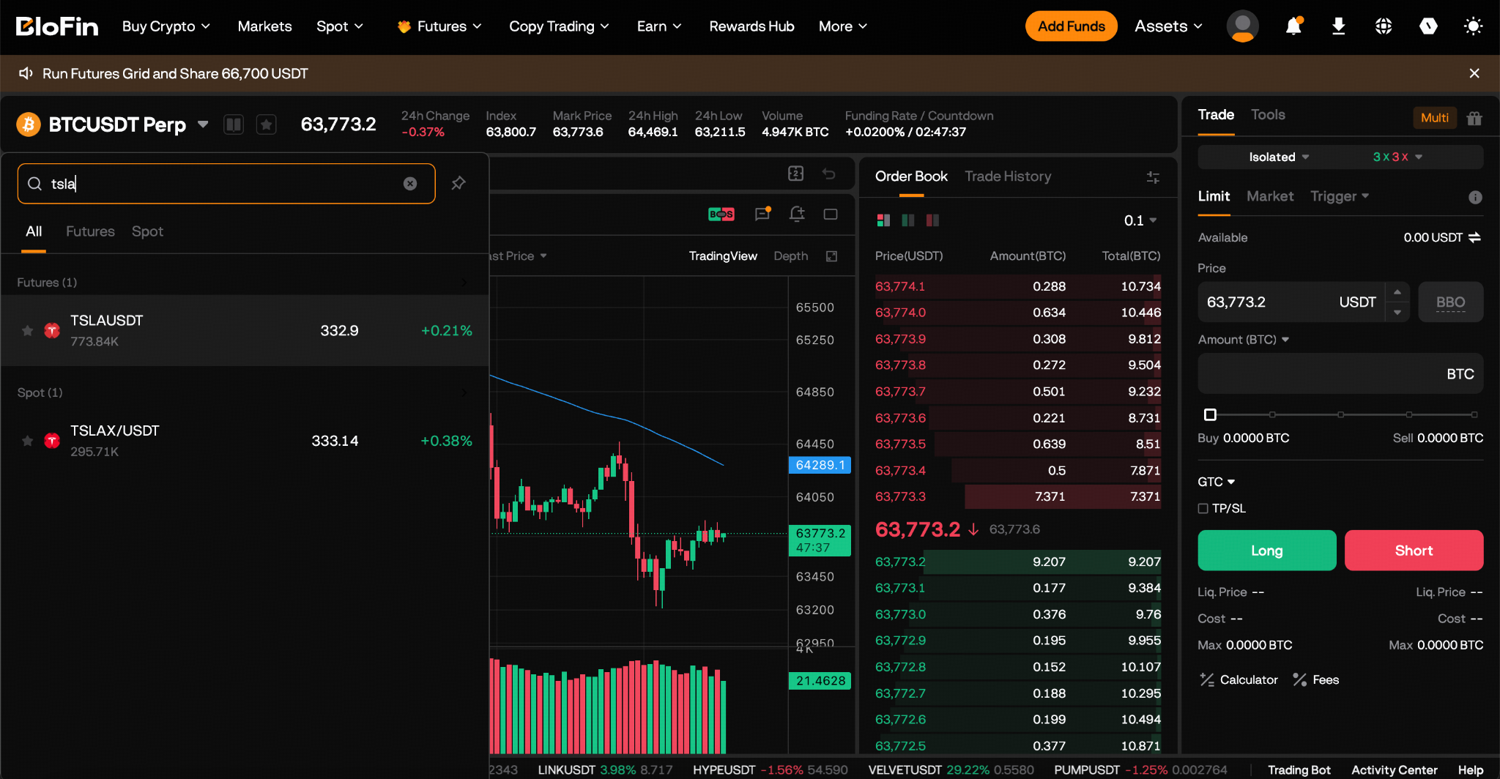
Step 3: Select the TSLAUSDT Perpetual contract from the results.
Step 4: Review contract specs and tick size. Then, choose isolated margin (risk limited to the position) or cross margin (shared collateral), and select your leverage multiplier conservatively.
Step 5: Choose between a limit order and market order. Use limit orders for price control or market orders for immediate execution. Enter quantity, set optional stop loss and take profit levels, and choose your direction: Long or Short.
You may choose to use platform tools such as stock research, alerts, and real time quotes to monitor a TSLAUSDT trade.
If you are new to derivatives, practice with small positions first to learn how margin and liquidation behave before committing meaningful capital.
Risk management when trading Tesla with leverage
Tesla is known for high volatility. Its historical performance includes deep drawdowns and sharp swings, which can intensify market volatility risk when leverage is used and prices fluctuate fast enough to liquidate positions quickly.
Key risk management rules:
Limit risk to a small percentage of your account per trade (1-2% is common) as part of sound investing discipline and a broader investment strategy.
Use lower leverage during high volatility periods such as earnings or major news.
Set stop-loss orders at technical support/resistance levels with some buffer.
Use isolated margin to limit risk to a single trade.
Monitor your margin ratio and liquidation price carefully.
Avoid holding large leverage positions during earnings or major news events, when volatility can fluctuate sharply.
Fees, funding rates, and costs of holding leveraged Tesla positions
Funding payments on TSLAUSDT Perpetuals occur every 8 hours to keep contract prices aligned with Tesla stock. These can be positive or negative depending on market conditions.
For example, a +0.01% funding rate means you pay $0.50 every 8 hours on a $5,000 position if you are long. Over multiple days, funding costs add up and reduce net returns.
BloFin charges maker and taker fees on trades. Typical futures fees are around 0.020% maker and 0.060% taker, calculated on notional size, not margin. By comparison, in exchange-traded products, a 1.00% expense ratio costs $100 annually per $10,000 invested.
Unlike owning Tesla stock in a brokerage account, where you pay no ongoing funding fees, leveraged perpetuals incur these costs continuously when positions are held overnight. That makes it important to measure results against your original cost, since recurring charges can drag on overall performance over time.
Example: Conservative vs aggressive Tesla leveraged trade
Two traders each deposit $2,000 with a bullish view on Tesla, and the difference in leverage decides how much room for error each has.
Conservative trader | Aggressive trader | |
Leverage | 2x | 10x |
Position size on $2,000 margin | $4,000 | $20,000 |
Stop-loss | 8% below entry | 2% below entry |
A 5% price rise | +10% on margin | +50% on margin |
A 3 to 4% price drop | A manageable loss, far from liquidation | Triggers the stop or approaches liquidation quickly |
The aggressive trader has more upside per point of movement and far less margin for error, and Tesla's ordinary daily volatility is more than enough to close that gap. Even when the trade idea is right, aggressive leverage can still work against you over the long run. The examples show how leverage and stop placement, not the direction call alone, drive the outcome, and why the more suitable setup depends on your risk tolerance.
Common mistakes and how to avoid them
Using maximum leverage on the first trade leaves no room for error. Start low and increase after gaining experience.
Averaging down on losing positions increases risk of liquidation. Define max loss and stick to it.
Ignoring funding costs during multi-day holds can erode profits. Calculate expected funding before entering.
Misjudging liquidation price leads to unexpected losses. Always check BloFin’s liquidation calculator.
Chasing Tesla’s volatile moves with oversized positions is risky. Use predefined plans and size limits.
The bottom line: Is leveraged Tesla trading right for you?
Trading Tesla with leverage through the TSLAUSDT perpetual gives flexible, 24/7 access to Tesla's price with the ability to go long or short, and it does so without a stock broker. In exchange, it carries high risk, ongoing funding costs, and no shareholder rights, and Tesla's own volatility makes the leverage cut harder in both directions.
So the honest filter is your financial situation, time horizon, and risk tolerance. This approach is generally not suitable for all investors and is closer to active trading than long-term investing. If you want Tesla exposure without that complexity, the simpler routes are buying real Tesla stock or holding unleveraged tokenized Tesla, and the trade-offs between the token and the share are laid out in tokenized Tesla vs real Tesla stock. If you do use leverage, the edge is not the size of the multiplier but the discipline around it: size small, define your loss before you enter, watch the liquidation price, and let consistency rather than any single trade do the work.
Frequently asked questions
What is a TSLAUSDT Perpetual contract?
It is a derivative that tracks Tesla's stock price with no expiry date, settled in USDT and traded 24/7 on BloFin. It lets you take a leveraged long or short on Tesla's price without owning the stock, with BloFin currently offering up to 20x leverage. Because it is a contract rather than a share, it conveys no ownership, no voting rights, and no dividends; it is purely a way to trade the price.
How much leverage can I use on Tesla on BloFin?
BloFin currently allows up to 20x on the TSLAUSDT Perpetual, but the maximum is rarely the wise choice. It is not suitable for many investors and should be judged against your risk tolerance and time horizon, because higher leverage shrinks the adverse move needed to liquidate you, and Tesla's normal volatility is large, so many traders use far lower multiples and cut leverage further around earnings and major news. Choose the multiplier from how much of your account you are willing to risk on the trade, not from what the platform permits.
Does trading the TSLAUSDT Perpetual make me a Tesla shareholder?
No. The perpetual gives price exposure only, so you get no equity ownership, no voting rights, and no dividends. You are trading a contract that tracks Tesla's price, not buying a share of the company. If shareholder rights matter to you, a real share through a brokerage is the instrument for that, not a perpetual.
What is funding on a perpetual, and how much does it cost?
Funding is a periodic payment exchanged between longs and shorts, roughly every 8 hours, that keeps the perpetual's price aligned with Tesla's. Depending on market conditions you either pay or receive it. As a rough sense of scale, a +0.01% rate means a long pays about $0.50 every 8 hours on a $5,000 position, and over a multi-day hold those payments accumulate, so factor expected funding into any position you plan to keep open and track its effect on performance alongside the position’s original cost.
What is liquidation, and how do I avoid it?
Liquidation is when your equity falls below the maintenance margin and BloFin closes the position to prevent further loss, typically costing you the margin on that trade. You reduce the risk by using lower leverage, keeping a stop-loss with some buffer, using isolated margin to contain the damage to one position, and watching your liquidation price rather than only your entry. Sizing small is the most reliable protection, because it moves the liquidation price further from the market.
Is trading the TSLAUSDT Perpetual the same as tokenized Tesla (TSLAx)?
No, and the distinction matters. The TSLAUSDT Perpetual is a leveraged derivative contract with funding and liquidation. Products such as leverage shares or leveraged ETFs can have different structures, fees, and underlying securities, so they should not be treated as identical to a perpetual. Tokenized Tesla (TSLAx) is an unleveraged, tokenized version of the spot share that you hold rather than trade on margin. Both track Tesla's price and neither conveys shareholder rights, but the perpetual is built for leveraged, short-term trading, while TSLAx is closer to simply holding price exposure.
Researched and written by the BloFin Academy editorial team with AI-assisted drafting. Updated August 2026. The TSLAUSDT perpetual is a USDT-settled linear stock perpetual on BloFin, offering up to 20x leverage at the time of writing; leverage caps, fees, and funding rates are set by BloFin and can change, so confirm the current contract specs and fee schedule on the platform. The leverage, funding, and fee figures in the examples are illustrative. Tesla's volatility and drawdown figures describe recent historical ranges.
This article is educational and general in nature, not financial or investment advice, and it gives no price target. Leveraged trading carries substantial risk: a TSLAUSDT perpetual can be liquidated, typically costing the margin committed and in extreme conditions more, and it accrues funding and trading fees continuously while open. It conveys no shareholder rights or dividends. Tesla is a high-volatility stock, and leverage magnifies that volatility in both directions. Nothing here is a recommendation to buy, sell, or hold any instrument. Trade only with capital you can afford to lose, do your own research, and consider speaking with a licensed professional before making financial decisions. BloFin does not provide investment advice.