
A large company makes news all year, and its quarterly results account for only a handful of those days. The rest arrive as product shows, jury verdicts, fines from regulators, changes to the big stock indexes and filings that reveal who bought or sold shares. Some of that news is booked months ahead, while some of it lands with no warning at all.
The awkward part is the hour. A keynote can start after the stock market has shut for the day, and a jury can return a verdict whenever it finishes. A regulator in Europe often announces before New York is awake. By the time the home market opens, the price may already have moved, and the size of a position was decided long before the headline.
Some crypto exchanges list stock perpetual futures that keep quoting through those hours, because each contract tracks the share through an index whose price keeps changing. On some of them, new positions may be limited to the home market's regular session, so what you can do depends on when the news lands. Tokenized shares follow their own weekday schedule.
Meta Platforms, whose apps include Facebook, Instagram and WhatsApp, trades in both forms on BloFin, one of those exchanges. The METAX/USDT Spot market prices a token that tracks the share, and the METAUSDT Perpetual is a leveraged contract on the same price, so a Meta keynote or court ruling reaches both of them.
How do you trade Meta around events and court rulings?
To trade Meta around an event, find out when it lands, set any new METAUSDT Perpetual position before Nasdaq's 4PM ET close, and size it for the move that kind of event has caused before. From that close until the 9.30AM ET open, and on weekends and holidays, the perpetual may accept only reduce-only orders (source: BloFin stock futures notice).
In UTC that overnight window runs from 8PM to 1.30PM during US daylight saving time and from 9PM to 2.30PM in standard time, which begins on November 1, 2026. A reduce-only order can only shrink or close a position, so the hours between Nasdaq's 4PM ET close and its 9.30AM ET open are for holding or cutting, never for adding. Prices, funding and liquidation keep running through them.
Non-earnings news falls into six groups, and each one has its own habits about timing. Some are on a published calendar, which means the position can be set while every order type is open. The others arrive whenever a court, a regulator or a filing deadline decides, so the size you hold on an ordinary day is the size that meets them.
Event | Known in advance? | When it usually lands | What that means for the perpetual |
|---|---|---|---|
Meta Connect keynote | yes, held each September | 2024 during the session; 2025 and 2026 after the close | after the close falls in the reduce-only window |
AI product launches | sometimes | Meta's own timing | a late-day launch can move the price overnight |
Jury verdicts and court rulings | trial dates yes, verdicts no | whenever the jury or judge finishes | can fall in any window |
Regulators in Europe and the UK | rarely | the European working day | mostly before Nasdaq opens |
Index rebalancing | yes, on the index provider's calendar | trades at the 4PM ET close | the close is the moment the window starts |
Insider and political trade reports | filing deadlines only | days or weeks after the trade | old news by the time it is public |
All six groups end up in the same contract. Its price follows Meta's share through an index and its liquidation price follows the mark price, which is why it pays to know how the META perpetual works before you size for any of them.
Meta Connect 2026 on BloFin's hourly prices
Meta Connect 2026 opened with Mark Zuckerberg's keynote at 4PM PT on September 23, 2026, which was 11PM UTC, three hours into the window when the METAUSDT Perpetual may take only reduce-only orders (source: Engadget). BloFin's index for the contract fell 2.0% in the keynote hour, from 747.65 USDT to a low of 732.51 USDT.
Connect is Meta's yearly show for its glasses, headsets and AI products. In 2026 Zuckerberg showed lighter Meta VR Glasses, Ray-Ban Meta Audio glasses with no camera and Muse Charm, a small handheld device for the Muse AI agent (source: TIKR). Glasses and headsets come from Meta's Reality Labs, the unit behind its hardware.
The index then drifted lower through the night. Its lowest point came in the hour from 9AM UTC on September 24, at 721.91 USDT against 747.65 USDT when the keynote hour began. By 1PM UTC, half an hour before Nasdaq opened, it had recovered to 735.62 USDT, still 1.6% down.
Then Nasdaq opened at 1.30PM UTC and the picture turned over. By 3PM UTC the index stood at 768.82 USDT, 6.5% above its overnight low. The share closed that day 4.5% higher (source: Yahoo Finance META history), while the Nasdaq-100 ended flat (source: Yahoo Finance Nasdaq-100 history). TIKR tied the rise to the new hardware Zuckerberg showed at Connect (source: TIKR).
That night tested a 1 META position opened at 744.74 USDT, the last mark price before 8PM UTC on September 23, in isolated margin. Each liquidation price is worked out with BloFin's formula (source: BloFin liquidation price FAQ), the 2.50% maintenance rate for positions up to 100 META (source: BloFin META position tiers) and the standard 0.06% futures taker fee in BloFin's fee structure.
Position on 1 META | Margin needed | Estimated liquidation price | Mark price outcome |
|---|---|---|---|
20x long | 37.24 USDT | 726.09 USDT | reached in the hour from 9AM UTC, low 722.52 USDT |
10x long | 74.47 USDT | 687.88 USDT | not reached that night |
20x short | 37.24 USDT | 762.46 USDT | reached in the hour from 1PM UTC, high 763.96 USDT |
10x short | 74.47 USDT | 798.77 USDT | not reached that night |
Both 20x positions were closed out on the same event, the long overnight and the short in the hour Nasdaq opened. A wrong guess about direction was only part of the risk. The bigger danger was a position too large to survive the swing on its way to wherever the price settled. At 20x the cushion was 2.5%, and BloFin's hourly mark price fell 3.0% below the entry overnight before it rebounded. That cushion is the gap between the entry and the liquidation price, set by the rules of leverage and liquidation.
Before the next keynote, the METAUSDT Perpetual page puts the contract's index price, mark price and next funding time side by side, and the METAX/USDT Spot page shows the token's order book, both updating through the night.
Past Meta Connect keynotes and the share price
Meta Connect has not moved the share the same way every year. In 2024 the keynote ran during Nasdaq's session and the share rose 0.9% that day, against 0.1% for the Nasdaq-100. In 2025 it came after the close and the share rose 0.6% the next day, behind the index's 1.0% (source: Yahoo Finance META history) (source: Yahoo Finance Nasdaq-100 history).
The 2024 keynote started at 10AM PT on September 25, 2024, so the reaction happened in normal trading (source: TechCrunch). The 2025 keynote started at 5PM PT on September 17, 2025, four hours after Nasdaq's 4PM ET close (source: Shacknews). The 2025 and 2026 keynotes both started after Nasdaq had shut for the day.
Connect keynote | Start, ET | Start, UTC | Inside Nasdaq's session? | Meta's move on the reaction day | Nasdaq-100 that day |
|---|---|---|---|---|---|
September 25, 2024 | 1PM ET | 5PM UTC | yes | +0.9% on September 25 | +0.1% |
September 17, 2025 | 8PM ET | 12AM UTC, September 18 | no | +0.6% on September 18 | +1.0% |
September 23, 2026 | 7PM ET | 11PM UTC | no | +4.5% on September 24 | 0.0% |
Each move compares the reaction day's close with the close of the session before (source: Yahoo Finance META history). Only 2026 stands out, and it came in a month when Muse was already moving the stock. So a Connect week is a known date with an uncertain size, and the history argues for planning on an ordinary-sized move with room for a large one.
For scale, Meta's average daily move over the 250 sessions to October 20, 2026 was 1.8%, up or down, and 16.8% of those sessions moved 3% or more. The 2024 and 2025 keynote reactions were both smaller than that average day.
AI launches: The Muse example
Meta's AI launches arrive on Meta's own timetable, set by the company and published on the day. Meta released its Muse AI agent on Tuesday, September 8, 2026 (source: Meta Newsroom). The share slipped 0.5% that day and then closed 6.6% higher on September 9, while the Nasdaq-100 fell 0.3% (source: Yahoo Finance META history) (source: Yahoo Finance Nasdaq-100 history).
Forbes reported that the shares rose the following morning as investors reacted to Tuesday afternoon's Muse announcement (source: Forbes Australia). Investors read Muse as a possible new revenue line beside advertising, a question explored in what Meta's Muse AI is.
BloFin's hourly index shows when the move reached the perpetual. At 8PM UTC on September 8 the index stood at 613.49 USDT, and by 8AM UTC on September 9 it had barely moved, at 618.13 USDT. Then it climbed 4.4% in four hours, to 645.40 USDT by 12PM UTC, while Nasdaq's pre-market session was trading.
Most of the move was in place before 1.30PM UTC, when the perpetual could take new positions again. A trader who wanted to open a long on the news had to wait until the index was already 5.0% above the previous evening's level. Anyone already holding a position could still close or trim it with reduce-only orders. The token's market stays open through the night on weekdays, so METAX could be bought that morning without leverage (source: BloFin xStocks risk disclosure).
So an AI launch behaves like a surprise even when rumors come first. The usable decision is the one made beforehand: how large a position you are willing to hold through a launch you cannot time. On a launch morning, METAX trading hours decide which of the two markets can take a new position.
Court rulings and jury verdicts
Court news reaches Meta on the court's schedule, not the market's. A trial date is public, but a jury returns its verdict when it finishes. In March 2026 Meta's share fell 8.0% in the session after two verdicts in two days, and in September it fell more than 3% in each of the two sessions around New Mexico's privacy verdict.
Each move compares a ruling day's close with the session before and sets the Nasdaq-100 beside it (source: Yahoo Finance META history) (source: Nasdaq-100 history at Nasdaq). Yahoo Finance tied the March 26 fall to the Los Angeles verdict, and the slide went on the next day (source: Yahoo Finance). The September and October 21 rows record what the share did on each day, and on their own they say nothing about what the privacy case was worth.
Meta's October 10-Q records both March verdicts: the $375 million New Mexico penalty and the first Los Angeles jury award. It also records a $25 billion privacy penalty ordered on October 21, 2026 (source: Meta Q3 2026 10-Q). It lists October 28, 2026 for the start of a combined trial of the next two Los Angeles plaintiffs. Trial dates like that one are public, while the hour a jury returns is never known in advance.
Ruling day | What happened | Meta's move that day | Nasdaq-100 that day |
|---|---|---|---|
March 24, 2026 | New Mexico jury orders a $375 million civil penalty | −1.8% | −0.8% |
March 25, 2026 | Los Angeles jury returns the first personal-injury verdict | +0.3% | +0.7% |
March 26, 2026 | first session after the Los Angeles verdict | −8.0% | −2.4% |
September 25, 2026 | New Mexico jury finds Meta misled users on privacy | −3.3% | +0.4% |
September 28, 2026 | first session after that verdict's weekend | −4.8% | −1.1% |
October 21, 2026 | New Mexico judge orders a $25 billion privacy penalty | +0.5% | +1.1% |
Judge Francis Mathew chose the $25 billion figure from a wide range. After the September 25 verdict, the two sides had put very different numbers to him. New Mexico had asked for $35 billion to $40 billion, while Meta had argued for a cap of $3.45 billion (source: NBC News) and, in an October 9 brief, asked for no more than $1.53 billion (source: Law.com). His order adds 15% interest after judgment. It leaves the state's request for injunctive relief, meaning court orders that make Meta change how it operates, for later briefing. Meta has booked an undisclosed amount for the expected loss and intends to appeal (source: Meta Q3 2026 10-Q).
The ruling came on a trading day, and Reuters reported it before Nasdaq's 4PM ET close (source: NBC News). Meta released its third-quarter results after that close (source: Meta third-quarter 2026 notice). The next session therefore carried both pieces of news at once, and its move cannot be credited to either one alone. A ruling that arrives with no set hour, as this one did, is the hardest kind of event to plan for.
For how penalties of that size compare with Meta's earnings, see Meta's lawsuits explained. Antitrust rulings have brought smaller moves. On November 18, 2025, the day Meta won the Federal Trade Commission's (FTC) antitrust trial, the share fell about half a point less than the Nasdaq-100 (source: Yahoo Finance META history) (source: Yahoo Finance Nasdaq-100 history). The FTC antitrust case and Meta stock covers that day.
Regulators in Europe and the UK
Regulators in Europe and the United Kingdom (UK) work in their own time zones, so their decisions often land before Nasdaq opens. London's 9AM is 8AM UTC during British summer time, five and a half hours before Nasdaq opens. For the METAUSDT Perpetual, news released in the European morning arrives while it may take only reduce-only orders.
Ofcom, the UK's online safety regulator, opened its first formal investigation into Meta under the Online Safety Act on October 6, 2026 (source: Insurance Journal). Meta's share slipped that day while the Nasdaq-100 rose, a gap of under one percentage point and too small to separate from an ordinary day (source: Yahoo Finance META history) (source: Yahoo Finance Nasdaq-100 history).
Brussels runs an hour ahead of London. A European Commission decision announced at 11AM in Brussels in the summer months is 9AM UTC, still four and a half hours before Nasdaq opens.
The practical point is about when you can act. A long held into a European decision can be cut that morning with a reduce-only order. A trader who wants to open a new position on the news waits for Nasdaq's 9.30AM ET open, which is 1.30PM UTC in US daylight saving time. By then Nasdaq's pre-market session has had hours to trade on it, as the Muse morning showed.
Index rebalancing days
Index rebalancing is Meta's most predictable event, and index providers publish the dates in advance. Index changes are made at the official closing price, so most index funds trade in the last closing auction before the change, which puts the volume at Nasdaq's 4PM ET close (source: Nasdaq). That is the same minute the METAUSDT Perpetual may switch to reduce-only orders.
S&P Dow Jones Indices announced on September 4, 2026 that its quarterly changes would take effect before the open on Monday, September 21, 2026 (source: S&P Dow Jones Indices). The funds trade on the last close before the changes, which was Friday, September 18.
Meta's volume that Friday was 27.6 million shares, 1.53 times its average over the previous 20 sessions (source: Yahoo Finance META history). The Nasdaq-100's annual reconstitution works the same way: Nasdaq announced the 2025 changes after the close on December 12, 2025, effective before the open on December 22 (source: Nasdaq press release, December 12, 2025). On the last session before that, December 19, Meta traded 50.0 million shares, 2.94 times its 20-session average.
Heavy volume was the common thread on both days, while the direction of the price was not. Meta fell 2.4% on September 18 while the Nasdaq-100 rose 0.7%. For a long-standing member, a rebalance mostly changes Meta's weight, one of the smaller forces among the things that move Meta's stock price.
Insider and political trade disclosures
Insider and political trade reports are late news by design. Meta's directors and officers must report most trades in its shares within two business days (source: SEC). Members of Congress and other senior officials have up to 45 days, under the Stop Trading on Congressional Knowledge (STOCK) Act (source: STOCK Act, Public Law 112-105).
A recent filing shows the lag. On September 24, 2026, the Connect reaction day, entities tied to Mark Zuckerberg sold 27,474 Meta shares, worth about $21.4 million together. The Form 4 reporting those sales was filed on September 28, two business days later and after a weekend (source: SEC Form 4).
The sales ran under a trading plan Zuckerberg adopted on January 31, 2026, which set them in advance. By the time a headline reports them, the trades are days old and the plan behind them is months old. A sale of that size is small beside Zuckerberg's total holding, which who owns Meta sets out.
A report from a member of Congress can be older still. For sizing, these reports belong with the ordinary days: there is no fixed hour to plan around, and the information inside them describes a decision someone else made weeks ago.
Sizing a Meta position for each kind of event
Size a Meta position for an event by choosing the most you will accept losing, then dividing it by the planned move for that kind of event. With a 50 USDT limit, Meta's 1.8% average day allows about 2,747 USDT of exposure.
The position value you can carry is your loss limit divided by the move you plan for.
Move you plan for | Size of the move | Position value for a 50 USDT loss limit |
|---|---|---|
Meta's average day, 250 sessions to October 20, 2026 | 1.82% | about 2,747 USDT |
Day after Connect 2026 | 4.50% | about 1,111 USDT |
First session after the New Mexico privacy verdict | 4.79% | about 1,044 USDT |
Day after the Muse launch | 6.55% | about 763 USDT |
A scheduled event lets you size before it, while every order type is open. An unscheduled one means the size you carry every day has to survive it. That is why a position held for weeks through a trial or a pending ruling deserves the larger planned move, even on days when nothing is expected.
Leverage changes the margin, never the loss on a given move. It does decide how much of the move the margin can absorb, and on the Connect night a 20x position had only a 2.5% cushion against a 3.0% overnight fall in the mark price. Isolated margin limits that loss to the position's own margin, one of the choices in the leveraged Meta trade guide.
For a known after-close event in US daylight saving time, such as a Connect keynote, the set-up looks like this on the METAUSDT Perpetual page.
Step 1: Before 8PM UTC on the event day, open the METAUSDT Perpetual page and check the Index Price, the Mark Price and the Funding Rate / Countdown at the top.
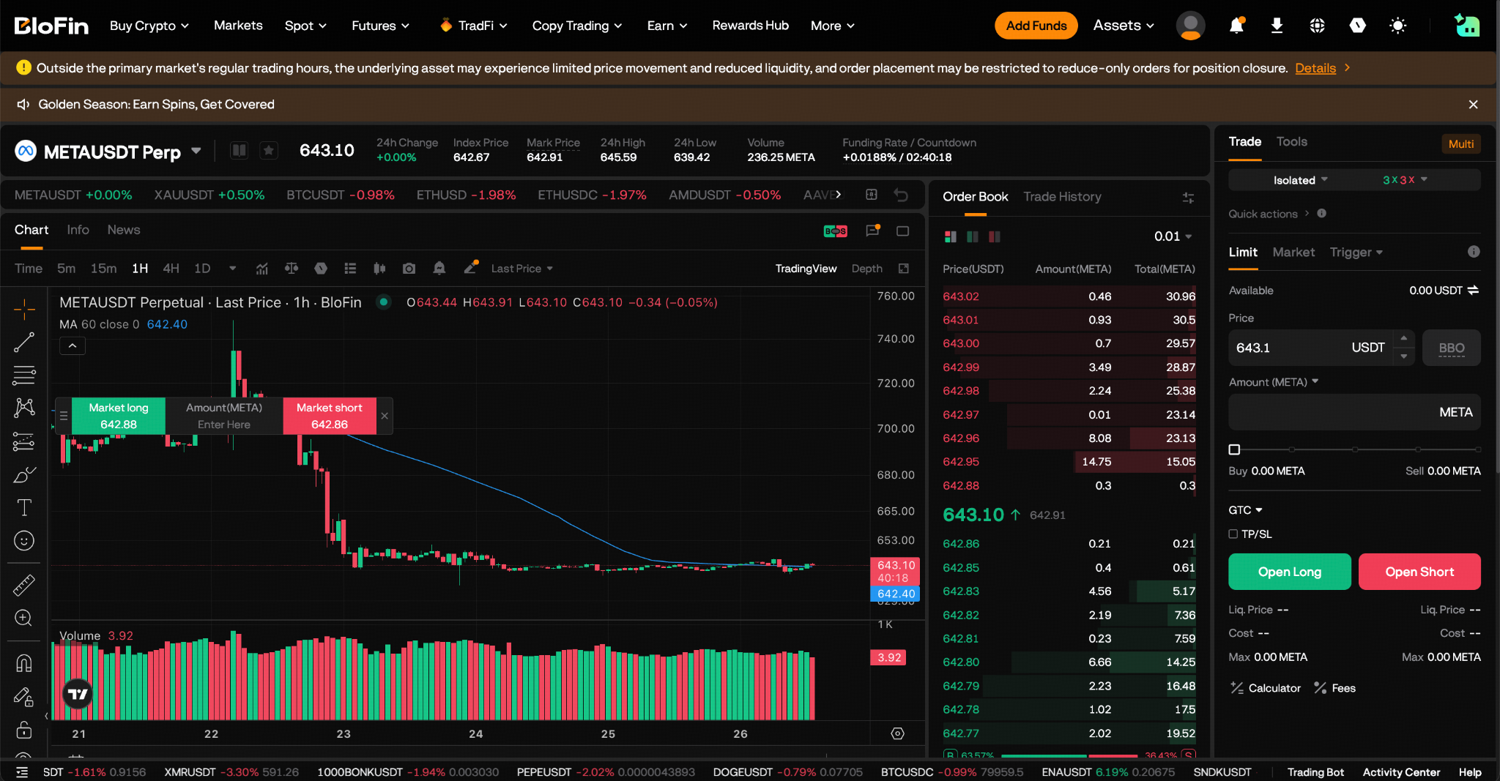
Step 2: Click the margin mode button, shown as Cross in the order panel, to choose cross or isolated margin, then click the leverage button beside it, such as 3X, to set the leverage.
Step 3: Choose Limit or Market, enter the size in Amount (META), and, to attach a take-profit (TP) or stop-loss (SL), tick TP/SL.
Step 4: Read the Liq. Price and Cost under the order buttons, or open the Calculator. Then compare the distance to the liquidation price with the move you planned for.
Step 5: Click Buy for a long or Sell for a short, then check the position under Positions. After 8PM UTC, use Reduce-only orders to trim or close it until 1.30PM UTC.
A stop-loss sends an order once its trigger is hit, and on a fast night it fills at whatever price is available, which can be well past the trigger. A trigger set on the mark price and one set on the last price can fire minutes apart when the two separate, which is why the distance between mark price and last price matters on an event night.
Meta's event calendar for the rest of 2026
Three dated events were set for Meta's last months of 2026: a combined trial in Los Angeles, the switch to US standard time and December's index changes. Meta's third-quarter report came out on October 21, 2026, and the routine for the next one is in trading Meta around earnings.
Meta's October 10-Q gives October 28, 2026 as the start date for the combined trial of the next two personal-injury plaintiffs in Los Angeles (source: Meta Q3 2026 10-Q). In New Mexico the penalty is set. The filing gives no date for the ruling on injunctive relief or for Meta's appeal, so either could land at any hour.
US daylight saving time ends on Sunday, November 1, 2026, and from that date BloFin's regular hours for stock futures run from 2.30PM to 9PM UTC (source: BloFin stock futures notice). So the window for new positions closes an hour later in UTC, at 9PM, for every event after that date.
December brings the year's last index changes. S&P's quarterly cycle also puts a rebalance in December. The Nasdaq-100's 2025 reconstitution took effect before the open on Monday, December 22, 2025 (source: Nasdaq press release), so its trading landed on Friday, December 19, the third Friday of that month. Each provider announces its exact effective date in advance, and the trading lands on the last close before it.
Looking to plan a Meta position around its next big event? To get started, you'll need to first create a BloFin account, fund your account with cryptocurrency, and go to the METAX/USDT Spot trading page or the METAUSDT Perpetual trading page.
Frequently asked questions
Does Meta Connect run for more than one day?
Meta Connect 2026 was set over two days. After Mark Zuckerberg's evening keynote on September 23, the developer sessions were scheduled for the next day, opening with a "developer state of the union" at 10AM PT, which was 1PM ET and 5PM UTC (source: Engadget). That second day fell inside Nasdaq's session, so its news reached a METAUSDT Perpetual that could take new positions.
How much of a day's trading happens at the close on index rebalancing days?
On a typical day, the closing auction accounts for less than 10% of the volume traded, while some index rebalancing dates see more than 30% of the day's volume traded in the close (source: Nasdaq). So on a rebalancing day, a large share of the session's trading is packed into the final auction at 4PM ET.
Who has to report stock trades under the STOCK Act?
The STOCK Act's trade reports cover the President, the Vice President, members of Congress and their senior staff, and top federal officials, including generals and admirals (source: STOCK Act, Public Law 112-105). Each must report a trade within 30 days of being told of it. The report can never come later than 45 days after the trade.
What is the short-swing profit rule for company insiders?
The short-swing profit rule lets a company take back any profit an insider makes from buying and selling its stock within six months (source: SEC). Here an insider is a director, an officer or anyone who owns over 10% of one class of its shares. The same part of the law, Section 16 of the Securities Exchange Act, also bars insiders from short selling the company's stock.
What is a Rule 10b5-1 trading plan?
A Rule 10b5-1 plan is a written trading plan an insider adopts before learning any inside information. It either sets the amount, price and date of the trades, gives a formula for them, or keeps the insider from any later say over them (source: 17 CFR 240.10b5-1). A director or officer then has to wait between 90 and 120 days before the first trade, depending on when the company next reports its results. So a sale made under one reveals little about how the insider sees the price that day.
Researched and written by the BloFin Academy editorial team with AI-assisted drafting. All facts independently verified. Primary sources include Meta's third-quarter 2026 notice, its Newsroom, its third-quarter 2026 10-Q and an SEC Form 4, the SEC's guidance on insider reports, SEC Rule 10b5-1, the STOCK Act, S&P Dow Jones Indices, Nasdaq's articles and index history, and Yahoo Finance's daily prices. News sources include Engadget, TechCrunch, Shacknews, TIKR, Forbes Australia, Yahoo Finance, NBC News (Reuters), Law.com and Insurance Journal. BloFin's sources are its stock futures notice, xStocks risk disclosure, liquidation price FAQ and META position tiers, and its hourly index and mark prices, current as of October 25, 2026.
Nothing in this article constitutes financial advice, and nothing in it is a recommendation to buy, sell or hold Meta in any form, or to trade or avoid any event. On the night of Meta Connect 2026, the METAUSDT Perpetual's mark price fell 3.0% below an entry taken before 8PM UTC and then rose far enough above it to liquidate a 20x short as well as a 20x long on the same event. Court rulings and regulators can move the price at hours when the perpetual may accept only reduce-only orders, so a leveraged position can be closed out during hours when you cannot open a new one. Past performance does not indicate future results. Do your own research and consider your risk tolerance before you trade on BloFin.