
Most shares are priced on what the business behind them earns. Analysts take a year of profit, set it against the share price, and ask whether buyers are paying a lot or a little for each dollar of profit. That works well for a retailer or a software firm, because its profit comes from selling things to customers.
It works badly for a company whose main asset is bitcoin. US accounting rules put every change in the coin's price into the company's profit each quarter. So one quarter can show a record gain and the next a loss of a similar size, while the business itself barely changes, and a ratio built on profit simply swings with the coin.
Investors therefore value such a company by its parts. They count the bitcoin, take off what the company owes, add its cash and its other business, and then compare the total with what the market pays for all the shares.
Strategy (MSTR), formerly MicroStrategy, is a company built this way. BloFin lists a perpetual contract that follows its share price, the MSTRUSDT Perpetual, among its traditional-finance markets.
How is MSTR stock valued?
MSTR stock is valued mainly from the bitcoin behind each share. You take the market value of Strategy's bitcoin and subtract the debt and preferred stock that get paid before common shareholders. Then you add its cash and its software business and divide by the share count. The share price sits at a premium or a discount to that figure.
Each part of that sum comes from a different place. The coin count comes from Strategy's weekly reports to the SEC, the US markets regulator, and the coin price comes from the market on the day you do the sum. The claims that rank first are Strategy's convertible notes and its perpetual preferred stock, and Strategy shows both at face value on its dashboard.
The cash includes a USD Reserve. Strategy describes it as a part of its dollar holdings intended to support its preferred dividends and the interest on its debt (source: Strategy Form 8-K filed November 16, 2026). The software business is the analytics company that MicroStrategy was before it started buying bitcoin.
What is left after the claims belongs to the common shareholders. The market is free to pay more or less than that amount: a premium means buyers pay more, and a discount means they pay less. Most of the argument about MSTR is really an argument about the size of that gap.
Valuing MSTR in five steps, with a made-up company
The valuation runs in five steps: value the coins, take off the debt, take off the preferred stock, add the cash, and add the software business. Then you compare that total with the market cap. A made-up company with round numbers shows how each step changes the answer before any real figures come in.
The company here is invented, and so is its coin. It holds 3,000 coins priced at $40,000, which makes its coins worth $120 million. It owes $15 million on convertible notes and has $25 million of preferred stock outstanding. It holds $8 million of cash and runs a small software business that sells $6 million a year. It has 2,000,000 shares, and they trade at $70.
Start from the $120 million of coins. Take off the $40 million of claims that rank ahead of the common shares, then add back the $8 million of cash. That leaves $88 million of net coin value, or $44 for each share.
Now give the software business a value. Paying four times its yearly sales, a multiple picked only for this example, adds $24 million. The sum of the parts comes to $112 million, or $56 a share.
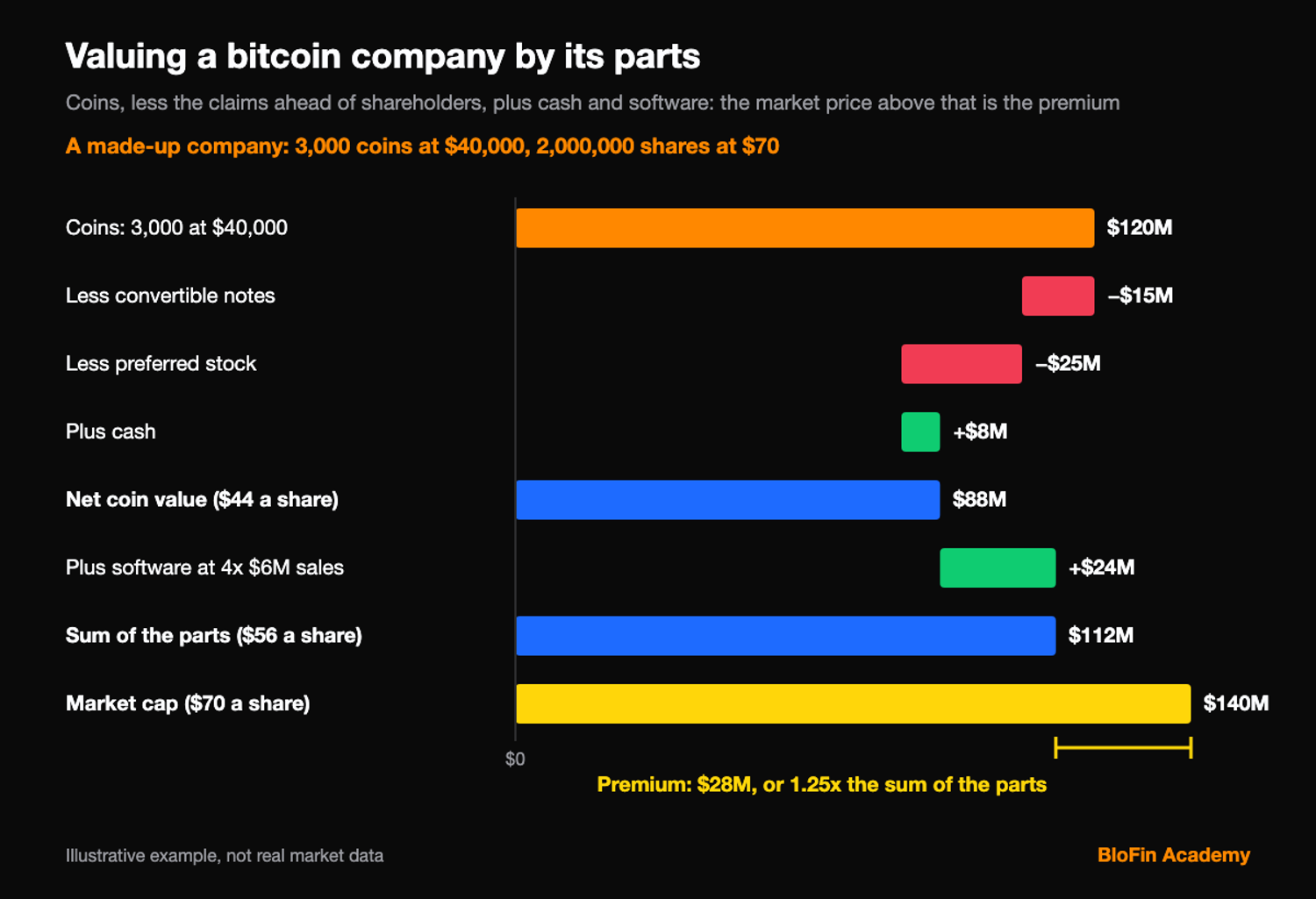
The market pays $70 a share, or $140 million for the whole company. That is 1.25 times the sum of the parts and 1.59 times the net coin value. So the made-up company trades at a 25% premium even after its software is counted. The premium is the part of the price that the list of parts cannot explain.
The claims also change how a move in the coin reaches the shares. They stay fixed in dollars while the coins move. A 25% fall in the coin takes the coins to $90 million and cuts the net value from $88 million to $58 million, a drop of 34.1%. The shareholders' slice moves faster than the coin, in both directions.

Strategy's valuation stack at the November 2026 close
The first four steps, run on Strategy's own figures, put its net bitcoin value at about $40.8 billion at the November 16, 2026 close. The market valued its common shares at about $44.1 billion (source: Strategy Form 8-K filed November 2, 2026, Strategy Form 8-K filed November 9, 2026, Strategy Form 8-K filed November 16, 2026, Nasdaq MSTR historical data). On that basic share count, buyers paid 1.08 times the bitcoin left after the claims, a premium of 7.9%.
Strategy held 850,849 bitcoin as of November 15, 2026. Its USD Reserve stood at $4.8 billion and its USD Cash at $151.2 million on the same date (source: Strategy Form 8-K filed November 16, 2026). Bitcoin traded at $65,042 at the 4PM ET Nasdaq close on November 16 (source: BloFin BTC-USDT market data). The Strategy dashboard showed $6.7 billion of debt and $12.7 billion of preferred stock, both at face value (source: Strategy dashboard). Strategy's third-quarter report gave a redemption value and liquidation preference of $14.1 billion on September 30, 2026. The figure is lower now because Strategy bought back about $1.3 billion of its STRC preferred stock between October 1 and November 15 (source: Strategy Form 10-Q for the third quarter of 2026, Strategy Form 8-K filed November 16, 2026).
The share count starts from the cover of Strategy's third-quarter report, which gave 422,354,607 shares across its two classes on October 25, 2026 (Class A 402,714,357; Class B 19,640,250) (source: Strategy Form 10-Q for the third quarter of 2026). Stock sales of 1,178,552, 2,051,348 and 2,087,040 shares in the three weeks to November 15 bring it to 427,671,547 (source: Strategy Forms 8-K filed November 2, 9 and 16, 2026). MSTR closed November 16 at $103.03 on Nasdaq (source: Nasdaq MSTR historical data).
Step | Input | Amount |
|---|---|---|
Bitcoin | 850,849 BTC at $65,042 | $55.3B |
Less debt | convertible notes, face value | −$6.7B |
Less preferred stock | perpetual preferreds, face value | −$12.7B |
Plus cash | USD Reserve and USD Cash | +$4.9B |
Net bitcoin value | left for common shareholders | $40.8B |
Market cap | 427,671,547 shares at $103.03 | $44.1B |
Per share, that is $129.40 of bitcoin before the claims and $95.44 after them, against a close of $103.03. Strategy keeps selling stock, and each new share spreads the same net bitcoin a little thinner.
Strategy's own reading of the gap uses a fully diluted share count. That count adds the shares that options, share awards and in-the-money convertible notes could still create. At the November 16 close, its dashboard showed a Net Reserve of $40.7 billion, close to the $40.8 billion built from the filings, and an mNAV of 1.09x (source: Strategy dashboard). The larger diluted count is why its reading sits above the 1.08 on basic shares. MSTR's mNAV covers how Strategy calculates that ratio and why websites disagree about it.
Where the software business fits
Strategy's software business is real but small next to its bitcoin. It brought in $125.4 million of revenue and $89.6 million of gross profit in the third quarter of 2026 (source: Strategy Form 10-Q for the third quarter of 2026). Four times that quarter's revenue is about $501.7 million a year. Each turn of yearly sales you choose to pay for it adds roughly $0.5 billion, about 0.9% of the bitcoin's value at the November 16 close.
At four times yearly sales the software adds about 4.9% to the net bitcoin value, and even ten times sales would add about 12%. That is why most valuations of MSTR start and end with the bitcoin and the claims.
The premium and the bitcoin price both move through the trading day, and the MSTRUSDT Perpetual moves with them. On the MSTRUSDT trading page, you can watch the price the market puts on Strategy's shares as it changes.
MSTR's P/E ratio and the fair-value swing in earnings
A price-to-earnings (P/E) ratio compares a share price with the earnings per share of the past 12 months (source: Investor.gov on the P/E ratio). For MSTR it carries almost no information, because Strategy's earnings follow the bitcoin price. In the third quarter of 2026 it earned $44.75 per diluted share. Over the first nine months of the year, it lost $6.27 per share.
The swing comes from fair-value accounting, which values an asset at its market price on the reporting date. The 10-Q says Strategy marks its coins to Coinbase's quoted price, and every change in their value goes into net income (source: Strategy Form 10-Q for the third quarter of 2026). In the third quarter that produced a $20.9 billion gain on digital assets, about 99.9% of the quarter's pretax income.
The same report shows how far the result can swing within one year. Common shareholders earned $19.1 billion in the third quarter. For the nine months they lost $2.3 billion, so the first six months of 2026 must have lost them about $21.4 billion.
Those results give a P/E that is either missing or meaningless. Stock Analysis lists MSTR's trailing P/E as n/a, and its trailing twelve months show a loss of $44.39 per share (source: Stock Analysis MSTR statistics). Take the third quarter alone and multiply it by four, and the $103.03 close gives a P/E of about 0.58. That would make any ordinary stock look absurdly cheap.
Neither figure tells you what the business earns from customers. Strategy's earnings are better read for the coin count, the claims and the reserve than for the profit line.
Price-to-book and enterprise value per bitcoin for MSTR
Since profit is unreliable here, investors use measures built on what Strategy owns and owes. Price-to-book compares the share price with the company's accounting value. Enterprise value per bitcoin compares the market's price for the whole business, debt included, with the coins it holds. Both start from the balance sheet.
Book value is a company's assets minus its liabilities, as its balance sheet records them. Strategy's stockholders' equity was $55.4 billion on September 30, 2026, with its preferred stock carried separately (source: Strategy Form 10-Q for the third quarter of 2026). Spread over the 422.0 million shares outstanding on that date, that is about $131.38 a share. The $103.03 close gives a price-to-book ratio of about 0.78, the same figure Stock Analysis shows (source: Stock Analysis MSTR statistics).
That ratio is under 1 partly because the book is out of date. The balance sheet valued Strategy's 847,666 bitcoin at $70.8 billion on September 30, about $83,552 a coin (source: Strategy Form 10-Q for the third quarter of 2026). Bitcoin's price at the November 16 close was 22.2% lower (source: BloFin BTC-USDT market data). Marking those coins to the later price would cut about $15.7 billion from the book before any tax effect. A price-to-book ratio for MSTR is only as current as the bitcoin price inside it.
Enterprise value (EV) adds the claims to the market cap and subtracts the cash, giving a price for the whole business. At the November 16 close, MSTR's EV was about $58.6 billion. That is $44.1 billion of market cap, plus $19.4 billion of debt and preferred stock, less $4.9 billion of cash.
Divided by 850,849 coins, that EV is about $68,855 per bitcoin, against a market price of $65,042 (source: BloFin BTC-USDT market data). So the market valued the whole company at 1.06 times its bitcoin. Stock Analysis shows a lower EV of $44.5 billion. It adds $6.8 billion of debt to its $43.6 billion market cap, takes off $5.9 billion of cash and leaves the preferred stock out (source: Stock Analysis MSTR statistics).
MSTR's premium as future accretion
The premium as future accretion is the bull case for paying more than the net bitcoin value. If Strategy keeps selling shares above that value and buys bitcoin with the money, every existing share holds more bitcoin afterwards. Bulls count how long that growth would take to cover today's premium. Critics reply that the count is circular.
The mechanism comes from Strategy itself. Its dashboard notes say that while mNAV is above one, a sale of new common stock that funds bitcoin purchases would generally be expected to lift net bitcoin per share. They add that this assumes the bitcoin price and the share price hold still, among other assumptions (source: Strategy dashboard notes). Accretive is the word for that: the deal leaves each existing share with more.
Strategy tracks the growth with BTC Yield. Its third-quarter release defines it as how much Strategy's bitcoin per share, counted in sats, rose or fell in percent over a period (source: Strategy Q3 2026 earnings release). Strategy's BTC Yield covers how that figure is worked out.
The bull method turns those two numbers into a length of time. In May 2025, in a piece on Yahoo Finance, James Van Straten described a metric called Days to Cover mNAV. It is the natural logarithm of the mNAV divided by the natural logarithm of one plus the daily BTC Yield (source: Yahoo Finance on Days to Cover mNAV). The result counts the days of bitcoin buying, at today's rate, that would close the gap between the share price and the bitcoin behind it. On round numbers, a company at 1.25x that grows its bitcoin per share by 10% a year covers its premium in about 2.34 years, and at 5% a year it takes about 4.57 years.
The bear reply is that the count assumes what it sets out to prove. Protos made the case in June 2025, about a months-to-cover version that Adam Back had endorsed. A company grows its bitcoin per share mostly by selling stock and preferreds on good terms. It can only do that while its shares trade above their net value, so the formula quietly assumes the premium will last (source: Protos on mNAV months to cover).
Strategy's 2026 numbers show the problem in practice. Its third-quarter release put BTC Yield at −3.7% for the year to October 25, 2026, and a yield below zero covers no premium, however long you wait. The release also says these figures do not measure financial performance, valuation or liquidity (source: Strategy Q3 2026 earnings release). The cover count rests on one assumption about the future, and 2026 shows how quickly that assumption can fail.
Is MSTR overvalued, and what do bulls and bears assume?
Whether MSTR is overvalued depends on what you think the premium pays for. Bulls see it as the value of Strategy's future fundraising and of a return to older premiums. Bears say the shares are worth only the bitcoin behind them. So the same 7.9% premium at the November 16 close reads differently under each view.
Bulls price the fundraising as a separate part. Cantor Fitzgerald's analysts put a value on what they call Strategy's treasury operations. In December 2025 they cut that value by about four-fifths, Decrypt reported, after lowering the amount they expected Strategy to raise over the next year from $22.5 billion to $7.8 billion (source: Decrypt on Cantor's Strategy note). Bernstein's case in January 2026 included the premium returning toward the mNAV of 1.57 it said Strategy had traded at historically, a figure from before Strategy redefined mNAV in July 2026 (source: Decrypt on Bernstein and Strategy's premium, Strategy dashboard notes).
Bears start from the bitcoin alone. Short-seller Jim Chanos said in June 2025 that Strategy's market value should not exceed the value of its bitcoin. He dismissed the methods Michael Saylor, Strategy's chairman, uses to lift its returns as "financial gibberish". Saylor has argued that the company's bitcoin-backed credit instruments justify the premium, Reuters reported (source: Reuters via Yahoo Finance on Chanos and Strategy's premium). On the bear view, a premium is money a buyer can lose even while bitcoin stands still, and the Cantor cut shows how fast the fundraising part can shrink.
So the numbers alone cannot settle it. If you expect Strategy to sell shares above their net value again and grow its bitcoin per share, a small premium looks like a fair price for that. If you expect the fundraising to stay shut, the same premium is how far the shares could fall toward their net bitcoin value. For how that fits your own money, see whether MSTR stock is a good investment.
What analyst ratings show for MSTR
Nearly all the analysts in S&P Global's count rate Strategy a buy. Stock Analysis, using S&P Global data last updated November 18, 2026, counted 16 analysts in November: 13 at strong buy, 2 at buy, 1 at hold and none at sell (source: Stock Analysis MSTR forecast). Among the individual ratings the page lists, which come from TipRanks, Monness downgraded Strategy to sell on November 18, 2026 (source: Stock Analysis MSTR forecast). A count shows how the covering analysts lean. It hides the assumptions behind each rating, which is where the bull and bear cases part.
What MSTR's valuation means for MSTRUSDT traders
The valuation stack lists the three things that move an MSTRUSDT position: the bitcoin price, the size of the premium, and the number of shares the net bitcoin is spread across. A trade on the perpetual is a trade on all three at once. That is why MSTR can move further than bitcoin on the same day.
To separate the premium from the coin, some traders hold MSTR and bitcoin positions against each other, and trading MSTR against bitcoin shows how that pair works. The coin count behind every share changes with Strategy's weekly filings, and how many bitcoin Strategy owns explains how to read them.
BloFin's MSTRUSDT Perpetual has no expiry date, is settled in USDT and can be traded with up to 20x leverage, and leverage and liquidation explains what that leverage risks. Funding payments on the contract are normally settled at 12AM UTC and again at 8AM and 4PM UTC, so one falls due every eight hours (source: BloFin MSTR contract details). Nasdaq's regular session opens at 9.30AM ET (2.30PM UTC) and closes at 4PM ET (9PM UTC) during US standard time, which began on November 1, 2026. According to BloFin's notice, trading in its stock futures, the MSTRUSDT Perpetual included, may be limited to reduce-only orders outside that weekday session, and also at weekends and on public holidays (source: BloFin stock futures notice). Reduce-only means you can shrink a position you already hold or close it, and nothing more.
Wondering whether MSTR is priced above what its bitcoin is worth? To get started, you'll need to first create a BloFin account, fund your account with cryptocurrency, and go to the MSTRUSDT Perpetual trading page.

Frequently asked questions
How many bitcoin stand behind one MSTR share?
About 0.00199 bitcoin, or roughly 198,949 sats, stood behind each MSTR share in mid-November 2026. That figure divides the 850,849 bitcoin Strategy held on November 15, 2026 by the 427,671,547 shares outstanding after its stock sales through that date (source: Strategy Form 10-Q for the third quarter of 2026, Strategy Forms 8-K filed November 2, 9 and 16, 2026). It is a gross figure, worked out before any debt or preferred claims come off.
How much MSTR stock did Strategy sell in mid-November 2026?
Strategy sold 2,087,040 MSTR shares for $244.7 million of net proceeds between November 9 and November 15, 2026. It used $33.4 million of that money to buy 485 bitcoin at an average of $68,887 each, including fees (source: Strategy Form 8-K filed November 16, 2026). Sales like these raise the share count behind every per-share figure, so the bitcoin per share moves even in a week with purchases.
Why is MSTR's price-to-sales ratio so high?
MSTR's price-to-sales ratio is high because its market value rests on bitcoin while its sales come only from software. Stock Analysis showed a price-to-sales ratio of 87.89 on November 17, 2026 (source: Stock Analysis MSTR statistics). So the ratio mostly measures the size of the bitcoin holding, and it says very little about the software business.
What average price did Strategy pay for its bitcoin?
Strategy paid an average of $75,452 per bitcoin, including fees and expenses, for the 850,849 coins it held on November 15, 2026. That is an aggregate cost of $64.2 billion (source: Strategy Form 8-K filed November 16, 2026). Bitcoin's price of $65,042 at the November 16 close was about 14% under that average (source: BloFin BTC-USDT market data). The balance sheet carries the coins at market value, so the cost matters mainly for gains and losses already booked.
Is Strategy's USD Reserve the same as its cash?
Strategy's USD Reserve is an earmarked part of its dollars rather than its whole cash balance. Strategy also keeps a separate pool, USD Cash, which it may use for broader purposes, including buying bitcoin (source: Strategy Form 8-K filed November 16, 2026). Stock Analysis lists $5.9 billion of cash and short-term investments at September 30, 2026, while the reserve and USD Cash came to $4.9 billion together on November 15, 2026 (source: Stock Analysis MSTR statistics, Strategy Form 10-Q for the third quarter of 2026, Strategy Form 8-K filed November 16, 2026).
Researched and written by the BloFin Academy editorial team with AI-assisted drafting. All facts independently verified. Primary sources are Strategy's Form 10-Q for the third quarter of 2026, its third-quarter 2026 earnings release, its Forms 8-K filed November 2, 9 and 16, 2026, and its dashboard and dashboard notes. Prices are Nasdaq's MSTR daily closes and BloFin's BTC-USDT price at the 4PM ET close; ratios and ratings come from Stock Analysis, with other sources from Investor.gov, Protos, Yahoo Finance, Reuters and Decrypt. Every valuation figure not quoted from a source was computed from those inputs at the November 16, 2026 close. BloFin's sources are its MSTR contract details and stock futures notice, current as of November 19, 2026.
Nothing in this article constitutes financial advice, and nothing in it is a recommendation to buy, sell or hold Strategy in any form. MSTR's premium over its net bitcoin can shrink or turn into a discount, and because Strategy's debt and preferred stock are fixed in dollars, a fall in bitcoin cuts the value behind each share faster than the coin falls. On the MSTRUSDT Perpetual, leverage can liquidate your margin when the price moves against you, funding payments can cost you money while you hold, and outside US market hours you may be limited to reducing a position. Past performance does not indicate future results. Do your own research and consider your risk tolerance before you trade on BloFin.