
Most companies join the stock market through an initial public offering. Banks buy new shares from the company and sell them to investors at a price set the evening before, and the first trade the next day shows how close that price was to what buyers would really pay.
A smaller group of companies skip the bank sale. Their existing shareholders sell straight onto the exchange, and nobody buys at a set price beforehand. That is why the "IPO price" that data sites print for such a company can mean three different numbers.
Making sense of that kind of debut starts with keeping the numbers apart: the exchange's reference price, the first trade and the first close. The next step is finding out who could sell on day one and who had to wait, which the company's own filing sets out in plain figures.
Palantir Technologies (PLTR) went public that way on the New York Stock Exchange (NYSE) in 2020, and Anthropic's IPO filing in October 2026 has put the two routes side by side again. BloFin offers the PLTRUSDT Perpetual, a contract that tracks Palantir's share price and settles in USDT, with price exposure and no ownership in the company.
What is Palantir's direct listing?
Palantir's direct listing was how the company went public on September 30, 2020, when its Class A shares began trading on the NYSE with no underwritten offering. Existing holders sold their own shares to buyers on the exchange, so Palantir sold no new stock and got none of the money from those sales (source: Palantir prospectus).
The prospectus registered up to 257,135,415 Class A shares for sale by holders it calls Registered Stockholders. It says that this sale, unlike an IPO, "is not being underwritten by any investment bank" (source: Palantir prospectus). Those shares made up 22.1% of the 1,163.5 million Class A shares Palantir counted on September 28, 2020 (source: Palantir share update, September 29, 2020).
Only the Class A shares were listed, under the ticker PLTR. The Class B and Class F shares stayed off the exchange (source: Palantir share update, September 29, 2020). The first trade went through just after 1.30PM ET (5.30PM UTC) at $10 a share (source: CNN).
That first trade was 37.9% higher than the $7.25 reference price the exchange had published the day before. By the end of the day the shares had slipped to $9.50, still 31.0% over the reference price but 5.0% under the opening trade (source: Nasdaq PLTR historical data, CNBC, September 29, 2020).
When did Palantir go public?
Palantir went public on Wednesday, September 30, 2020, about twelve weeks after its first filing with the Securities and Exchange Commission. It sent a private draft on July 6, made the filing public on August 25 and changed it six times in September. The SEC declared it effective on September 22 (source: SEC EDGAR filings for Palantir).
Two more updates followed in the last week, on September 25 and September 29. Each one gave new share counts and lock-up terms in a short company report, filed alongside a free writing prospectus, which is offering material published outside the main filing (source: SEC EDGAR filings for Palantir).
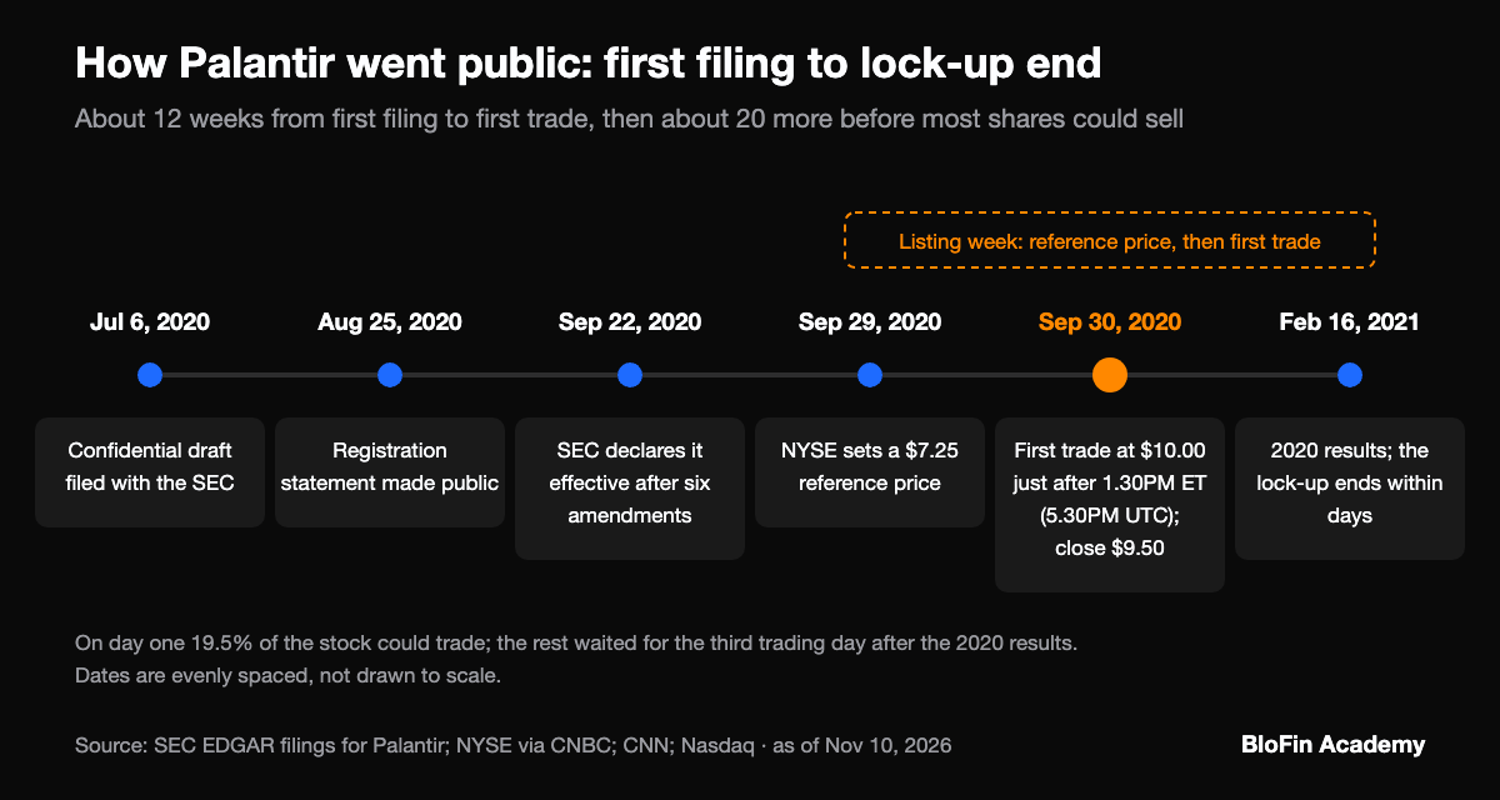
The exchange published the $7.25 reference price on September 29, and trading began the next afternoon. The software company Asana also listed directly that day. The two were the third and fourth major direct listings, after Spotify in April 2018 and Slack in June 2019 (source: Renaissance Capital, CNBC, September 29, 2020).
Palantir's Class A shares traded on the NYSE until November 25, 2024, and moved to Nasdaq the next day under the same PLTR ticker, a switch the company announced on November 14 (source: Palantir Nasdaq transfer announcement, Palantir 10-K, 2024).
How a direct listing differs from an IPO
A direct listing differs from an IPO in who sells the first shares and who sets the first price. In a traditional IPO, the company sells new shares to banks at an agreed price, and the banks pass them on to investors. In a direct listing, existing holders sell on the exchange, and the opening trade sets the first price.
An IPO normally includes book building, the step in which banks collect orders from large investors and use that demand to fix the offering price. Palantir skipped it (source: Palantir prospectus). The first public price came from orders placed on the exchange itself, sorted the way an order book sorts them.
The prospectus warned that individual investors "may have greater influence in setting the opening public trading price", and that the price could swing more than after an IPO (source: Palantir prospectus). Cooley's PubCo blog later described the same split: a direct listing's first price comes from the opening auction, "not by agreement among the company and underwriters, as in a traditional IPO" (source: Cooley PubCo).
Money flows in a different way too. Palantir's listing fees were to be "expensed in the period incurred and not deducted from net proceeds to the issuer as they would be in an initial public offering" (source: Palantir prospectus). An IPO cover shows the other side. Anthropic's has a line for the banks' underwriting discount next to the money the company gets (source: Anthropic S-1/A). The company gained a public market and a public price, while the cash from every share sold that day went to the holder who sold it.
In 2020, a company listing directly on the NYSE could only arrange sales by existing holders. On December 22, 2020, the SEC approved a rule change that let companies sell new shares in a direct listing as well, Cooley reported the next day (source: Cooley PubCo). Palantir's listing came before that change, so it was a sale by existing holders only.

Anthropic's 2026 IPO filing and Palantir's listing
Anthropic's IPO filing shows the traditional route that Palantir passed over. Its amended filing of November 2, 2026 opens with the words "This is an initial public offering". Anthropic will sell new Class A shares and some existing holders will sell more, while the price range is still blank (source: Anthropic S-1/A).
The cover of that filing names 22 banks, with Goldman Sachs and Morgan Stanley listed first. The price will be agreed between Anthropic, the selling holders and the banks, who also get an option to buy extra shares from the company (source: Anthropic S-1/A).
Palantir's prospectus named 12 firms as financial advisors and asked Morgan Stanley to consult with the market maker who set the opening price (source: Palantir prospectus). So the same bank appears in both deals: as an advisor to an exchange auction in 2020, and as one of the two lead banks on Anthropic's offering in 2026.
The two filings hold back insider selling in different ways. Anthropic's directors, officers and the holders of almost all of its stock agreed to lock-ups in two tiers. Its co-founders and holders of more than 0.5% of its shares wait until shortly after its results for the third quarter of 2027, or one year if that comes first. Everyone else waits until shortly after its first-quarter 2027 results, or 180 days if that comes first (source: Anthropic S-1/A). Palantir let about a fifth of its stock trade from the first day and tied the end of its lock-up to its 2020 results (source: Palantir prospectus).
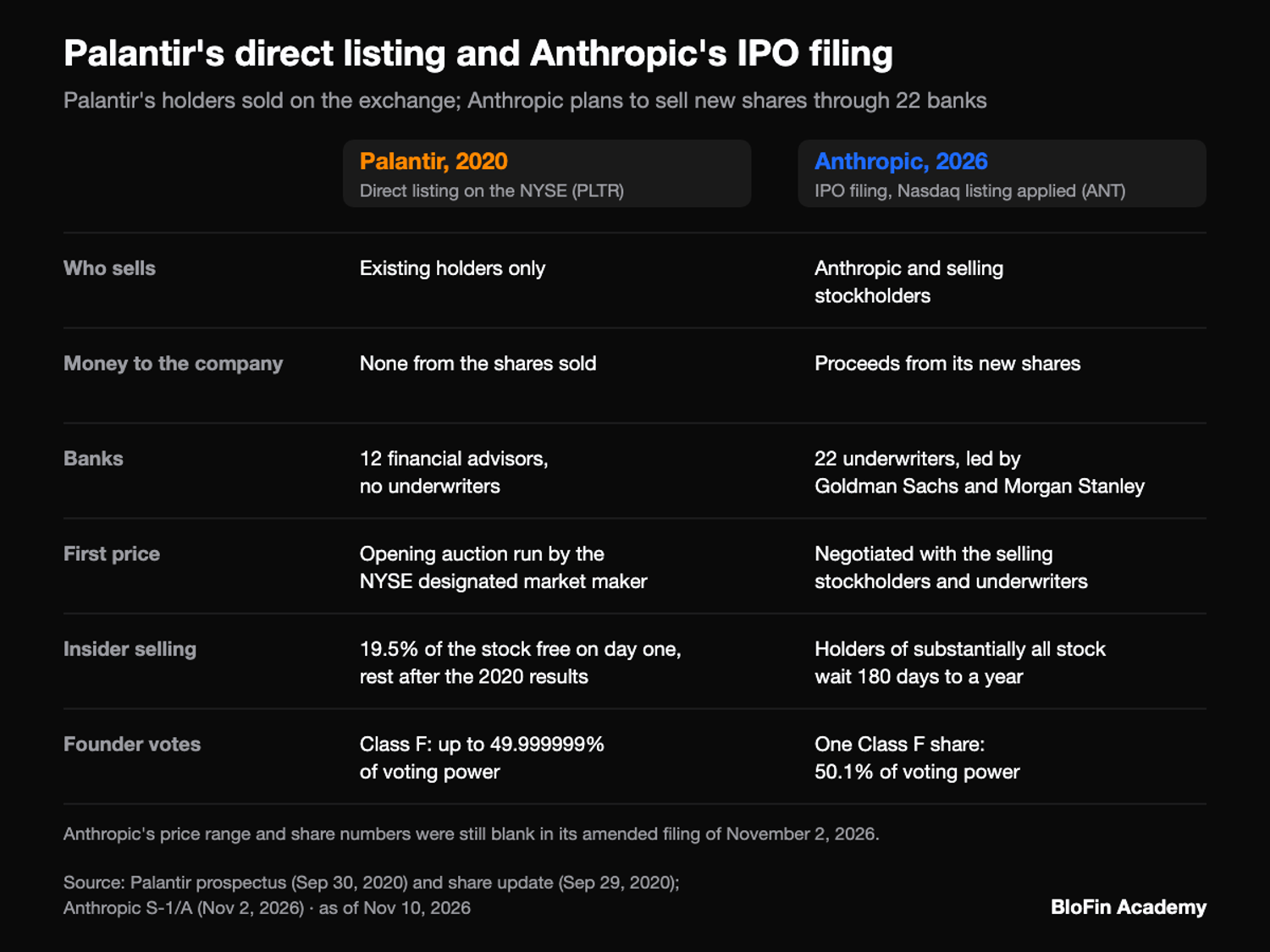
Founder control is where the two filings look most alike. Anthropic plans to issue a single Class F share to a company owned by its founders, carrying 50.1% of all votes and no claim on profits (source: Anthropic S-1/A). Palantir created its own Class F stock for its founders when it listed in 2020, with votes that change in number (source: Palantir prospectus). Anthropic adds a layer Palantir never had. It is a public benefit corporation. An independent Long-Term Benefit Trust elects most of its board through a special class of stock, Class T, a setup laid out in Anthropic's IPO plans (source: Anthropic S-1/A).
Why Palantir chose a direct listing
Palantir's finance chief gave two reasons for choosing a direct listing: a strong balance sheet, and long-serving staff and other stockholders who wanted to sell on day one. David Glazer said in 2020 that "the company was in a strong position on our balance sheet" (source: Cheddar).
In the same interview, Glazer said Palantir wanted to give its stockholders and long-serving employees "the ability to sell on day one, so that's really why we took the direct listing route" (source: Cheddar). Palantir was founded in 2003, and its shares had been widely traded on the private market for years, CNBC noted on the day it listed (source: CNBC, September 30, 2020).
Chief executive Alex Karp added a reason about who gets in. CNBC reported in March 2021 that the choice was made partly to level the playing field between individuals and institutions. It quoted Karp: "I like so-called retail investors for lots of reasons" (source: CNBC, March 16, 2021). In a direct listing, a small investor's order and a large fund's order go into the same opening auction.
Glazer later explained the timing. Five years on, he recalled that the listing came early in the pandemic, when few companies were trying to go public, and said Palantir "decided to go public as quickly as possible" (source: CNBC, September 30, 2025).
Palantir's reference price and opening trade
The reference price and the opening trade are two separate numbers in a direct listing. The NYSE set Palantir's reference price at $7.25 before trading began, as a guide that usually reflects recent private trades. The opening trade at $10 was the first price at which shares really changed hands (source: CNBC, September 29, 2020, CNBC, September 30, 2020).
Renaissance Capital made the same point at the time, saying the reference price was neither an offering price nor the opening price (source: Renaissance Capital). CNBC reported on listing day that no stock changed hands at $7.25, so no buyer on September 30 paid that price (source: CNBC, September 30, 2020).
The opening price came out of an auction run by the stock's designated market maker, the exchange firm in charge of keeping trading in that stock orderly. The market maker set it from buy and sell orders sent in by brokers, working with Morgan Stanley, and could weigh the private sale prices listed in the filing (source: Palantir prospectus).
The first trade came in the afternoon, four hours after the exchange's regular 9.30AM ET (1.30PM UTC) open. From there the shares reached a high of $11.42 and a low of $9.11 before the $9.50 close. That range was 23.1% of the opening price, on volume of 338,584,400 shares (source: Nasdaq PLTR historical data).
At the $10 opening price, Palantir's shares outstanding were worth $16.5 billion, by CNBC's count (source: CNBC, September 30, 2020). Measured from the $10 first trade, which was the first price anyone paid, the Nasdaq close of $169.20 on November 9, 2026 is 16.92 times as high (source: Nasdaq PLTR historical data).
Palantir's private funding rounds before the listing
Palantir's private funding rounds set the yardstick its debut was judged against. In 2015, a funding round valued the company at $20.4 billion and its stock at $11.38 a share, CNBC reported on listing day (source: CNBC, September 30, 2020). Five years later, the opening trade still came in 12.1% below that 2015 share price.
Private trading in 2020 ran well below the 2015 level. The prospectus listed private sales between $4.17 and $11.50 a share from January 1 to September 1, 2020, against a range of $4.50 to $6.50 in 2019 (source: Palantir prospectus). The 2020 sales had a volume-weighted average of $6.02, the same kind of average a VWAP order aims for.
Prices climbed in the weeks before the listing. CNBC reported private trades at an average of $7.31 a share in August 2020 and $9.17 on September 1, the last day before the cutoff for the filing's figures (source: CNBC, September 29, 2020). The $7.25 reference price sat 20.4% above the 2020 average.
A late round came from Japan. Palantir sold new Class A shares at $4.65 each in the first half of 2020 and again in July. By June 30, SOMPO Holdings held or had agreed to buy 107,526,881 of them, the prospectus shows (source: Palantir prospectus). At $4.65 a share, that stake comes to about $500 million. Crunchbase described SOMPO as the leader of a $550 million round in June 2020 and counted at least $2.6 billion of total funding, from investors including Founders Fund (source: Crunchbase News).
The shares took five weeks to pass the 2015 price after the listing. They first closed above $11.38 on November 5, 2020, at $11.88, after a lowest October close of $9.03 on October 5 (source: Nasdaq PLTR historical data).
Palantir's lock-up after the listing
Palantir's lock-up let a limited part of its stock trade on the first day and held back the rest until after its 2020 results. Executives, directors and holders of more than 99% of the stock agreed to wait until the start of the third trading day after Palantir released its results for 2020 (source: Palantir prospectus).
Direct listings had usually let companies avoid a lock-up for existing holders, Cheddar noted at the time (source: Cheddar). The Palantir lock-up came in two waves. By the prospectus figures, 451,758,861 shares could trade from day one, including 68,149,214 shares from vesting stock awards, while 1,863,150,291 shares had to wait (source: Palantir prospectus).
That split put 19.5% of the stock in the first wave. CNBC reported that existing holders could sell up to 20% of their stake (source: CNBC, September 30, 2020). Palantir's September 29 update, counting as of September 28, put the day-one figure higher, at 475.8 million shares. That count had two parts: 407.7 million shares, including shares from stock options, and 68.1 million shares from stock units that vested with the listing (source: Palantir share update, September 29, 2020).
About 25.8 million of those day-one shares were expected to be sold to pay personal taxes (source: Palantir share update, September 29, 2020). The founders had their own terms, under which 89,007,617 shares held by them and their affiliates could be sold at once (source: Palantir prospectus).
Not every holder managed to sell straight away. Some current and former employees complained early in the session that they could not reach the system for selling their stock, CNBC reported (source: CNBC, September 30, 2020).
The second wave came in February 2021. Palantir reported its 2020 results on February 16, 2021 (source: SEC EDGAR filings for Palantir). On February 23, the Motley Fool wrote that the lock-up "expired last week" and listed 3.8 million shares sold by co-founder Stephen Cohen and a 20-million-share sale disclosed by Peter Thiel through a trading plan (source: The Motley Fool).
The price fell 25.1% over those two weeks, from a $31.91 close on February 12 to $23.90 on February 26. More than 300 million shares traded on both February 18 and February 19 (source: Nasdaq PLTR historical data). The results and the end of the lock-up landed in the same week, so the price data alone cannot show how much of the fall came from each.
Palantir's share classes at the listing
Palantir listed with three classes of common stock, and only Class A traded. The prospectus gave each Class A share one vote and each Class B share 10 votes. Class F shares carry a number of votes that can change, and they sit in a trust set up by Karp, Cohen and Thiel (source: Palantir prospectus).
Class F was created for the listing. Palantir authorized 1,005,000 Class F shares and swapped them for the same number of Class B shares held by the founders, as part of governance changes made for the listing (source: Palantir prospectus). Through Class F, the founders can control as much as 49.999999% of all votes.
The listing also turned the company's preferred stock into 795,363,151 Class B shares (source: Palantir prospectus). On September 28, 2020, Palantir counted 1,163.5 million Class A shares outstanding, against 483.7 million in Class B and 1.0 million in Class F (source: Palantir share update, September 29, 2020).
Votes were spread very unevenly at the listing. Based on Class A shares outstanding at June 30, 2020, Class A holders had about 3.4% of the votes. Directors, executives and their affiliates had about 50.8% (source: Palantir prospectus). Palantir's report for the third quarter of 2026 says its share classes still put voting power in the founders' hands. That shapes who controls Palantir today. The founders' 1,005,000 Class F shares were still outstanding on October 26, 2026 (source: Palantir 10-Q, Q3 2026).
Palantir exposure through the PLTRUSDT contract
A contract listing on a crypto exchange is a different event from a company listing its shares. BloFin's market data dates the first trading of the PLTRUSDT Perpetual to February 9, 2026, at 10.30AM ET, which was 3.30PM UTC. The contract tracks Palantir's share price with leverage of up to 20x (source: BloFin PLTRUSDT market data).
Holding the contract gives no ownership interest in Palantir, according to BloFin's stock futures notice. Its disclaimer adds that a holder receives no dividends and has no vote or other shareholder rights (source: BloFin stock futures notice). The Class A, Class B and Class F votes from 2020 stay with shareholders.
The contract settles in USDT, trades every day, weekends included, and runs a funding fee settlement every eight hours. Outside Nasdaq's regular hours, the trade page warns, price moves can be small, trading can be thin and orders may be limited to reduce-only orders, which only close a position (source: BloFin PLTRUSDT Perpetual page). Leverage makes gains and losses larger, and a leveraged position can be liquidated when losses grow too large for its margin.
BloFin has no tokenized Palantir share on its spot market, so the perpetual contract is the BloFin route among the ways to get Palantir exposure with crypto, alongside broker shares and funds held elsewhere.
The contract's funding rate, mark price and last trade sit together on the PLTRUSDT Perpetual page.
How to read a direct listing prospectus on EDGAR
You can read Palantir's listing terms yourself in the SEC's free EDGAR database. The final prospectus from September 30, 2020 sits under the form code 424B4. Five of its parts show what sets a direct listing apart from an IPO. They are the cover, the risk factors, the price history, the lock-up section and the plan of distribution.
Step 1: Open Palantir's company page on EDGAR and select View filings to see the full list. Type 424B4 into the Search table box, or enter dates around September 2020 in the From Date and To Date boxes.
Step 2: Open the prospectus and read the cover page. It gives the number of shares registered for sale and says whether a bank underwrites them. It also explains who sets the opening price.
Step 3: Press Ctrl+F (Cmd+F on a Mac) and search for Sale Price History of Our Capital Stock. That section lists the private trade prices the market maker could weigh. For 2020 it gives a range of $4.17 to $11.50 and a $6.02 average (source: Palantir prospectus).
Step 4: Press Ctrl+F again and search for Shares Eligible for Future Sale to read the lock-up terms. It shows how many shares could trade from the first day and which event ended the lock-up.
Step 5: Open the free writing prospectus filed on September 29, 2020 for the final share counts. It gives the September 28 totals for each share class and the number of shares free to trade on day one.
An IPO prospectus has most of the same sections, plus a price range on the cover. In place of Palantir's Plan of Distribution, it has a section titled Underwriting, as Anthropic's filing shows. Reading the two cover pages one after the other shows which route each company took.
Looking to trade Palantir? To get started, you'll need to first create a BloFin account, fund your account with cryptocurrency, and go to the PLTRUSDT Perpetual trading page.

Frequently asked questions
What was Palantir's IPO price?
Palantir held a direct listing, so it had no IPO price. The New York Stock Exchange set a $7.25 reference price as a guide. The first trade on September 30, 2020 was at $10.00, and the shares closed their first day at $9.50 (source: Nasdaq PLTR historical data). Sites that print an IPO price for Palantir usually show one of those three numbers.
Did Palantir raise money when it went public?
Palantir raised no money from the shares sold at its listing, because every share traded that day came from an existing holder. Its prospectus says the company would receive none of the proceeds from those sales. It also paid its advisors' fees as an ordinary expense (source: Palantir prospectus).
Could Palantir employees sell shares on the first day?
Palantir employees and other existing holders could sell up to 20% of their stake on the first day, CNBC reported, since the lock-up let about a fifth of the stock trade from the opening. Some employees said they could not reach the selling system early in the session (source: CNBC, September 30, 2020). The rest of their shares stayed locked up until after the 2020 results in February 2021.
How many shares did Palantir have when it listed?
Palantir's three classes added up to 1,648.2 million shares outstanding on September 28, 2020: 1,163.5 million Class A, 483.7 million Class B and 1.0 million Class F (source: Palantir share update, September 29, 2020). CNBC used a larger, fully diluted count for the same week, which adds unvested stock and options (source: CNBC, September 29, 2020).
What is a primary direct listing?
A primary direct listing is a direct listing in which the company sells new shares in the opening auction and raises money, alongside any sales by existing holders. The SEC approved that option for the New York Stock Exchange on December 22, 2020. That came after Palantir's listing, which sold existing shares only (source: Cooley PubCo).
Researched and written by the BloFin Academy editorial team with AI-assisted drafting. All facts independently verified. Primary sources include Palantir's prospectus, its share update of September 29, 2020 and its other filings on SEC EDGAR, and Anthropic's amended registration statement of November 2, 2026. Price data comes from Nasdaq's daily table for Palantir, with reporting from CNBC, CNN, Renaissance Capital, Cheddar, Crunchbase News, Cooley PubCo and The Motley Fool. BloFin facts come from its PLTRUSDT Perpetual page, its stock futures notice and its own PLTRUSDT market data, current as of November 10, 2026.
Nothing in this article constitutes financial advice, and nothing in it is a recommendation to buy, sell or hold Palantir in any form. Palantir's shares fell 25.1% in the two weeks around the end of its lock-up in February 2021, and its first day's trading range was 23.1% of the opening price. The PLTRUSDT Perpetual carries no shares or votes, offers leverage of up to 20x that can lead to liquidation, and may be limited to reduce-only orders outside regular US hours. Past performance does not indicate future results. Do your own research and consider your risk tolerance before you trade on BloFin.