
Governments buy software in a different way from most companies. An army or a health service often signs one big deal that sets the most it may spend over several years. It then pays for the work in pieces, as its yearly budget allows. The figure in the news is usually that maximum, so a deal worth billions on paper can bring in far less money in any one year.
That gap matters to anyone who reads defense news as a guide to a company's sales. Public budgets are set one year at a time. Buyers can often end a contract early, and some of the biggest customers keep the details secret. The size of a deal and the money it brings in are two separate questions.
A handful of software makers now earn a large part of their sales in this way. They sell data and AI tools to armed forces, spy agencies and civilian departments. Their reports show government sales apart from business sales, so investors can see how much rides on public spending.
Palantir Technologies (PLTR) is one of them. Its government customers paid it $1.1 billion in the third quarter of 2026, just under half of its revenue, in results it reported on November 2, 2026 (source: Palantir Q3 2026 Form 10-Q). Two months earlier, the US Army had moved one of its Palantir programs, TITAN (Tactical Intelligence Targeting Access Node), from test models into production (source: DefenseScoop, September 2026).
What are Palantir's government contracts?
Palantir's government contracts are the deals under which armed forces, spy agencies, health services and police forces pay for its software. The biggest come from the US Army and other US forces. Most are framework deals with a ceiling, so the announced value is the most the buyer may spend, while the money itself arrives order by order.
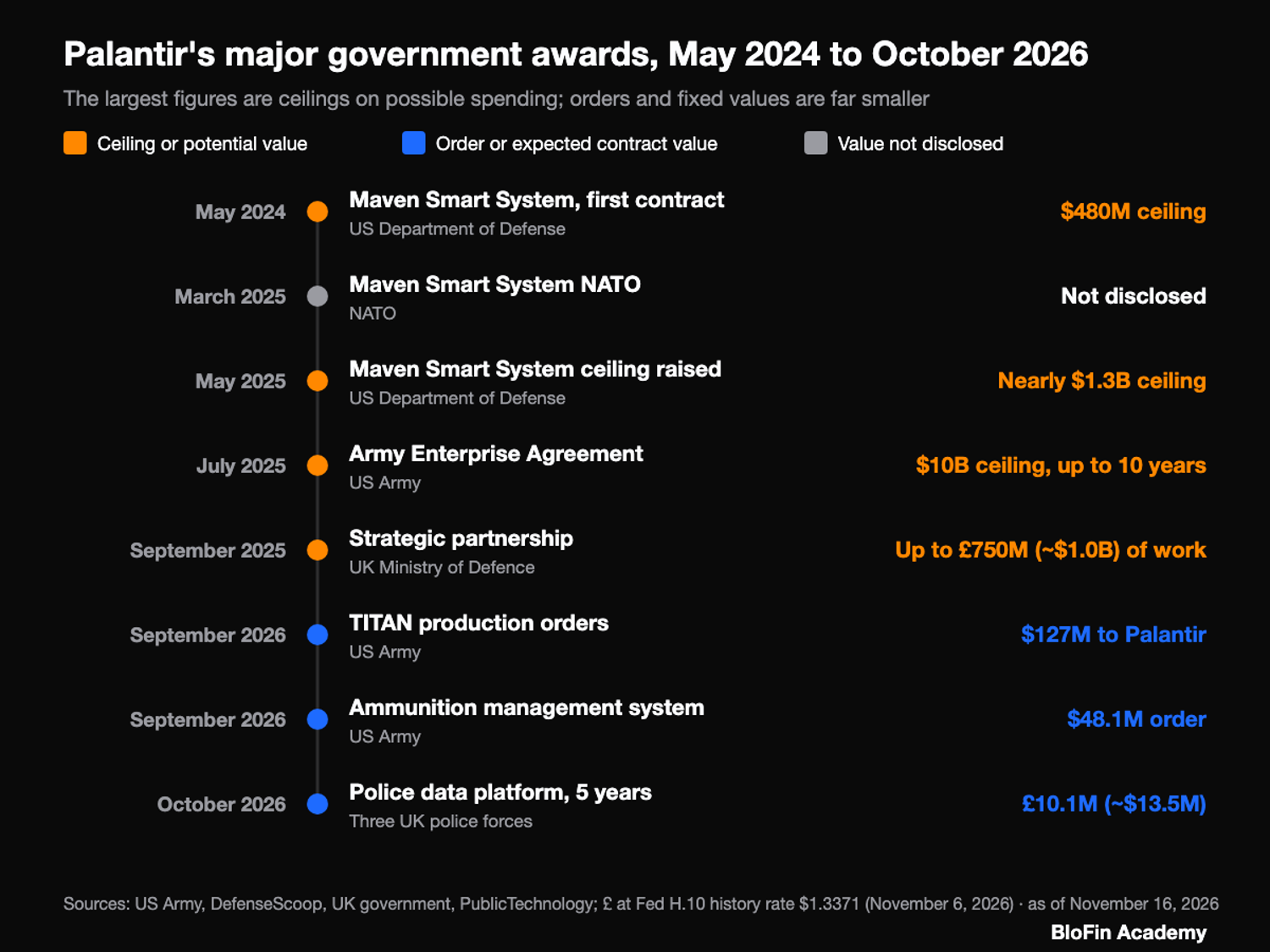
The best-known US deals are the Army Enterprise Agreement, with a $10 billion ceiling over up to 10 years (source: US Army), and Maven Smart System, the military's AI software for finding targets. TITAN, a mobile Army ground station, is the third. Most of this work runs through the Department of Defense, which a September 2025 executive order also lets go by the name Department of War, though its legal name stays the same until a law changes it (source: White House Executive Order 14347).
Outside the US military, Palantir works for NATO, the UK's National Health Service (NHS), the UK's defense ministry and several UK police forces. It also works for Homeland Security Investigations (HSI), the investigations arm of US Immigration and Customs Enforcement (ICE). Government work is one of the two customer groups behind what Palantir does, and large companies are the other.
How much of Palantir's revenue comes from governments?
Government customers paid Palantir $1.1 billion in the third quarter of 2026. That was 49.5% of its $2.3 billion revenue, according to its quarterly filing. A year earlier the share was 53.6%. The share is falling even though government revenue grew 81%, because sales to companies grew faster still (source: Palantir Q3 2026 Form 10-Q).
Most of that money is American. US government customers paid $953 million, up 96% from a year earlier. Governments outside the US paid $192 million, up 31%. On the earnings call, chief financial officer David Glazer said the US growth came from work on existing programs and from new awards (source: Palantir Q3 2026 earnings call transcript).
Worked out from those figures, the $953 million from US agencies is 41.2% of all Palantir's revenue and 83.2% of its government revenue. Governments around the world still paid almost as much as companies did, so any change in public budgets reaches about half of the company's sales.
The contract figures in Palantir's report say less about government work than they seem to. Remaining performance obligations (RPO) are the contracted revenue that customers are unable to cancel. They stood at $4.9 billion at September 30, 2026 (source: Palantir Q3 2026 Form 10-Q). Glazer said this figure is mostly business customers, because it leaves out deals with a first term under 12 months. It also leaves out anything beyond a termination for convenience clause, and both are common in government deals (source: Palantir Q3 2026 earnings call transcript).
Contract ceiling, obligated money and recognized revenue
A government contract usually carries three different numbers. The ceiling is the most the buyer may spend over the whole term. Obligated money is the part the buyer has formally committed from a budget it already has. Recognized revenue is what the seller books as it delivers the work, quarter by quarter, so it trails both of the others.
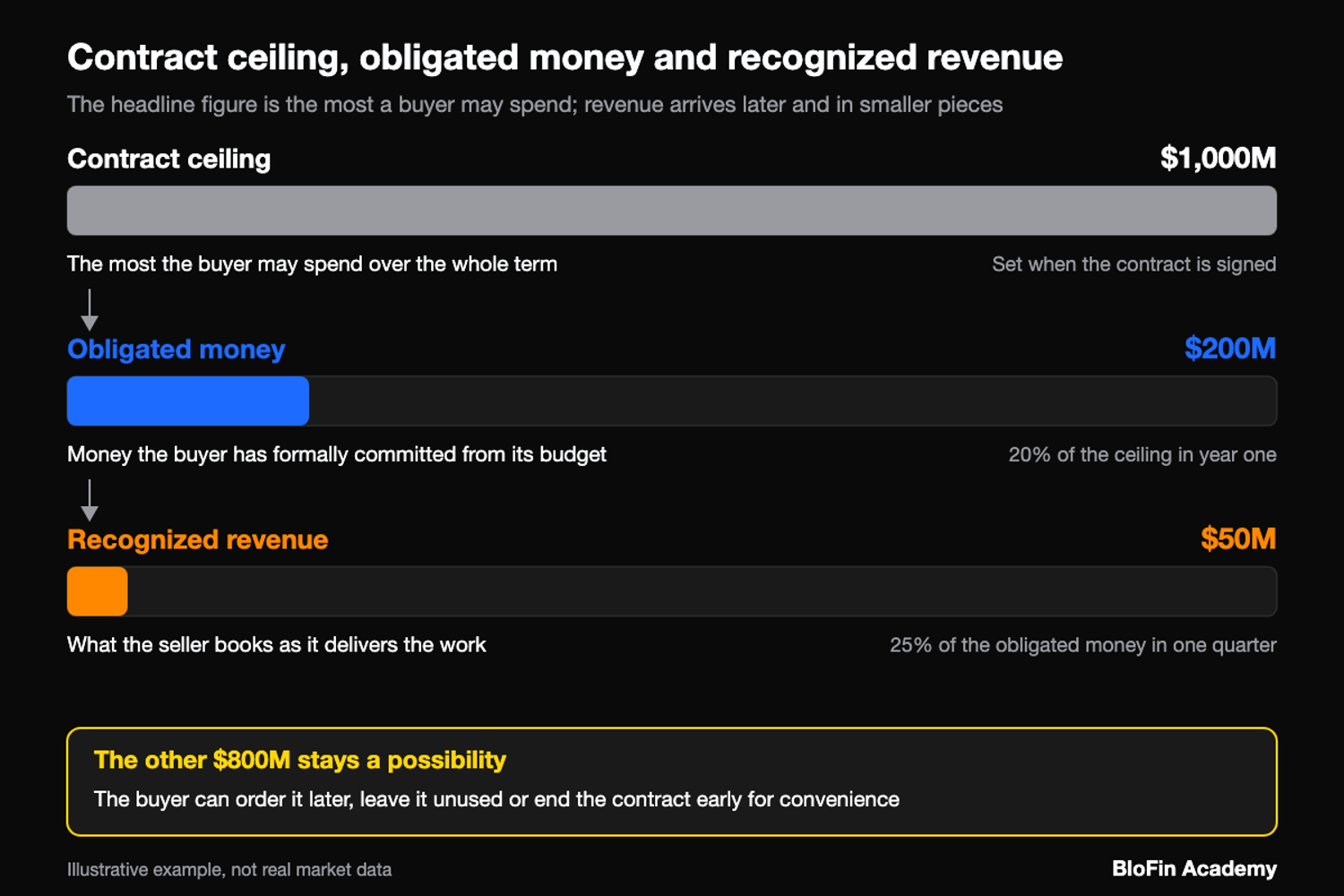
Say an agency signs a deal with a $1 billion ceiling over ten years. In the first year it might commit $200 million of it, which is one fifth of the ceiling. In the first quarter, the seller might book $50 million of that as staff start to use the software. The other $800 million stays a possibility. The agency can spend it later, leave it unused or end the deal early. So the money booked in any one year is often a small slice of the headline.
A real Army award shows the same gap. In 2019 Palantir won a deal to build a field version of the Army's intelligence analysis system, the Distributed Common Ground System-Army (DCGS-A). Defense News reported the deal as worth $876 million over 10 years. An industry source told Defense News that the first order was $20 million, about 2.3% of that headline value (source: Defense News).
Two features of government work keep even committed money uncertain. Palantir's quarterly filing says it "allows many of its customers to terminate contracts for convenience" before the stated term ends. In plain words, a buyer can walk away even when the seller has done nothing wrong. The filing also warns that government buyers face uncertainty over their budgets and spending levels (source: Palantir Q3 2026 Form 10-Q).
Palantir's own deal figures, which it reports with its quarterly earnings, follow the same logic. Remaining deal value (RDV) is the total remaining value of all its existing contracts, counting every option and assuming none ends early (source: Palantir Q3 2026 results, Palantir Q3 2026 earnings call transcript). It was $13.4 billion at September 30, 2026, far more than the $4.9 billion of RPO that customers are unable to cancel (source: Palantir Q3 2026 earnings call transcript). Most of the gap between the two is money that customers can still choose not to spend. That is why the bigger number is the less certain one.
A contract headline is easier to read with four questions in mind. Is the figure a ceiling, an order or a fixed price? How many years does it cover? Are some of those years options that the buyer may skip? And has any money been committed from this year's budget yet? The answers turn a large number into a rough sense of what the seller may actually book. Two deals with the same headline can mean very different things for a company's sales.

The US Army Enterprise Agreement
The US Army Enterprise Agreement, announced on July 31, 2025, folds 75 earlier Palantir deals into one contract: 15 main contracts and 60 related ones. Its $10 billion figure covers up to 10 years. The Army calls it the "maximum potential value" of the contract, and it says the figure is not a specific amount obligated or committed (source: US Army).
What the Army gets is simpler buying. The agreement sets discounts that grow with the amount bought over its term. It lets the government buy goods and services as it needs them, and it removes fees that used to pass through resellers. The Army said this shortens the time it takes to buy. It also puts one set of terms in place of 75 (source: US Army).
The agreement has since taken on more work. In March 2026 the Pentagon ordered every Maven Smart System contract to move onto it. That makes it the main buying route for Palantir's biggest military program as well (source: DefenseScoop, April 2026).
Compare the ceiling with what Palantir already earns from Washington, one year at a time. Spread evenly over 10 years, the $10 billion ceiling comes to $1 billion a year. Palantir's US government revenue was $953 million in a single quarter, which at that pace works out to about $3.8 billion a year. That is simple arithmetic, not a forecast. It shows that a headline this large, spread over its term, is a fraction of what US agencies already pay Palantir each year.
Maven Smart System and the program-of-record order
Maven Smart System is Palantir's AI software for the US military. It pulls data from many military systems and intelligence feeds into a single view and helps forces find and strike targets faster. The Pentagon signed its first production contract for it, a $480 million, five-year ceiling, in May 2024. A year later it raised the ceiling to nearly $1.3 billion through 2029 (source: DefenseScoop, April 2026).
That first deal was a framework contract. It set a ceiling and let the buyer place orders under it as needs came up. At the start, Palantir said the work would cover five US combatant commands, the military's top regional and functional commands. The higher ceiling, more than two and a half times the first one, gave the buyer room to order more, and the orders themselves still come later. DefenseScoop reported that the system has been used in live-fire exercises and in real conflicts by several combatant commands (source: DefenseScoop, April 2026).
On March 9, 2026, Deputy Defense Secretary Steve Feinberg ordered that Maven become a formal program of record by the end of fiscal 2026, which ended on September 30. DefenseScoop reported that the change opens the way to more stable funding. Feinberg wrote that it would also make buying simpler and make clear who answers for results (source: DefenseScoop, April 2026).
The memo ordered the running and oversight of the system to move from the National Geospatial-Intelligence Agency to a Maven program office. That office sits inside the Pentagon's Chief Digital and AI Office. The memo also told the research and engineering office to adjust the timelines if any step would hold up delivery to troops. The September deadline was firm on paper, with room to move in practice (source: DefenseScoop, April 2026).
NATO's Maven Smart System
NATO bought its own version, Maven Smart System NATO, for Allied Command Operations, one of the alliance's strategic commands. The NATO Communications and Information Agency finalized the contract on March 25, 2025. NATO said it took only six months to go from setting out the need to buying the system, and that the command would start using it within 30 days (source: DefenseScoop, April 2025).
NATO said it plans to use the system for a wide range of AI tools, from large language models to machine learning. Neither side commented on what NATO paid. Even so, DefenseScoop reported that Palantir's stock rose about 8% on the Monday morning of the announcement, April 14, 2025 (source: DefenseScoop, April 2025). A contract can move the share price before anyone knows its value, which is a common pattern in how news moves prices.
Contract news like this can also land while Nasdaq is closed, which is where the gap risk when Nasdaq reopens comes from.
BloFin's PLTRUSDT Perpetual keeps pricing Palantir at those times, and the PLTRUSDT trading page shows its current price.
The Army's TITAN contract
TITAN is a mobile Army ground station on a military vehicle. It uses AI to turn data from sensors, drones, aircraft and satellites into target recommendations. On September 1, 2026, the Army moved it into production with $192 million of orders. Of that, $127 million went to Palantir, which works with L3Harris and three other firms on the program (source: DefenseScoop, September 2026).
TITAN is built so its analysts can keep moving with the troops, in the truck or in a vehicle next to it, while they collect sensor data. The orders cover eight systems, to be delivered over 18 months: four of the larger "advanced" version and four "basic" ones. The advanced version rides on the back of an Army medium tactical vehicle, and the basic one goes mainly on a Joint Light Tactical Vehicle. Anduril received the other $65 million to build the vehicle-mounted hardware and wire it into each truck (source: DefenseScoop, September 2026).
The orders follow a $178.4 million award in 2024, when Palantir beat RTX for the right to build TITAN and then delivered 10 test models. Half of those ride on medium tactical vehicles, three on Joint Light Tactical Vehicles and two on the lighter Infantry Squad Vehicle. An Army project manager said the production effort is the result of four years of soldier feedback on those test models. The Army said it expects more production awards in fiscal 2027, which runs from October 2026 to September 2027 (source: DefenseScoop, September 2026).
Palantir's chief revenue officer, Ryan Taylor, listed the TITAN production deal among the quarter's government wins on the November 2 call (source: Palantir Q3 2026 earnings call transcript). TITAN follows a common path for an Army program. Years of test work under one award come first. Production orders follow, each with its own dollar figure, and each new order is a fresh decision by the buyer rather than a sure thing.
The Army placed a separate order with Palantir that month. On September 17, 2026, it announced a $48.1 million delivery order for an ammunition management system (source: US Army, September 2026).
Palantir's civilian and allied government contracts
Outside the US military, Palantir's government customers include HSI, the NHS, the UK's defense ministry, UK police forces and NATO. Each of these deals is smaller than the Army's. Together, though, they spread the business across agencies and countries, and revenue from governments outside the US grew 31% in the third quarter of 2026.
HSI renewed its contract for Investigative Case Management, the Palantir software it uses to manage its cases, in September 2022. Palantir put the renewal at $95.9 million over five years when it was signed, about $19.2 million a year. Federal spending records show the order has since grown to about $171 million committed (source: USAspending). That is small next to the Army deals, but it has run for years. HSI looks into crime across borders that makes use of trade, travel and money systems (source: Intelligence Community News).
The NHS Federated Data Platform
NHS England awarded its Federated Data Platform contract to Palantir in November 2023. The consulting firms Accenture and PwC were among the firms that supported its bid. NHS England said the deal would last seven years and cost £330 million. That is about $441 million at the Federal Reserve's November 6, 2026 rate of $1.3371 per pound (source: The Register, Federal Reserve H.10 history).
The platform joins up information held in separate NHS systems. The health service said it expected to invest £25.6 million, about $34.2 million, in the first year. Spread evenly, £330 million over seven years is about £47.1 million a year. So the first year was planned well under the average (source: The Register, Federal Reserve H.10 history).
The £330 million is itself a ceiling. Stotles, a public procurement data service, lists £182.2 million of published awards to Palantir under the deal, about $244 million. It describes the £330 million as the most the deal can reach as more NHS trusts adopt the platform (source: Stotles, Federal Reserve H.10 history).
UK defense and policing
The UK's defense ministry signed a partnership with Palantir on September 18, 2025. The government said the partnership could find work worth up to £750 million, about $1.0 billion, over five years. That figure is an estimate of possible deals, not a signed contract. Palantir also pledged to invest up to £1.5 billion, about $2.0 billion, in the UK. It also promised up to 350 jobs and a London base for its European defense business. The release said the AI tools involved had already been tested in Ukraine (source: UK government).
The newest UK deal is with the police. Bedfordshire, Cambridgeshire and Hertfordshire police signed a five-year deal for Palantir's Foundry software on October 9, 2026. The procurement notice valued it at £10.1 million, about $13.5 million. It covers a system that brings data from many sources together for analysis. The regional unit that supports seven forces in the east of England is also understood to be covered (source: PublicTechnology).
Third-party AI models in Palantir's defense work
Palantir's defense software runs AI models made by other companies, so a Pentagon dispute with one model maker becomes a supplier risk. On March 3, 2026, the Pentagon labeled Anthropic, the maker of Claude, a supply chain risk. It ordered Anthropic products out of its systems within 180 days and barred contractors from using Claude in department work (source: Lawfare).
The dispute began over contract terms. Anthropic would not let Claude be used for domestic mass surveillance or in fully autonomous weapons, and talks broke down (source: Lawfare). Anthropic fought the label in two courts. The Pentagon had used two separate legal steps to impose it. In August 2026, Judge Rita Lin in California ruled that one of them broke the First Amendment, because it punished Anthropic for its views (source: Lawfare, The Next Web, October 14).
In Washington, a three-judge appeals panel upheld the other designation 2-1 on September 25, 2026. On October 13, 2026, Anthropic asked the full appeals court to rehear the case, Bloomberg reported, as The Next Web relayed (source: The Next Web, October 14, Lawfare).
For Maven, the practical question was the swap, because Claude was one of the models inside it. Palantir's chief technology officer, Shyam Sankar, spoke on CBS's Face the Nation in October 2026. He said the Pentagon had already replaced Anthropic's models with no effect on operations. He said the department now runs models from xAI, OpenAI and Google, plus open ones such as Nvidia's Nemotron, and that whoever builds an application chooses which model it uses (source: The Next Web, October 13). The Pentagon's own chief technology officer said in September 2026 that nine-tenths of its classified AI work no longer ran on Anthropic's models, with the remainder due to move within weeks (source: The Next Web, October 14).
The episode shows a link that contract values hide. Palantir sells the software layer, and outside labs make the models inside it. A ban on one lab forces Palantir and its customers to switch models inside running systems, even though the contract itself stays in place.
Defense budgets and stopgap funding
US defense money arrives through yearly spending bills, and when a bill is late, a stopgap holds spending at the previous year's level. Stopgaps usually stop new programs from starting and can delay contracts. Fiscal 2027 began under one that expires on December 11, 2026 (source: Air & Space Forces Magazine). Budget dates like this shape the government side of Palantir's revenue.
Under the current one, the Pentagon is working with $838.5 billion, 44% less than the $1.5 trillion it asked for. When stopgaps run long, the GAO has noted that contracting offices can struggle to issue contracts in time. Citing the GAO, the magazine said this is the 38th time in 50 years that the department has started a year this way (source: Air & Space Forces Magazine).
Following Palantir's next government contract award? To get started, you'll need to first create a BloFin account, fund your account with cryptocurrency, and go to the PLTRUSDT Perpetual trading page.

Frequently asked questions
How many people use Palantir's Maven Smart System?
More than 100,000, according to Palantir. On its November 2, 2026 earnings call, the company said Maven had passed that number. It is now open to every branch of the US military, beyond the combatant commands that used it first, and to many combat support agencies. Palantir also said 46 teams from across the military had just taken part in a Maven hackathon. It said 25,000 people build tools on it (source: Palantir Q3 2026 earnings call transcript).
When does Palantir's NHS contract end?
NHS England awarded the data platform contract in November 2023 for up to seven years. Its first term ends in March 2027, and the deal runs longer only if the government chooses to extend it (source: Stotles, The Register). Parliamentary watchdogs have urged the government to end it at that point (source: PublicTechnology). It was first put out to tender as five years with a two-year extension option, at up to £480 million. NHS England put the awarded deal at £330 million (source: The Register). The Financial Times has reported that ministers have instead decided to extend the deal by two years. The government had not commented when PublicTechnology reported this on November 10, 2026. The site put the deal's potential value at close to £500 million, about $669 million (source: PublicTechnology).
Why did Palantir sue the US Army?
Palantir sued in 2016 in the US Court of Federal Claims. It argued that the Army's plan for its next intelligence analysis system shut out commercial software such as its own. The court ruled for Palantir in October 2016. It found the Army had broken the Federal Acquisition Streamlining Act of 1994 by failing to check whether products already on sale could meet its needs (source: Defense News).
Is Palantir part of the Golden Dome missile defense plan?
Reports say it is helping with the software. On March 24, 2026, Reuters reported, citing a source familiar with the matter, that Anduril and Palantir were working together on software for Golden Dome, after The Wall Street Journal first reported it. Reuters gave no contract value for that work, and it named Lockheed Martin, RTX and Northrop Grumman as the program's prime contractors. The program's director had put the project's price at $185 billion (source: Reuters via The Star). Most of Golden Dome's money came from the 2025 reconciliation law, which the current stopgap does not cover. Its director, Gen. Michael Guetlein, warned in August 2026 that a stopgap does not help the program. It has no earlier budget level to fall back on (source: Air & Space Forces Magazine).
What does Palantir's software do for ICE?
At HSI, Palantir's case management software is the system of record for every HSI case. HSI staff in 225 US cities and at embassies abroad log their investigations in it before a case reaches court. Palantir has worked with HSI since 2011, and HSI picked the software because it could be delivered quickly and controls who sees each record (source: Intelligence Community News).
Researched and written by the BloFin Academy editorial team with AI-assisted drafting. All facts independently verified. Primary sources include Palantir's third-quarter 2026 Form 10-Q, results release and earnings call, US Army and UK government announcements, a White House executive order and the Federal Reserve, with reporting from DefenseScoop, Defense News, Lawfare, Reuters, Stotles, The Register, PublicTechnology, Intelligence Community News, Air & Space Forces Magazine and The Next Web. BloFin facts come from its own PLTRUSDT market data, current as of November 16, 2026.
Nothing in this article constitutes financial advice, and nothing in it is a recommendation to buy, sell or hold Palantir in any form. Government customers paid just under half of Palantir's revenue in the third quarter of 2026, so a delayed budget, a canceled contract or a dispute over a supplier can move the share price sharply, and contract news often lands while Nasdaq is closed. The PLTRUSDT Perpetual is a leveraged contract settled in USDT that gives you no ownership of Palantir shares, and a leveraged position can be liquidated in a price gap. Past performance does not indicate future results. Do your own research and consider your risk tolerance before you trade on BloFin.