
When a company's share price climbs for years, one share can end up costing more than many small investors want to pay. Some companies then cut every share into several smaller ones. The price of each share falls, and the value of the business stays where it was.
That move is called a stock split, and it gets a lot of attention for an event that changes so little.
The arithmetic is simple. The rules on who decides sit in the company's charter and in the law of its home state, so a split headline is a question you can answer from public filings.
Palantir Technologies (PLTR) draws regular split talk in the financial press, and its own filings settle the record. Palantir's price trades on BloFin through the PLTRUSDT Perpetual, a USDT-settled contract that moves with the share price. It gives you exposure to the price without owning any shares.
What is a Palantir stock split?
A Palantir stock split would cut each Palantir share into more shares. The share count would rise and the price per share would fall by the same ratio, so the company's total value would stay the same. Palantir has not split its stock since its shares began trading on September 30, 2020 (source: StockSplitHistory PLTR, Nasdaq PLTR historical data).
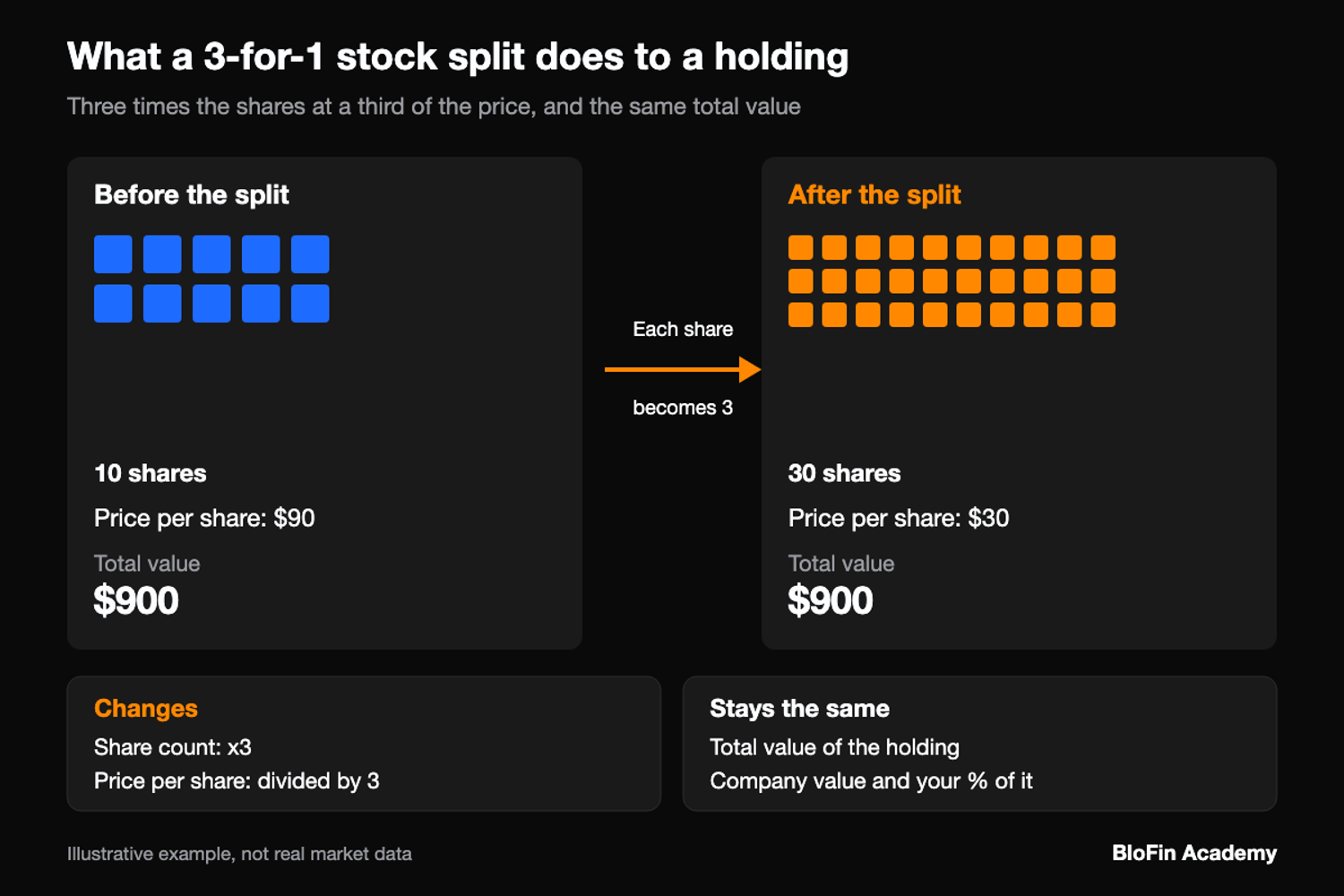
The ratio tells you how many new shares replace each old one. In a 3-for-1 split, every share becomes three and the price of each share drops to about a third.
Palantir's charter, the founding rulebook it files with the state of Delaware, ties its three classes of common stock together. If the company splits one class, the others are split "in the same proportion and manner" unless shareholders approve something different (source: Palantir certificate of incorporation).
Has Palantir stock ever split?
Palantir stock has never split. StockSplitHistory's database lists zero splits for PLTR. In a column on October 24, 2026, the Motley Fool's Keith Noonan wrote that Palantir had yet to split in its roughly six years as a public company (source: StockSplitHistory PLTR, Motley Fool, October 24, 2026).
Palantir's own filings point the same way. A company reports a change to its charter on Form 8-K under Item 5.03. Palantir's only such filing since its listing was filed on December 28, 2022, and it carries the charter that sets out the three share classes (source: SEC EDGAR filing index).
Nasdaq's daily price history for Palantir starts on September 30, 2020, with a $10.00 open and a $9.50 close (source: Nasdaq PLTR historical data). That is the same first-day close the Motley Fool reported in June 2025, so those early prices have never been scaled down for a later split (source: Motley Fool, June 21, 2025).
The share counts in Palantir's filings show no sudden jump either. Total shares outstanding rose 2.24% in 2025, to 2,391.2 million, and reached 2,409,497,474 on October 26, 2026 (source: Palantir 10-K, 2025, Palantir 10-Q, third quarter 2026).
The stock closed at $169.20 on November 9, 2026, about 17.8 times that first-day close.

What a stock split changes for shareholders
A split of any stock changes two numbers in your account: how many shares you hold and the price of each one. The total value of your holding stays the same. So do the company's value, its sales and cash, and your percentage of the company, because the same business is cut into more pieces.
Investor.gov, the education site of the Securities and Exchange Commission (SEC), defines a split as more shares "without a change in the shareholders' equity" (source: Investor.gov, Stock Split). In its example, 100 shares at $100 each become 200 shares at $50 each after a two-for-one split.
Say you hold 10 Palantir shares at the November 9, 2026 close of $169.20, so your holding is worth $1,692.00. After a 3-for-1 split, you would hold 30 shares at $56.40 each, and 30 times $56.40 is still $1,692.00.
The whole company works the same way. Palantir's 2,409,497,474 shares at $169.20 give a market value of about $407.7 billion, worked from the 10-Q share count and the Nasdaq close. After a 3-for-1 split, 7,228,492,422 shares at $56.40 still come to $407.7 billion.
Any number quoted per share moves with the split, so earnings per share would be divided by the same ratio. Palantir pays no cash dividend, and its 10-Q states that none has ever been declared or paid on its capital stock (source: Palantir 10-Q, third quarter 2026).
The Motley Fool's Harsh Chauhan wrote in June 2025 that a split leaves a company's prospects and fundamentals unchanged (source: Motley Fool, June 21, 2025). What a split can change is how the price looks to a buyer, which is the reason companies usually give for doing one.
Forward and reverse stock splits
A forward stock split raises the share count and lowers the price of each share. A reverse stock split does the opposite, merging several shares into one that costs more. Either kind leaves your holding's value unchanged on the day it happens, so the direction tells you about the company's reasons, not its worth.
Investor.gov's reverse split example is a one-for-ten, where every ten shares become one, so 10,000 shares turn into 1,000 (source: Investor.gov, Reverse Stock Splits). The same page says companies use them to lift a low share price, for example to meet an exchange's minimum price rule. Some small holders get cash for a leftover fraction of a share.
Investor.gov also says companies often split forward to make their shares more affordable. Nvidia said its 2024 split would make its stock easier for employees and investors to own (source: Nvidia press release, May 22, 2024).
How a stock split happens, from announcement to split-adjusted trading
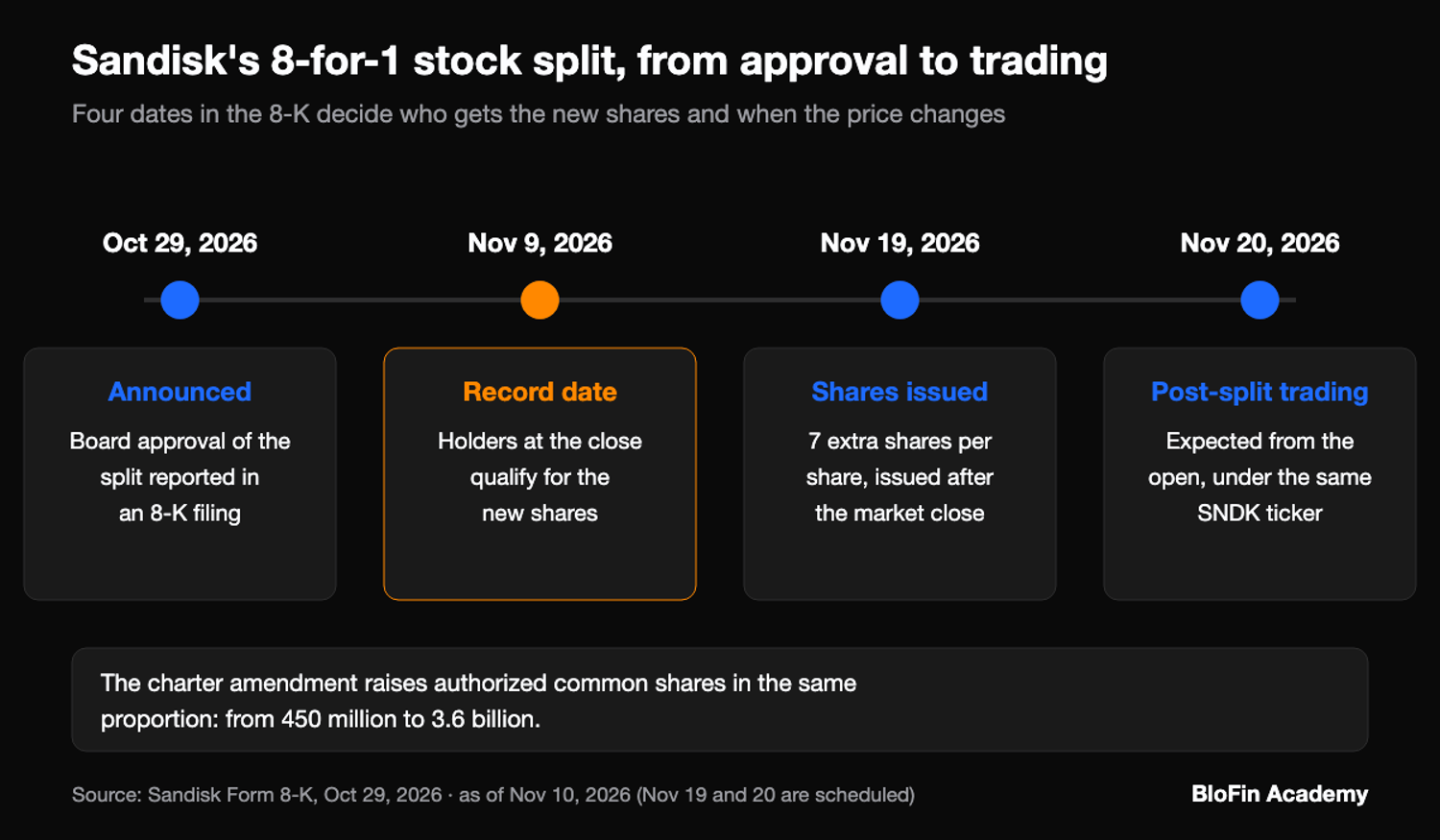
A stock split follows a set order. The board approves it and the company announces it. Holders on the record date qualify for the new shares, the shares are handed out, and the stock starts trading at the lower, split-adjusted price. Each step has a date, and the company's announcement lists them all.
Sandisk (SNDK) set out those steps in October 2026. In an 8-K dated October 29, 2026, it reported that its board had approved an eight-for-one forward split (source: Sandisk 8-K, October 29, 2026). A change to its charter lifts its authorized common shares from 450 million to 3.6 billion, the same eightfold step.
The filing says holders of record at the close on November 9, 2026 receive seven extra shares for each share they own. Those shares are issued after the market closes on Thursday, November 19. The stock is expected to start trading on a post-split basis at the open on Friday, November 20, under the same ticker.
Recent stock splits at large US companies
Nvidia in 2024 and Booking Holdings in 2026 both announced a forward split, at ten-for-one and 25-for-1, and named the day it would take effect (source: Nvidia press release, May 22, 2024, Motley Fool, February 24, 2026). Ten-for-one turns each share into ten and 25-for-1 turns each into 25, so each new share starts at about a tenth or a twenty-fifth of the old price.
Nvidia announced a ten-for-one forward split on May 22, 2024. Its release said each holder of record at the close on June 6, 2024 would receive nine more shares after the close on June 7. Trading on a split-adjusted basis was expected to start at the open on June 10, 2024 (source: Nvidia press release, May 22, 2024).
Booking Holdings announced a 25-for-1 forward split after the close on February 18, 2026. The Motley Fool's Sean Williams wrote that it would take effect on April 2. It would lower the share price from its $4,076.79 close on February 20 to about $163, he added (source: Motley Fool, February 24, 2026). The split took effect on April 2, and the shares began trading on a split-adjusted basis on Monday, April 6 (source: Booking 8-K, April 2, 2026).
How a Palantir stock split would be decided
A Palantir stock split would start with its board of directors. It would then run through Palantir's charter and the company law of Delaware, where Palantir is incorporated. Its three classes of common stock shape that path, because Delaware's no-vote charter route for a split is open only to a company with one class of stock.
Delaware law and the one-class route
Delaware law lets a company change its charter to split its shares. The board adopts a resolution and puts the change to a shareholder vote (source: Delaware General Corporation Law, Section 242). The same section lets a company skip that vote for a forward split only if it has "only 1 class of stock outstanding."
Palantir has three classes outstanding, so that shortcut's condition does not fit it. A company can also hand every holder extra shares as a dividend paid in its own stock, and Palantir's charter has a clause for exactly that.
Palantir's charter and its three share classes
The clause says how a dividend paid in shares would work across the classes. As a base rule, the same dividend must be paid "on all shares of Common Stock" with the same record and payment dates. Otherwise, Class A shares can go to Class A holders only if Class B shares go to Class B and Class F holders at the same rate and on the same dates (source: Palantir certificate of incorporation).
The charter also limits new Class F shares. It allows more only through a matching dividend or split, a share exchange it describes, or a vote of the Class F holders. All 1,005,000 Class F shares the charter allows are already issued (source: Palantir 10-Q, third quarter 2026).
Authorized shares and the room for a split
A split needs enough authorized shares, the cap a charter sets on how many shares a company may issue. Palantir's balance sheet shows 20 billion Class A shares authorized at September 30, 2026. That is 8.67 times the 2,306,705,341 outstanding on October 26, and the Class B cap of 2.7 billion compares with 101,787,133 outstanding (source: Palantir 10-Q, third quarter 2026).
On those counts, a 3-for-1 split would take Class A to 6,920,116,023 shares, 34.6% of its cap, and Class B to 305,361,399, or 11.3%. The largest whole ratio that keeps Class A under today's cap is eight-for-one, at 18,453,642,728 shares. A three-way split of Class F would need 3,015,000 shares, three times its cap.
The founders' votes
Under the charter, a majority of Palantir's voting power can raise an authorized share count without a separate vote by each class. The Class F shares sit in a trust set up by founders Stephen Cohen, Alexander Karp and Peter Thiel. They give the founders control of up to 49.999999% of the company's total voting power (source: Palantir 10-Q, third quarter 2026).
Leaving Class F aside, the founders and their affiliates held about 22% of the voting power on October 26, 2026, according to the same filing. That Class F power depends on the founders and certain affiliates owning at least 100 million Palantir securities together. The charter says that line is "equitably adjusted" for a stock split.
Why the Palantir stock split question comes up
The Palantir stock split question comes up because the share price has grown many times over since 2020 and stock split columns keep naming it, including the Motley Fool's in October 2026 (source: Motley Fool, October 24, 2026). Booking started its split from a much higher price.
At the November 9, 2026 close, one Palantir share cost $169.20. Booking closed at $4,076.79 on February 20, 2026, according to the Motley Fool. On those two figures, Palantir's price was 4.2% of Booking's.
Fractional shares take some of the pressure off. In June 2025, Chauhan noted that many trading platforms let investors buy fractional shares. He added that a split can still make a costly stock feel easier to buy for some investors (source: Motley Fool, June 21, 2025).
Palantir split shares, cost basis and the PLTRUSDT contract
For a Palantir shareholder, the cost of each share would be divided by the same ratio as the price. The Internal Revenue Service (IRS) says in Publication 550 that the basis of split shares is figured the same way as for a stock dividend of identical stock (source: IRS Publication 550).
Its example is one share bought for $45 that receives two new shares, leaving three shares costing $15 each (source: IRS Publication 550).
A PLTRUSDT position on BloFin holds no Palantir shares. BloFin's notice on stock futures says the contracts "do not convey any ownership interest" (source: BloFin stock futures notice). Its disclaimer adds that holders of stock futures get no voting rights, no dividends and no other shareholder rights.
Each perpetual contract stands for 0.01 PLTR, which is also the smallest Palantir position you can open on BloFin. At the 170.17 USDT last price BloFin's market data showed at 5.58AM UTC on November 10, 2026, one contract carried 1.70 USDT of exposure (source: BloFin PLTRUSDT market data).
Leverage of up to 20x makes losses bigger as well as gains, and BloFin can reduce or liquidate a leveraged position before all its margin is gone. Outside regular US market hours, stock futures trading may be limited to orders that only close a position (source: BloFin stock futures notice). The PLTRUSDT trading page shows the latest trade beside the mark price.
How to check for a Palantir stock split announcement
You can check for a Palantir stock split yourself. Any split would show up in Palantir's filings on SEC EDGAR, the SEC's free public database. The split filing would name the ratio, the record date and the first day of split-adjusted trading.
Step 1: Open Palantir's filing list on SEC EDGAR and narrow it to Form 8-K, the report a company files for major events.
Step 2: Look for an 8-K that lists Item 5.03, a change to the charter, or Item 8.01, other events, and check whether it names a split ratio.
Step 3: Write down the record date and the first split-adjusted trading day. Holders on the record date get the new shares, and the quoted price drops on the later date.
Step 4: After the split, check that your brokerage account shows the new share count and cost per share, and that the next 10-Q cover shows each class grown by the ratio.
Looking to trade Palantir? To get started, you'll need to first create a BloFin account, fund your account with cryptocurrency, and go to the PLTRUSDT Perpetual trading page.

Frequently asked questions
Can Palantir split only its Class A shares?
Only with extra approvals. Palantir's charter says a split of one class applies to the others in the same proportion. Treating the classes differently needs a majority of the total voting power and, if a class would be harmed, a majority of that class voting on its own (source: Palantir certificate of incorporation).
Is a stock split taxable in the US?
Receiving split shares is generally not taxed when it happens. IRS Publication 550, written for 2025 returns, says stock dividends are generally not taxable and are not reported on the return, with some exceptions, for example when any shareholder could choose cash or other property instead (source: IRS Publication 550). Your own tax position may differ.
How did Nvidia's 2024 split change its dividend?
Nvidia raised its quarterly cash dividend by 150% alongside its ten-for-one split, from $0.04 to $0.10 per pre-split share. The release put that at $0.01 per share on a post-split basis, payable on June 28, 2024 (source: Nvidia press release, May 22, 2024). The payout per share went from $0.04 before the split to $0.01 after it, while the ten shares that replaced each old share would receive $0.10, 150% more than before.
How long does a stock split take after it is announced?
Nvidia and Sandisk each set split-adjusted trading about three weeks after the announcement, while Booking took almost seven. Nvidia announced its ten-for-one split on May 22, 2024 and set split-adjusted trading for June 10, 19 days later. Sandisk announced its eight-for-one split on October 29, 2026 and expects post-split trading from November 20, 22 days later. Booking announced its 25-for-1 split on February 18, 2026, and split-adjusted trading began on April 6, 47 days later (source: Nvidia press release, May 22, 2024, Sandisk 8-K, October 29, 2026, Booking 8-K, April 2, 2026).
Would a split change a Palantir holder's voting power?
A split of every class by the same ratio would leave each holder's share of the vote unchanged. Each Class A share has one vote and each Class B share ten, and the classes have the same rights apart from voting and conversion (source: Palantir 10-K, 2025). Tripling every class keeps those proportions.
Researched and written by the BloFin Academy editorial team with AI-assisted drafting. All facts independently verified. Primary sources include Palantir's 2025 10-K, its third-quarter 2026 10-Q and its certificate of incorporation on SEC EDGAR, the Delaware General Corporation Law, Sandisk's October 29, 2026 8-K and Nvidia's May 22, 2024 results release. Price data comes from Nasdaq's daily table for Palantir, with reporting and data from The Motley Fool, StockSplitHistory, Investor.gov and IRS Publication 550. BloFin facts come from its PLTRUSDT Perpetual page, its stock futures notice and its own PLTRUSDT market data, current as of November 10, 2026.
Nothing in this article constitutes financial advice, and nothing in it is a recommendation to buy, sell or hold Palantir in any form or a prediction of whether Palantir will split its stock. The PLTRUSDT Perpetual conveys no ownership interest in Palantir shares, offers leverage of up to 20x that magnifies losses, and orders may be limited to reduce-only outside regular US hours. Past performance does not indicate future results. Do your own research and consider your risk tolerance before you trade on BloFin.