
A futures contract usually has an end date, and on that date its price has to meet the price of whatever it tracks. That deadline is what keeps the two close together in the months before it. A contract that never expires needs another way to stay near the market it follows, or its price could drift away for as long as traders let it.
Perpetual futures handle that with funding, a small payment that passes between the buyers and the sellers of the contract at set times through the day. If the contract is priced above the market it tracks, the buyers generally pay the sellers, and if it is priced below, the payment runs the other way, which gives traders a reason to close the gap (source: iShares, What are perpetual futures?). Each payment is a fraction of a position's value, so it is easy to ignore until a large one lands.
The same mechanism runs on perpetuals that track US shares, such as Palantir. The difference is that the share behind the contract stops trading every evening and over the weekend, while the contract carries on trading, and its funding keeps settling, through those hours.
For Palantir Technologies (PLTR), BloFin offers the PLTRUSDT Perpetual, with USDT as its settlement currency. BloFin sets its funding rate from the distance between the contract's price and its index price, BloFin's reference price for the Palantir share, averaged over each eight-hour period. The latest settlement in the record, at 12AM UTC on November 11, 2026 (7PM ET on November 10), was +0.0123%, so long positions paid shorts 0.0123% of their value (source: BloFin PLTRUSDT funding history). The largest rate in the contract's history was about 79 times that size.
What is the PLTR perpetual funding rate?
The PLTR perpetual funding rate is the percentage of a position's value that passes between longs and shorts in BloFin's PLTRUSDT Perpetual at each settlement, normally every eight hours. With a positive rate the longs pay the shorts, and with a negative rate the shorts pay the longs. Only positions still open when a settlement happens take part in it.
BloFin uses funding to pull the price of its perpetual contracts toward the asset underneath them, and it charges each payment as the position's nominal value times the funding rate (source: BloFin funding rate rules). On a position worth 1,000 USDT, a rate of +0.0100% means the long pays 0.10 USDT and the short receives 0.10 USDT.
Three prices sit behind that payment. The index price is that reference price, and BloFin's notice says its stock futures rest on a basket of tokenized-stock indices that are already circulating (source: BloFin stock futures notice). The last price is the price of the contract's most recent trade. The mark price is the value BloFin treats as fair for the contract. It combines the index price with a funding-related adjustment and other inputs, and BloFin relies on it to work out liquidations and unrealized profit and loss (source: BloFin index, mark and last price).
When the contract trades above its index it is said to trade at a premium, and below it at a discount. The difference between the two prices is the basis. A premium usually comes with positive funding rates, so longs pay shorts, and a discount comes with negative funding, so shorts pay longs. Researchers who model these contracts describe the same design: a perpetual has no expiry that forces it to meet the spot price, so funding does that work (source: He, Manela, Ross and von Wachter, Fundamentals of Perpetual Futures).
How BloFin calculates the PLTR perpetual funding rate
BloFin builds each funding rate in three steps. It measures the contract's premium over its index price, averages that premium across the period with the latest readings weighted most, then pulls the result toward an interest term of 0.03% a day, by at most 0.05%. The result must sit inside a cap and floor, ±3% per settlement on PLTRUSDT (source: BloFin funding rate rules, BloFin PLTRUSDT market data).
The first step is the premium index. BloFin starts from the impact bid and impact ask prices. These are the average prices you would get if you sold a set amount of the contract into the bids, or bought the same amount from the asks, and BloFin's platform sets that amount. When the impact bid sits higher than the index price, the premium is positive. When the impact ask sits lower than the index, it is negative, and when the index lies between them, it is zero. Dividing by the index price turns the result into a percentage (source: BloFin funding rate rules).
The second step averages those premium readings across the funding period, with weights of 1, 2, 3 and so on. So a reading near the end of the period counts several times as much as one near the start. Three readings of 0.0200%, 0.0400% and 0.0600% give a weighted average of about 0.0467%, while a plain average would give 0.0400%. A premium that builds late in the period therefore moves the rate more than one that fades.
The third step brings in that interest term, which BloFin's rules set at 0.03% a day. In BloFin's formula the funding rate equals the average premium plus the gap between the interest term and the premium, with that gap held between −0.05% and +0.05%. Put plainly, when the premium is within 0.05% of the interest term, the rate equals the interest term. When the premium is further away, the rate follows the premium, pulled 0.05% back toward the interest term. BloFin then holds that figure inside the rate limits it sets to manage risk (source: BloFin funding rate rules).
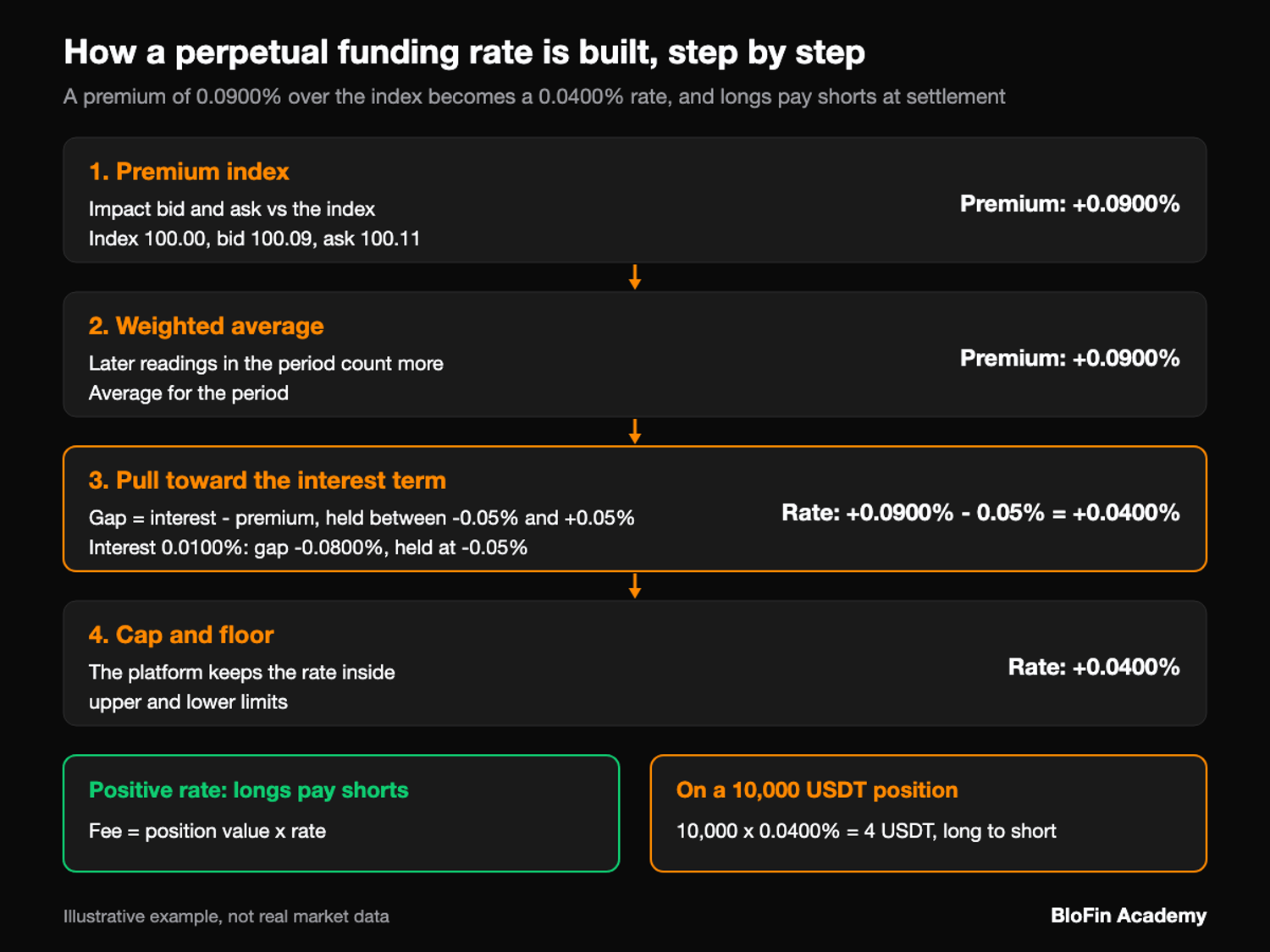
Round numbers show the arithmetic. In an illustrative example, with an index of 100.00, an impact bid of 100.09 and an impact ask of 100.11, the premium index is 0.0900%. Take the interest term for one eight-hour period as 0.0100%, a third of 0.03% a day. If 0.0900% were the period's weighted average, the gap of −0.0800% would be held at −0.05%, so the rate would be 0.0900% − 0.05% = 0.0400%. On a position worth 10,000 USDT, the long would pay the short 4 USDT at that settlement.
BloFin's rules describe one method for all of its perpetual contracts, with settings such as the impact amount left to its platform. The rates the contract has actually printed are in its funding history, and most of them sit much closer to zero than the illustrative 0.0400%.
PLTRUSDT funding settlement times in UTC and ET
PLTRUSDT funding normally settles three times a day, eight hours apart: 12AM UTC, 8AM UTC and 4PM UTC. Under US standard time, which ends on March 14, 2027, those are 7PM, 3AM and 11AM ET. Under daylight saving time they are 8PM, 4AM and 12PM ET. Only positions open at those moments pay or receive.
Because the schedule is fixed in UTC, the settlements keep their UTC times when the US moves between standard and daylight saving time, and the ET times shift by an hour instead. US daylight saving time starts on the second Sunday of March and ends on the first Sunday of November, which in 2026 meant March 8 and November 1 (source: NIST, Daylight Saving Time).
Nasdaq's regular session runs 9.30AM to 4PM ET, which under standard time is 2.30PM to 9PM UTC. That makes the 4PM UTC (11AM or 12PM ET) settlement the only one that falls while the share is trading, on any trading day. Under standard time, the 12AM UTC (7PM ET) settlement comes three hours after Nasdaq closes at 4PM ET (9PM UTC), during the after-hours session that runs to 8PM ET (1AM UTC). The 8AM UTC (3AM ET) one comes an hour before pre-market trading opens at 4AM ET (9AM UTC) (source: Nasdaq trading hours).
Timing matters for what you owe. BloFin's rules say a position that is closed ahead of the fee being charged owes no funding for that settlement (source: BloFin funding rate rules). A position opened a minute after a settlement therefore pays nothing until the next one, eight hours later, while a position held across a settlement pays or receives the full rate on its value at that moment.
The PLTRUSDT trading page displays the current funding rate together with the time remaining until the next settlement, so both are visible before you open or close a position.
The ±3% funding rate cap on PLTRUSDT
The PLTRUSDT funding rate can go no higher than +3% and no lower than −3% per settlement. At a mark price of 172.47 USDT, read at 4.24AM UTC on November 11, 2026 (11.24PM ET on November 10), a 4 PLTR position is worth 689.88 USDT (source: BloFin PLTRUSDT market data). A settlement at the cap would move 20.70 USDT between the two sides.
The cap and floor appear in BloFin's market data as 0.03 and −0.03, which are decimals for 3%, and the funding interval is eight hours (source: BloFin PLTRUSDT market data). The ±0.05% limit inside the formula and the ±3% cap are two separate layers. The first shapes the rate from the premium, and the second is the outer limit on what any one settlement can charge.
The contract has never come close to that outer limit. Its largest rate, −0.9765% at 12AM UTC on April 13, 2026 (8PM ET on April 12), used about a third of the room between zero and the floor (source: BloFin PLTRUSDT funding history). On the 4 PLTR position, that settlement moved 6.74 USDT from the short to the long.
The cap is one of the contract settings of the PLTRUSDT Perpetual, and like the others it can change. BloFin's contract page says the platform tunes parameters to market conditions and does not publish a separate notice when it does (source: BloFin PLTRUSDT contract details).
PLTRUSDT funding rates by settlement time and weekday
Across the record, from 4PM UTC (11AM ET) on February 9, 2026 to 12AM UTC on November 11 (7PM ET on November 10), the 12AM UTC settlement (7PM or 8PM ET) carried the largest rates. Their average absolute size was 0.0270%, against 0.0109% at 8AM UTC (3AM or 4AM ET) and 0.0124% at 4PM UTC (11AM or 12PM ET).
The typical settlement was far smaller than any of those averages. Of all the settlements in that record, 72.0% settled between −0.0029% and +0.0029%, and the median size was 0.0020%, which on the 689.88 USDT position comes to about one cent of USDT (source: BloFin PLTRUSDT funding history). A handful of large settlements lift the averages, so the median is the better guide to an ordinary one.
The large ones followed the calendar, with the biggest on Sundays and Mondays in UTC. Taking 0.1000% either way as the mark of a large rate, 35 settlements from February 9 to November 11, 2026 reached it (source: BloFin PLTRUSDT funding history). Of those, 18 came at 12AM UTC, which is 7PM or 8PM ET on the evening before. Monday and Sunday settlements in UTC averaged 0.0447% and 0.0426% in size, while those from Tuesday to Friday averaged between 0.0036% and 0.0064%. Weekend settlements in UTC were large 9.4% of the time, against 2.2% on weekdays.
One value stands out in the record. In the February 9 to November 11 settlements, a rate of exactly 0.0120% printed more often than any other, ahead of zero, and every one of those settlements fell in September and October 2026. It printed evenly across the three settlement times, 35 or 36 times at each, and 29 of its settlements fell on a weekend.
The largest PLTRUSDT funding rates and Nasdaq closures
All 35 PLTRUSDT funding settlements of 0.1000% or more in either direction, from February 9 to November 11, 2026, fell while Nasdaq was shut for a weekend or a market holiday. None came during a regular session or an ordinary weeknight, when the largest rates were 0.0223% and 0.0430% in size.
Nasdaq's 2026 closures included its market holidays on Presidents Day, Good Friday, Memorial Day, Juneteenth, July 3 and Labor Day (source: Nasdaq PLTR historical data, Nasdaq trading hours). Each settlement falls into one of three groups. One is the regular session, 9.30AM to 4PM ET, which in UTC runs 2.30PM to 9PM under standard time and 1.30PM to 8PM under daylight time; the others are overnight breaks on weeknights and weekend or holiday closures.
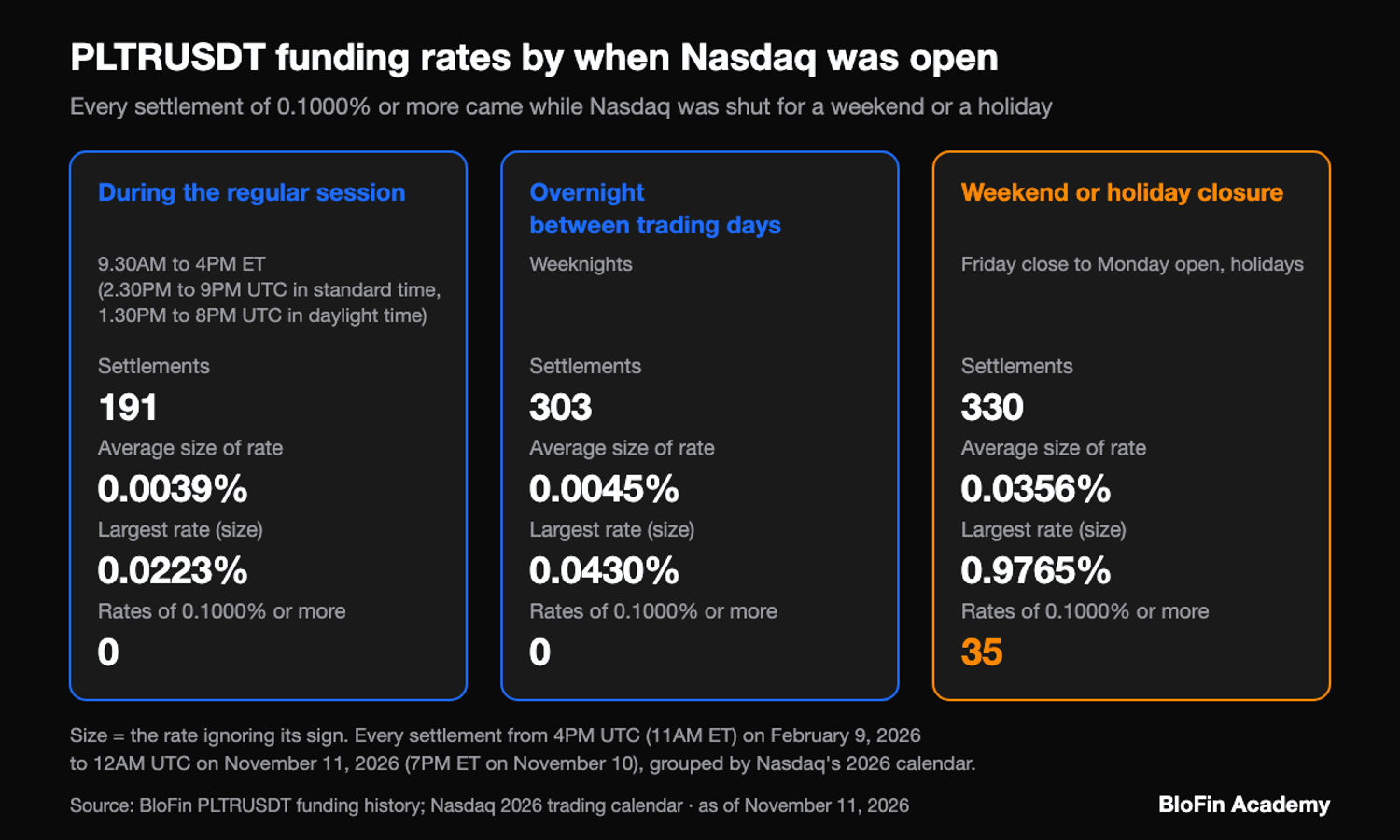
The big rates came in runs. Four consecutive settlements from 12AM UTC on Sunday, March 1 (7PM ET on Saturday, February 28) to 12AM UTC on Monday, March 2 (7PM ET on Sunday, March 1) were all positive and added up to +1.9388%. The last of them, +0.7781%, is the largest positive rate in the record. Two April weekends ran the other way, with four settlements to 12AM UTC on April 13 (8PM ET on April 12) adding up to −1.5089% and the next weekend's four to −1.2944% (source: BloFin PLTRUSDT funding history).
The share's next session did not move consistently with the sign of those rates. After the March run, the stock opened 2.61% above its February 27 close and finished Monday, March 2 up 5.82%. After the April 12 run it opened 1.69% above the April 10 close and finished April 13 up 3.37%, and after the April 19 run it finished April 20 down 0.34% (source: Nasdaq PLTR historical data). Positive funding came before a rise, and so did negative funding, so a large weekend rate has pointed both ways.
The record has been calm since October. The last settlement of 0.1000% or more was +0.1359% at 12AM UTC on October 19 (8PM ET on October 18). Of the 69 settlements after it, through 12AM UTC on November 11 (7PM ET on November 10), none was larger than 0.0218% in either direction, and 65 settled within ±0.0029% (source: BloFin PLTRUSDT funding history).
What PLTRUSDT funding costs per settlement, week and month
On the same long of 4 PLTR, worth 689.88 USDT at the November 11 mark price, the latest settlement cost 0.08 USDT. The median seven days in the February 9 to November 11 record cost 0.32 USDT and the median thirty days 2.18 USDT, if the position kept that value. The same amounts went to a short of equal size.
That record holds 804 runs of seven days (21 settlements) and 735 runs of thirty days (90 settlements) (source: BloFin PLTRUSDT funding history). The extremes show how far one span can sit from the middle.
Holding span | Median for a long (USDT) | Most a long paid (USDT, UTC dates) | Most a long received (USDT, UTC dates) |
|---|---|---|---|
One settlement | 0.01 paid | 5.37, 12AM UTC on March 2 (7PM ET, March 1) | 6.74, 12AM UTC on April 13 (8PM ET, April 12) |
Seven days | 0.32 paid | 13.25, March 1 to March 7 | 13.95, April 12 to April 19 |
Thirty days | 2.18 paid | 15.50, February 20 to March 22 | 31.62, March 22 to April 21 |
Longs paid more often than they received, and more often over thirty days than over seven. In the February 9 to November 11 record, a long paid in 67.4% of seven-day spans and 81.1% of thirty-day spans (source: BloFin PLTRUSDT funding history). The largest amounts went the other way, because the April weekend runs paid longs more than any stretch paid shorts.
Two things move the real figure for your own position. Each payment is worked out on what the position is worth at that settlement, so it moves with the price as well as with the rate. And past rates do not set future ones. As iShares points out, what a perpetual costs to hold comes from every funding rate charged while it is open, not only the one in force on the day you buy (source: iShares, What are perpetual futures?). Allowing for a run of large payments when you size a position is part of managing risk on BloFin futures.
How to check your PLTRUSDT funding fees on BloFin
When you trade BloFin futures, your own PLTRUSDT funding payments are listed in the trading history, under the Funding Fee instrument type. Each record shows the time, coin, symbol, margin and funding fee. A settlement leaves no record if you held no position at that moment, or if you closed the position before the funding fee was settled.
Step 1: Go to Assets and click Order Center.
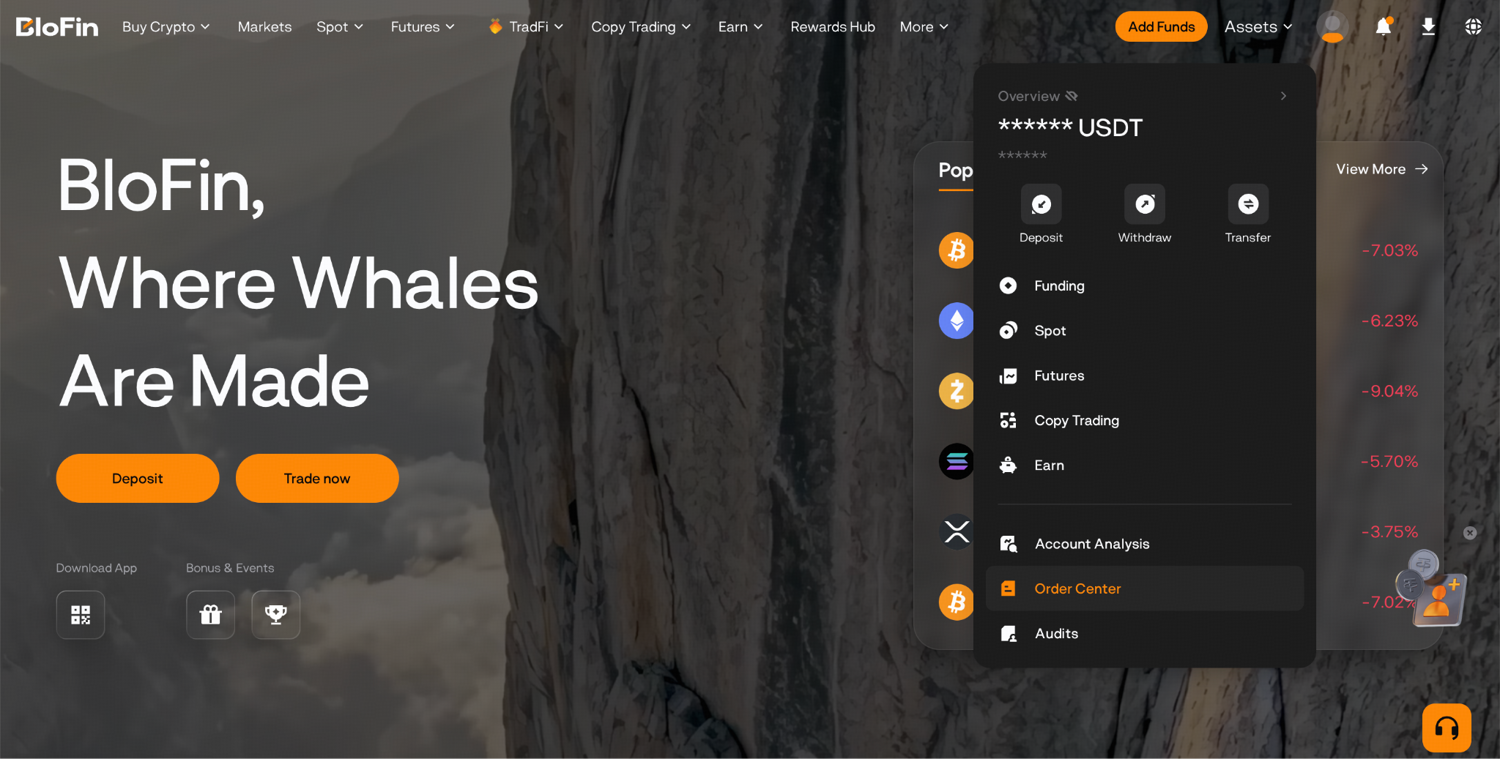
Step 2: Choose Trading History.
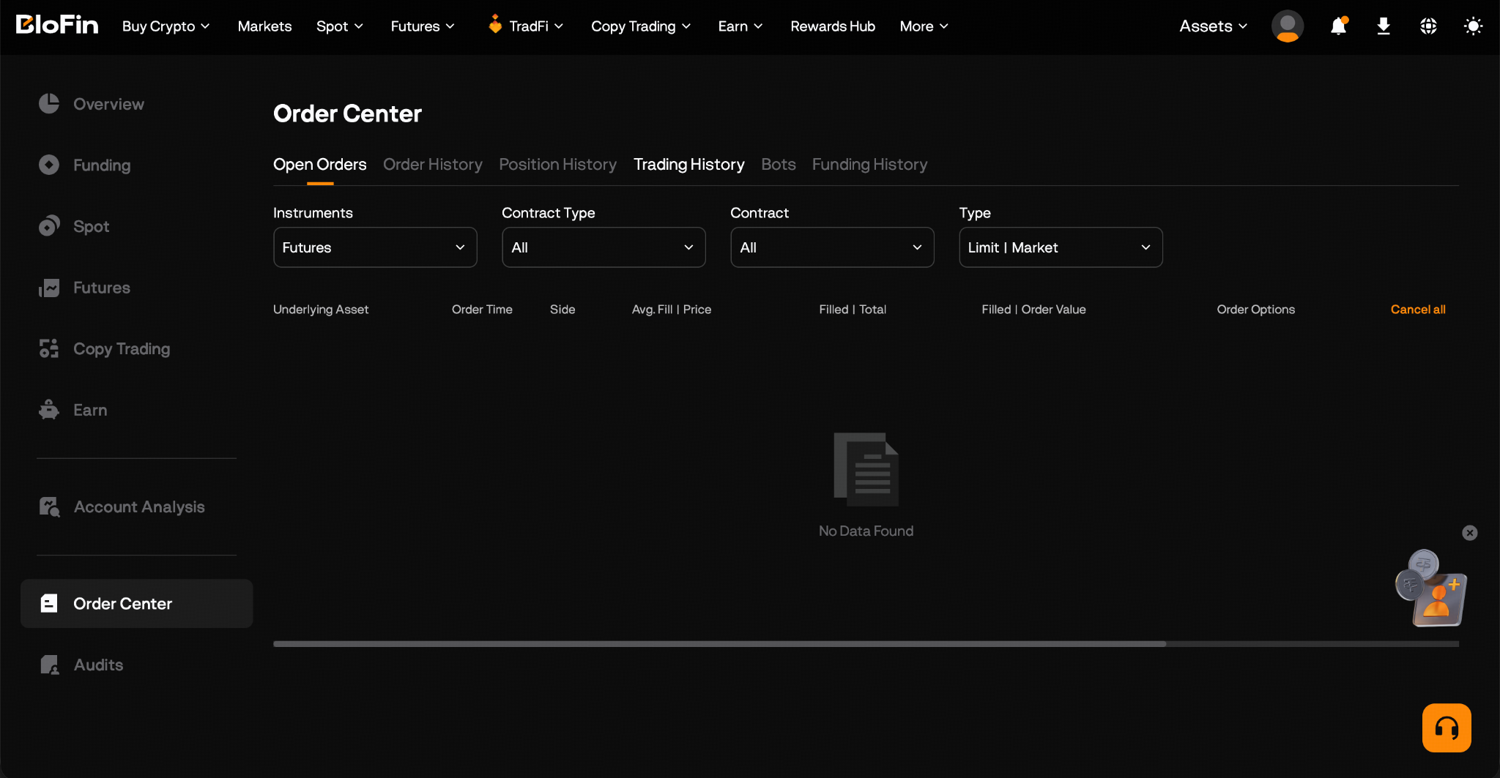
Step 3: Under Type, choose Funding Fee.
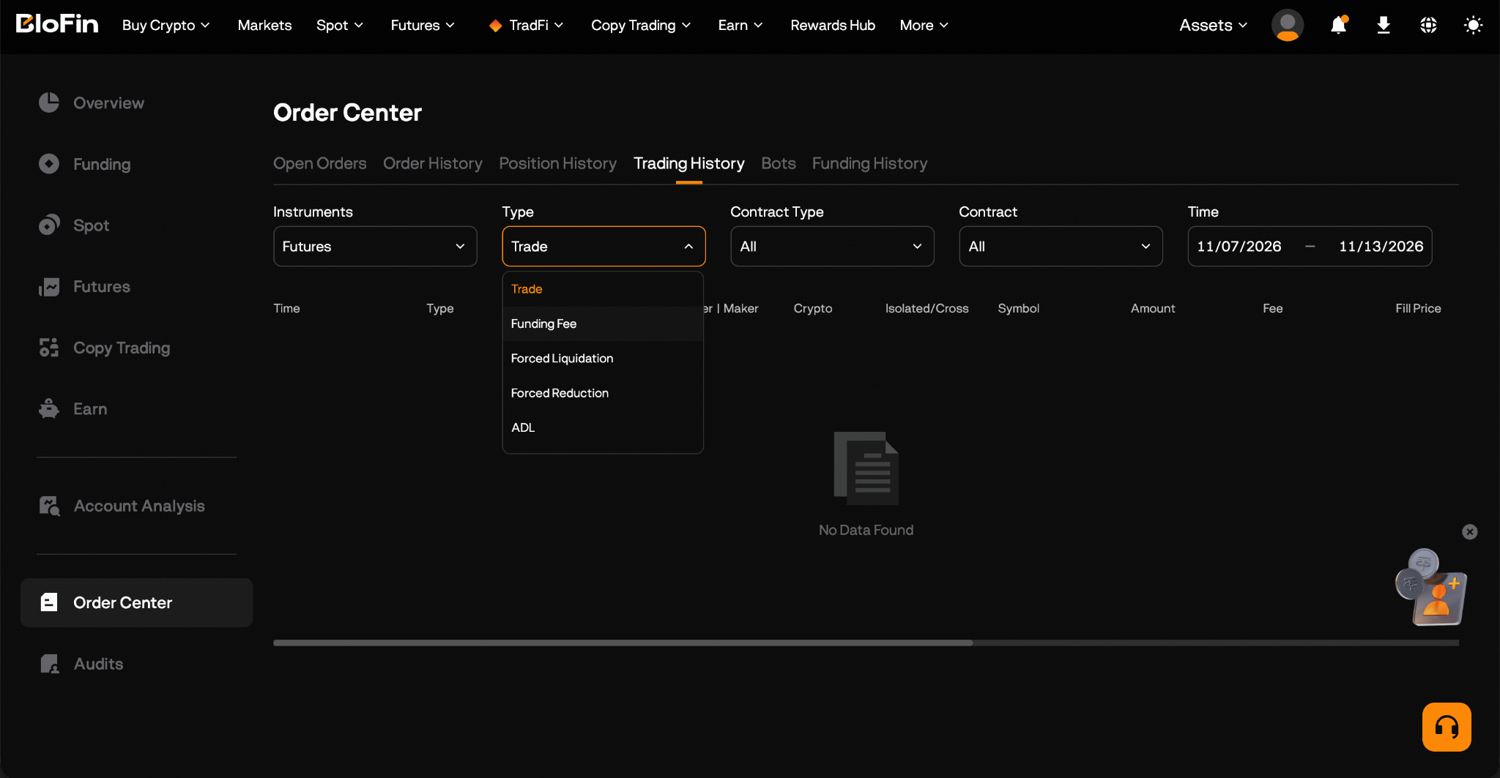
Step 4: Set the Contract Type, Contract and Time range to the period you want (source: BloFin, How to check my funding fees).
Those records cover only your own positions. The PLTRUSDT funding history page lists every past settlement with its time and rate, whether or not you held a position.
Looking to trade Palantir? To get started, you'll need to first create a BloFin account, fund your account with cryptocurrency, and go to the PLTRUSDT Perpetual trading page.

Frequently asked questions
Does BloFin keep the funding fee on the PLTR perpetual?
Funding goes from the holders on one side of the contract to the holders on the other. BloFin's help pages describe funding fees as periodic payments between long and short position holders that BloFin does not charge as a trading fee (source: BloFin, How to check my funding fees). Trading fees are charged separately. BloFin's standard futures trading fee is 0.0200% of the trade value when your order adds liquidity as a maker and 0.0600% when it takes liquidity as a taker.
Does leverage change the funding fee on a PLTR perpetual position?
The fee stays the same at any leverage, because funding is worked out on the whole position value, however much margin backs it. What changes is the share of your margin it takes, since higher leverage on a futures position shrinks the margin behind the same position. Take a 4 PLTR position worth 689.88 USDT at the November 11 mark price. The 12AM UTC settlement on November 11, 2026 (7PM ET on November 10) cost it 0.08 USDT, which was 0.12% of the margin at 10x and 0.25% at 20x. The median thirty days from February 9 to November 11, 2026 came to 3.16% of a 10x margin (source: BloFin PLTRUSDT funding history).
Does the funding rate shown before a PLTR perpetual settlement change?
Yes, it can change right up to the settlement. For the 4PM UTC (11AM ET) settlement on November 3, 2026, BloFin's market data showed −0.0005% at 8.35AM UTC (3.35AM ET) and +0.00003% at 10.04AM UTC (5.04AM ET), and the rate then settled at +0.0008% (source: BloFin PLTRUSDT market data, BloFin PLTRUSDT funding history). The rate that counts is the settled one, which is the figure the funding history keeps.
Can PLTR perpetual funding settle more often than every eight hours?
BloFin's funding rules list settlement periods of eight, four, two and one hours across its perpetual contracts, and PLTRUSDT's interval is eight hours. The same rules say BloFin may change the settlement timing in real time as market conditions require, and that "the actual fee assessment might span a minute" (source: BloFin funding rate rules, BloFin PLTRUSDT market data). Every PLTRUSDT settlement from February 9 to November 11, 2026 came exactly eight hours after the one before.
Does the PLTR perpetual funding rate jump after Palantir earnings?
It has barely moved after any of the three reports since the contract listed. SEC EDGAR accepted the Palantir results filings at 4.06PM ET on May 4 and August 3, 2026 (8.06PM UTC) and on November 2, 2026 (9.06PM UTC) (source: SEC EDGAR, May 4 filing, SEC EDGAR, August 3 filing, SEC EDGAR, November 2 filing). The first settlement after each, at 12AM UTC (8PM ET in May and August, 7PM ET in November), printed −0.0003%, −0.0009% and −0.0017%, and neither of the two settlements after each was larger than 0.0025% in size. The biggest rate of a report week came the evening before one, +0.5859% at 12AM UTC on May 4 (8PM ET on Sunday, May 3) (source: BloFin PLTRUSDT funding history).
Researched and written by the BloFin Academy editorial team with AI-assisted drafting. All facts independently verified. Primary sources include the Palantir results filings on SEC EDGAR, Nasdaq's daily price table for Palantir and its trading-hours and holiday page, NIST's daylight saving time rules, iShares' guide to perpetual futures and the paper "Fundamentals of Perpetual Futures". BloFin facts come from its funding rate rules, its funding fee records guide, its stock futures notice, its index, mark and last price page, its PLTRUSDT contract details and its PLTRUSDT funding history and market data, current as of November 11, 2026.
Nothing in this article constitutes financial advice, and nothing in it is a recommendation to buy, sell or hold Palantir in any form. A PLTRUSDT long pays funding at every settlement where the rate is positive and a short pays whenever it is negative, at up to 3% of the position's value per settlement. The largest rates so far came while Nasdaq was closed for weekends and holidays, and leverage makes each payment a larger share of your margin. Past funding rates do not indicate future ones. Do your own research and consider your risk tolerance before you trade on BloFin.