
A share price can drop sharply on a day when the company behind it says nothing at all. Buyers and sellers are changing their minds about the future on those days, and news sites rush to explain the move while the market is still open.
Those quick explanations often disagree with each other. One site blames an election, another blames slower bookings and an automated headline blames a small share sale by a director. Many are written hours before the closing price exists, which leaves the reader to work out which account deserves any trust.
A better way to read a sharp fall is to set it beside earlier ones. Comparing each move with a broad stock fund, the company's filings and what named outlets reported shows which reasons come up more than once and where the accounts disagree.
Palantir Technologies (PLTR) fell sharply on November 5, 2026, in a sell-off that outlets tied to AI politics, slower bookings and defense budgets. Its other big moves of 2026 have their own reported reasons, and some of those were disputed at the time. On BloFin, the PLTRUSDT Perpetual lets you trade that price through a USDT-settled perpetual contract, which fell that day too and has risks of its own.
Why is Palantir stock down?
Palantir stock is down 9.77% for 2026 and 23.28% under its October 9 record close, after a 9.73% fall on November 5, 2026 capped eight lower closes in a row. The streak ended the next day, when the stock rose 3.48% to $160.38 (source: Nasdaq PLTR historical data). Outlets gave overlapping reasons for the November 5 fall: an AI sell-off after the US midterm elections, slower contract bookings and worries about defense budgets. TIKR reported no company news that day, and each outlet weighted those reasons differently (source: Yahoo Finance, Benzinga, TIKR).
The stock closed at $154.99 on November 5, down from $171.70 the day before on volume of 50,014,330 shares, a little under the 53,062,480 shares traded on November 3. Only February 4 brought a bigger one-day fall in 2026. The eight lower closes in a row took 22.05% off the October 26 close of $198.84, and the November 5 close was 25.86% under the record close of $209.05 set on October 9 (source: Nasdaq PLTR historical data).
QQQ's fall is the other number that matters here. The QQQ fund, which follows the Nasdaq-100 index, dropped 6.49% that day, a move about two-thirds the size of Palantir's (source: Nasdaq QQQ historical data). Yahoo Finance and TIKR described a sell-off in AI stocks, and Yahoo Finance reported that a software fund fell less than half as much as a chip fund (source: Yahoo Finance, TIKR). QQQ's fall is hard to separate from that AI selling, so its size alone cannot settle how much of Palantir's fall came from elsewhere.
Reported reasons for Palantir's November 5 fall
Reports on the November 5 fall named four reasons: an AI sell-off after the midterm elections, slower contract bookings, possible cuts to defense budgets and a high valuation. These overlap, and no outlet can show which reason drove which sale. The outlets also differ on which one mattered most, so each account carries its own source.
Yahoo Finance treated the fall as political and aimed at software's AI winners. It reported that Democrats won both chambers of Congress after a campaign in which candidates in both parties attacked AI data centers. In its account, that worry spread from chipmakers to the software names most tied to the AI build-out. The same report shows the selling was selective, since Palantir and CrowdStrike fell nearly 10% while Salesforce and Adobe lost 2% or less. One AI software stock went the other way, as AppLovin jumped 31% on its own strong results (source: Yahoo Finance).
Benzinga put more weight on Palantir's own numbers. It said investors were weighing slower growth in new contracts along with political risk to military spending. It also passed on a Politico report from October 30 that the Pentagon was preparing for a possible $400 billion cut to a proposed $1.5 trillion budget (source: Benzinga). Benzinga also quoted Direxion's Ryan Lee, who called the stock "priced to perfection," which is the valuation argument in a single phrase.
TIKR reported that Palantir had no news of its own and argued that AI stocks were being marked down as a group. Its evidence was a comparison between two companies. Lockheed Martin, a defense company, fell about 7% on November 4 and was down about 2% during the November 5 session as TIKR wrote, when the AI software company Snowflake was down 6% (source: TIKR).
MarketBeat ran the odd one out, an automated-style headline linking the fall to insider selling (source: MarketBeat). The Form 4 behind that headline shows a director selling 1,358 shares, which gives that headline little support.
Why Palantir stock fell after beating earnings
Palantir stock fell after beating earnings as analysts pointed to a slowdown in new contract bookings (source: CNBC). Total contract value, the lifetime worth of deals signed in a quarter, grew 6% in the third quarter of 2026 after growing 49% in the second, while revenue rose 96% (source: Palantir Q3 2026 earnings release, Palantir Q2 2026 earnings release).
The timing is easy to get wrong. On November 2, the day of the report, the stock closed down 3.13% at $178.34 (source: Nasdaq PLTR historical data). Palantir released its results after the market closed that day, so the November 2 fall came before anyone trading in the regular session could have read them (source: Benzinga).
November 3 then told a milder story. The stock closed at $175.40, down 1.65%, on a day QQQ rose 0.62% (source: Nasdaq PLTR historical data, Nasdaq QQQ historical data). Over those two sessions Palantir lost 4.73% while QQQ lost 0.75%, so QQQ's fall was far smaller beside Palantir's than it was on November 5 (source: Nasdaq PLTR historical data, Nasdaq QQQ historical data).
One number analysts singled out was US commercial bookings. They reached $1.5 billion, up 11%, after a record $2.1 billion and growth of 153% a quarter earlier (source: Palantir Q3 2026 earnings release, Palantir Q2 2026 earnings release, CNBC). The headline figures in Palantir's earnings were strong, with revenue up 96%. Revenue counts sales earned in the quarter, while bookings count deals signed for later years, so a slowdown in bookings can show up before any slowdown in revenue does.
Analysts offered a reason that may make the slowdown look worse than it is. Goldman Sachs said the company tied some of it to shorter contract lengths, and Piper Sandler said it believed the 11% was a one-off effect of those lengths (source: CNBC). A one-year deal adds less to contract value than a three-year deal with the same customer, even when the yearly spending is identical. Only the next few reports can show whether those analysts are right.
Palantir stock's big moves of 2026 and their reported reasons
Palantir stock's big moves of 2026 ran in both directions, from an 11.62% fall on February 4 to a 29.45% rise on August 4. Setting each move beside the QQQ fund shows that most large falls came on days QQQ fell far less, which makes November 5 unusual, since QQQ fell sharply with it (source: Nasdaq PLTR historical data, Nasdaq QQQ historical data).
Twelve sessions in 2026 moved the stock 7% or more either way, and five other moves are listed for their size or a specific reported reason. Each move runs from one Nasdaq close to the next, and each reason is what a named outlet reported at the time, which can differ from what truly drove the selling (source: Nasdaq PLTR historical data, Nasdaq QQQ historical data).
2026 date | Palantir | QQQ | Reason reported |
|---|---|---|---|
February 4 | -11.62% | -1.75% | Valuation worries and a critical hedge fund letter, despite strong results and two upgrades to Buy (source: Motley Fool) |
April 9 | -7.30% | +0.68% | Michael Burry's post the day before, saying Anthropic was "eating Palantir's lunch" (source: Yahoo Finance on Burry) |
April 23 | -7.24% | -0.56% | ServiceNow's post-report fall dragged on software stocks (source: 24/7 Wall St. via Yahoo Finance) |
May 5 | -6.93% | +1.30% | New contracts grew 61%, and the raised sales growth forecast of 71% sat under the quarter's 85% (source: Motley Fool on May 5, Palantir Q1 2026 earnings release) |
May 28 | +8.17% | +0.84% | Snowflake's report set off a software and AI rally (source: 24/7 Wall St.) |
May 29 | +9.21% | +0.37% | Dell's results supported its AI partnership with Palantir (source: 24/7 Wall St.) |
June 16 to 25 | -20.37% | -3.71% | No single reason widely reported |
July 1 | +7.77% | -1.52% | No single reason widely reported |
July 27 | +7.00% | -0.31% | No single reason widely reported |
July 28 | -6.08% | -0.97% | Cleveland Research hinted at weak commercial spending (source: Motley Fool via Yahoo Finance) |
August 4 | +29.45% | +3.40% | Second-quarter results beat forecasts and the 2026 outlook rose (source: TIKR on August 4, Palantir Q2 2026 earnings release) |
August 7 | +10.32% | +1.17% | No single reason widely reported |
September 2 | -5.81% | +0.23% | Google DeepMind's restricted cyber AI model, though the report said it may only have set off a pullback already brewing (source: Investing.com via Yahoo Finance) |
September 3 | +7.71% | +1.19% | No single reason widely reported |
October 16 | -7.22% | -2.50% | Fell alongside a software sell-off, with 43 of 45 stocks in one basket falling as the report was written (source: Yahoo Finance on October 16) |
November 3 | -1.65% | +0.62% | Analysts pointed to slower bookings in a report that beat forecasts (source: CNBC) |
November 5 | -9.73% | -6.49% | A sell-off in AI stocks after the midterms, slower bookings and defense budgets, as reported (source: Yahoo Finance, Benzinga) |
A Palantir fall beside a QQQ rise points away from broad selling, while a fall in both leaves the cause open.
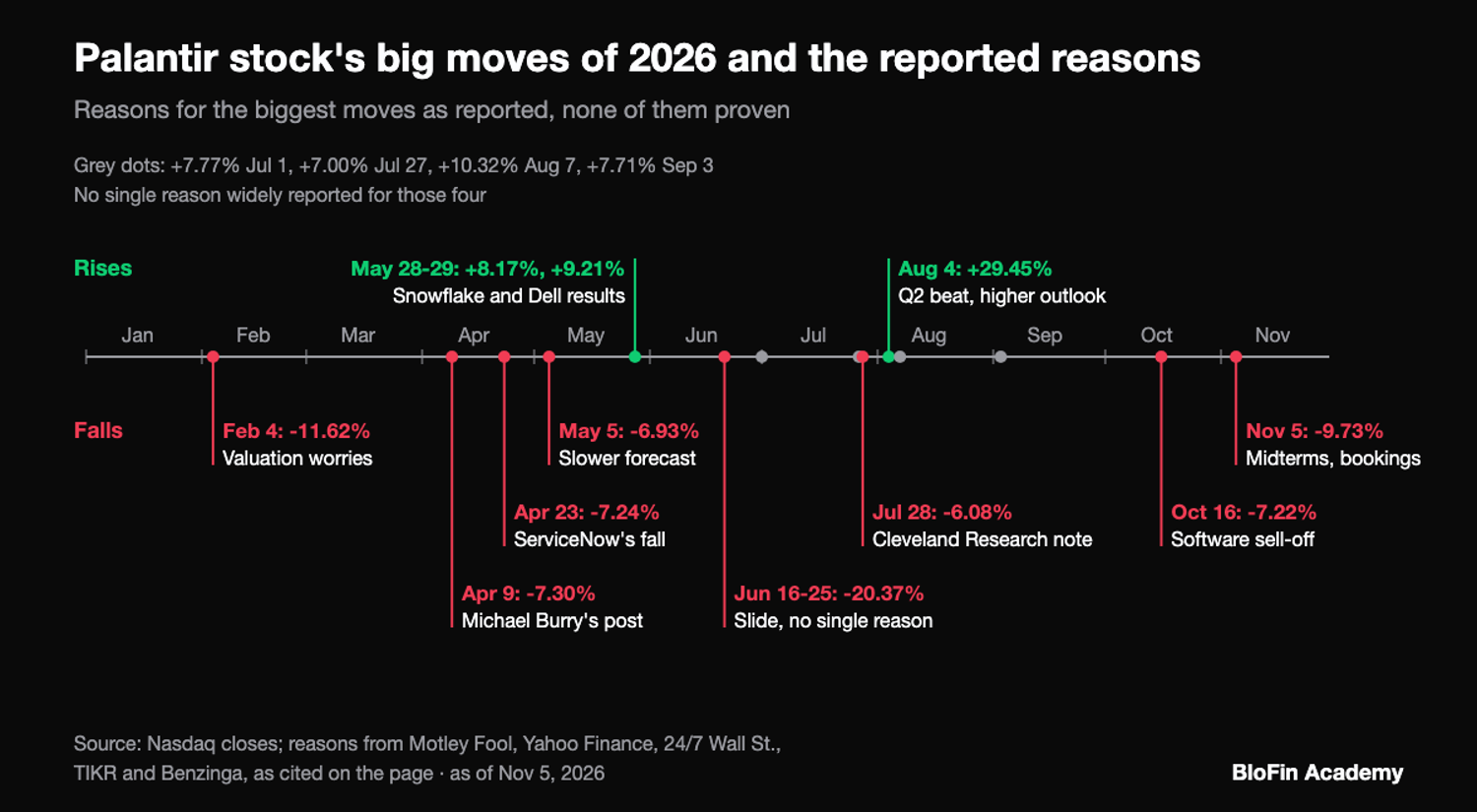
From January 5 to November 5, Palantir fell 5% or more on 17 sessions. QQQ rose on seven of those days and dropped 2% or more on only three: October 16, October 30 and November 5 (source: Nasdaq PLTR historical data, Nasdaq QQQ historical data). The link also runs the other way. QQQ fell 2% or more on ten sessions in 2026, and Palantir closed lower on all ten, though by 5% or more on only three. No single reason for the October 30 fall of 6.27% has been widely reported, and QQQ lost 3.47% that day. The June slide took 20.37% off the stock in seven sessions, while QQQ lost 3.71%, and its worst day, June 22, closed 6.98% lower with QQQ down 0.36%.
The July 27 gain was followed the next day by the fall tied to Cleveland Research. The largest fall also shows how quickly a first reaction can reverse. The stock rose 6.85% on February 3, the first session after its fourth-quarter report, and then lost 17.65% across the next two sessions (source: Nasdaq PLTR historical data). Anyone reading only the first day's headline would have missed what came next.
What moves Palantir stock?
What moves Palantir stock, in outlets' accounts of its 2026 sessions, is a short list of repeating events. They have pointed to company reports, valuation worries, budget headlines, short-seller posts, worries about rivals, partner results, research notes and swings in AI and software stocks, and some of these have also pushed the stock up.
Earnings reports and bookings
A company report is a regular event for this stock, since it can reset what buyers expect from the next few quarters. The May 5 fall shows the downside. Motley Fool pointed out that new contracts grew 61%, and that even the raised sales forecast of 71% growth for the year sat under the quarter's 85%, which it gave as the reason for the selling (source: Motley Fool on May 5, Palantir Q1 2026 earnings release). The upside came three months later on August 4, when a beat and a higher outlook came with the year's largest gain (source: TIKR on August 4, Palantir Q2 2026 earnings release). A good result has been able to send this stock either way.
Valuation resets
A valuation reset is a fall that happens when investors lower what they will pay for a business, even while it keeps growing. Motley Fool described February 4 in those terms. Revenue was still growing quickly, yet a critical hedge fund letter and valuation concerns led investors to rotate out of the stock (source: Motley Fool). Investing.com made a similar point about the September 2 fall, writing that scrutiny of the stock's high valuation had already left it sensitive to news of competition (source: Investing.com via Yahoo Finance).
Insider sales
Insider sales get blamed in headlines, and the November 5 alert is one example. The filing shows director Lauren Friedman Stat sold 1,358 shares on November 2 at $186.29, worth $252,981.82, under a Rule 10b5-1 trading plan entered on February 11 (source: Stat Form 4). Such a plan sets up trades in advance. That sale also equals 0.0037% of the 37,183,890 shares that traded that day, and it happened three sessions before the fall it was attached to (source: Nasdaq PLTR historical data).
That sale was not a sell-to-cover, the automatic kind that pays tax when stock awards vest. One plan sale says little about what an insider thinks of the price.
Government budget headlines
Government budget news can move this stock because public customers are a large part of its sales. US government customers brought in $953 million of $2.313 billion in the third quarter, or 41%, and US commercial revenue of $984 million passed that figure (source: Palantir Q3 2026 earnings release). Benzinga linked the Politico report on Pentagon planning to the November 5 fall. TIKR drew the opposite lesson from the same 41%, writing that a tighter budget reaches the smaller part of Palantir's sales and that AI valuations were the bigger force that day (source: Benzinga, TIKR).
TIKR also noted that Congress sets the Pentagon's budget and that the $1.5 trillion request compares with the $901 billion currently approved. Jefferies expects something near the House's plan of about $1.15 trillion, which would still be roughly 28% more than the current budget (source: TIKR).
Defense news has also been credited with a rise. Barchart wrote in mid-March that the stock had climbed about 16.3% in a month, helped by the US-Iran war and rising expectations for defense spending (source: Barchart via Yahoo Finance).
Short-seller reports
A short seller profits when a stock falls, so a famous one saying so can move the price within a day. The Burry post in April fits this pattern. Yahoo Finance reported a fall of as much as 8% the day after the post, as investors worried about competition from Anthropic, and the Nasdaq close for April 9 showed 7.30% (source: Yahoo Finance on Burry, Nasdaq PLTR historical data). The stock had also lost 6.20% on April 8, the day of the post, and it closed 9.40% higher five sessions after April 9. A high price and reliance on government budgets are two of the risks in Palantir stock.
Competitors and partner results
A rival can move the stock because it raises doubts about how long Palantir can keep its lead. Michael Burry argued in April that Anthropic offers an easier and cheaper product for businesses (source: Yahoo Finance on Burry). Investing.com tied the September 2 fall to Google DeepMind's cyber AI model, limited to government authorities, critical infrastructure operators and software maintainers, while saying it may only have set off a pullback already brewing (source: Investing.com via Yahoo Finance). Partner results can help too, as the Dell results did on May 29, and the Snowflake report had lifted software stocks the day before (source: 24/7 Wall St.).
Independent research notes
Research firms survey a company's customers and partners, in work known as channel checks, and what they report can move a stock without any word from the company itself. On July 28, Motley Fool reported, a Cleveland Research hint of weak commercial spending came before a 6.08% fall. Oppenheimer's Param Singh disputed it, so the evidence pointed two ways at once (source: Motley Fool via Yahoo Finance). The company's own numbers arrived days later, when US commercial bookings came in 153% higher and the stock rose 29.45% (source: Palantir Q2 2026 earnings release, Nasdaq PLTR historical data).
Analyst upgrades
An upgrade is one analyst firm's opinion that a stock deserves a better rating, and it gives no protection on the day. Two upgrades to Buy around the February report did not stop the stock losing 11.62% on February 4 (source: Motley Fool). Analyst notes can also lean against a fall, as Piper Sandler's did in November when it called the 11% bookings figure a one-off (source: CNBC).
AI and software sector swings
A sector swing is when money leaves a whole group of software or AI stocks at once, which can pull Palantir down on a day it has good news of its own. On April 23, 24/7 Wall St. reported that ServiceNow's fall after its results raised concerns across software stocks, and the stock fell 7.24% despite a fresh $300 million Department of Agriculture contract (source: 24/7 Wall St. via Yahoo Finance). On October 16, a Yahoo Finance basket of 45 software stocks had 43 falling as it wrote, with combined losses over $260 billion (source: Yahoo Finance on October 16). Barchart counted fears of an AI bubble among the pressures on the stock in March (source: Barchart via Yahoo Finance). The late-May jump shows the reverse, when Snowflake's report helped set off a software and AI rally (source: 24/7 Wall St.).
AIPCon
AIPCon is Palantir's flagship customer event. The ninth one took place on March 12 (source: Barchart via Yahoo Finance). The stock rose 1.25% that day while QQQ fell 1.72%, then gave back 1.66% the next day (source: Nasdaq PLTR historical data, Nasdaq QQQ historical data). That is a modest reaction, and a single event can show only so much.
Palantir stock after earlier big falls
Palantir stock went both ways after its earlier big falls of 2026. Of the 15 falls of 5% or more from January 2 with 20 later sessions to measure by November 5, it closed higher 20 sessions later after nine of them and lower after six. The results ran from a 17.38% loss to a 40.64% gain, which describes past moves and predicts nothing (source: Nasdaq PLTR historical data).
Five sessions on, the picture was more even still, with 7 of 16 falls followed by a higher close and 9 by a lower one (source: Nasdaq PLTR historical data). Some individual cases show why these averages tell you so little. The February 4 fall was followed by a 9.41% gain over 20 sessions. The June 2 fall was followed by a 17.38% loss over the same stretch, on the way into the June slide. The largest gain came after the July 22 fall, and the 29.45% jump on August 4 landed inside that window. The May 5 fall, which followed a report, was followed by a 4.63% gain over 20 sessions.
Each of those periods contained a different event, so they tell you nothing about what comes next. They do show that a sharp fall has not been a reliable signal in either direction this year, and they cover a small sample from one stock. A fall also takes a larger rise to undo, since a Palantir share would need to gain 10.78% from its November 5 close to get back to $171.70.
PLTRUSDT during Palantir's November 5 fall
The PLTRUSDT Perpetual fell 10.61% across the UTC day of November 5, from 171.5 to 153.3 USDT, on BloFin's own daily candles. It follows the stock in its own market, and its percentages differ from the Nasdaq close because its day runs on UTC and includes hours when Nasdaq is shut.
Nearly half of the contract's fall came in one hour. The hourly candle from 2PM UTC went from 166.72 to 157.78 USDT, a 5.36% drop, on 345.9 PLTR of the day's 874.97 PLTR in volume, or 39.5% (source: BloFin PLTRUSDT market data). That hour includes the Nasdaq open at 9.30AM ET (2.30PM UTC), and a one-hour candle cannot show how much of the move came before or after it. The candles also record trades that took place, and they cannot show whether new orders were being accepted at the time.
The contract also keeps trading after the Nasdaq close. Its last trade stood at 157.09 USDT at 6.59AM UTC on November 6, about 2.47% over its 153.3 USDT daily close, hours before Nasdaq reopened (source: BloFin PLTRUSDT market data). That number is the last trade on BloFin, which can differ from what Palantir's shares do at the next open.
Leverage changes what a fall like that can mean. A 10x isolated position holds margin of about a tenth of its value. BloFin can reduce or liquidate a position when its margin ratio reaches 100%, and that ratio counts the maintenance margin the position must keep, so this can happen before the whole margin is gone. The test runs on the mark price, which can differ from the last trade, and these candles show last trades only.
Outside Nasdaq's regular hours and on weekends and holidays, orders on stock futures may be limited to reduce-only, which means they can only shrink a position (source: BloFin stock futures notice). A gap on the contract can arrive in those hours with little chance to act.
If you want to see how the contract reacts to the next headline, its PLTRUSDT Perpetual page shows the contract's price, mark price and funding rate in one place.
How to check why Palantir stock is down on any day
To check why Palantir stock is down on any day, start with the QQQ fund, then the company's filings, then at least two named outlets. The check needs only free public pages, takes a few minutes and works for any listed stock, though it can narrow the possible reasons without proving one of them.
Start with QQQ's move on Nasdaq's historical page. If QQQ fell too, compare a software fund such as IGV, because QQQ is heavy in technology and can carry the same selling, and be wary of any story built only on Palantir. If QQQ rose, look for company or sector news.
Next, open Palantir's filing list on the SEC's EDGAR site. An 8-K is the form companies use to announce major events, so a fall with no new 8-K points away from a company announcement. For any insider sale, read the Form 4 and check two things: the box showing a pre-arranged plan and the size against that day's volume.
Then read two named outlets and note where they differ, along with the time they published. Benzinga's November 5 article had the stock down 9.10% at 12.30PM ET (5.30PM UTC), and the close turned out 0.63 percentage points worse (source: Benzinga, Nasdaq PLTR historical data). A site's automated headline is a lead to check, and a date match alone is weak evidence of a cause.
Two dates show how the method works. On May 5 QQQ rose 1.30% while Palantir fell 6.93%, a new report was on file and an outlet pointed at slower contract and forecast growth, so the accounts point at the company. On November 5 QQQ fell 6.49%, TIKR reported no company news and the outlets disagreed, so the accounts describe a sector-wide fall with several possible reasons on top, none of them proven.
Looking to trade Palantir? To get started, you'll need to first create a BloFin account, fund your account with cryptocurrency, and go to the PLTRUSDT Perpetual trading page.
Frequently asked questions
How much market value did Palantir lose on November 5?
About $40.3 billion, from $413.7 billion to $373.4 billion, counting the 2,409,497,474 shares of all three classes listed on the latest quarterly filing's cover. Yahoo Finance put the loss at about $40 billion (source: Nasdaq PLTR historical data, Palantir Q3 2026 Form 10-Q, Yahoo Finance). On the 2,306,705,341 Class A shares alone, the same close comes to $357.5 billion.
Did Palantir announce anything on November 5?
TIKR reported that Palantir had no news of its own that day. The company's last big announcement was on November 2, when it beat its own forecast and raised its 2026 revenue guidance to $8.53 billion (source: TIKR, Palantir Q3 2026 earnings release). To check any date yourself, open the company's filing list on the SEC's EDGAR site.
What is Palantir's 200-day moving average?
It was $153.53 at the November 6 close, the average of the last 200 Nasdaq closes, which left the stock 4.46% over it (source: Nasdaq PLTR historical data). Traders watch this moving average as a rough line between a long uptrend and a long downtrend. On November 5 the stock had closed just 0.93% above it, at $154.99 against $153.56, which Benzinga and Yahoo Finance both noted (source: Benzinga, Yahoo Finance).
Why did Palantir stock jump in August 2026?
TIKR tied the jump to the second-quarter report, with revenue of $1.9 billion, up 93% (source: TIKR on August 4, Palantir Q2 2026 earnings release). The stock rose 29.45% on August 4 on 175,034,700 shares. It added another 10.32% on August 7, a gain with no single reason widely reported (source: Nasdaq PLTR historical data).
Is Palantir stock down for the year?
Yes, by 9.77%, from a $177.75 close on December 31, 2025 to $160.38 on November 6, 2026. The stock has still risen 49.51% from its lowest 2026 close of $107.27 on June 25, and it set its record close on October 9 (source: Nasdaq PLTR historical data).
Researched and written by the BloFin Academy editorial team with AI-assisted drafting. All facts independently verified. Primary sources include Palantir's earnings releases for the first three quarters of 2026, its third-quarter Form 10-Q and a Form 4. Price data comes from Nasdaq, with reporting from Yahoo Finance, Benzinga, TIKR, MarketBeat, CNBC, The Motley Fool, 24/7 Wall St., Investing.com and Barchart. BloFin facts come from its stock futures notice and its own PLTRUSDT Perpetual data, current as of November 10, 2026.
Nothing in this article constitutes financial advice, and nothing in it is a recommendation to buy, sell or hold Palantir in any form. Palantir's stock lost 22.05% over eight sessions to November 5, 2026, and outlets could only report reasons for that fall, which overlap and cannot be proven. The PLTRUSDT Perpetual fell 10.61% in one UTC day, more than the margin on a 10x isolated position, and its trading may be limited to reduce-only orders outside regular US hours. Past performance does not indicate future results. Do your own research and consider your risk tolerance before you trade on BloFin.