
Before you put money on any crypto exchange, two plain questions are worth asking. Is my money actually there, and could someone steal it? Exchange collapses and hacks have answered both questions badly for millions of people, so it makes sense to check before you trust a platform with your funds.
Both questions are back in the news. On October 29, 2026, Binance said someone had sent coins out of its wallets without permission, with an estimated total impact it put at around $6.3 billion. Binance said it would cover all losses from its SAFU fund and its own money, and that it found no sign that any wallet private key had leaked. It also paused deposits and withdrawals while it ran security checks (source: Bitcoin.com News, October 29, 2026).
Blockchain analytics firm TRM Labs counted about $6.4 billion moved out of Binance wallets on ten blockchains, most of it in about 20 minutes. That is about four times the $1.5 billion taken from Bybit in February 2025. TRM says it is highly confident the attack came from TraderTraitor, a North Korean hacking group (source: TRM Labs, October 29, 2026). Early tallies by other analysts ran lower, at up to $5.8 billion, so the final number may still change as more facts come out (source: Bitcoin.com News, October 29, 2026).
A theft that big is a good reason to ask the same two questions about BloFin. BloFin's proof of reserves lets you check the first answer yourself, without taking the exchange's word for it. Its Fireblocks custody and the checks on every withdrawal answer the second.
Is BloFin safe?
BloFin is a crypto exchange that protects user funds with a 1:1 proof of reserves you can check yourself, Fireblocks custody for user assets, ISO 27001 security certification and account tools such as two-factor authentication and passkeys. No exchange is free of risk, so your own account security matters as much as the platform's.
Each of those measures answers a different question. Proof of reserves tells you whether your money is there, because you can confirm your balance is counted in the reserves BloFin holds. Custody, certification and monitoring decide whether someone could take it, because they control how BloFin's wallets are run and who can move funds out. The account tools cover the one gap the platform cannot close for you: someone logging in with your stolen password.
What makes a crypto exchange safe?
A crypto exchange is safe when it holds the assets it says it holds and keeps them out of reach of thieves, both outside and inside the company. These are two separate risks. An exchange can do well on one and still fail on the other.
The first risk is that the money is simply not there. That is what happened at FTX. Its founder, Samuel Bankman-Fried, took billions of dollars of customer deposits for other uses, according to the US Attorney's office in Manhattan, and was sentenced to 25 years in prison on March 28, 2024 (source: US Attorney's Office SDNY, March 28, 2024). Customers lost access because their deposits had already been spent; a hack was not what emptied the exchange. The defense against this risk is transparency, which in crypto means publishing reserves that users can check.
The second risk is theft. An exchange can hold every coin it owes and still lose a large amount if an attacker takes control of the systems that send withdrawals. The defense here is how the exchange stores coins, who can approve a transfer and how fast unusual activity gets spotted. A safe exchange needs both defenses.
Where do crypto exchange hacks happen?
Exchange hacks usually go after the hot wallet. That is the part of an exchange's holdings that stays connected to the internet, so customer withdrawals can be paid out quickly. Coins in cold storage sit in wallets whose keys are kept offline, so moving them takes extra approval steps. Those steps make cold storage safer, but not immune.
The October 29 theft at Binance hit the hot side. TRM Labs says the evidence points to a break-in at Binance's hot wallet signing system, the part that approves coins going out (source: TRM Labs, October 29, 2026). Binance's first findings suggest it may have started with a hacked engineer's laptop, which gave the attacker access to an internal service where they could send withdrawals without permission (source: Bitcoin.com News, October 29, 2026). Binance is still looking into how the attacker got in.
Cold wallets can be reached too, through the people and software that approve their transfers. The $1.5 billion taken from Bybit on February 21, 2025 came from what Bybit called its "ETH Multisig Cold Wallet", during a planned move to its hot wallet. The attackers had first hacked a developer machine at Safe, the wallet provider whose app Bybit's signers used, and disguised a malicious transaction as the routine transfer (source: BleepingComputer, February 26, 2025).
That is why exchanges split their holdings. They keep only what day-to-day withdrawals need in hot wallets, which limits how much a single break-in can reach, and hold the rest in cold storage with stricter approval rules. Hot and cold wallets compared explains the trade-off in more detail, and how exchange custody works shows how centralized exchanges run their wallets.
How does BloFin protect user funds?
BloFin protects user funds through five measures: a 1:1 proof of reserves, custody through Fireblocks, real-time transaction monitoring with Chainalysis, an ISO/IEC 27001 security certification and Payment Card Industry Data Security Standard (PCI DSS) certification for card payments. Each covers a different part of the risk, and BloFin has dated each one in its own notices.
Measure | What it covers | Announced |
|---|---|---|
Fireblocks custody | Custody of user assets and cold wallet management | Since launch, per a December 20, 2023 notice |
Proof of reserves upgrade | BTC, ETH and USDT reserve ratios and wallet addresses on the Proof of Reserves page | February 2, 2024 |
Chainalysis monitoring | Real-time monitoring of crypto transactions | June 12, 2024 |
ISO/IEC 27001 | Information security management, with regular audits | April 17, 2025 |
PCI DSS | Security of card payment data | September 21, 2025 |
Proof of reserves
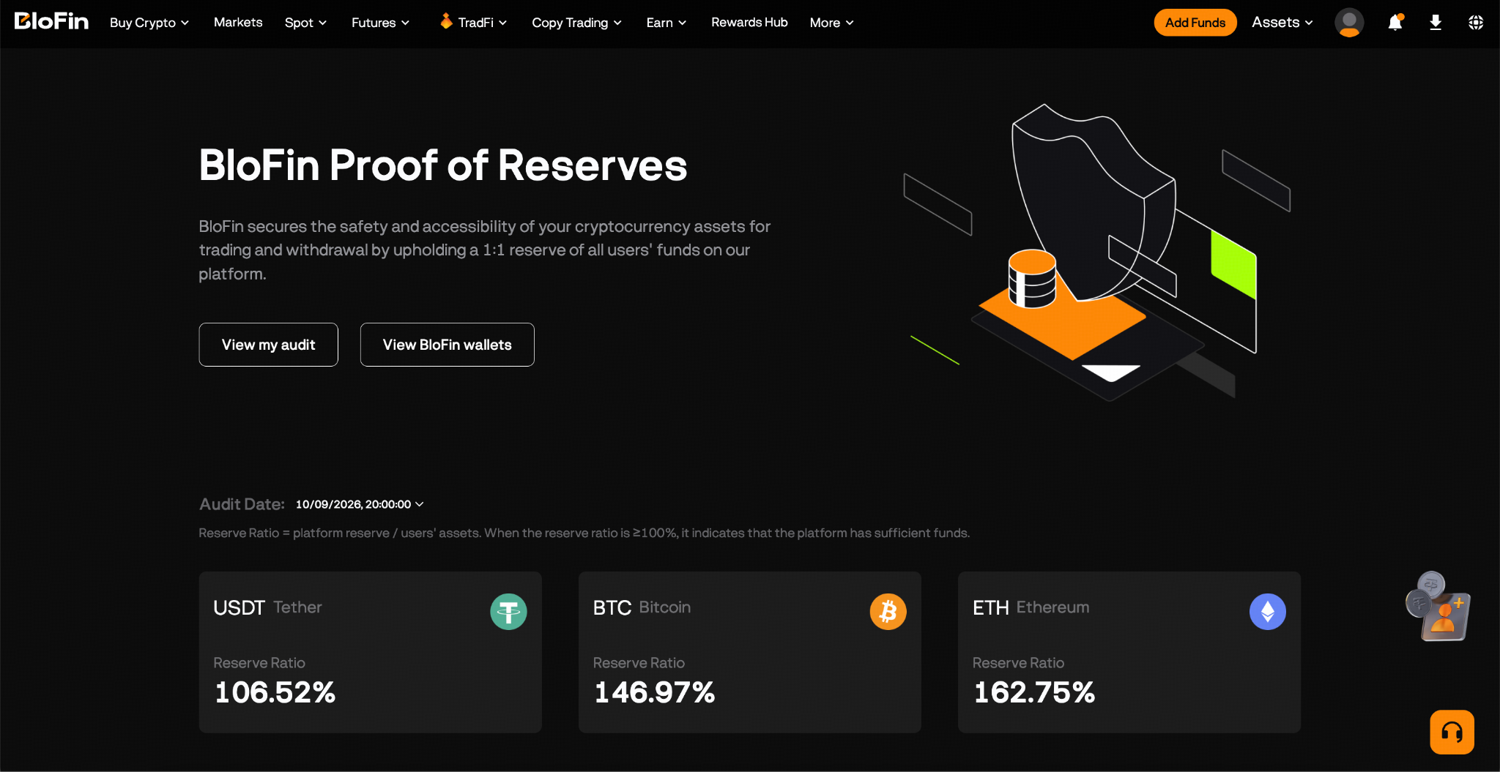
BloFin says it keeps a 1:1 reserve of all user funds, which means every coin in a user account is matched by the same coin in BloFin's wallets (source: BloFin Help Center, Proof of Reserves). Since an upgrade on February 2, 2024, the Proof of Reserves page has shown reserve ratios for BTC, ETH and USDT and listed BloFin's wallet addresses. Each user can also view a snapshot of their own assets for every audit period (source: BloFin, February 2, 2024). A ratio above 100% means BloFin holds more of that coin than its users have deposited.
The check uses a Merkle tree, a structure that combines every user's balance into a single digital fingerprint. You can confirm your own balance is included without seeing anyone else's. If any balance in the tree were changed, the fingerprint would change with it. BloFin also states that customer assets sit in separate accounts from its company assets and are not lent out or staked without the customer's permission, as its guide to BloFin's proof of reserves explains.
Fireblocks custody
BloFin has used Fireblocks since its first day of business. In BloFin's own words on Fireblocks' customer page, Fireblocks provides secure custody for users' assets and is built for managing cold storage (source: Fireblocks, BloFin customer story). BloFin's help center also describes the partnership as dating from launch (source: BloFin Help Center, December 20, 2023).
For a trader, the practical point is that BloFin's cold storage runs on an outside custody platform instead of wallet software BloFin wrote itself, so its security does not rest on BloFin's own engineers alone. Theft is still possible on any exchange, as the Bybit and Binance cases show, so custody is one layer of protection rather than a guarantee.
Security certifications and monitoring
BloFin announced on April 17, 2025 that it had been certified under ISO 27001, the international standard for managing information security, and said it would keep running regular audits and assessments (source: Decrypt, April 17, 2025). The standard covers how a company controls access to its systems, handles data and responds to incidents. On September 21, 2025, BloFin added PCI DSS certification, the card industry's standard for handling payment card data, which applies when you buy crypto with a card (source: CryptoSlate, September 21, 2025).
Since June 12, 2024, BloFin has used Chainalysis's crypto risk tools to monitor transactions in real time (source: Decrypt, June 12, 2024). This kind of monitoring flags deposits and withdrawals linked to known scams, hacks or sanctioned addresses. It helps an exchange avoid becoming a route for stolen funds.
How can you check BloFin's reserves yourself?
You can check that your own balance is included in BloFin's reserves in a few minutes, using the snapshot data BloFin publishes for every audit period. The check covers your futures (equity), funding, earn and copy trading (equity) accounts.
The reserve ratio on that page is simple arithmetic. Say you are reading the BTC line, and users hold 1,000 BTC in total across their accounts and BloFin's listed wallets hold 1,200 BTC. The ratio is 1,200 ÷ 1,000 = 120%, so every user's BTC is covered with 200 BTC to spare. A ratio under 100% would mean the wallets hold less than users are owed.
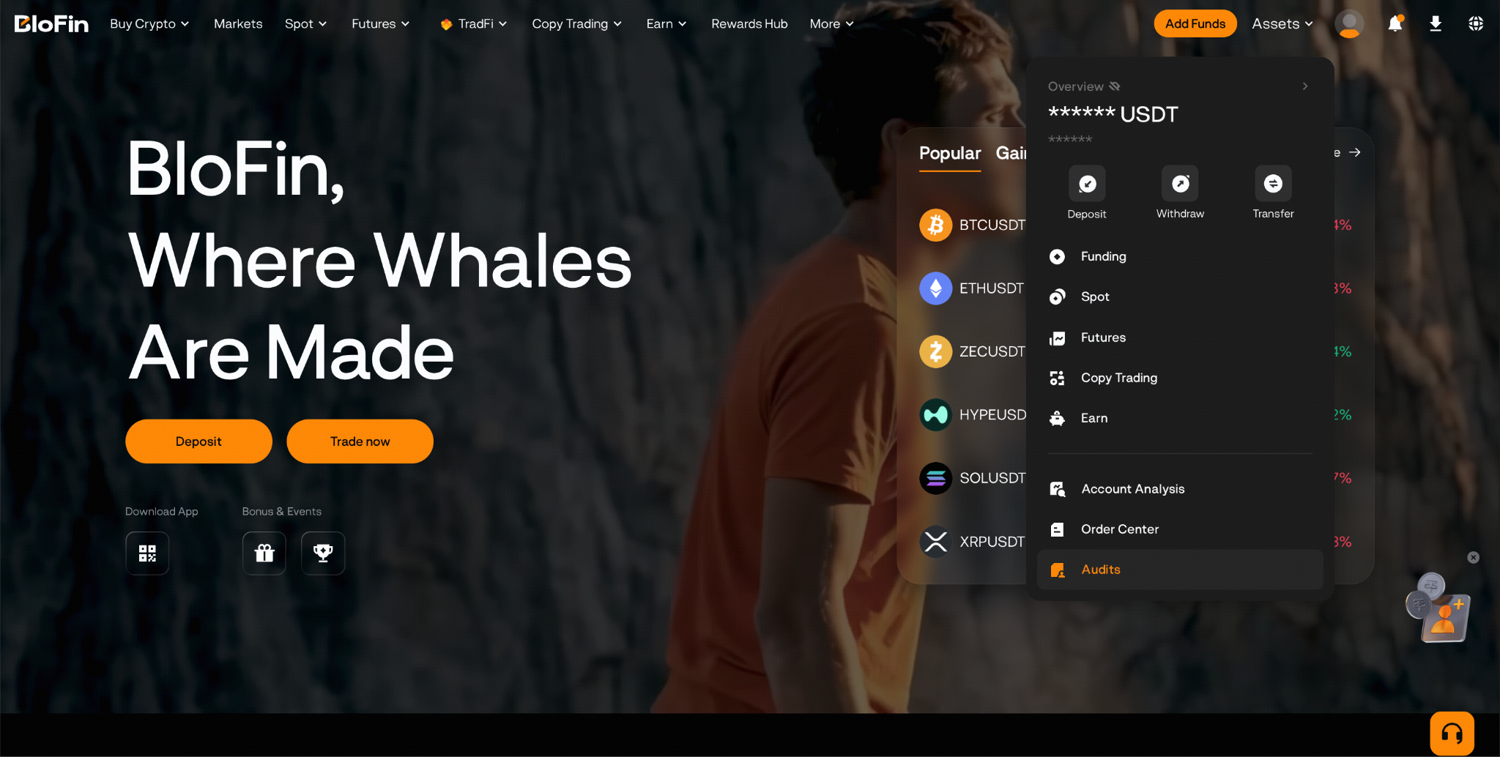
Step 1: Log in to your BloFin account, click Assets and select Audits from the drop-down menu.
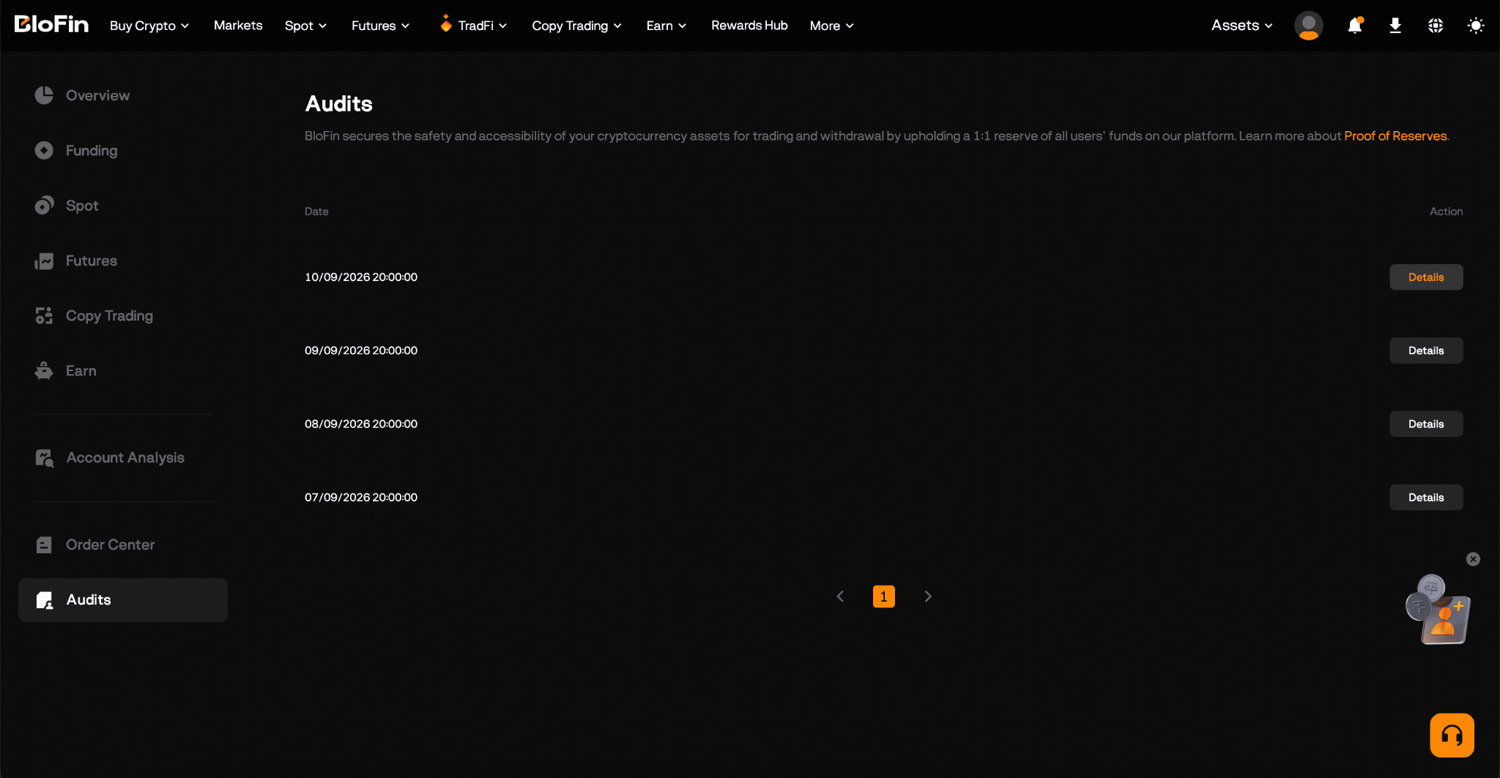
Step 2: Click the corresponding Details button of the latest report to view your asset data.
Alternatively, you may also head directly to the Proof of Reserves page and click View my audit.
A successful check tells you two things. Your balance is counted, and BloFin's published reserves cover the total for each listed coin on the snapshot date. It cannot tell you about debts or other obligations BloFin may have outside those wallets, because proof of reserves checks reserves against user balances, not against BloFin's other liabilities. That limit applies to every exchange's proof of reserves, so it helps to know exactly what the check proves.
The check covers the accounts you trade from. Margin for a futures position, such as one on the BTCUSDT Perpetual, sits in your futures account, so its equity is counted in every snapshot you verify. Once you are logged in, the Positions tab on the BTCUSDT Perpetual page lists your open positions and the margin behind each one.
How do you protect your own BloFin account?
You protect your own BloFin account by turning on two-factor authentication, adding a passkey, setting an anti-phishing code and using a password you use nowhere else. Platform security cannot stop someone who logs in with your own password and code, so these steps matter as much as anything the exchange does.
BloFin uses Google Authenticator for two-factor authentication, which asks for a six-digit code at every login and withdrawal. Passkeys go a step further. They let you log in with your fingerprint, Face ID or a security key, and they only work on the real BloFin website, so a fake login page cannot capture them. On BloFin, a withdrawal can leave only from your Funding Account, and only after security verification with an email code and your authenticator code or passkey, so a stolen password alone cannot send coins out. The anti-phishing code is a phrase you choose that appears in every genuine BloFin email, which makes fake emails easy to spot.
Here is why the layers matter. Say you reused your BloFin password on another site, that site is breached, and an attacker tries the password on BloFin. With Google Authenticator on, the login stops at the six-digit code the attacker does not have. With a passkey, there is no password step to abuse at all. And if the attacker emails you a fake "security alert" to get the code, the missing anti-phishing code gives it away.
BloFin's only official website is https://blofin.com. BloFin will never ask for your password, your Google Authenticator code or your seed phrase. How to secure your BloFin account walks through each of these tools step by step, including a list of fake BloFin domains to avoid.
What should you do if an exchange you use is hacked?
If an exchange you use is hacked, check its official website and verified social accounts for updates, ignore anyone who contacts you offering help, and wait for withdrawals to reopen before you move funds. Scammers move fastest in the first hours, when users are worried and searching for news.
Fake support messages and phishing emails tend to follow every large hack, because attackers know users will be looking for instructions. Do not click links in messages about the incident, and do not share your password or authentication codes. Treat any "recovery service" that asks for a fee as a scam. Phishing attacks in crypto shows the most common tricks.
Once things settle, look at how much you keep on any exchange. Money you trade with needs to be on the exchange. Coins you plan to hold for months or years are fully under your control only in a wallet where you keep the keys yourself. What is self-custody explains how that works and what responsibility comes with it.
No exchange can rule out a hack, and the Binance theft shows that even the biggest platform can be hit. What differs from one exchange to the next is how much of the risk you can check yourself. On BloFin, you can confirm your balance is counted in the latest proof of reserves snapshot, and you can protect your account with Google Authenticator, a passkey and an anti-phishing code. Keeping only the coins you trade on the exchange limits what any single break-in could reach. Together, those steps answer the two questions every exchange user faces: is my money there, and could someone else move it?
If you’re ready, you can create a BloFin account, fund your account with cryptocurrency, and set up Google Authenticator before your first trade on Spot or Perpetuals.
Frequently asked questions
How often does BloFin update its proof of reserves?
BloFin publishes a new snapshot for each audit period. Each user can view their own asset snapshot for every period on the Personal Asset Audits page, and the Proof of Reserves page shows the reserve ratios for BTC, ETH and USDT from the latest audit (source: BloFin, February 2, 2024). That means you can check your balance against more than one snapshot, not just the most recent one.
How do I withdraw crypto from BloFin to my own wallet?
Move the coins to your Funding Account first, because BloFin sends withdrawals only from there. Then go to Assets, select Withdraw, pick the coin and the network your wallet uses, paste your wallet address and enter the amount. Google Authenticator or a passkey must be set up before you can withdraw. How to make a withdrawal from BloFin covers networks and memo tags in detail.
What if I lose the phone with my Google Authenticator?
Use the backup key you saved when you first set up Google Authenticator to restore your codes on a new phone. If you did not save the backup key, you will need to go through BloFin's account recovery process by contacting support through blofin.com. This is why the setup steps ask you to store the backup key somewhere safe, away from your phone.
What do fake BloFin websites look like?
Fake BloFin sites copy BloFin's look to trick users into depositing funds. Domains that have been used include blofin.lol, blofintyu.top, blofincoin.com, blofinsign.com and blofin-ai.com. The only official site is https://blofin.com, so type the address yourself or use a bookmark instead of clicking links in messages or ads.
What happens to my funds if BloFin pauses withdrawals?
A withdrawal pause stops coins from leaving the exchange, but your balance stays in your account. Exchanges usually pause withdrawals during security checks or network problems and reopen them once the issue is fixed. During any pause, rely only on BloFin's official website and announcements, and ignore messages offering to speed up a withdrawal.
Researched and written by the BloFin Academy editorial team with AI-assisted drafting. All facts independently verified. Primary sources include BloFin's Help Center, announcements and Academy guides, Fireblocks, the US Attorney's Office for the Southern District of New York, BleepingComputer, TRM Labs and Bitcoin.com News, with BloFin's certification and monitoring announcements as published by Decrypt and CryptoSlate, current as of October 30, 2026.
Nothing in this article constitutes financial advice, and nothing in it is a guarantee that funds on any exchange, including BloFin, cannot be lost. Proof of reserves compares reserves with user balances on a snapshot date, not with an exchange's other liabilities, and crypto held on any exchange is exposed to platform and security risk. BloFin services are not available in restricted locations, including the United States. Do your own research and consider your risk tolerance before you trade on BloFin.