
For most of investing history, the most valuable phase of a company's growth has been off-limits to ordinary investors. The window between a startup's earliest funding rounds and its eventual public listing is often when a company like Stripe, SpaceX, Anthropic, OpenAI, or Polymarket is growing fastest, attracting the sharpest institutional money, and building toward a valuation that the public markets will eventually price at a premium. For most retail investors, that window has simply not been accessible.
Retail investors have historically been left to watch from the outside. By the time a company reaches its IPO, the bulk of the value creation has already occurred in the private markets. Early backers who got in at a $500 million valuation are selling into a $10 billion public debut. For everyone else, the open market is the only option, and the most attractive entry is already in the past.
BloFin Pre-IPO is built to close that gap. It is a token sale platform that gives eligible users economic exposure to high-growth private companies before a potential IPO, with a minimum subscription of 100 USDT and a secondary trading market after distribution. The structure is meaningfully different from simply buying shares, and understanding how it works is essential before participating.
What is BloFin Pre-IPO?
BloFin Pre-IPO is a revolutionary platform within BloFin that allows eligible users to gain early economic exposure to private companies via tokenized assets. It is not a brokerage. It does not give users direct ownership of equity. What it does is give users economic exposure to the potential upside of a private company's valuation, through a token structure backed by real underlying assets held by a third-party asset provider.
Each listing represents a separate project with its own subscription window, pricing, supply, and terms. Listings appear in advance so users can review the details before the subscription period opens.
The asset provider behind BloFin Pre-IPO is Realta, a third-party company that operates under a Special Purpose Vehicle (SPV) framework. BloFin distributes the tokens Realta issues; Realta manages the underlying assets. This distinction matters and is covered in detail below.
What are Pre-IPO tokens?
Pre-IPO tokens are digital tokens that provide economic exposure to a private company's equity value. They are not equity or shares. Holding a Pre-IPO token does not make you a shareholder in the underlying company and does not confer any of the rights that equity ownership typically includes.
Specifically, Pre-IPO tokens do not give holders voting rights in the underlying company. They do not entitle holders to dividends. They do not grant any direct equity stake or shareholder privileges. Holders have no governance participation in the underlying company and no direct claim against its assets.
What Pre-IPO tokens do provide is potential economic upside. If the underlying company successfully lists on a public exchange and its valuation at IPO is higher than the price you subscribed at, the proceeds from liquidating the position after the lock-up period are converted to USDT and distributed to token holders on a pro-rata basis. The token is, in effect, a claim on the economic outcome of that underlying equity position as managed through the SPV.
Tokens are issued on a 1:1 asset-backed basis. Realta holds the actual equity position in the private company; each token represents a proportional economic claim against that position as held within the SPV. There is no leverage and no synthetic construction involved.
Importantly, Pre-IPO tokens cannot be withdrawn from BloFin. You cannot transfer them to an external wallet or move them on-chain. Your options within BloFin are to trade them on the spot market after distribution or to hold them and wait for a qualifying liquidity event such as an IPO or acquisition.
How the token structure works: The Realta SPV framework
An SPV, or Special Purpose Vehicle, is a dedicated legal entity created for a single, defined purpose. Carta, which administers SPVs globally, defines it as "a separate legal entity created by a fund manager for a single, specific objective, which is often to make an investment in one company” (source: Carta). Investopedia offers a similar framing, describing an SPV as a subsidiary created to isolate financial risk from a parent company (source: Investopedia). In this context, Realta creates an SPV specifically to hold the underlying equity position in a target private company. The SPV is separate from Realta's other activities and exists solely to hold that one asset position.
The process works as follows. Realta identifies the target private company and creates the SPV. The SPV then acquires an equity position in the private company through secondary market transactions or through participation in a funding round. Once the equity position is held within the SPV, Realta issues digital tokens against that position on a 1:1 backed basis. BloFin then distributes those tokens to subscribers who participated during the subscription window.
This structure means there is a clear chain: the SPV holds the equity, Realta manages the SPV and issues the tokens, and BloFin distributes the tokens to users. Token pricing is based on secondary market data and publicly available valuation references from funding rounds. BloFin does not set the price of Pre-IPO tokens. The subscription price reflects what the underlying equity is trading at in secondary markets at the time of listing.
The SPV framework provides a defined legal wrapper around the underlying asset, which is the mechanism that makes the 1:1 backing meaningful. It also defines what happens in exit scenarios: the SPV participates in IPO proceeds, acquisition proceeds, or liquidation proceedings as a shareholder, and distributes whatever it receives to token holders.
Why this is different
Pre-IPO tokens occupy a genuinely distinct position in the investment landscape. It is worth comparing them to both traditional pre-IPO access and to crypto launchpads to understand where they sit.
Traditional pre-IPO investing, which refers broadly to acquiring a position in a private company before it lists on a public exchange, has historically been dominated by institutional investors, venture capital firms, and private equity funds (source: Investopedia). For individual investors in the United States, direct access to private company shares on secondary marketplaces requires accredited investor status. An accredited investor is defined as an individual with an annual income of at least $200,000 ($300,000 jointly with a spouse), or a net worth exceeding $1 million excluding their primary residence, among other qualifications (source: SEC).
Beyond eligibility, investment minimums vary by platform and transaction type. The investments are nearly entirely illiquid until the company IPOs, is acquired, or buys back shares. Legislative changes such as the JOBS Act of 2012, signed by President Obama on April 5, 2012, opened some indirect pathways through equity crowdfunding and pooled investment vehicles, but direct access to specific private companies has remained largely out of reach for most retail investors (source: SEC).
BloFin Pre-IPO changes the access conditions materially. Eligible users can subscribe with as little as 100 USDT. There is a secondary trading market after tokens are distributed, which provides a liquidity path that has not existed in traditional pre-IPO structures. The trade-off is that users hold tokens with economic exposure rather than direct equity, and the platform is subject to BloFin's eligibility restrictions and terms.
Crypto launchpads offer a different value proposition entirely. A launchpad lists tokens for newly created blockchain-native projects: protocols, DeFi platforms, games, and other crypto-native ventures. Pre-IPO tokens, by contrast, offer exposure to established private companies with real-world revenue, institutional backing, and known valuations derived from disclosed funding rounds. These are companies that have operated for years, have built user bases, and are on a trajectory toward public markets. The underlying asset class is fundamentally different from a newly minted protocol token.
What pre-IPO investing offers
Pre-IPO investing has attracted serious institutional capital for decades for a reason: the private-to-public transition is historically one of the most value-generating phases in a company's life cycle. Understanding why helps clarify what you are actually underwriting when you subscribe.
Growth happens before the IPO
By the time a company lists on a public exchange, the compounding growth that drove early investors' returns has largely already occurred. Research on private market trends consistently shows that companies are staying private longer: in 2024, the average time to IPO reached nearly 11 years, up from under seven years in 2014 (source: Forge Global). That extended private phase is where some of the most significant valuation growth takes place. A company that raises at a $1 billion valuation and lists at $20 billion has generated 20x returns in the private markets. Public market investors participating at IPO price are entering after that run has already happened.
Pre-IPO exposure allows an investor to take a position before the IPO repricing. If the company lists at a valuation materially above the pre-IPO subscription price, the return to token holders is proportional to that gap.
Exposure to established companies, not speculative projects
The companies that reach pre-IPO stage are categorically different from early-stage startups or blockchain-native projects. They typically have years of operating history, disclosed funding rounds from institutional venture capital firms, audited financials, substantial user bases, and valuations derived from real transaction data in secondary markets. The risk profile is meaningfully different from betting on whether a new protocol will achieve product-market fit.
Polymarket, for example, the prediction market platform behind the first BloFin Pre-IPO listing, was founded in 2020, raised institutional capital, and built a product with real-world usage. The underlying asset carries execution risk and IPO risk, but it is not speculative in the same way as a token launch with no revenue history.
Portfolio diversification into private equity-adjacent assets
For investors who already hold crypto assets, pre-IPO tokens offer exposure to a different underlying asset class within the same platform. The returns are not correlated to BTC or ETH price movements. They are driven by private company fundamentals, IPO market conditions, and the specific trajectory of the underlying business. This diversification is particularly useful for crypto-native investors looking to broaden their portfolio without leaving the ecosystem they are already familiar with.
Traditional portfolio theory has long held that private equity exposure improves risk-adjusted returns over a public-equity-only portfolio. Pre-IPO tokens offer a version of that exposure at a scale and entry point that was previously inaccessible to most individual investors.
Why choose BloFin Pre-IPO
Beyond the general case for pre-IPO exposure, BloFin's implementation addresses several of the specific drawbacks that have historically made pre-IPO investing impractical for retail participants.
The minimum subscription of 100 USDT removes the capital barrier that restricted the asset class to wealthy accredited investors. The secondary trading market after token distribution creates a liquidity path that does not exist in traditional pre-IPO positions, which are typically entirely illiquid until a qualifying exit event. The APR earned during the procurement period means that committed capital is not sitting idle while Realta completes the asset acquisition. And unlike a direct secondary market purchase of private shares, a failed process does not simply leave subscribers with nothing to show for the wait; BloFin Pre-IPO includes a specific protection mechanism for this, covered in the next section.
The trade-off for all of this is that token holders receive economic exposure rather than equity ownership, and the tokens cannot be withdrawn from BloFin. The structure is a genuine innovation in accessibility, but it is not equivalent to direct equity ownership, and it should not be evaluated as if it were.
The downside protection mechanism
BloFin Pre-IPO includes a protection mechanism for certain failure scenarios that is worth understanding clearly, because it changes the risk profile for users who are waiting rather than already holding tokens.
If total subscriptions across all participants do not reach the minimum threshold before the subscription window closes, the project does not proceed. All subscribers receive a full refund of their committed USDT, plus interest calculated at the Fixed Terms Earn rate for the period their funds were locked. They did not get the exposure they wanted, but they are not penalized financially for the attempt.
If the listing does proceed but Realta is unable to complete the asset acquisition during the procurement period due to market conditions, counterparty issues, or other unforeseen circumstances, the listing is cancelled at that point. All subscribers again receive a full refund of their committed USDT plus interest accrued at the stated APR for the procurement period. For example, 2.5% APR on rPOLYMKT's procurement period is the rate applied in this scenario.
During a procurement period that runs its full course and results in successful token distribution, users have already earned the stated APR on their committed funds for the entire duration.
The practical effect of this mechanism is that users who subscribe and end up in a failed scenario are not simply left with locked funds that return flat. The interest component, while modest, means the waiting period has a small positive economic return even when the primary goal of token acquisition does not materialize. It is not a hedge against loss on the token itself, but it does address the specific risk of time spent waiting.
How the subscription process works
Each Pre-IPO listing runs through four sequential phases. Understanding all four before subscribing is important because the outcome at each phase affects what happens next.
Phase 1: Subscription
During the subscription window, users commit USDT to the project. Funds are locked from the moment of subscription for the duration of the window. The project has a minimum total subscription threshold that must be met for the listing to proceed. If total subscriptions across all participants fall below this threshold by the time the window closes, the listing does not proceed, and all funds are returned to users with interest calculated at the Fixed Terms Earn rate. This is not a guarantee of participation. It is a confirmation that sufficient demand exists to justify the asset acquisition.
Phase 2: Asset procurement
Once the subscription window closes and the threshold has been met, Realta proceeds to acquire the underlying equity position and issue the backed tokens. This process typically takes between 7 and 15 working days. During the entire procurement period, users' committed funds earn the stated APR. In the case of the first listing, rPOLYMKT, the procurement APR is 2.5%. If the asset acquisition fails for unforeseen reasons during this period, the listing is cancelled and a full refund with interest is issued to all subscribers.
Phase 3: Allocation and distribution
If Realta successfully acquires the underlying asset, tokens are distributed to subscribers on a pro-rata basis. The formula is straightforward: your allocation equals the actual total token supply multiplied by your subscription amount divided by the total amount committed across all subscribers. If the actual token supply acquired by Realta is lower than the estimated maximum (which can happen if secondary market liquidity was constrained during procurement), allocations are proportionally reduced. Any USDT that was committed but not allocated to tokens is automatically refunded. Both token allocations and any refunds are credited directly to your Spot Account.
Phase 4: Trade or hold
After tokens are distributed, they are listed on BloFin's Spot market. From this point forward, holders can trade the token against USDT at any time during trading hours, providing an active liquidity mechanism. Alternatively, holders can continue to hold the token and wait for a qualifying liquidity event (an IPO, an acquisition, or another exit), at which point the SPV liquidates the underlying position and distributes net USDT proceeds.
Your exit options
Once tokens are distributed, holders have several possible paths to exit their position, each tied to a different outcome.
Spot trading is the primary and most immediate exit mechanism. After distribution, each Pre-IPO token is listed on BloFin's Spot market, where it trades against USDT. Holders can sell at any time at the prevailing market price. This is the main source of liquidity within the platform and does not require waiting for any external event.
A successful IPO is the scenario most holders are implicitly underwriting when they subscribe. If the underlying company goes public on a recognized exchange, the SPV's position is sold after the post-IPO lock-up period expires. A lock-up period is a defined window following an IPO during which early holders and insiders are restricted from selling their shares; for pre-IPO secondary positions, the length of this period varies by company and deal structure (source: Investopedia). Once the lock-up lifts, the position is liquidated at the prevailing market price, and net proceeds are converted to USDT and distributed to token holders on a pro-rata basis.
Acquisition is another exit path. If the underlying company is acquired before it IPOs, the SPV participates in the acquisition as a shareholder. Proceeds from the acquisition are liquidated and distributed to token holders in USDT after deducting applicable fees and costs.
A failed IPO is a scenario that must be considered. If the company cancels, withdraws, or indefinitely postpones its IPO plans, the underlying pre-IPO position does not automatically expire. The asset provider retains the ability to liquidate the pre-IPO assets at its discretion when a secondary sale opportunity exists. Net proceeds from any such liquidation are distributed to token holders. This is a longer-tail outcome with no defined timeline.
Company wind-up is the worst-case scenario. If the underlying company undergoes liquidation proceedings, the SPV participates as a shareholder in those proceedings. Shareholders in a liquidation typically rank behind creditors, which means recovery may be partial or zero. Any proceeds that are recovered by the SPV are distributed to token holders. This scenario represents a potential total loss of the subscribed amount.
What to know before you subscribe
Pre-IPO tokens are speculative instruments. That framing is not boilerplate. It reflects the actual risk profile of the underlying asset class.
Private company valuations are estimates, not audited figures. When a company raises a funding round at a certain billion-dollar valuation, that number reflects what a set of investors agreed to pay for a specific tranche of shares under specific terms at a specific point in time. It does not represent a verified, independently audited assessment of what the company is worth, and it does not guarantee that the company will trade at or above that valuation if and when it goes public. Secondary market data that informs token pricing is similarly derived from willing buyer and seller transactions in illiquid markets, which can diverge significantly from public market prices.
The company may never IPO. Pre-IPO investing is predicated on an anticipated exit event that has not yet occurred and is not guaranteed to occur. Companies change their plans, market windows close, regulatory environments shift, and competitive dynamics evolve. A company that appears on a clear IPO trajectory when you subscribe may not follow through. There is no defined deadline by which the underlying company must achieve a liquidity event.
The token supply you receive at distribution may be lower than the estimated maximum. If Realta encounters constrained liquidity in the secondary market during procurement, it may acquire fewer tokens than the originally estimated supply. Your allocation is calculated on the actual total supply, not the estimated one. Any USDT not allocated to tokens is refunded.
Post-IPO settlement is in USDT at market price on the settlement date, which is after the lock-up period expires. The price on that date is unknown at the time of subscription. If the company lists at a valuation below your subscription price or if market conditions deteriorate between listing and lock-up expiry, you may receive less USDT than you subscribed with. This is a direct loss scenario that does not involve any platform error or failure.
Tokens cannot leave BloFin. Your only exit within the platform is the Spot market or a qualifying liquidity event. If you need capital that is currently sitting in Pre-IPO tokens, you are dependent on the spot market finding a buyer at a price you are willing to accept.
Please do note that eligibility restrictions apply.
Who Pre-IPO is for
BloFin Pre-IPO is designed for a specific kind of investor: someone who wants exposure to high-growth private companies that are too far along for early-stage crypto speculation but not yet accessible through public markets, and who is comfortable holding a speculative position with a longer and undefined time horizon.
The product makes sense for users who already have a crypto portfolio and are looking to diversify into a different underlying asset class: established private companies with real-world revenue and institutional backing, rather than protocol tokens or blockchain-native projects. It also makes sense for users who have watched companies like Polymarket grow for years without any mechanism to participate in that growth, and who are now willing to take on the specific risk profile of the Pre-IPO token structure in exchange for that access.
It is not appropriate for users who need guaranteed returns. The stated APR applies only during the procurement period and only in circumstances where tokens are not ultimately distributed or where the acquisition fails; it is not an ongoing yield on a held token position. It is not appropriate for users who need immediate full liquidity, since the spot market may not always reflect the price they want, and the primary exit via IPO settlement is tied to an event that has no guaranteed timeline. It is not appropriate for users who are unwilling to accept the possibility of partial or total loss of their subscribed amount.
How to get started with BloFin Pre-IPO
Before subscribing to a Pre-IPO listing, take time to read the full project announcement for that specific listing. Terms including subscription price, total supply, minimum and maximum per user, subscription window dates, procurement period length, and APR all vary by project. Do not carry assumptions from one listing into the next.
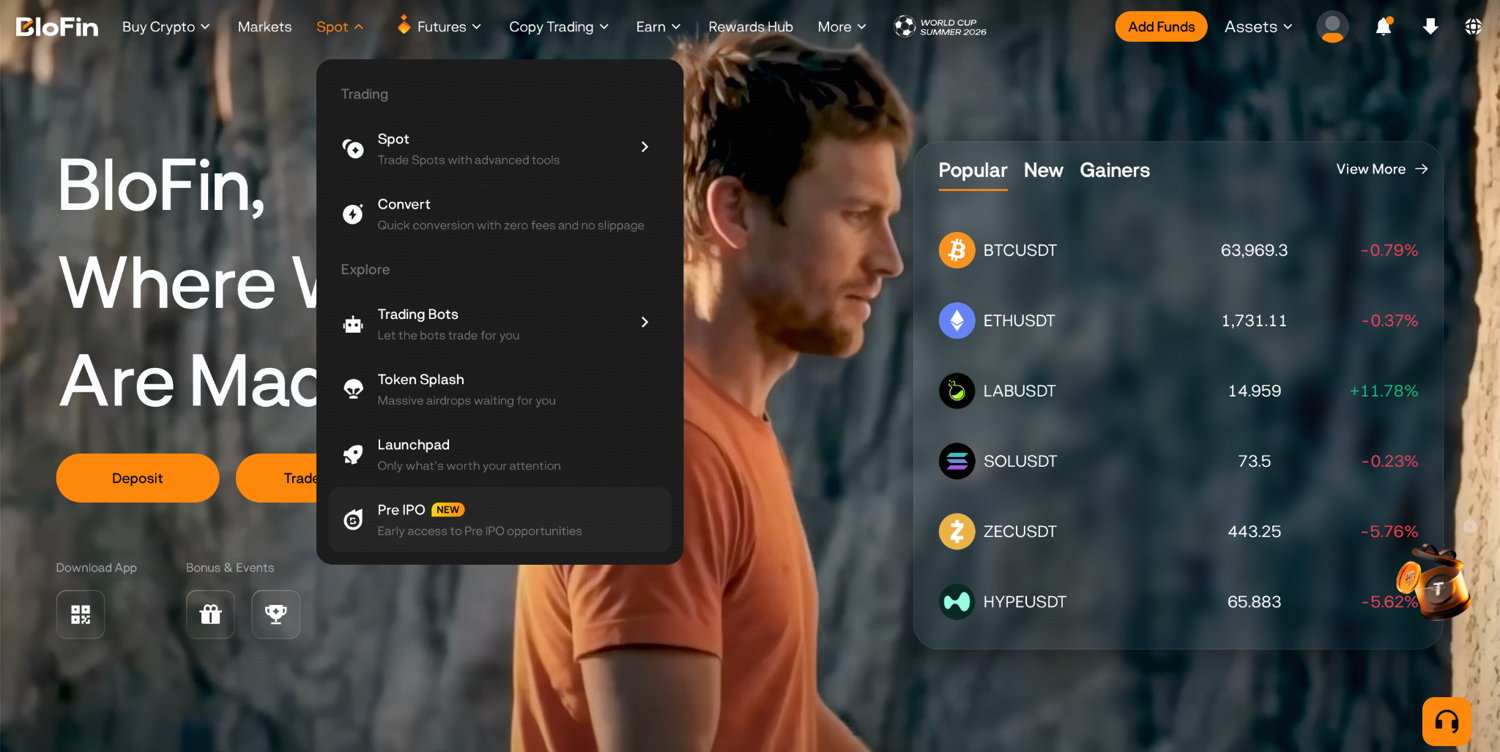
Step 1: Log in to your BloFin account and hover your cursor over the Spot tab. Then, click Pre-IPO to see active and upcoming listings. Each listing shows its key parameters and opens a dedicated project page with the full announcement.
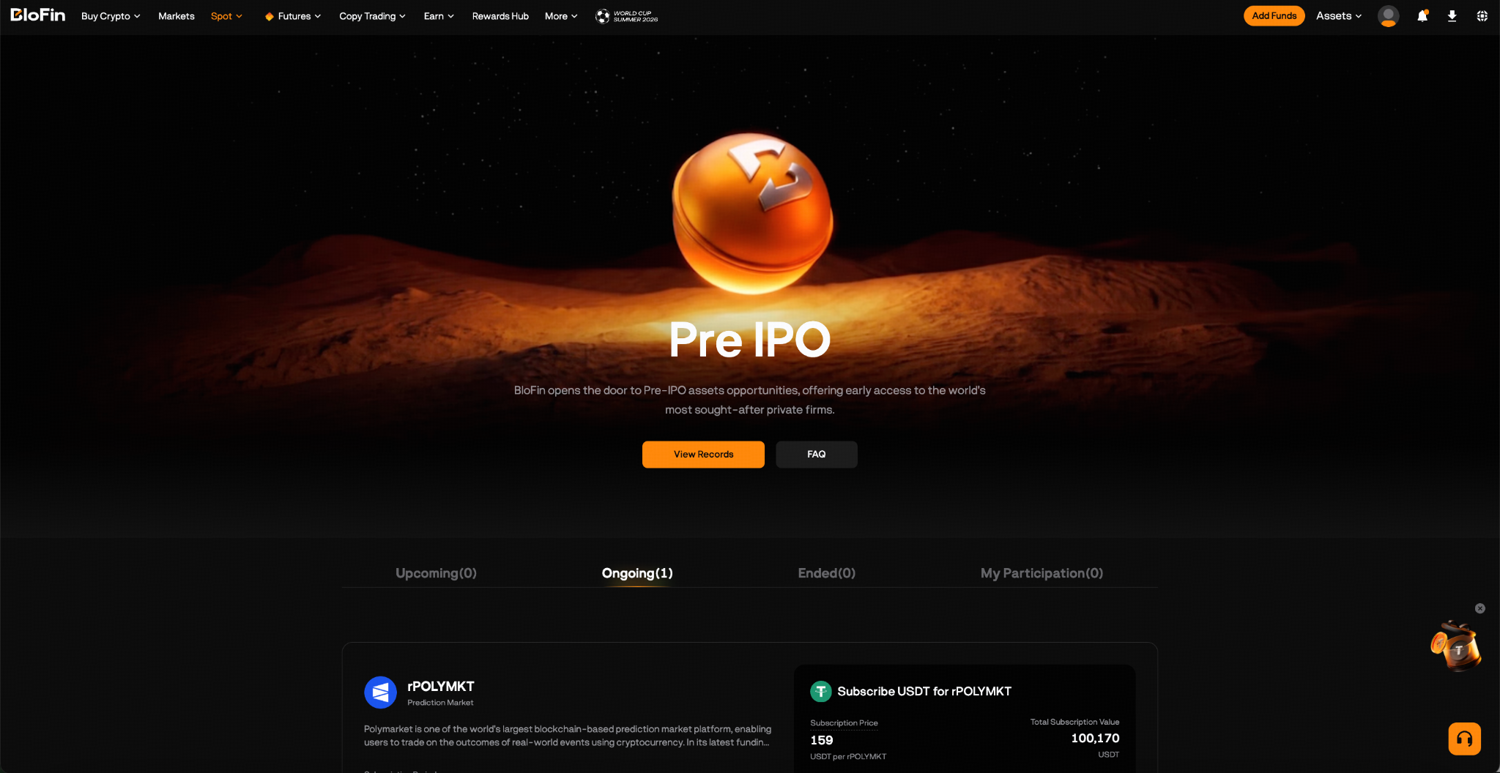
Step 2: On the Pre-IPO page, click on the project that you’re interested to learn more about and review the subscription price, total supply, minimum and maximum subscription per user, the subscription window dates, the procurement period length, the APR, and the eligibility requirements.
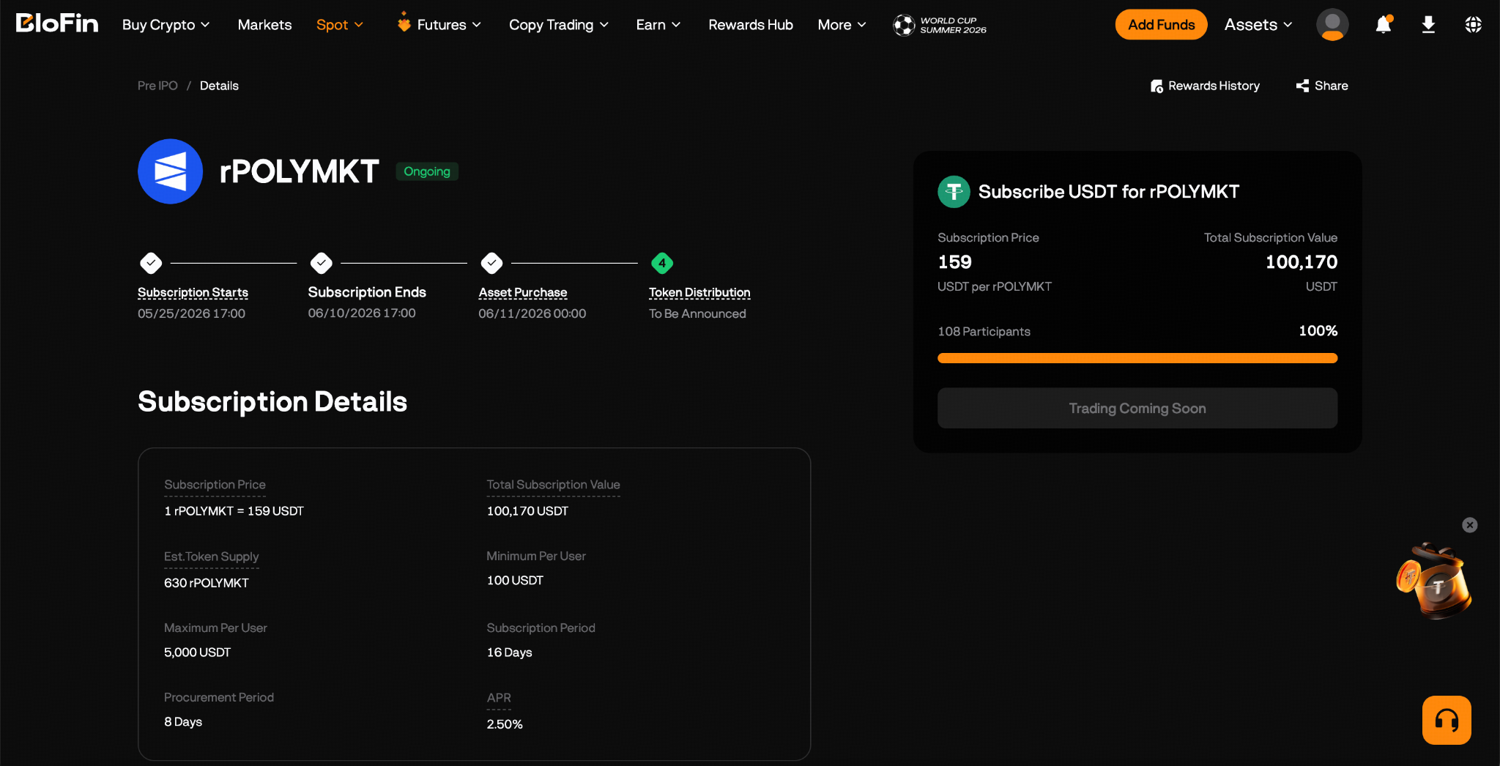
The announcement for rPOLYMKT, for example, specifies a subscription price of 159 USDT per token, a total subscription value of 100,170 USDT, an estimated token supply of 630 rPOLYMKT, a minimum per user of 100 USDT, a maximum of 5,000 USDT, and a procurement APR of 2.5%. Read these details carefully before subscribing.
Step 3: Please note that all first-time participants must complete the required risk acknowledgments and declarations before they can subscribe. This is a one-time step that covers eligibility and risk disclosure. You will not be able to submit a subscription until this is done.
Step 4: Navigate to the project page when the subscription window is open, enter your subscription amount within the stated minimum and maximum, review the details, and click Confirm. Your funds are locked immediately upon confirmation and remain locked for the duration of the window.
Step 5: After the subscription window closes, Realta proceeds to acquire the underlying asset. This process takes 7 to 15 working days. Your committed USDT earns the stated APR during this period. You do not need to take any action.
Step 6: Once the procurement period concludes and tokens are distributed, your pro-rata allocation of tokens and any unallocated refund are credited to your Spot Account. Check your Spot Account balance to confirm receipt.
Step 7: Go to BloFin's Spot market and check the trading pair for your token. You can sell your tokens for liquidity at the prevailing market price after the Spot market opens, or you can hold your position and monitor the underlying company's progress toward a qualifying liquidity event.
Frequently asked questions
What is BloFin Pre-IPO?
BloFin Pre-IPO is a platform within BloFin that allows eligible users to subscribe to tokens backed by pre-IPO equity positions in private companies. It is powered by a partnership with Realta, a third-party asset provider that operates under an SPV framework.
What are Pre-IPO tokens?
Pre-IPO tokens are digital tokens issued on a 1:1 asset-backed basis against an underlying equity position held in a Special Purpose Vehicle managed by Realta. They provide economic exposure to a private company's equity value but do not constitute equity ownership. After distribution, they trade on BloFin's Spot market and can also be held toward a qualifying liquidity event.
What is the difference between Pre-IPO tokens and equity ownership?
Equity ownership gives the holder a direct stake in the company, typically including voting rights, dividend entitlements, and shareholder privileges. Pre-IPO tokens provide none of these. They provide economic exposure: the potential for financial gain if the underlying company's valuation increases and a liquidity event occurs, but with no governance rights, no dividends, and no direct claim against the company's assets. Holders are essentially participating in the economic outcome of a position held by an SPV, not holding equity themselves.
What is Realta and what role does it play?
Realta is the third-party asset provider supporting BloFin Pre-IPO. Realta creates and manages the Special Purpose Vehicle that holds the underlying equity position in the private company, acquires the actual equity through secondary market transactions or direct investment, and issues tokens against that position on a 1:1 backed basis. BloFin distributes those tokens to subscribers. Realta is separate from BloFin and operates independently in managing the underlying asset.
What happens if the minimum subscription threshold is not met?
If the total amount subscribed across all participants does not reach the minimum threshold by the time the subscription window closes, the listing does not proceed. All subscribers receive a full refund of their committed USDT, plus interest calculated at the Fixed Terms Earn rate for the period their funds were locked.
What happens during the procurement period?
Once the subscription window closes and the minimum threshold has been met, Realta proceeds to acquire the underlying equity position and issue the backed tokens. This typically takes 7 to 15 working days. During the entire procurement period, all committed USDT earns the stated APR. If the asset acquisition fails during this period, a full refund plus interest is issued to all subscribers.
How is my token allocation calculated?
Your allocation is calculated on a pro-rata basis using the following formula: actual total token supply multiplied by your subscription amount divided by the total amount committed by all subscribers. If the actual token supply acquired is lower than the estimated maximum, allocations are reduced proportionally. Any USDT not allocated to tokens is refunded automatically.
Can I withdraw my Pre-IPO tokens to an external wallet?
No. Pre-IPO tokens cannot be withdrawn from BloFin or transferred on-chain. They exist only within the BloFin platform. Your available options are to sell them on BloFin's Spot market (once it is available) or to hold them and wait for a qualifying liquidity event such as an IPO or acquisition.
How do I exit my position?
The primary liquidity mechanism is BloFin's Spot market, where Pre-IPO tokens trade against USDT after distribution. You can sell at any time at the prevailing market price. Alternatively, if the underlying company IPOs, is acquired, or undergoes another qualifying liquidity event, the SPV liquidates the underlying position and distributes net USDT proceeds to token holders after applicable lock-up periods and settlement timelines.
What happens if the company never goes public?
If the company cancels or indefinitely postpones its IPO, the tokens remain tradeable on BloFin's Spot market. The asset provider retains the ability to liquidate the pre-IPO assets at its discretion when a secondary sale opportunity exists. If the company is eventually acquired, proceeds are similarly distributed. If the company winds up entirely, the SPV participates in liquidation proceedings as a shareholder and distributes any recovered proceeds. In the most adverse scenario, this could result in partial or total loss of the subscribed amount.
Are returns guaranteed?
No. Pre-IPO tokens are speculative instruments. The APR earned during the procurement period applies only for that specific phase and only in scenarios where tokens are not distributed or procurement fails. Returns from holding the token depend entirely on the underlying company's performance, its path to a liquidity event, and the market price of the token on BloFin's spot market. Post-IPO settlement occurs at the market price on the settlement date, which may be lower than the subscription price.
Who is eligible to participate?
Eligibility requirements are determined by BloFin and Realta. Users from certain jurisdictions may be restricted. First-time participants must complete the required eligibility declarations and risk acknowledgments before subscribing. Users should review the current eligibility requirements on the BloFin Pre-IPO page before attempting to participate.
For more information, please refer to the BloFin Pre-IPO Subscription Agreement and BloFin Pre-IPO Risk Disclosure Statement.
Disclaimer: This information is provided “as-is” and is for educational purposes only. Purchasing private market assets is speculative, illiquid, and involves the risk of loss. Pre-IPO Tokens do not represent actual ownership of the underlying stocks, and holding these assets does not entitle you to any dividends, interest, voting rights, shareholder privileges, or rights offerings. The underlying Pre-IPO projects are also NOT guaranteed to undergo an initial public offering ("IPO") in any jurisdiction. The underlying companies have not endorsed, approved, or authorized this Product. Pre-IPO Tokens are not direct equity ownership and are not offered as securities. BloFin is not registered as, nor purports to act as, a broker-dealer, exchange operator, transfer agent, custodian, or similar regulated entity in any jurisdiction.
This Service is not (i) investment advice or an investment recommendation; (ii) an offer or solicitation, buy or sell digital assets; or (iii) financial, accounting, legal or tax advice. You should carefully consider whether trading or holding digital assets is suitable in light of your financial condition and risk tolerance. Please consult any legal, tax or investment professional for questions about your specific circumstances. Digital assets are subject to market volatility, involve a high degree of risk and can lose value. Historical returns are not indicative of future returns and past performance is not indicative of future results. BloFin is not responsible for any potential losses. Terms and Conditions shall apply.