
- The year started with expectations for rate cuts, which gradually shifted toward hikes due to elevated inflation and surprisingly strong employment. The resilient labor market gave the Fed room to raise rates under its dual mandate of stable prices and maximum employment.
- Rate hike expectations accelerated in November, dragging Bitcoin sharply lower. Higher expected rates and a tighter monetary policy environment put significant pressure on it, invalidating the case that Bitcoin’s current bear market had ended.
- Rate hike expectations now extend into the first half of 2027, so this challenging environment could persist for risk assets for another six months.
- Going forward, Bitcoin will be very sensitive to any factors affecting rate expectations. The recent PCE release provides a good example of investors looking for any sign of relief from data.
At the start of 2026, markets expected the Fed to keep cutting rates. Eleven months later, the Fed has raised rates once, a second hike in December is close to certain, and futures price more hikes in 2027. The turn came in stages.
The Year Started With Rate Cuts Priced In
The Fed cut by 75 basis points across its last three meetings of 2025, taking the policy rate to 3.50%–3.75%. In January, futures priced one or two more cuts for 2026.
The case looked sound at the time. Job growth was slowing and services inflation was easing. Tariffs were expected to lift prices once and then drop out of the annual inflation rate. Jerome Powell, then Fed chair, described the 2025 cuts as support for the labor market while tariff effects passed through.
An Oil Shock Took Rate Cuts Off the Table
The Middle East conflict that began in late February changed the market expectation. It disrupted oil supply and shipping, and higher oil prices and transportation costs threatened to feed through to a broader range of goods and services.
The Fed still projected one cut in early March. By late March, expectations for cuts had largely disappeared.
The picture was still mixed at that time. Expensive energy prices also squeezes household budgets and could weaken demand leading to a slower economic growth, which could potentially create a case for easing if growth deteriorates. By early May, markets expected the Fed to hold for the rest of the year.
The Resilient Job Market Give Fed Room to Prioritize Containing Inflation
The Fed's mandate covers stable prices and maximum employment. Early in the year the two pulled in different directions: inflation sat above the 2% target, while slowing hiring raised the risk to jobs. That labor-market risk had been the main reason for the 2025 cuts.
The risk faded over the spring and summer. Unemployment held between roughly 4.1% and 4.3%, and the employment side of the mandate no longer called for support. Inflation became the Fed's priority.
The Fed's own projections track the shift. Between March and September, officials raised their 2026 PCE inflation forecast from 2.7% to 3.7% and lowered their unemployment forecast from 4.4% to 4.1%. The median year-end policy rate rose from 3.4% to 4.1%, a move from one projected cut to roughly two hikes.
Projection released | PCE inflation | Core PCE inflation | Unemployment | Year-end policy rate |
March | 2.7% | 2.7% | 4.4% | 3.4% |
June | 3.6% | 3.3% | 4.3% | 3.8% |
September | 3.7% | 3.4% | 4.1% | 4.1% |
Rate Hike Expectations Rose Sharply in November
Rate expectations had been rising for much of the year, but the move accelerated in November. After the Fed held rates on October 28, the odds of a December hike were about 78%. By mid-November, a hike was seen as close to certain, and market now priced the policy rate at 4.50%–4.75% by June 2027, which implies three more quarter-point increases.
The shift in Fed officials’ public comments is also significant. The October meeting minutes, released in November, showed that almost all participants expected further rate increases would be appropriate. A couple even thought a hike larger than 25 basis points could warrant consideration in December if inflation data were unfavorable.
This sharp repricing of the rate path added pressure to both gold and Bitcoin, contributing to November’s steep declines and invalidating the earlier case that Bitcoin’s bear market had ended. With expected hikes now extending into the first half of 2027, the monetary backdrop could remain challenging for another six months.
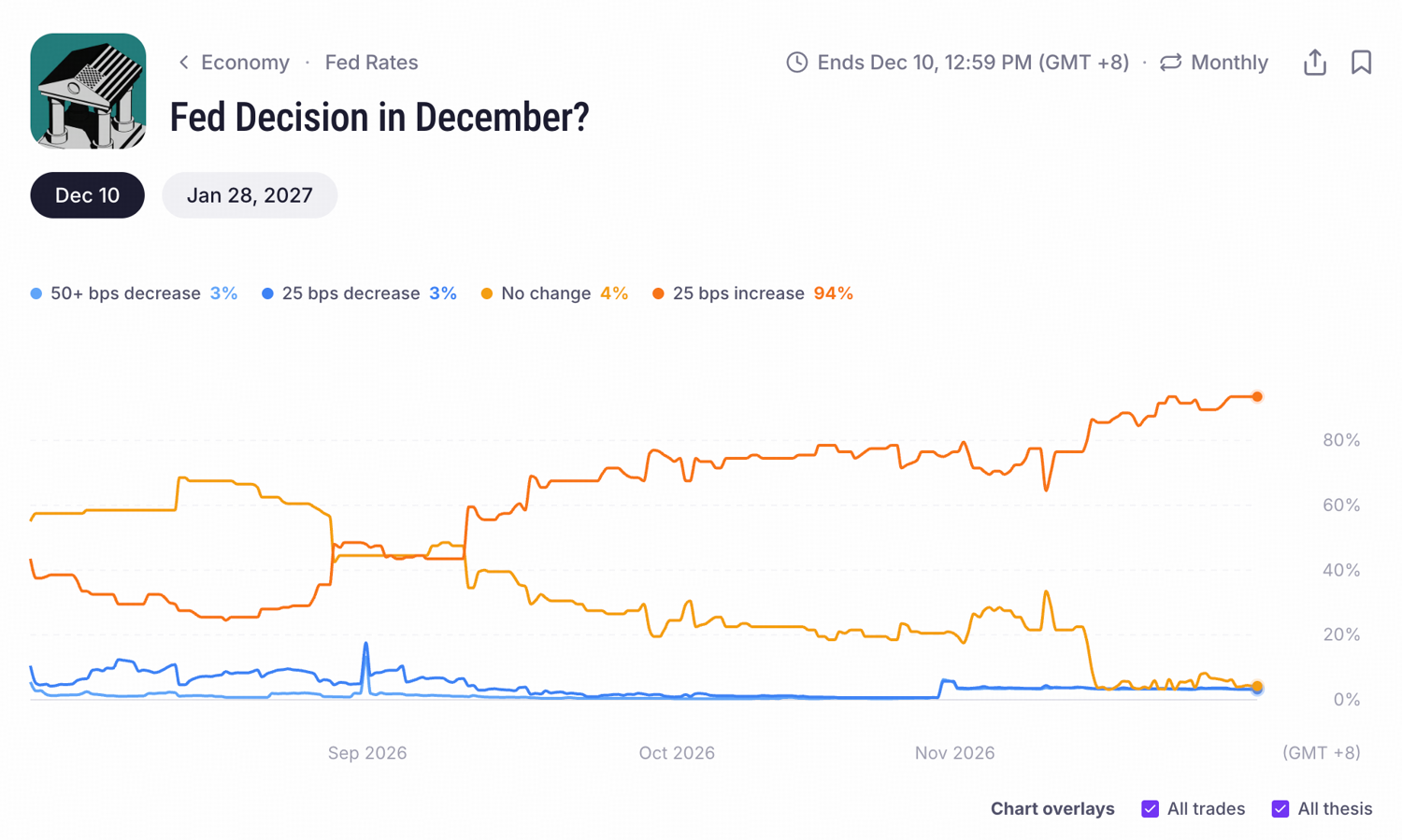
Bitcoin Will Remain Highly Sensitive to Rate Expectations
Bitcoin is likely to stay highly sensitive to inflation releases, employment data and Fed comments over the coming months. With further hikes already priced in, small changes in the expected pace or extent of tightening can produce large price moves.
The November 25 PCE release showed how the same report can be interpreted differently. Annual core PCE inflation rose to 3.3%, above the expected 3.2%, adding to concerns about further tightening. Monthly core inflation eased to 0.29% in October from 0.32% in September, and real consumer spending was broadly flat, which suggests some moderation in demand. Inflation remained sticky, while the monthly figures gave less reason to expect faster hikes.
Bitcoin fell sharply in the morning selloff, then recovered from their lows as Treasury yields declined and stocks rebounded. This session shows how quickly the market can turn when investors are worried about tighter policy and looking for signs of relief.
What Matters Next
The monetary backdrop could remain challenging into mid-2027, while Bitcoin’s turning point may arrive earlier if rate expectations begin to ease. Against a market baseline of further hikes, incoming data will matter most when it changes expectations for how much tightening remains. Persistent inflation would reinforce the pressure; a clearer slowdown in economy could create room for relief even while policy rates remain high.

Disclaimer: This information is provided "as is" for general informational purposes only, without warranty as to accuracy or completeness. It is not financial advice or an offer or solicitation to buy or sell any digital assets or financial instruments. You are responsible for evaluating the risks, conducting your own research, and seeking independent professional advice.