
AI stocks have experienced heightened volatility in recent weeks. Record capital expenditure, higher funding costs from rising interest rates, and a market led by a narrow group of AI names have put the bubble question back at the center.
Few investors still question AI's capability to change the world. The debate centers on payoff, whether revenue can grow fast enough to justify the current build-out, which is increasingly financed with debt.
The long-term AI demand is real. Enterprise agents and emerging consumer agents will create almost unlimited demand for inference token demand. However, the timing of that demand and when this capital expenditure will generate positive free cash flow for companies remain uncertain. This means the AI trade could go through a long and deep correction as investors worry about the timing of profitability even as adoption continues. Given how fast the AI space is developing, this timing cannot be forecasted with useful precision, so the better response is to actively manage AI exposure.
We think shifting from individual stocks to index investing is a prudent way to reduce risk amid the current uncertainty. Given the high concentration of AI stocks in market-cap-weighted indices, equal-weight equity exposure can lower that concentration while retaining some of the upside. Surging bond yields also make bonds more attractive, paying investors to wait as they take some gains off the table. Bitcoin and crypto, underowned after two years in which capital flowed to AI, offer the strongest growth case for 2027.
A Bubble Can Run Far Longer Than Expected
Calling a bubble and timing it are two different things. Alan Greenspan warned of irrational exuberance in December 1996, when the Nasdaq traded near 1,300. The index then nearly quadrupled to its March 2000 peak above 5,000 before losing nearly 78% over the following two years. An investor who exited on the warning missed the largest gains of the decade.
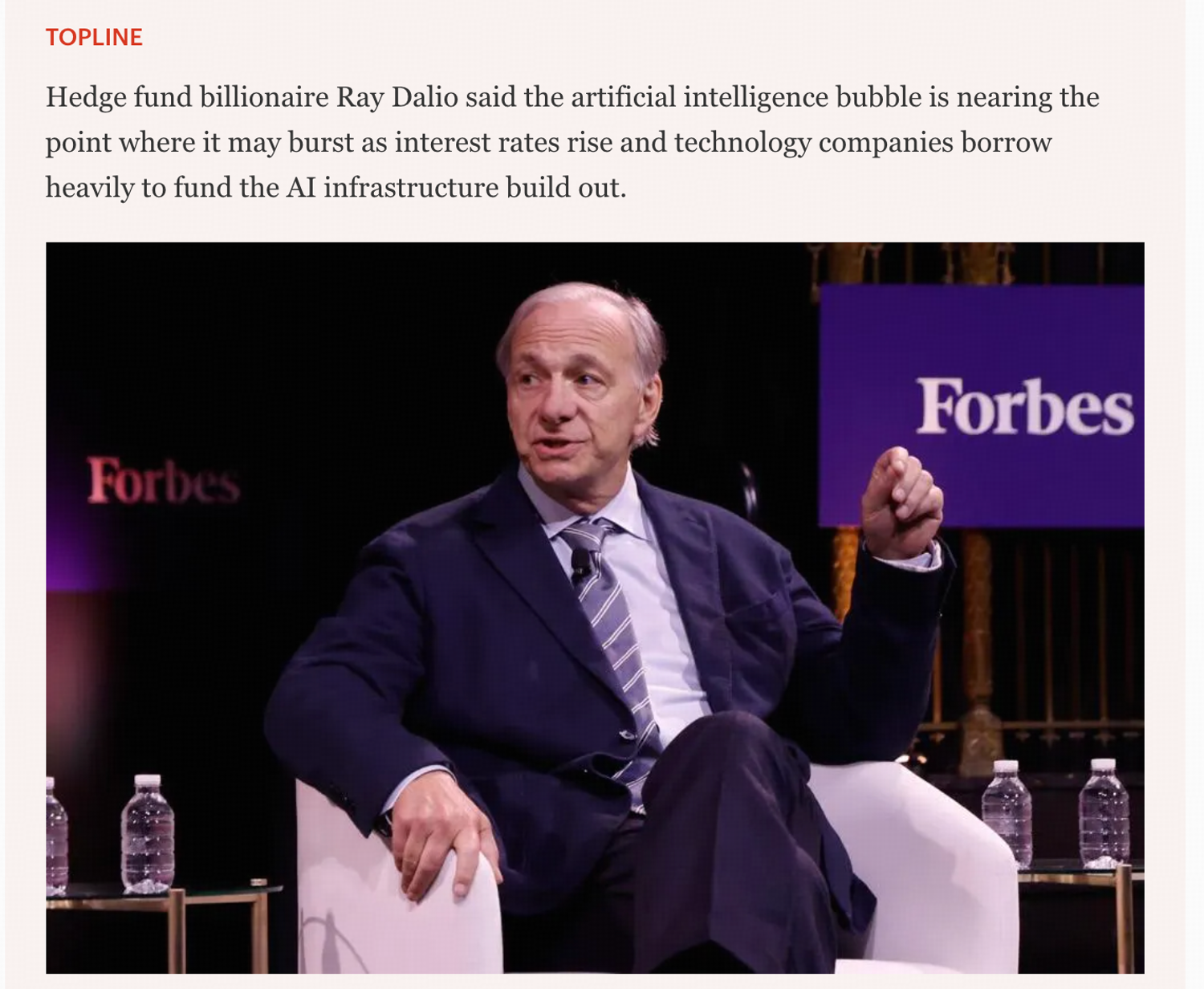
Today, rising interest rate and debt-servicing costs could accelerate a bubble burst. Prominent investor Ray Dalio has warned that the combination of rising rates and debt-funded AI spending is bringing the market closer to a potential breaking point.
Higher funding costs are already hitting leveraged, debt-reliant AI infrastructure builders. CoreWeave, for example, fell sharply and its bonds dropped into distressed territory with yields climbing toward or above 15%.
On the flip side, there are also many reasons this may not be the bust. Profitable hyperscalers (Microsoft, Alphabet, Amazon and Meta) and Nvidia continue to generate cash flow and are less immediately dependent on expensive external debt. Demand indicators have not broadly cracked; the stress is more about the cost and sustainability of funding the build-out. Similar episodes of volatility around rates or financing have occurred earlier in the cycle without ending the trade.
Neither path can be ruled out. So what can an investor do?
Equal-Weight Index
Equal weight index is the simplest way to stay invested while cutting AI exposure.
The S&P 500 is more of a momentum index. Each company's weight tracks its market value, so a stock that rises takes a larger shares. Th AI-led mega-cap has dominated the index. Nvidia is SPY's largest holding at 7%, and Broadcom and Micron, both AI chip suppliers, sit in its top 15. The Magnificent Seven make up roughly 35% of the fund, top 10 companies make up around 39%, and technology over 35% of the index.
The equal weight index reduces this concentration. For example, RSP, the Invesco S&P 500 equal-weight fund, resets each stock to roughly 0.20% at every quarterly rebalance, so its top 10 holdings make up 2% at each rebalance. The rebalance trims recent winners and tops up laggards, which tilts RSP toward mid-sized companies.
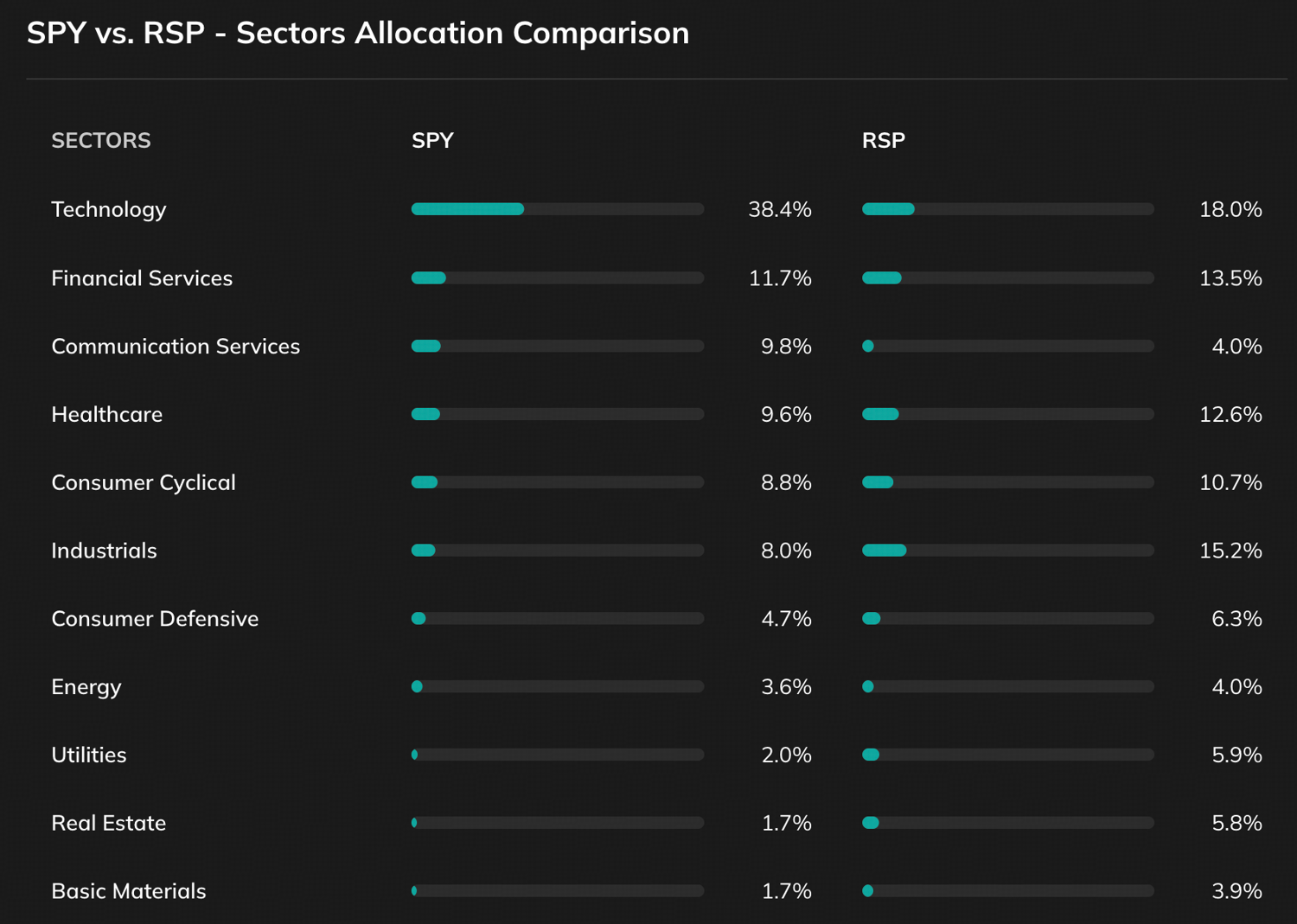
For someone already holding QQQ or individual mega-cap/AI names, adding an equal-weighted S&P 500 fund such as RSP is a straightforward way to lower concentration risk while keeping broad U.S. large-cap exposure.
Holding cap-weighted and equal-weighted funds side by side keeps broad exposure while reducing dependence on a handful of names, and the mix can shilft toward equal weight if one deems the AI bubble will burst in more near term. The higher weights in non-tech and more defensive areas within equal weight index can provide a partial cushion in that scenario, though it is not a full hedge.
A 5% Treasury Yield Pays Investors to Wait
Treasury yields sit near their highest levels since 2002, which gives sidelined capital real income. The 10-year yield stood at around 5.10% and the 3-month bill at around 4.3%. The 10-year TIPS yield, the inflation-adjusted return on Treasury inflation-protected securities, stood at almost 3%, so investors can lock in close to 3% above inflation. Cash no longer costs much to hold.
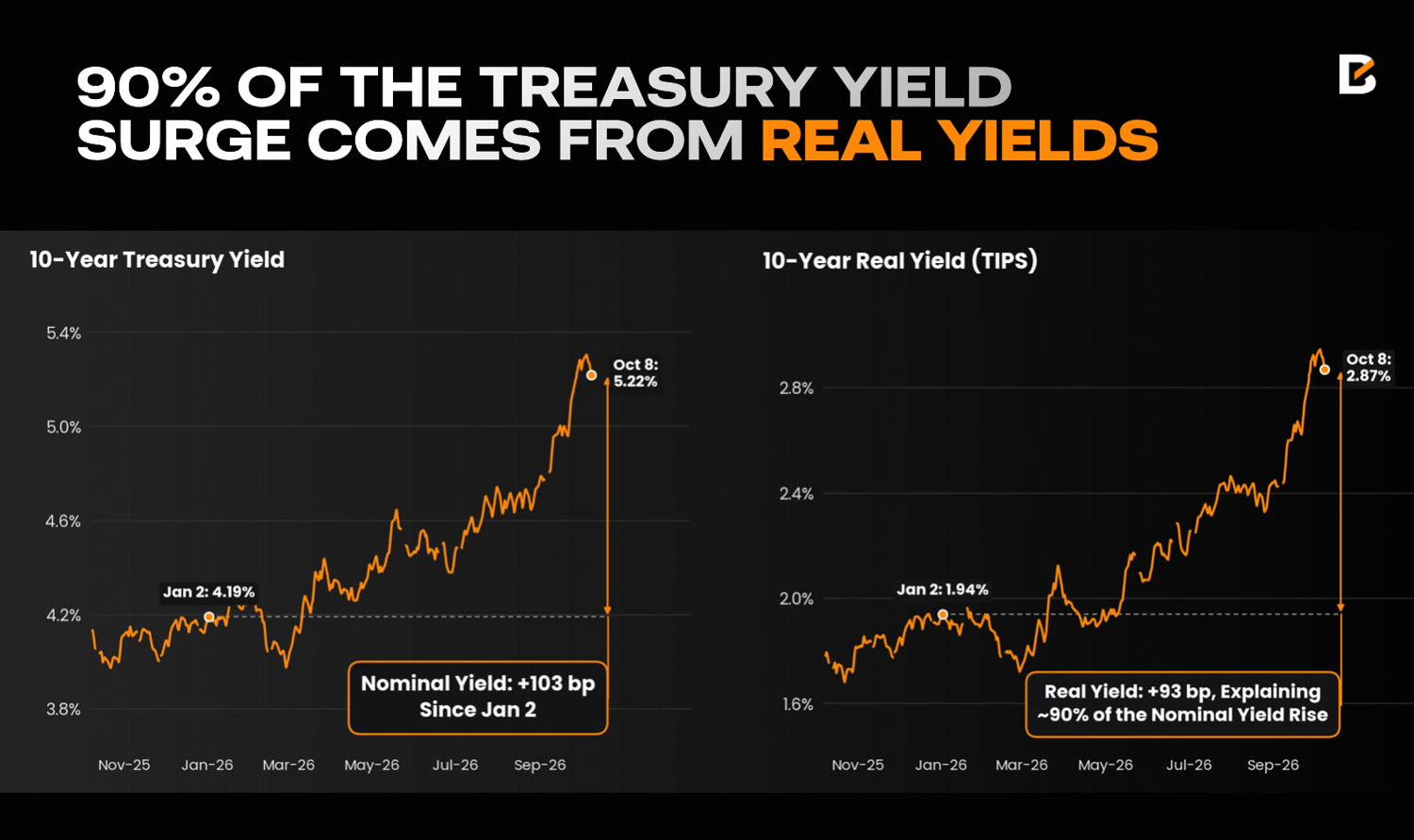
Longer maturities carry greater duration risk: if yields rise further, bond prices could fall further to offset the interest earned. The 2-year Treasury at around 4.7% and the 5-year at around 4.8% offer attractive yields with less sensitivity to rate changes.
That changes the math of patience. An investor sitting on large AI gains can realize part of them, lock in a 4-5% yield and wait for the next major opportunity without depending on getting the top right.
Bitcoin is now the Underowned Asset
Bitcoin price peaked above $126,000 on October 6, 2025, fell to just below $59,000 on June 30, 2026, a drawdown of more than 53%, and trades near $82,000 as of now.
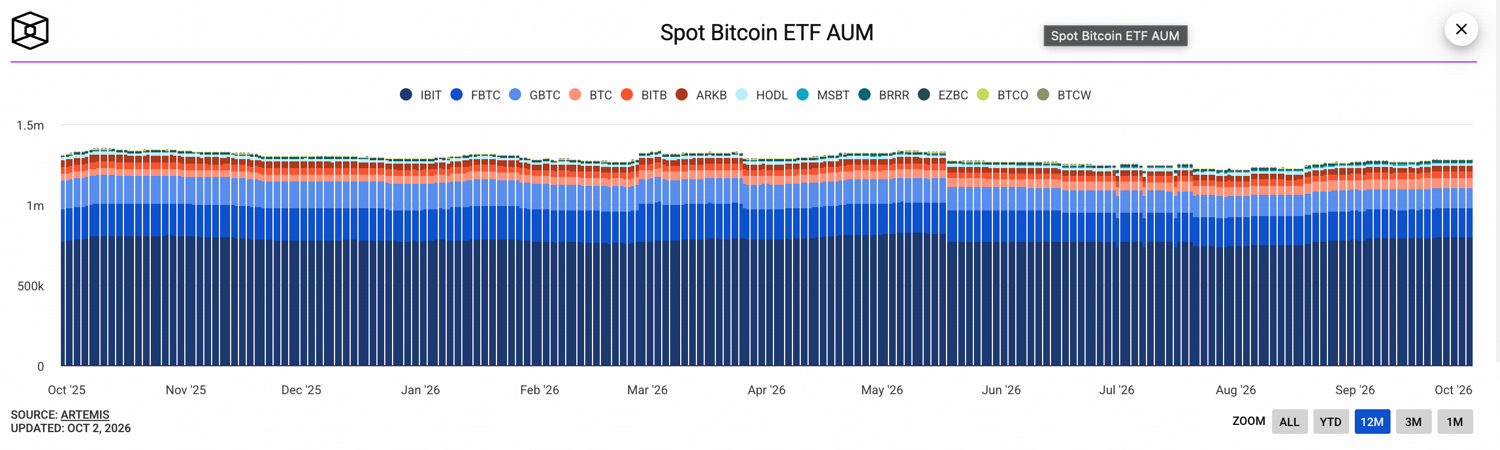
This cleared out leverage and reset sentiment. Beneath the bear market, however, fundamentals have been improving. Despite headlines about large inflows and outflows, Bitcoin ETFs have maintained their total assets under management in BTC terms since the beginning of the year. Strategy, the Bitcoin treasury company, faced serious market concerns about its financial health. Now, STRC’s discount to par is narrowing and the company has also shifted from selling BTC to accumulating it again.
Related Article: Bitcoin's New Bull Market: No More Boom and Bust
While AI stocks drove two-thirds of the S&P 500's gains for the past two years, crypto lost allocations to the AI trade. We think a new Bitcoin cycle is beginning from this underowned base, and expect the wider crypto ecosystem to grow rapidly in 2027, driven by the convergence of stablecoins, tokenized assets and AI agents.
Bottom Line
None of the above methods provides a direct inverse hedge against the AI trade. We don’t think it is wise to use short positions to neutralize AI exposure. AI remains in a period of rapid growth, and its development continues to accelerate.
Current concerns about profitability are real, but the outlook could change quickly if enterprise and consumer agents gain faster adoption. The key is to maintain adequate AI exposure while reducing risk somewhat to prepare for potential sentiment shocks.
We think parking cash in Treasuries at today’s high yields, rotating some capital into equal-weight indices and allocating to Bitcoin can help reduce exposure to an AI bubble burst while providing access to other high-growth opportunities.
Disclaimer: The information provided herein does not constitute investment advice, financial advice, trading advice, or any other sort of advice, and should not be treated as such. All content set out below is for informational purposes only.