
- Higher real yields account for roughly 90% of this year’s increase in nominal Treasury yields. The bond market is not pricing in higher inflation, it is pricing in higher (infaltion-adjusted) real yield.
- Higher-for-longer policy rates, stronger competition for capital and concerns about fiscal sustainability all push investors to demand greater returns above inflation.
The Headline Rate Hides the Real Move
The U.S. 10-year Treasury yield reached 5.22% on October 8, 2026, up from 4.19% on January 2, a rise of 1.03 percentage points, or 103 basis points. The Fed also raised its policy rate by 25 basis points on September 16. Together, these developments point to a higher cost of borrowing. To understand their significance, we need to look more closely at what the Treasury yield represents.
U.S. 10-Year Treasury Yield (%)
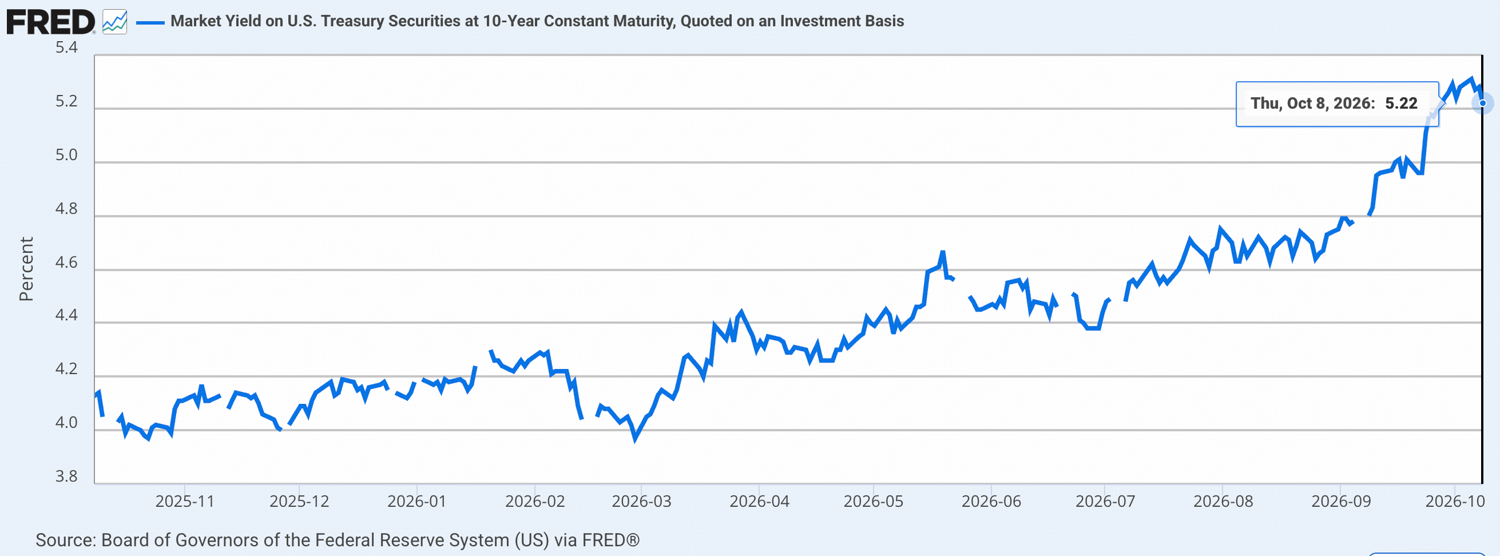
The headline Treasury yield is a nominal yield, quoted before accounting for inflation. For investors, the economic value of that return depends on how much purchasing power inflation erodes. An investment yielding 5% when inflation averages 3%, for example, delivers an inflation-adjusted return of approximately 2%.
Real yields are measured using Treasury Inflation-Protected Securities, or TIPS, whose principal adjusts with U.S. consumer inflation. Their quoted yields therefore represent the return available above inflation. The difference between conventional Treasury yields and TIPS yields of the same maturity provides an approximate measure of expected inflation over that period.
On October 8, the conventional 10-year Treasury yielded 5.22%, while the 10-year TIPS yielded 2.87%. The difference of 2.35 percentage points indicates the market’s approximate expectation for average annual inflation over the next decade.
U.S. 10-Year Real Yield (%)
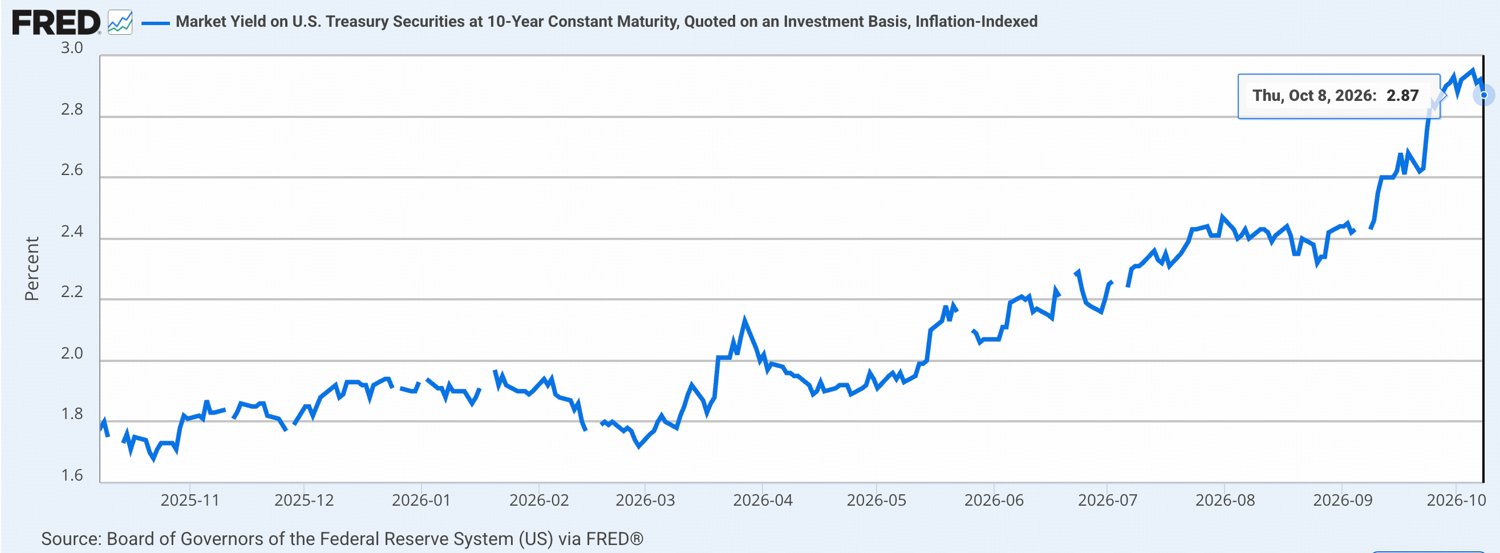
The decomposition shows that higher real yields account for roughly 90% of this year’s increase in nominal Treasury yields. Between January 2 and October 8, the 10-year real yield rose from 1.94% to 2.87%, an increase of 93 basis points. Market-implied inflation expectations increased by just 10 basis points, from 2.25% to 2.35%.
10-year Treasury | Jan 2, 2026 | Oct 8, 2026 | Change | Share of rise |
Nominal yield | 4.19% | 5.22% | +103 bp | - |
Real yield (TIPS) | 1.94% | 2.87% | +93 bp | 90% |
Breakeven inflation | 2.25% | 2.35% | +10 bp | 10% |
This is a rise in the real cost of money. Long-term inflation expectations have moved relatively little, while the return investors require above inflation has risen sharply. The bond market is not pricing in higher inflation, it is pricing in higher (infaltion-adjusted) real yield.
Three Forces Behind Higher Real Yields
A higher policy-rate path. The Federal Reserve raised the policy rate by 25 bp to 3.75% to 4.00% on September 16, 2026. The vote was 12–0, and it was the first hike since 2023. The September Summary of Economic Projections puts the median end-2026 rate at 4.1%, which implies one more hike this year.
Stronger demand for capital. The AI buildout is now funded in the same bond market that funds the Treasury. Hyperscalers issued about $248 billion of investment-grade debt in 2026 through September, according to Apollo, up from $108 billion in all of 2025.
Corporate bonds and Treasuries compete for allocations from overlapping groups of investors, including pension funds, insurers and asset managers. A surge in corporate issuance gives these buyers more alternatives and increases the volume of debt the market must absorb.
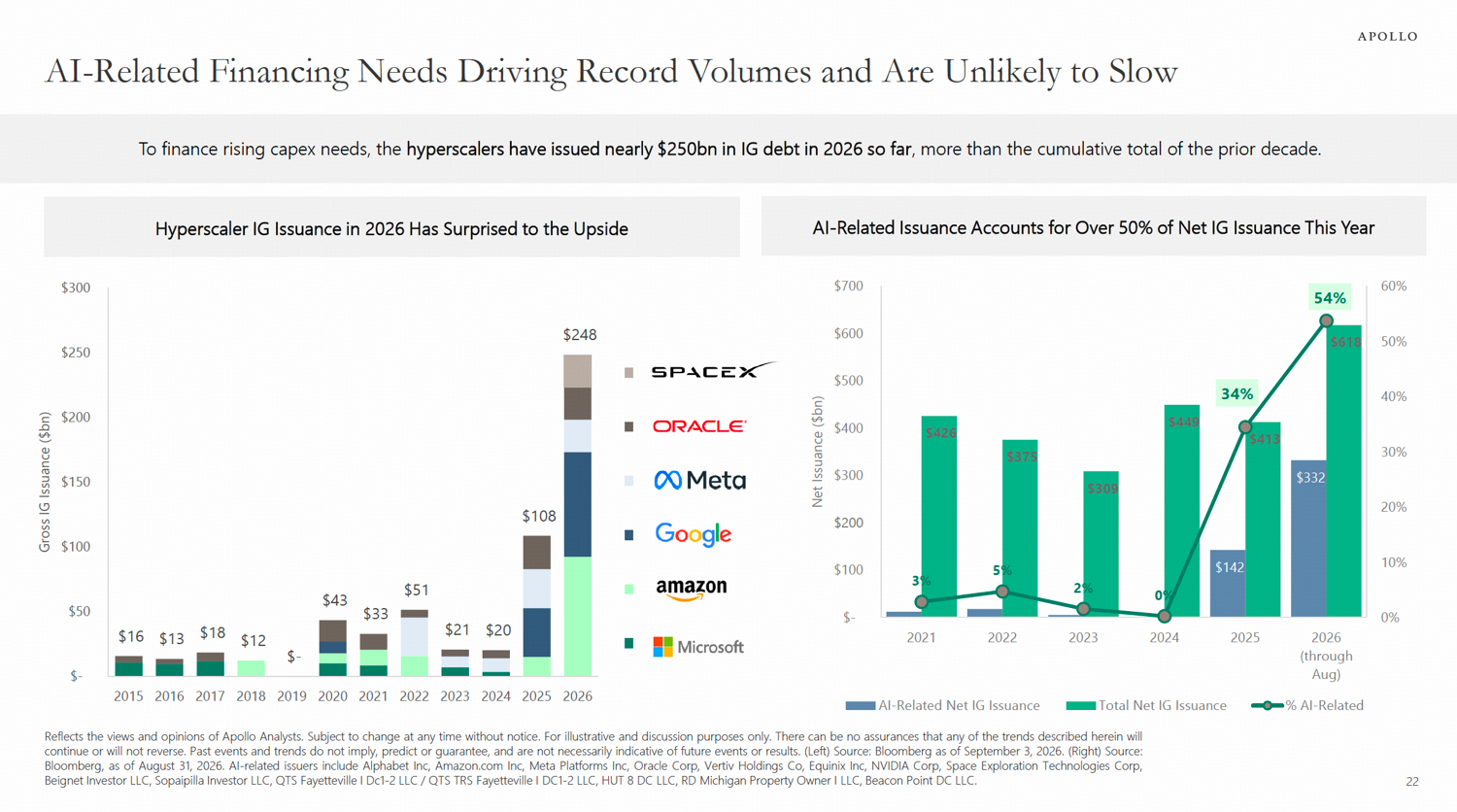
Source: Apollo
Growing concerns about long-term fiscal sustainability. Persistent deficits and a rising debt burden raise questions about how the government will finance its obligations over time. Higher interest rates add to debt-servicing costs as existing debt matures and is refinanced. Without stronger revenues or spending restraint, those costs can increase borrowing needs further.
These pressures can raise the term premium, the additional yield investors require to hold a long-term bond instead of repeatedly reinvesting in short-term government debt. Fiscal concerns can therefore keep long-term borrowing costs elevated even when near-term inflation expectations remain relatively stable.
All three forces increase the return investors require above inflation. Higher expected policy rates raise expected inflation-adjusted returns when inflation expectations remain stable. Stronger investment demand increases competition for available savings, pushing up the real cost of capital. Fiscal uncertainty add a premium as investors demand compensation for absorbing more government debt.
Disclaimer: The information provided herein does not constitute investment advice, financial advice, trading advice, or any other sort of advice, and should not be treated as such. All content set out below is for informational purposes only.