
The CLARITY Act, the most comprehensive crypto market-structure bill in US history, faces a decisive moment this week.
The Senate is scheduled to remain in Washington only until Aug 7, and as of Aug 3, no floor vote has been scheduled, leaving just days for the bill's fate to become clear. The House already passed its version in July 2025 with bipartisan support, and a unified Senate draft was released in late July.
The remaining hurdle is significant. Passage requires 60 votes to clear a filibuster, and Republicans hold roughly 53 seats, which means meaningful Democratic support is essential.
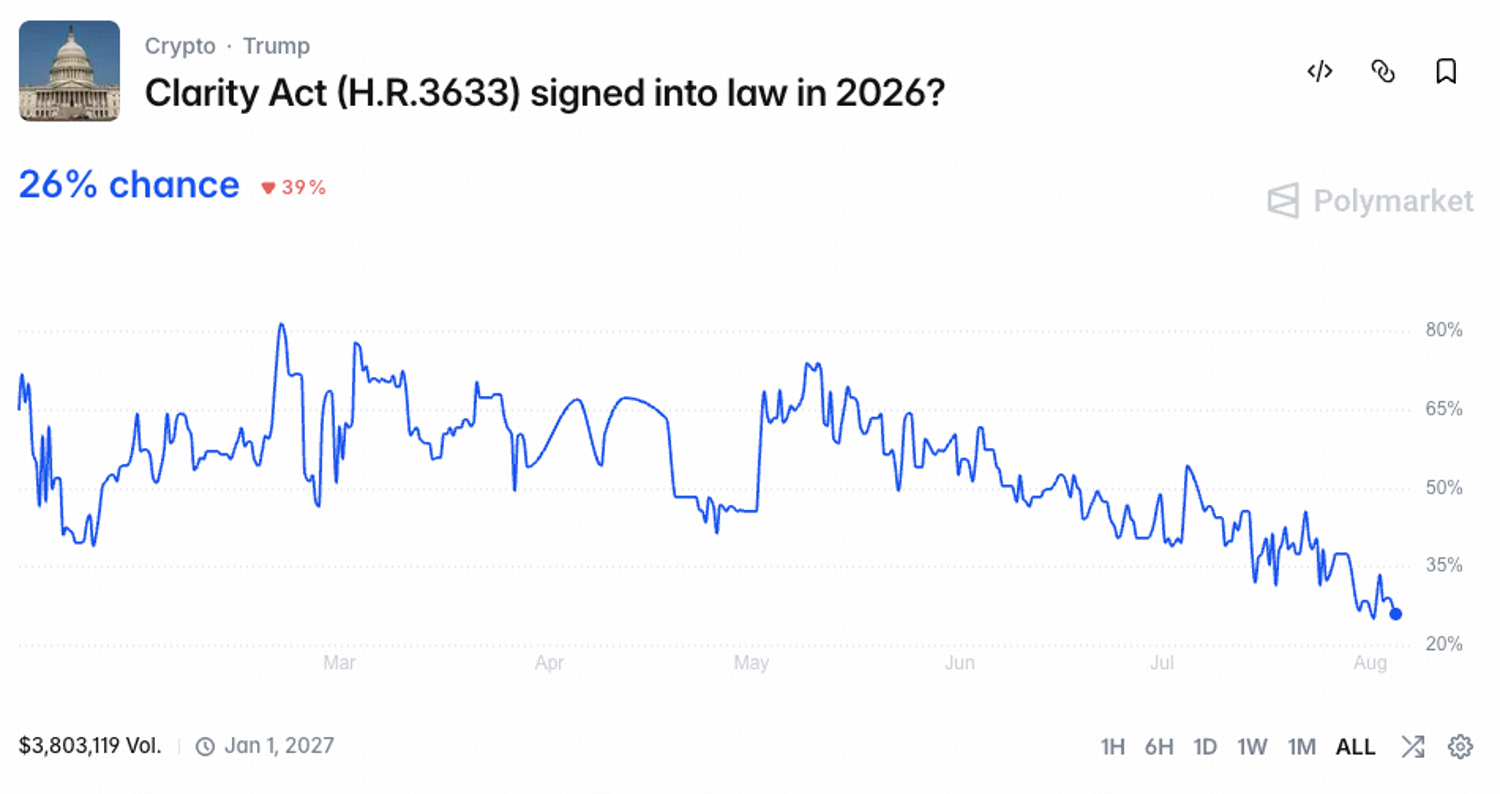
Prediction markets currently price only around a 26% chance that the bill becomes law in 2026. If the window closes, the next realistic opening may not come until after the midterms, leaving crypto markets in regulatory limbo for another year or more.
What the Bill Actually Does
At its core, the CLARITY Act answers one question that has haunted crypto for a decade: who regulates what?
For years, the SEC treated nearly every token as an unregistered security, while the CFTC believed many were commodities but lacked the power to oversee spot trading. Projects did not know where to apply, exchanges did not know what they could list, and investors did not know who protected them. The bill resolves this with a set of concrete rules:
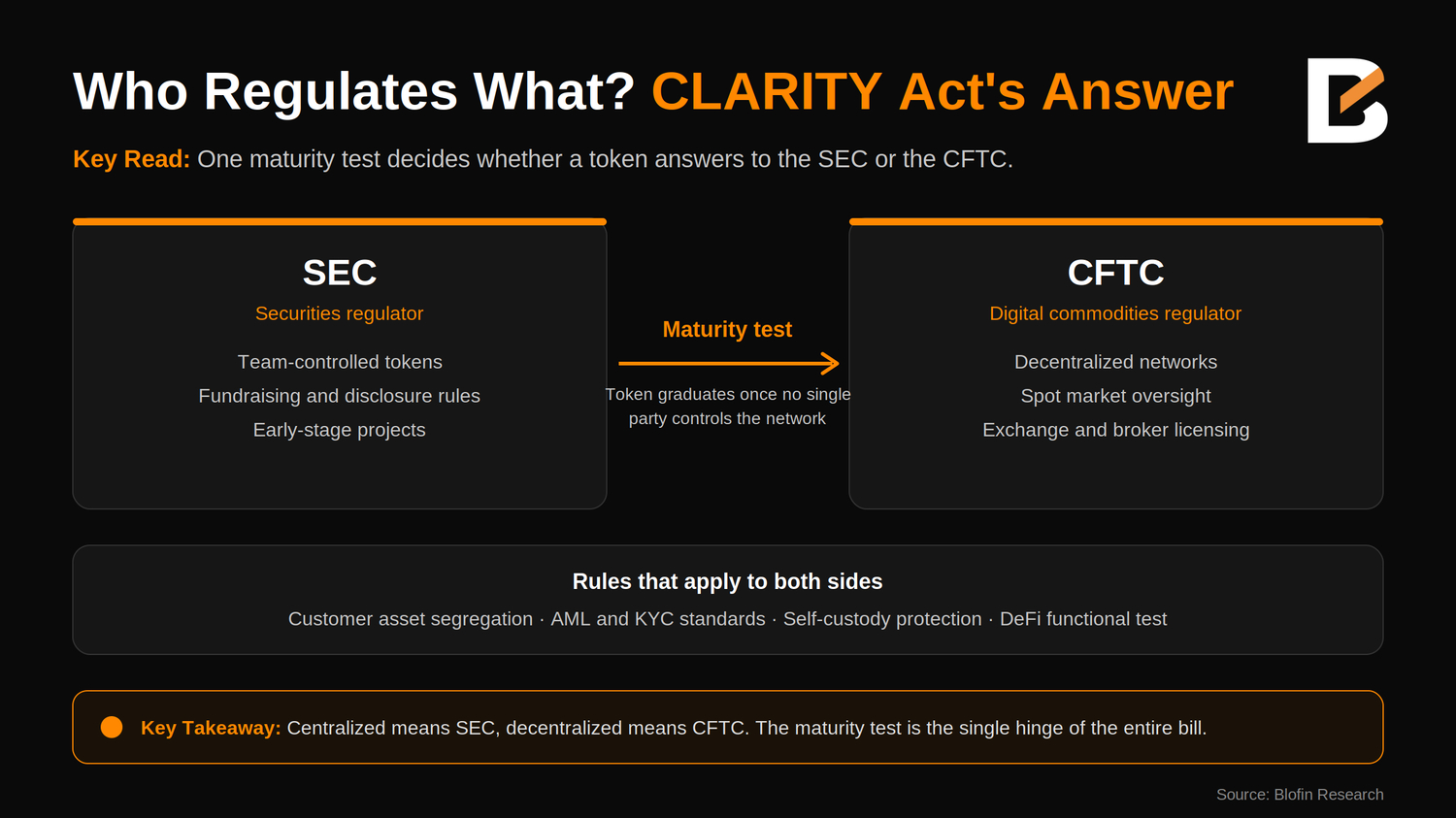
- A clear split between the SEC and CFTC. The dividing line is simple: if an asset's value depends on a central team's efforts, it is a security and belongs to the SEC. If the network is sufficiently decentralized, it becomes a "digital commodity" under the CFTC, which gains new authority over spot markets for the first time. Years of jurisdictional tug-of-war end here.
- A "maturity" test, or a graduation path for tokens. Every token starts life as a security while its founders are in control. Once the network decentralizes, for example when no single party holds an outsized share of tokens or governance power, it can "graduate" into a digital commodity. Centralized means SEC; decentralized means CFTC. Projects finally have a rulebook telling them exactly what compliance looks like at each stage.
- Exchanges must operate like regulated financial institutions. Digital-commodity platforms must register with the CFTC and meet bank-like standards on capital, risk controls, and market surveillance. In return, they get what the industry has never had: a legal license to serve US customers without fear of sudden enforcement.
- Your assets can no longer be quietly used by the platform. Past exchange collapses shared one root cause: platforms treated user deposits as their own money. The bill bans this. Client assets must sit with qualified custodians, using them for anything such as staking requires the customer's explicit consent, and if a platform goes bankrupt, custodied assets are legally the customer's property, not part of the estate handed to creditors.
- Token issuers can raise funds, but not just tell stories. A slick pitch deck is no longer enough. Projects get a simplified fundraising pathway, but in exchange must regularly disclose how the token actually works: its real utility, how many tokens the team holds, whether insiders are selling, known code risks, and the economic design behind it.
- Self-custody and developers are protected. Federal agencies generally cannot ban individuals from holding assets in their own wallets. And simply writing open-source code or running a node does not make someone a regulated financial intermediary, removing a legal cloud that has hung over developers for years.
- DeFi is judged by one question: who holds the off switch? Protocols that truly run on immutable, open-source code get legal breathing room. Projects that call themselves decentralized while a team retains admin keys or can freeze user funds are treated as what they functionally are, centralized intermediaries with full compliance obligations.
- Stronger AML and consumer safeguards. The merged text includes more than 16 anti-illicit-finance provisions, tighter KYC and transaction monitoring, and a ban on platforms paying deposit-like fixed interest on payment stablecoins. Yield tied to real economic activity, such as staking, remains allowed.
What It Means for the Market
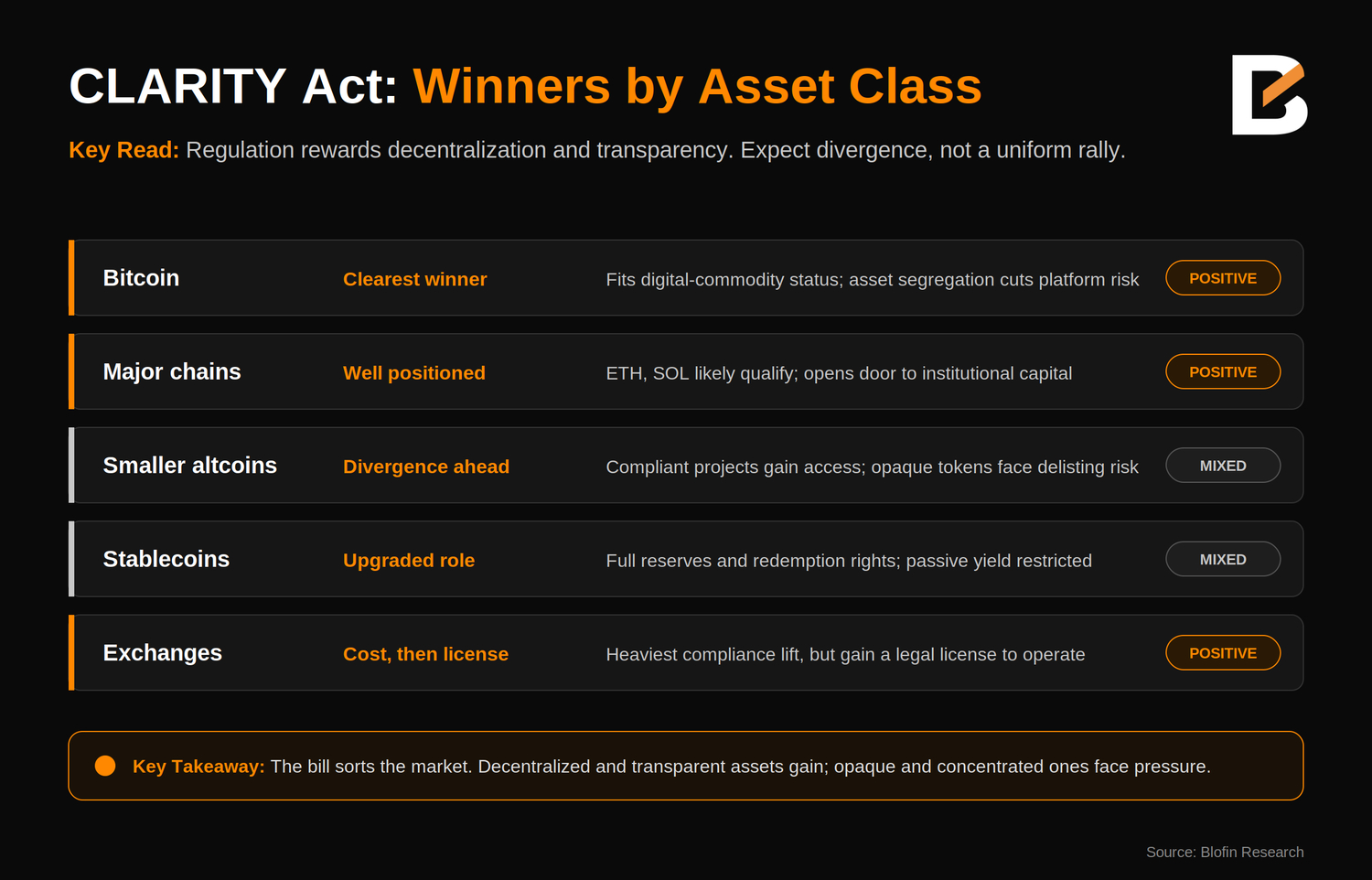
Bitcoin is the most straightforwardly positioned asset. With no controlling team, it fits squarely into the digital-commodity category, and asset-segregation rules reduce counterparty risk for holders using centralized platforms.
Major public chains with broad usage and distributed governance, such as Ethereum and Solana, are well placed to qualify as digital commodities, opening the door to institutional capital that currently avoids regulatory ambiguity. Younger networks with concentrated token ownership would stay under SEC oversight until they decentralize, raising compliance costs and listing hurdles.
Smaller altcoins face a sorting mechanism. Projects willing to meet disclosure standards gain a legitimate path to US markets, while opaque or highly concentrated tokens may find major platforms unwilling to list them. Expect divergence rather than a uniform outcome.
Stablecoins move further toward becoming regulated payment infrastructure: full-reserve requirements, regular attestations, and clear redemption rights. Restrictions on passive yield may reshape how platforms structure stablecoin products, but rewards tied to genuine economic activity such as staking or liquidity provision remain permissible under the draft.
Exchanges and brokers face the largest operational lift, covering registration, custody segregation, and surveillance obligations, but they also gain what the industry has long asked for: a legal license to operate.
The market is already trading this event. Bitcoin has held a tight range between $62,000 and $64,000 as investors wait for the Senate's move, a sign that a clear outcome in either direction could set the next trend.
But the bigger picture matters more than one vote. Today's rules rest on agency guidance that any future administration can rescind; only a statute is permanent. That is what makes the CLARITY Act structurally significant.
Watch for a scheduled vote or cloture filing before August 7, and either way, the framework above is the rulebook the market is likely to converge on.
Disclaimer: The information provided herein does not constitute investment advice, financial advice, trading advice, or any other sort of advice, and should not be treated as such. All content set out above is for informational purposes only.