
- The global messaging network SWIFT is partnering with over 30 global banks to build a blockchain-based ledger, leveraging Consensys’ technology, exploring pilots on Linea, and opening opportunities for projects like Chainlink.
- Stripe launched Open Issuance, a platform that makes stablecoin issuance as simple as a few lines of code, aiming to create interoperable tokens while tackling compliance and custody, though liquidity fragmentation remains a challenge.
- CME Group plans to launch 24/7 trading for its Bitcoin and Ether futures by early 2026, a shift that not only meets institutional demand for nonstop access but could also eliminate the well-known “CME gap” that has long shaped Bitcoin price dynamics.
Swift Embarks on Blockchain Transformation for Global Payments
Swift, the backbone of international financial messaging, has announced a bold step into blockchain. The cooperative network, which powers tens of millions of transactions daily, is building a blockchain-based ledger in collaboration with more than 30 of the world’s leading financial institutions, including JPMorgan Chase, HSBC, Bank of America, and Deutsche Bank.
The first prototype, developed with technology from Consensys (founded by Ethereum’s Joseph Lubin), will focus on enabling real-time, 24/7 cross-border payments. Looking ahead, Swift aims to extend its infrastructure to support digital assets such as stablecoins, tokenized deposits, and other tokenized instruments.
This initiative follows years of experimentation with blockchain, including contributions to the Monetary Authority of Singapore’s Project Guardian. While no official timeline has been shared, the project signals a significant milestone in bridging traditional finance with blockchain innovation.
Key Take
Swift’s new system is built for interoperability, bridging today’s fiat payment rails with digital assets, from stablecoins and tokenized deposits to CBDCs, positioning the network as a unified backbone for global value exchange.
Chainlink could emerge as a major beneficiary of Swift’s blockchain push, with its oracle services, data feeds, and Cross-Chain Interoperability Protocol (CCIP) providing the secure connective tissue between Swift’s network and both public and private blockchains.
Another project that can benefit from Swift’s development is Linea, the Ethereum Layer 2 from Consensys. Swift is piloting on-chain payments and messaging on Linea, leveraging its zk-rollup technology and privacy features. With participation from over a dozen major banks, including BNP Paribas and BNY Mellon.
Stripe Unveils Open Issuance to Let Businesses Launch Their Own Stablecoins
Payments giant Stripe is stepping deeper into crypto with the launch of Open Issuance, a new platform that lets any business launch and manage their own stablecoin with just a few lines of code.
The service gives businesses full flexibility: minting and burning coins, customizing reserve ratios between cash and Treasuries, and choosing partners. Reserves will be managed by BlackRock, Fidelity, and Superstate, with lead banks holding cash for liquidity.
The platform is explicitly designed to support full interoperability among all stablecoins issued through it. Businesses can enable 1:1 interoperability with other Open Issuance stablecoins, and the ability to swap between them is already live via the Bridge API.
In a sign of its regulatory ambitions, Stripe will apply for a federal banking charter and a New York trust license to comply with emerging U.S. stablecoin rules.
Key Take
Stripe’s Open Issuance effectively turns stablecoin issuance into a service. By handling the heavy lifting, compliance, custody, reserves, and mint/burn mechanics, it lowers technical barriers and opens the door to a wave of new, interoperable stablecoins. Businesses can focus on payments, settlement, or DeFi use cases without needing deep crypto expertise. Much like Stripe once simplified online card payments, it now aims to do the same for stablecoins.
Stablecoins have long suffered from fragmentation, with multiple issuers and blockchains creating siloed liquidity and user bases. Stripe’s Open Issuance could make stablecoins interoperable by standardizing issuance, but liquidity will likely remain fragmented, fostering shared liquidity will be a key chllange for stablecoin market development going forward.
Beyond Open Issuance, Stripe is also backing Tempo, a new Layer-1 blockchain built with Paradigm to support high-throughput stablecoin payments, with 100k+ TPS and sub-second finality.
CME Group to Launch 24/7 Crypto Futures and Options Trading
CME Group, the world’s largest regulated marketplace for Bitcoin and Ether futures, is preparing to launch around-the-clock trading for its cryptocurrency futures and options markets. Pending regulatory approval, the service could begin in early 2026, bringing CME’s operations in line with the nonstop nature of crypto markets. The exchange, which already dominates institutional crypto derivatives trading with billions in open interest, said the change is driven by growing client demand for continuous risk management and uninterrupted market access.
Currently, trading in CME’s crypto products pauses on weekends and outside business hours. By moving to 24/7 availability through CME Globex, CME aims to give institutional investors the stability of a regulated exchange without the constraints of traditional trading hours.
Key Take
CME’s Bitcoin futures market has an outsized impact on crypto trading dynamics, largely due to the phenomenon known as the “CME gap.” Because CME futures close on Friday afternoon and reopen Sunday evening, while the spot crypto market trades 24/7, significant price moves often occur during the weekend. When CME reopens, it can create a gap between Friday’s closing price and Sunday’s opening price on the futures chart.
These gaps are closely watched by traders because Bitcoin has historically shown a strong tendency to “fill the gap”, revisiting those price levels before resuming its trend. This makes CME futures not only a key venue for institutional investors, but also a critical reference point for broader market behavior.
CME's 24/7 trading could effectively end the Bitcoin Gap as we know it. By removing the weekend closures that create these discontinuities, futures prices will track spot movements in real-time, preventing gaps from forming in the first place. The "gap fill" trade, where prices revert to fill the void, will become obsolete, potentially lowering volatility tied to these events.
Weekly Market Chart: Memecoins Lose Their Shine as Altcoins Surge
The GMCI memecoin index has flatlined around 220, a steep drop from last year’s peak of 600 when tokens like Fartcoin, Bonk, and WIF dominated retail attention, according to data from The Block. In contrast, broader altcoin indexes, especially the top 30, have hit new highs since November, underscoring a sharp divergence in investor appetite.
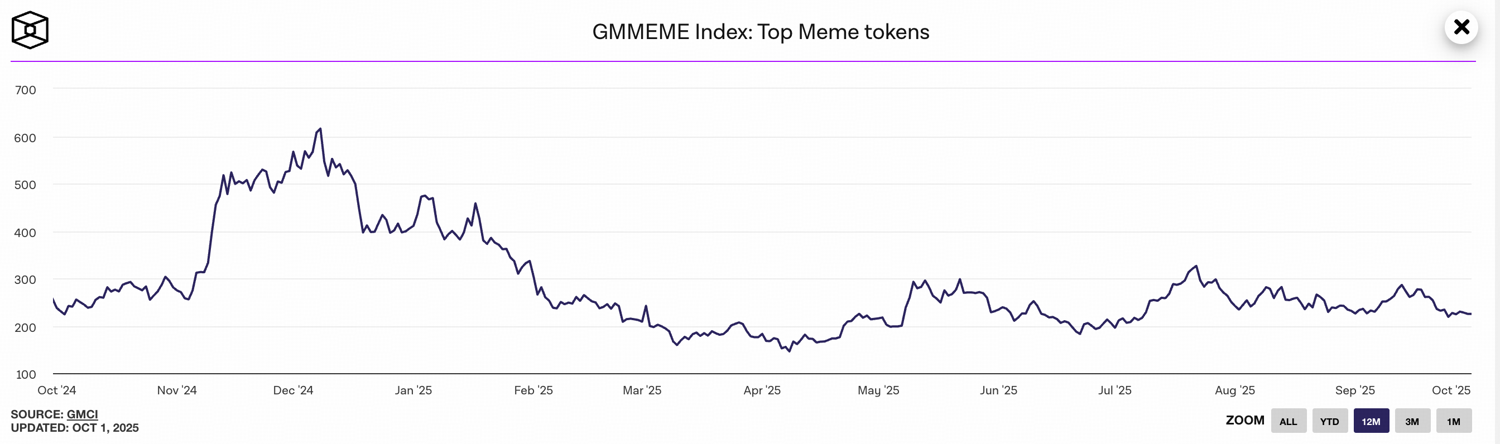
Source: The Block https://www.theblock.co/data/crypto-markets/crypto-indices/gmmeme-index-meme-tokens
Retail traders now appear to be shifting toward projects with tangible utility and revenue potential, such as stablecoins, real-world asset tokenization, and DeFi protocols.
Recent launches like ASTER and XPL have been well received, suggesting memecoins’ role as a retail gateway is giving way to tokens tied to development roadmaps and fundamentals.