
Bitcoin is entering a new bull market. That is our base case as trend and on-chain indicators recover from the 2026 downturn. The more interesting question is how this advance will unfold. The last cycle upswing delivered smaller gains than earlier cycles, and the subsequent decline has so far been considerably shallower. Together, these developments suggest Bitcoin is gradually outgrowing the extreme boom-and-bust pattern that shaped expectations for more than a decade.
The Trend Has Turned
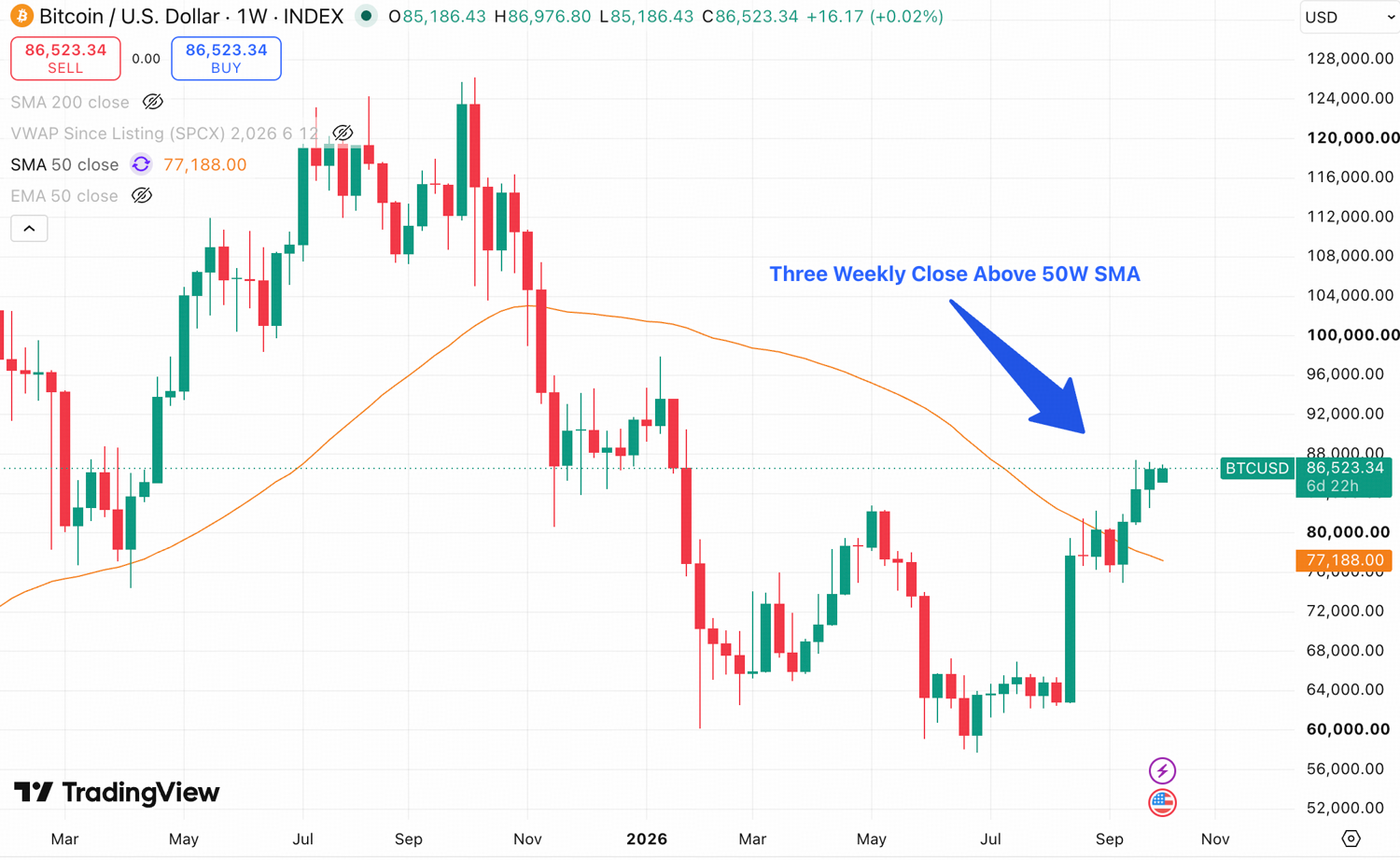
The first evidence comes from a signal we identified ahead of the recovery. In our September 7 research, we outlined two key reference points: the 200-week moving average helps identify where a bear-market bottom may form; the 50-week moving average helps confirm when the trend has turned. During downturns, the 50-week MA often becomes resistance, with recovery attempts repeatedly stalling beneath it. Sustained reclaims accompanied the cycle transitions in 2015, 2019, and 2023.
That recovery has now gained follow-through. Bitcoin reclaimed the 50-week SMA, then around $78,800, at the September 20 weekly close near $81,200. It subsequently closed September 27 near $84,456 and was trading around $86,500 on October 5. The advance has therefore extended beyond the initial breakout into a third completed weekly close. In our view, this persistence significantly strengthens the case that the bear-market low is behind us.
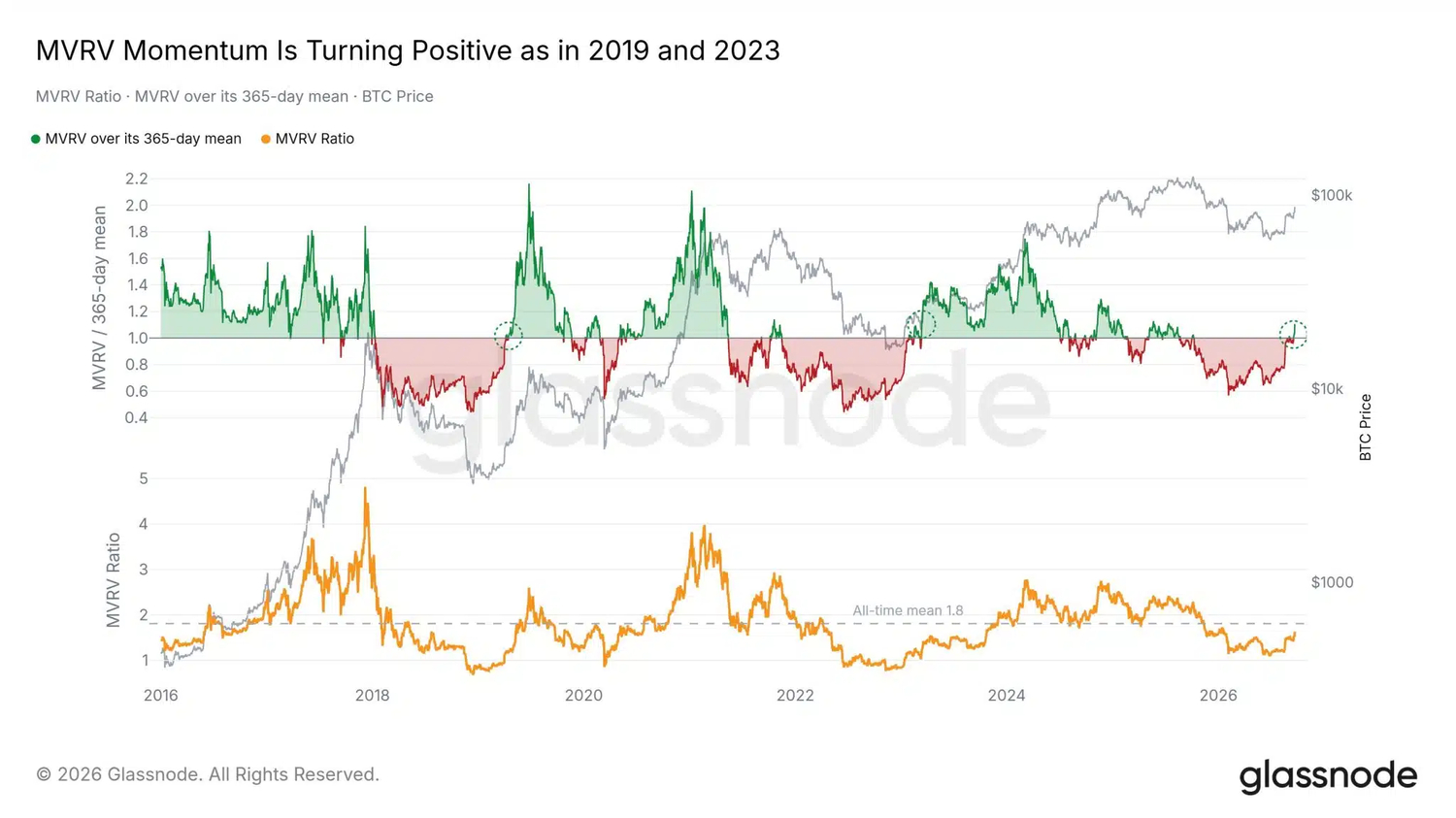
On-chain momentum points the same way. MVRV moved above its 365-day average in September, echoing the transitions of 2019 and 2023. MVRV is market value divided by realized value, the market price set against the average on-chain cost basis of all coins. A reading above its annual average means valuation momentum has recovered above trend, while a reading below means the market is still cheapening relative to its own recent history.
Compressed on Both Sides
Bitcoin's price swings have grown smaller in both its bull and bear markets. The latest downturn is the strongest piece of evidence. Measured on daily closes, Bitcoin declined from $124,824 in October 2025 to $58,525 on 30 June 2026, approximately 53%. That compares with 84.5% in 2013 to 2015, 83.8% in 2017 to 2018 and 76.7% in 2021 to 2022. Assuming June holds, this is the shallowest of the cycle-ending bear markets by a wide margin, and the preceding advance was also the smallest of the four.
Smaller declines follow smaller advances. The trough-to-peak multiple fell from approximately 112 times in the 2015 cycle to 21 times in the 2018 cycle, and to 8 times in the last cycle. The amplitude of the cycle has narrowed on both the upside and the downside, which is what a maturing asset should look like.
Full cycle (through-to-through) | Cycle peak | Trough-to-peak advance | Peak-to-trough decline |
Nov 2011 to Jan 2015 | November 2013 | approximately 530x | 84.5% |
Jan 2015 to Dec 2018 | December 2017 | approximately 112x | 83.8% |
Dec 2018 to Nov 2022 | November 2021 | approximately 21x | 76.7% |
Nov 2022 to Jun 2026 | October 2025 | approximately 8x | 53% |
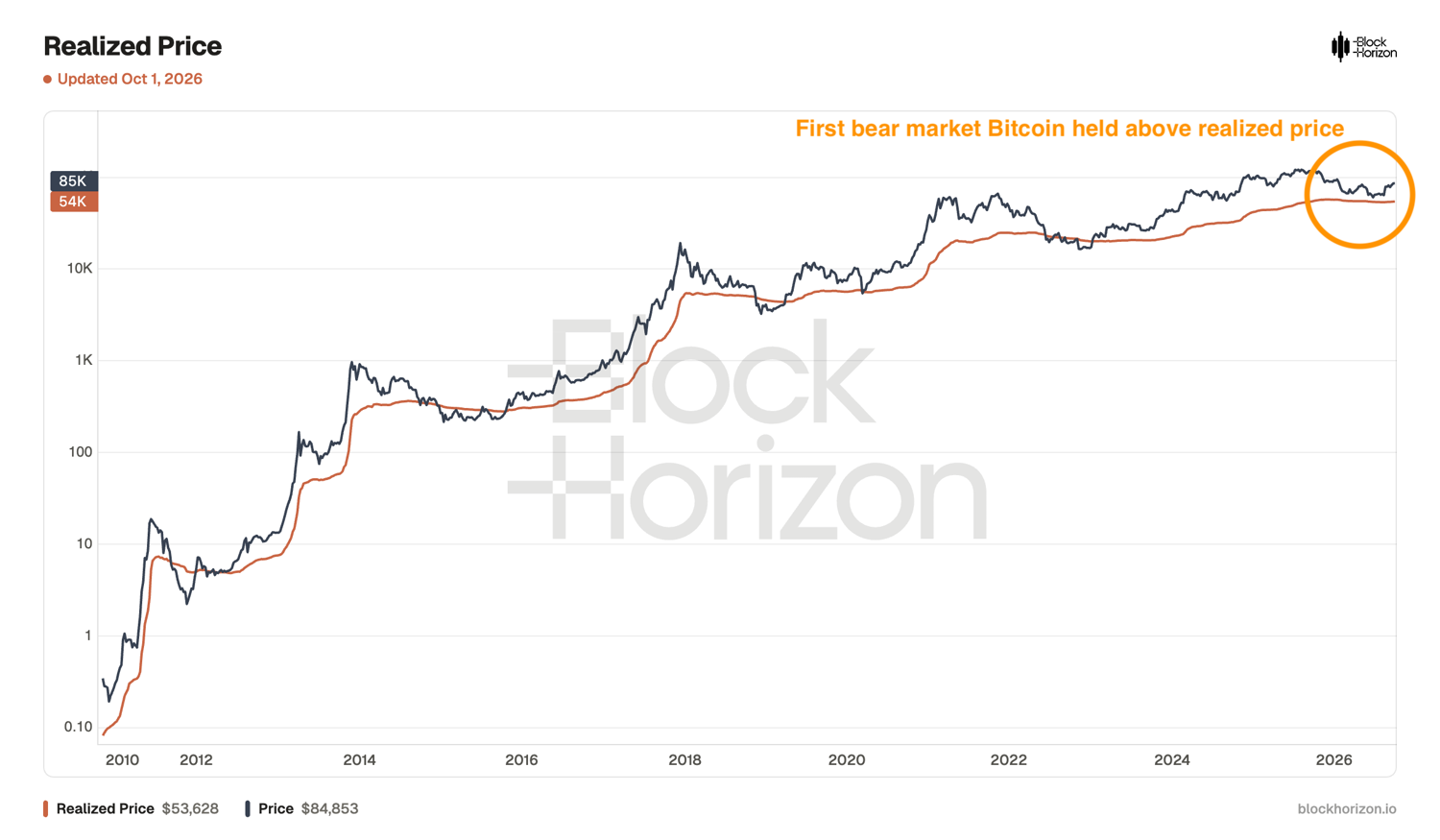
This is also the first bear market in which Bitcoin held above realized price. Realized price approximates the network's aggregate cost basis using the price at which each coin last moved. Bitcoin traded below it in every previous cycle-ending bear market, in 2015, 2018 and 2022. This time it never closed a day below realized price.
Why the Swings Are Narrowing
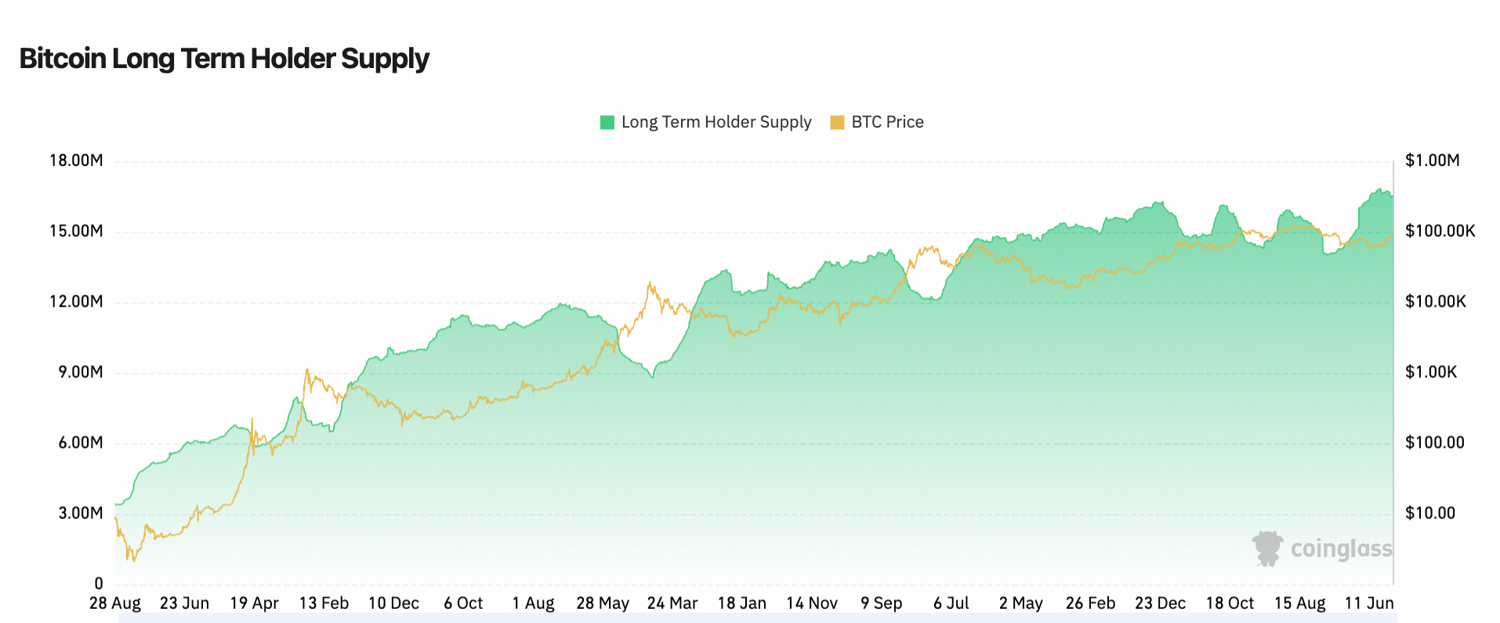
A broader and more patient ownership base is the most plausible explanation. Long-term holders have been on an upward trend throughout Bitcoin history. Coins held for at least 155 days reached about 16.64 million BTC in Sep 2026, roughly 83% of circulating supply.
The ETF investor base proved resilient through the downturn. Headlines about large daily inflows and outflows can obscure the broader picture: US spot Bitcoin ETFs held around 1.3 million BTC on October 2, broadly unchanged from the end of January. Even as Bitcoin experienced a peak-to-trough drawdown of approximately 53%, aggregate ETF holdings remained stable between those dates. Individual investors continued buying and selling, yet the investment-product base retained its overall Bitcoin exposure, a sign of more durable participation beneath the daily flow headlines.
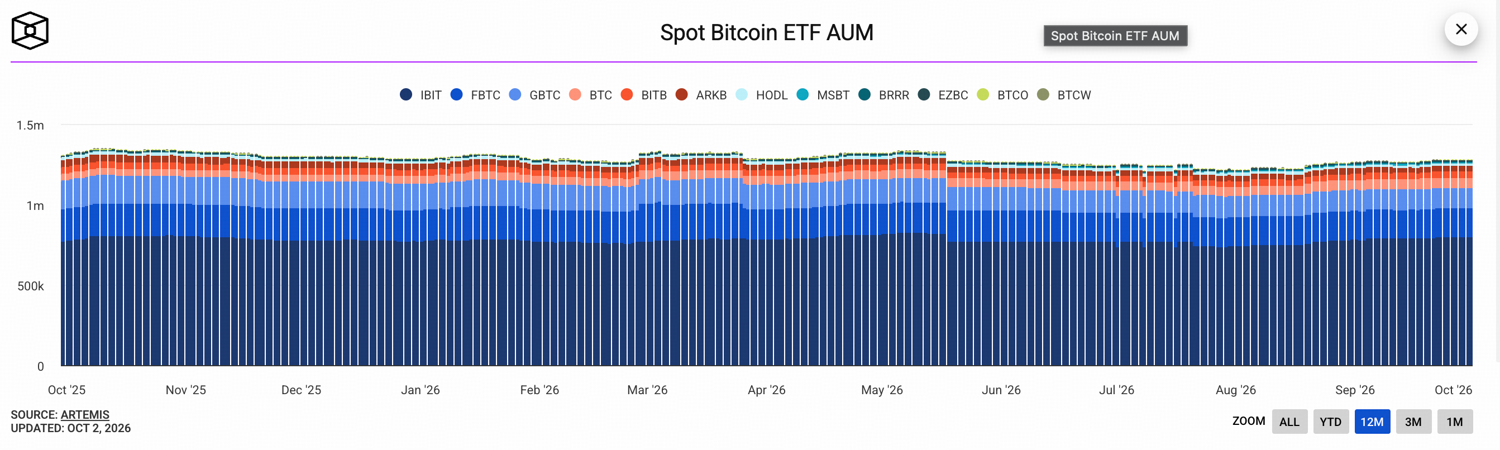
In addition, public companies continued accumulating Bitcoin through the bear market, holding approximately 1.29 million BTC, equivalent to 6.4% of circulating supply. Together with US spot Bitcoin ETFs, the two groups held roughly 13% of all Bitcoin in circulation. Resilient ETF holdings and continued corporate accumulation suggest that a substantial pool of capital maintained its commitment to Bitcoin through falling prices.
No More Boom and Bust
The four-year cycle was widely declared dead in 2025, while Bitcoin was setting all-time highs. The argument rested on new demand. Spot ETFs and corporate treasuries were absorbing supply on a scale no earlier cycle had seen, and that bid looked large enough to override the halving calendar.
The familiar timing nevertheless persisted. Bitcoin’s October 2025 peak arrived roughly 18 months after the April 2024 halving, close to the 17–18-month intervals in prior cycles. A bear market followed.
What changed was the severity and duration of the cycle. The preceding bull market delivered a smaller price multiple, while the subsequent drawdown was considerably shallower. If June remains the cycle low, the bear market also ended about eight months after the peak, compared with roughly 12–13 months in the previous downturns. Following that older timetable would have meant waiting until October or November 2026 for a bottom.
Together, these developments suggest that Bitcoin is gradually outgrowing the traditional boom-and-bust cycle. Its four-year rhythm can remain visible while its influence weakens. Smaller upside multiples, shallower losses and a shorter downturn point toward a market whose extremes are becoming less pronounced.
We expect this evolution to continue. Bitcoin has entered a new bull market, and that the traditional boom-and-bust era is gradually drawing to a close. Sharp corrections will remain part of the journey. A more mature market, however, offers the prospect of an advance with a more durable foundation and less destructive reversals.
Disclaimer: The information provided herein does not constitute investment advice, financial advice, trading advice, or any other sort of advice, and should not be treated as such. All content set out below is for informational purposes only.