
- Treasury buybacks are not QE. U.S. Treasury can not print money. But, the signal is a path to financial repression: the government is trying to hold long yields below the market rate.
- Treasury cannot cap the long rate on its own for a long time. A lasting ceiling requires the Fed to buy bonds and that is QE. A even more radical version was used in 1942–1951, when the Fed just capped long term Treasuries yield at 2.5%.
The U.S. Treasury announced on August 19 that it would at least double the maximum size of its liquidity-support buybacks in the 10-to-20-year and 20-to-30-year bonds, lifting the cap from $2 billion to at least $4 billion per operation.
The news reversed over six months of position unwinding of debasement trade, gold rose roughly 15% in August and bitcoin roughly 25%.
But what exactly is the debasement trade? How can a Treasury buyback program, which does not create money in the way Federal Reserve quantitative easing does, strengthen that thesis? And why is the trade usually expressed through scarce assets such as gold and bitcoin rather than equities?
This article unpacks the logic behind, the role Treasury policy now plays in it, and what is the distinction between hard assets and stocks.
The unwinding of 2025 debasement trade
The debasement trade is a wager that large, ongoing government deficits will eventually be met with easier monetary policy. Persistent fiscal deficits mean the Treasury keeps spending more than it collects and must issue more bonds to finance the spending. Monetary policy accommodation means the Federal Reserve eventually makes that debt cheaper to carry, by cutting rates, slowing balance-sheet runoff, or directly buying Treasuries again, i.e. QE.
If that happens, cash and government bonds lose purchasing power. Investors express the bet by owning scarce assets the state cannot print at will, mainly gold, silver, and bitcoin, and by staying underweight the dollar and long-term Treasuries.
The 2025 version of that trade was more than a simple inflation hedge. It was a bet on fiscal dominance: the idea that deficits would stay large enough that the Fed would ultimately prevent government borrowing costs from rising too far.
However, the assumption cracked when President Trump nominated Kevin Warsh as Fed chair on January, 2026. Warsh had left the Fed Board of Governors in 2011 after questioning the second round of quantitative easing. He later argued that the central bank should shrink its balance sheet more quickly, quantitative tightening rather than renewed expansion. Markets read the nomination as a lower probability that the Fed would absorb fiscal pressure by expanding its balance sheet again.
That repricing drove the unwind in debasement trade in the first half of 2026. Gold fell about 28% from its late-January record near $5,600 an ounce to around $4,000 by late June. Silver dropped more than 50% from its record near $120. Bitcoin traded below $62,000, roughly half its October 2025 high near $126,000.
Long-term bond stress brought the U.S Treasury into the debasement trade
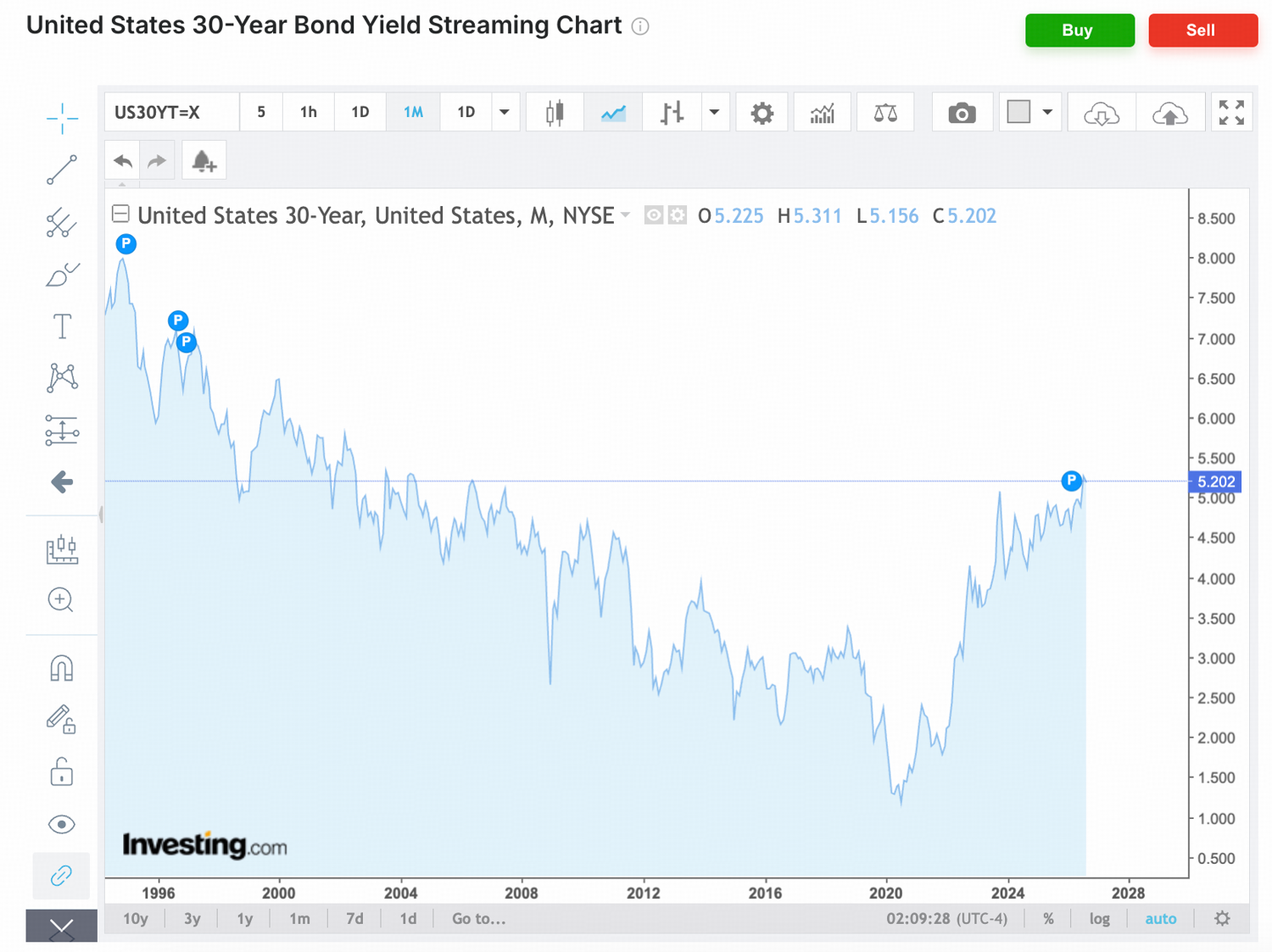
On August 18, the 30-year U.S. Treasury yield reached its highest level since 2007. One day later, Treasury announced that it would at least double the maximum size of its liquidity-support buybacks for long-term bonds.
Source: Investing.com
The timing changed how markets interpreted this. Treasury buybacks had originally been presented as a tool to improve liquidity in older, less actively traded bonds. Announcing a larger program immediately after the 30-year yield reached a nineteen-year high introduced another policy implication: Treasury is increasingly unwilling to tolerate a disorderly rise in long-term borrowing costs.
The Federal Reserve has the strongest influence over short-term interest rates through its policy rate. The 10-year and 30-year yields, however, are driven much more by the market, reflecting expectations for inflation, growth, and the amount of government debt investors are being asked to absorb. When those yields rise, the effect spreads quickly. Mortgage rates move higher, corporate financing becomes more expensive, and the federal government has to refinance maturing debt at higher rates.
For a government already running large deficits and carrying a historically high interest bill, that feedback loop becomes increasingly uncomfortable. Higher yields increase interest expense; larger interest expense adds to future borrowing needs; heavier issuance can then put additional upward pressure on yields.
Treasury buybacks give the government one way to ease that pressure. When Treasury repurchases older long-dated bonds from the market, it creates an additional source of demand for those securities. Bond prices rise when demand strengthens, and yields move in the opposite direction. At the same time, removing some long-duration bonds from private hands reduces the amount of bonds investors need to absorb.
This does not mean Treasury has established a formal ceiling for the 30-year yield. The announcement does, however, give the market a potential policy threshold. If long-term yields move high enough to threaten market liquidity or materially worsen government financing conditions, investors now have more reason to expect a Treasury response.
That change in expectations is what connected the buyback announcement to the debasement trade.
Not QE, but it is the signal
There is one important caveat to the Treasury buyback story: Treasury cannot create money to fund these purchases.
Only the Federal Reserve can create reserve balances. Treasury has to finance every buyback through existing cash, tax receipts, or new borrowing. In practice, that could mean drawing down the Treasury General Account or issuing more short-term bills and using the proceeds to retire longer-dated bonds.
This makes the mechanism very different from quantitative easing.
Under QE, the Federal Reserve buys Treasuries by creating new reserves, the money out of thin air. Its balance sheet expands, bonds is removed from private investors, and the financial system receives additional liquidity in return. Treasury buybacks do not work this way.If Treasury issues short-term bills to fund purchases of long-term bonds, the government is largely exchanging one form of debt for another.
The direct liquidity impact is therefore much smaller. The policy signal, however, can still be significant.
If markets begin to believe that Treasury will respond whenever borrowing costs rise too far, then investors may start pricing an implicit degree of support into the long end of the curve. That is where the concept of financial repression becomes relevant.
Financial repression
Financial repression broadly describes policies that keep government borrowing costs below the level the market might otherwise demand, especially when public debt is high. The objective does not need to be an explicit yield cap. It can also emerge through debt-management policies, regulation, balance-sheet tools, or issuance choices that reduce upward pressure on government borrowing costs.
For investors, the key issue is the real return on government debt.
If inflation remains relatively sticky while policy increasingly resists higher nominal yields, real yields become less attractive. Bondholders are effectively being asked to accept a lower inflation-adjusted return, which makes scarce assets more competitive.
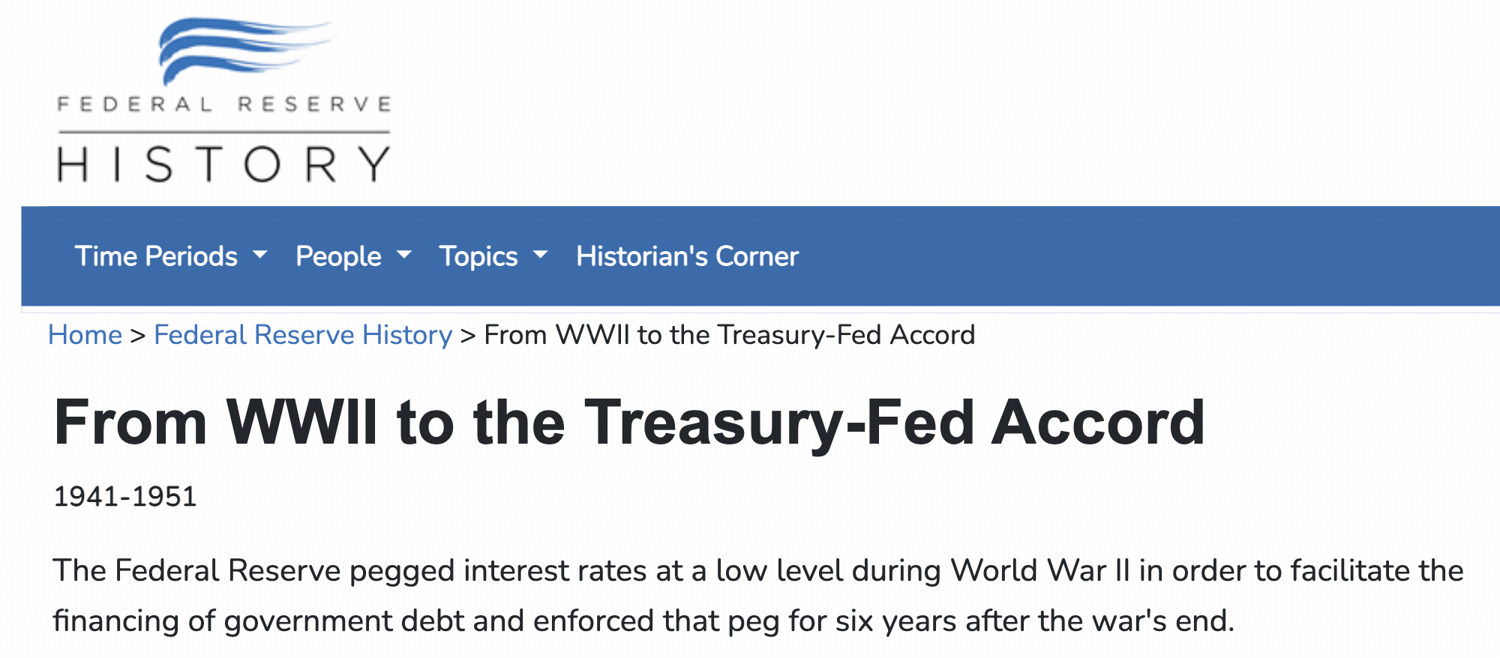
The clearest U.S. example came during and after World War II. From 1942 to 1951, the Federal Reserve maintained a 2.5% ceiling on long-term Treasury yields to help the government finance wartime debt at manageable rates. Inflation later rose sharply, meaning holders of government bonds experienced deeply negative real returns.
Japan offers a more recent example. Under yield-curve control, introduced in 2016, the Bank of Japan actively managed longer-term government-bond yields within a specified range. The objective and economic environment were different, but the underlying mechanism was similar: long-term government borrowing costs became increasingly influenced by policy rather than being left entirely to market pricing.
A $4 billion Treasury buyback operation is too small to enforce a meaningful ceiling on the 30-year yield, and Treasury itself does not have the monetary capacity to defend a target indefinitely. Sustained control over long-term rates would eventually require much larger interventions or cooperation from the Federal Reserve.
The significance lies in the direction of policy. If rising long-term yields increasingly trigger Treasury intervention, larger buybacks, shorter-duration issuance, or eventually support from the Fed, the market may begin to price a greater probability of financial repression ahead.
Why the Debasement Trade Favors Gold and Bitcoin Over Equities?
Stocks aren't a pure debasement hedge because they're tied to the same system. Companies earn and report in fiat dollars, governments can tax them, regulate them, or force banks and insurers into Treasuries. Moderate inflation can be fine for stocks, especially firms with pricing power. Heavy inflation plus financial repression is different: real equity returns often compress even when indexes look “up” in nominal dollars.
Hard assets play a different role. Gold, silver, and Bitcoin are valued partly because their supply is difficult or impossible for governments to expand at will.
Stocks can grow with the economy, which is great, but they don't protect you the same way when the currency itself is being diluted. That's why the "debasement trade" specifically calls out these hard assets.
Disclaimer: The information provided herein does not constitute investment advice, financial advice, trading advice, or any other sort of advice, and should not be treated as such. All content set out below is for informational purposes only.