
Gold (XAUUSDT) usually moves against interest rates. When rates are high, holding a metal that pays no interest costs more, so gold tends to perform poorly. However, for three years from 2023 to 2025, gold ignored this common rule in macro.
From 2023 to 2025, gold rose from about $2,000 to above $4,000 while US rates stayed high. The 10-year Treasury yield stayed around 4% or higher most of the time during that period, and gold still doubled its price.
This year the rule seems to be working again. After a blow-off top at over $5,000 per ounce, gold fell back to the current around $4,000 with the Fed restarted raising interest from September for the first time since 2023.
The rule probably never stopped working. The gold price is set by the marginal buyer and the marginal seller, whose decisions are now driven by different considerations.
Why High Rates Could Not Hold Gold Down
Higher rates did hurt gold. Western investors did what the rule predicts and sold. Global gold ETFs lost about 244 tonnes in 2023. ETF holdings were roughly flat in 2024, down 6.8 tonnes. In 2025, ETF investors turned buyers, but by then central banks and Asian buyers had already pushed the price higher. Western ETF money followed a rally that other buyers had started.
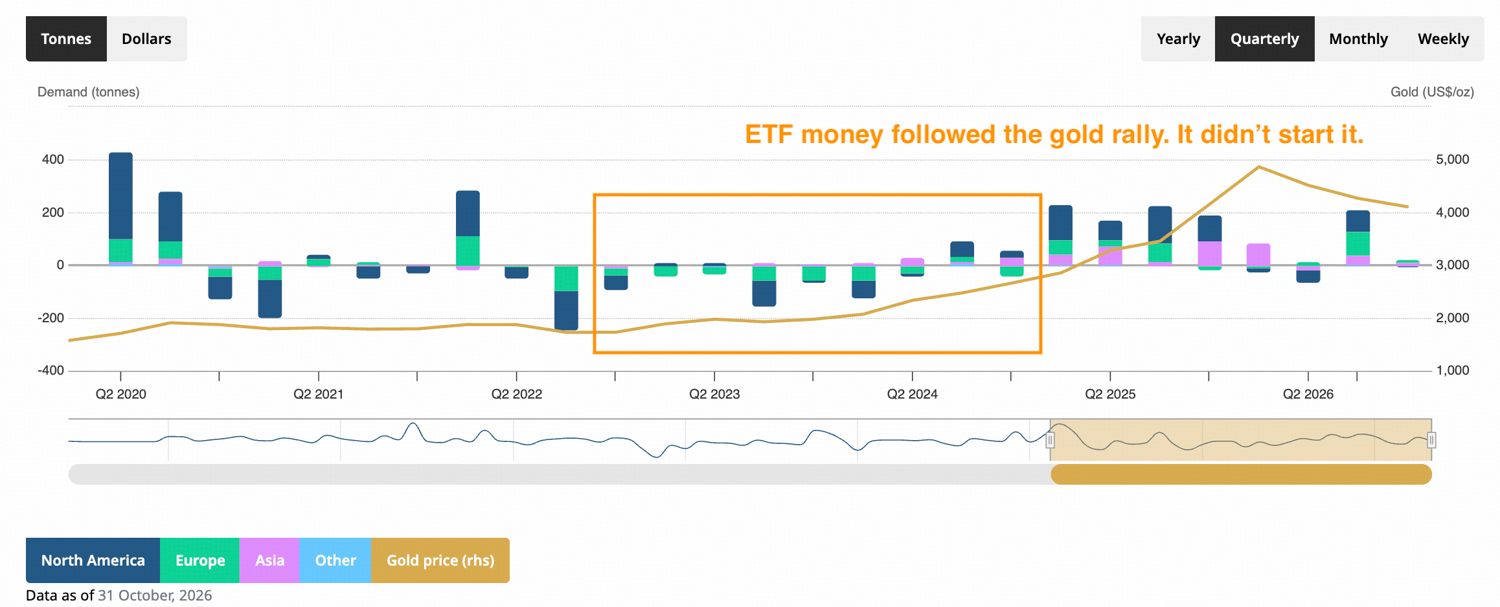
Central banks began diversifying their reserves away from the dollar and into gold. They bought more than 1,000 tonnes of gold a year from 2022 to 2024, more than double their 2010–2021 average of 473 tonnes, and another 863 tonnes in 2025.
Asian retail buyers also stepped in. Global bar and coin demand hit a 12-year high of 1,374 tonnes in 2025, with most of it coming from Asia. These buyers care about diversification and safety more than yield, so higher rates did little to stop them.
So rates were weighing on gold the whole time. The buying from central banks and Asia was big enough to set the marginal price.
Why Rates Matter Again in 2026
The main change in 2026 is real yields. The 10-year TIPS yield, the return on inflation-protected Treasuries after inflation, traded between about 1.5% and 2.3% through 2024 and 2025. Gold (XAUUSDT) could rally inside that range because a 2% real return was not enough to pull much money away from it. The capital drawn into Treasuries at those yields was smaller than the diversification demand from central banks and investors, so diversification buyers set the marginal price.
The real yield crept higher in the first half of 2026, but the breakout came in September, when it moved above that range. It peaked near 2.9% in early October and was 2.60% on November 5. That is when gold came under real pressure, falling from about $4,600 to about $4,000.
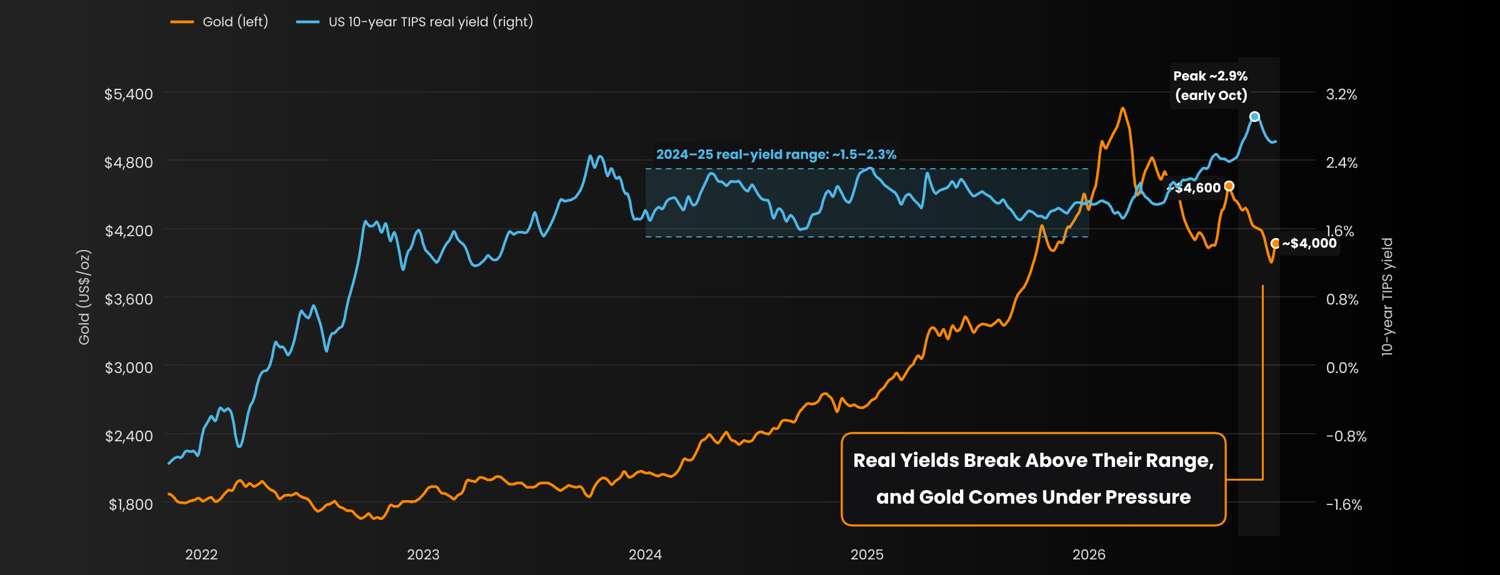
A real yield near 3% changes the math for gold holders. An investor can now lock in close to 3% above inflation in a government bond, while gold pays nothing. Every extra point of real yield raises the cost of holding gold and pulls more capital toward Treasuries.
That shift changed who sets the marginal price.
Diversification buyers have not stopped. ETF holdings hit a record 4,275 tonnes in October, and central bank buying reached a 2026 high. However, the capital now drawn by real yields is large enough to outweigh them, so rate-sensitive money sets the price again. Central bank buying can slow the fall, but it cannot drive the price higher on its own. At about 1,000 tonnes a year, central banks spend roughly $130 billion, around 0.5% of a $30 trillion gold market. Their buying tends to pick up as prices fall, which helps build a floor near $4,000.
The Fed added to the pressure. When gold peaked in January, markets expected rate cuts this year. Instead, the Fed hiked to 3.75%–4.00% in September, and futures now put the odds of another hike on December 9 at around 70%.
What Would Bring Gold's Edge Back
Gold's (XAUUSDT) long-term thesis never changed. Under fiscal dominance, a heavily indebted government has only one way out: reduce the real value of its debt over time. That means some form of financial repression, such as holding interest rates below inflation so that savers slowly lose ground.
In the short to medium term, however, the pressure from real yields is also real. If real yields keep rising from here, gold can fall further.
Still, there are early signs that the rise in real yields may be losing momentum. A major part of this year's rise in long-term yields came from AI spending. Fast-growing capex pushed hyperscalers, AI labs and data center operators to borrow heavily, and bond markets had to absorb that debt. Alphabet, Amazon, Meta, Microsoft and Oracle alone issued about $220 billion of bonds in the first eight months of 2026, more than double their 2025 total. That financing demand may now be near its peak according to institutional analysis and prominent tech investors. Goldman Sachs and investor Gavin Baker both expect AI companies' external financing needs to top out around 2027. (Source: https://www.goldmansachs.com/insights/goldman-sachs-exchanges/how-ai-debt-is-reshaping-the-credit-market)
High yields are also starting to tighten financial conditions. Yields on CCC-rated bonds have reached about 18%, a sign that weaker borrowers are struggling to fund themselves. Each further rise in long-term yields now carries a larger cost to the economy, which makes it harder to sustain.
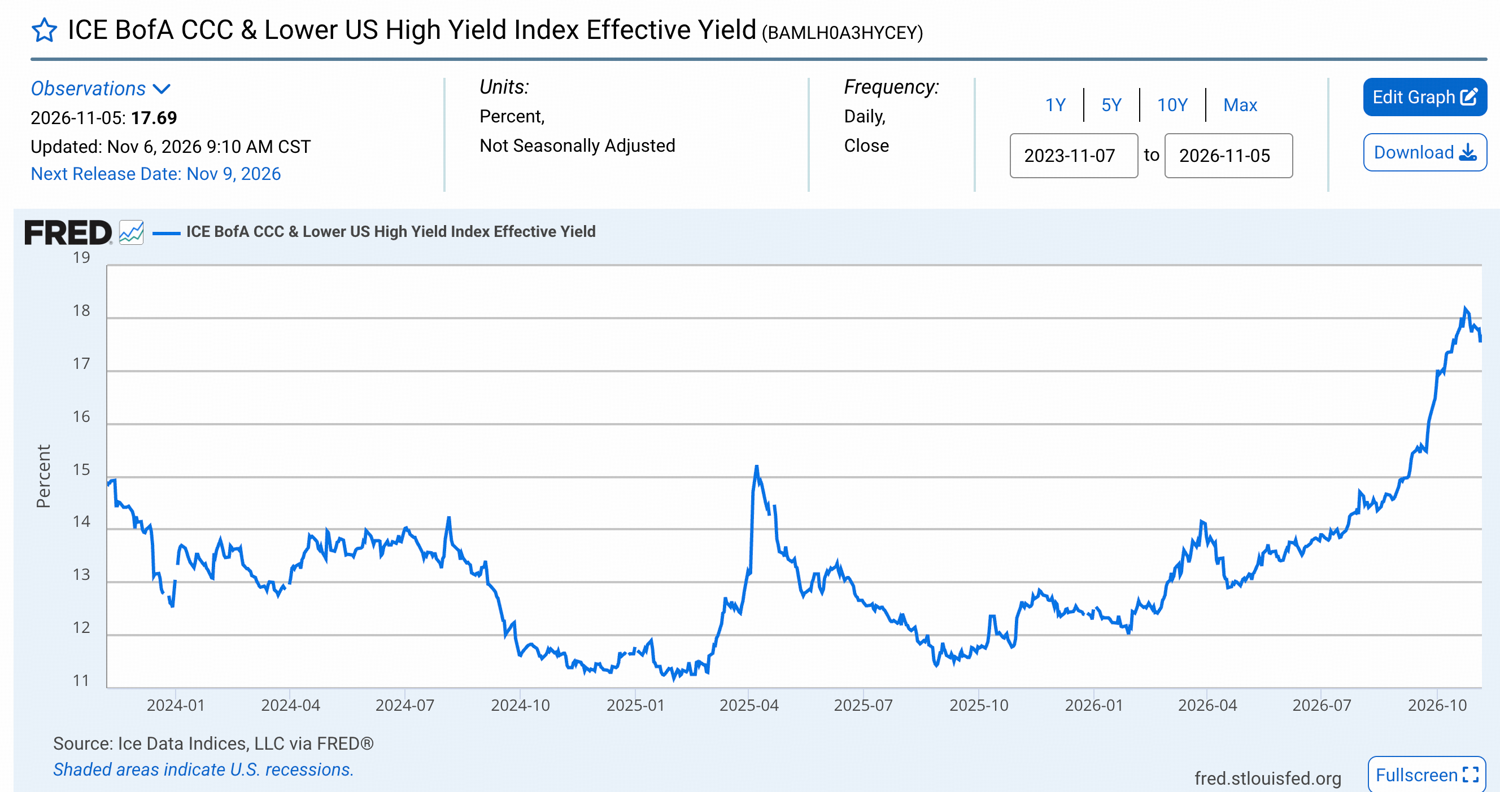
The AI investment boom has added to the upward pressure on real yields. As financing demand nears a potential peak and tighter financial conditions start to bite, the balance of risks may be shifting toward lower real yields, a potentially supportive backdrop for gold.

Disclaimer:This information is provided "as is" for general informational purposes only, without warranty as to accuracy or completeness. It is not financial advice or an offer or solicitation to buy or sell any digital assets or financial instruments. You are responsible for evaluating the risks, conducting your own research, and seeking independent professional advice.