
The case for raising interest rates to fight inflation rests on a chain of assumptions that held for four decades. Our view is that two separate forces have broken that chain, making rate hikes a far less effective tool against today’s inflation.
First, much of the inflation the Fed is fighting now originates outside the channels that rate policy can easily reach. Second, the debt stock has grown so large that higher rates increasingly transfer income into the private sector through interest payments.
The first weakens the effectiveness of rate hikes. The second can make them counterproductive.
How Rate Policy Is Supposed to Work
The Federal Reserve does not directly set every interest rate in the economy. Its main policy tool is the short end of the curve, the federal funds rate, the overnight rate at which banks lend reserves to each other. By raising or lowering this rate, the Fed changes the starting point for the entire interest-rate structure. Short-term Treasury yields usually adjust first, while longer-term yields respond through expectations about future policy, inflation, growth, and risk premia.
In theory, higher policy rates fight inflation by tightening financial conditions. They make borrowing more expensive for households, companies, and governments; they reduce the present value of future cash flows, weighing on asset prices; they strengthen the incentive to save rather than spend; and they slow credit creation. As demand cools, businesses find it harder to raise prices, wage pressure softens, and inflation is supposed to move back toward target.
When Inflation Comes From Supply
Rate hikes work best when inflation is mainly demand-driven. If households are borrowing aggressively, companies are expanding too quickly, and spending is running ahead of supply, higher rates can cool the economy through the credit channel. They make loans more expensive, reduce discretionary demand, weaken asset prices, and slow investment.
That is a poor tool for the inflation problem the Fed faces today. The current inflation uptick is being driven mainly by energy, tariffs, and geopolitically sensitive input costs. Higher overnight rates do not create more oil, remove tariffs, reopen disrupted shipping routes, or make critical materials cheaper. They can only reduce demand enough to offset part of the price pressure, which means fighting supply inflation by weakening the real economy.
If inflation is coming mainly from energy, tariffs, and geopolitically driven input costs, rate hikes become a blunt instrument. They may lower inflation eventually, but the mechanism is economic pain rather than a direct solution to the source of the pressure.
When Higher Rates Become Pro-Liquidity
The more important problem is fiscal. Supply-driven inflation explains why rate hikes have limited reach over the source of today’s price pressure. But the debt problem goes further: it can change the direction of the policy effect itself. At today’s debt levels, higher rates do not only restrain the economy through tighter credit. They also increase the government’s interest payments to the private sector, turning part of monetary tightening into a fiscal income transfer.
The U.S. government is now paying over $1 trillion a year in interest expense, around 14% of total federal spending. As older debt matures and gets refinanced at higher rates, that interest bill rises further. A larger interest bill widens the deficit, and unless the government cuts spending or raises taxes elsewhere (which are both quite unlikely), it has to issue more debt to fund the gap.
Federal Government Interest Payments
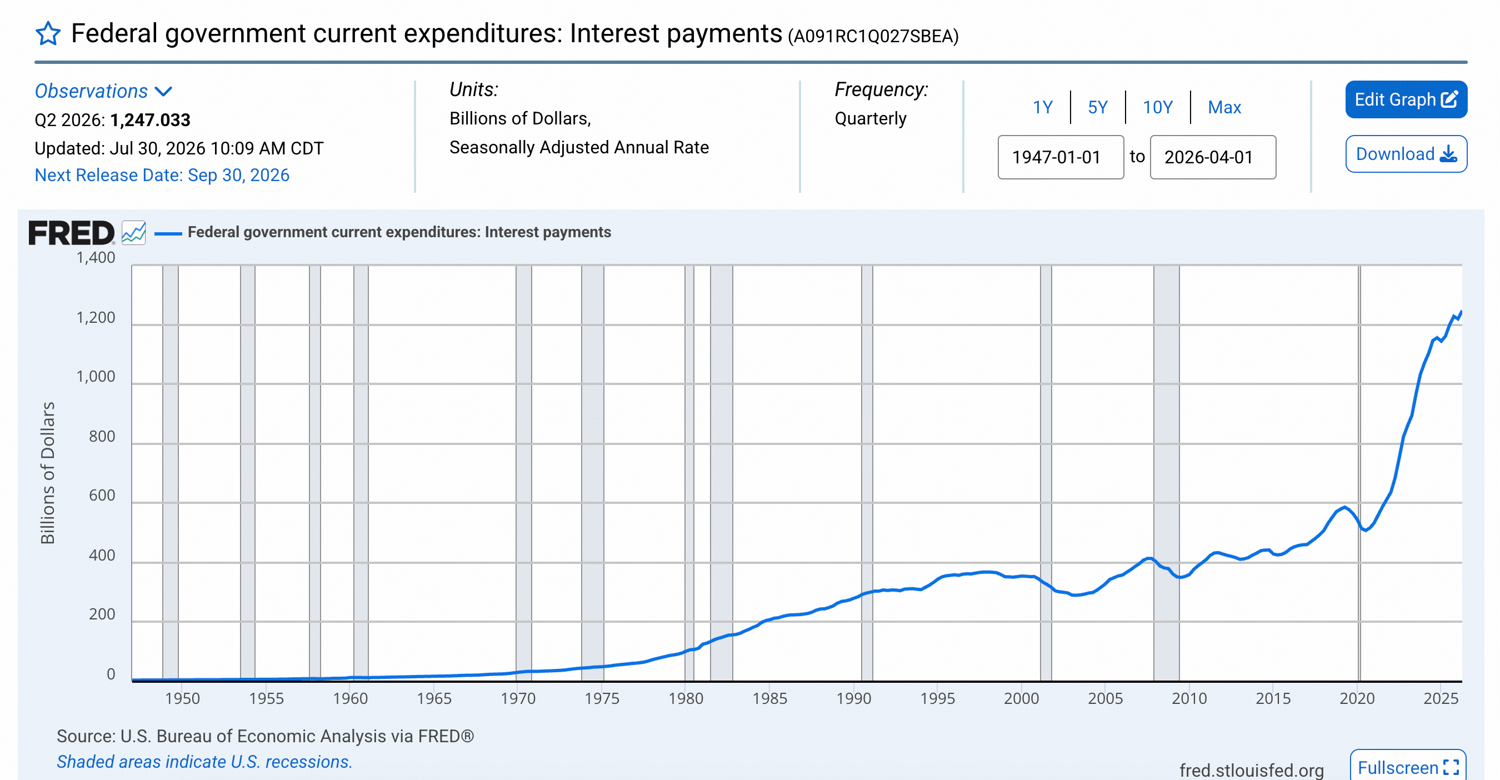
That changes the effect of monetary tightening. Higher rates still pressure borrowers, but they also increase income for Treasury holders: pension funds, banks, money-market funds, insurance companies, households. Those interest payments flow into the private sector, where they can be spent, saved, or reinvested. At today’s debt level, the income-transfer effect is large enough to offset part of the tightening the Fed is trying to create.
This view moved from market commentary into official literature. The BIS 2026 Annual Economic Report argues that high public debt makes monetary policy transmission more complex: rate hikes increase government interest payments, transfer income to bondholders, support demand, and weaken the contractionary effect of policy. Its related working paper, Public debt and monetary policy transmission, finds that high public debt is associated with a weaker response of inflation and inflation expectations to tighter monetary policy, while output still falls at least as much as in lower-debt economies. In plain English: the economy still takes the hit, but inflation becomes harder to bring down. (Source: https://www.bis.org/publications/working-paper-1365-public-debt-and-monetary-policy-transmission-evidence-advanced-and-emerging-europe)
This is why higher rates can become pro-liquidity in the current environment. The Fed raises the short rate to slow demand, while the Treasury’s interest bill sends more income to the private sector and forces more debt issuance. The result is a feedback loop: higher rates raise fiscal costs, higher fiscal costs increase borrowing needs, and the interest payments themselves support private-sector income.
Disclaimer: The information provided herein does not constitute investment advice, financial advice, trading advice, or any other sort of advice, and should not be treated as such. All content set out below is for informational purposes only.