
What Are Tokenized Securities and How Do They Work?
Tokenized securities are essentially digital tokens that represent ownership of traditional financial assets (like stocks or bonds) on a blockchain. In simple terms, tokenization means taking a real-world asset and converting it into a digital token that can be traded on blockchain. For example, instead of holding a paper stock certificate or an entry in a broker’s database, an investor could hold a crypto token that stands for a share of a company. These tokens are backed by the actual asset and confer the same ownership rights – they are just a new digital wrapper for the asset
At a high level, tokenized securities work by tying real assets to blockchain-based tokens. Here’s a step-by-step overview of how they are typically backed, issued, and traded:
- Underlying Asset and Custody: A trusted entity (for example, a financial company) secures the real-world asset that will be tokenized. If it’s a stock, this means buying actual shares of the company and holding them in custody. The tokens are usually fully collateralized 1:1 by the underlying asset, meaning each token corresponds to one share (or a fraction of a share) held in reserve. A licensed custodian (often a bank or regulated firm) holds the actual stocks or assets in a trust. This ensures that the token has real value behind it.
- Token Issuance on a Blockchain: The issuer then creates digital tokens on a blockchain platform to represent those assets. This often involves smart contracts – self-executing code on the blockchain – that manage the token’s properties (like total supply and redeemability). The tokens are issued in compliance with applicable laws (for instance, some platforms follow specific regulatory frameworks like Switzerland’s DLT Act). The result is a crypto token (often following standards like Ethereum’s ERC-20) that legally or contractually corresponds to the real asset in custody.
- Trading the Tokens: Once issued, these security tokens can be traded just like cryptocurrencies, either on specialized exchanges or sometimes on decentralized finance (DeFi) platforms. Holders can buy or sell tokenized stocks 24/7 on supported exchanges or peer-to-peer, without needing a traditional stockbroker. The price of the token is designed to closely track the price of the underlying asset.
Overall, the system relies on trust in the issuer/custodian. The blockchain records who owns the tokens, and transfers are transparent and quick. Meanwhile, the custodian guarantees that for every token in circulation, the corresponding real asset is held in reserve.
Stablecoins and Tokenized Securities: Unlocking Global Access to U.S. Markets
For many investors outside the United States, gaining exposure to U.S. stocks has long been difficult. High fees, regulatory restrictions, limited access to brokerage accounts, and inconvenient trading hours have created significant friction, especially for retail investors in emerging markets. While U.S. equities remain among the most sought-after assets globally, the traditional financial system offers few seamless and inclusive pathways for international participation.
This is where blockchain-based innovation is beginning to fill the gap. The combination of tokenized securities and stablecoins offers both access and infrastructure: tokenized stocks—such as Apple or Tesla shares issued by platforms like Backed Finance and Securitize—allow investors to gain exposure to real U.S. equities on-chain, often in fractional amounts and without the need for a traditional brokerage. Meanwhile, stablecoins like USDC or USDT serve as a borderless medium of exchange, enabling near-instant, low-cost settlement of these securities across time zones and jurisdictions.
As stablecoin regulation in the U.S. progresses—highlighted by the recent advancement of the GENIUS Act in the Senate—markets are optimistic that a clear legal framework could accelerate the convergence of tokenized finance. With compliant stablecoins facilitating frictionless global payments and tokenized securities providing transparent access to U.S. assets, a liquidity loop may finally be emerging—one where capital can move, invest, and settle entirely on-chain, across borders and without legacy gatekeepers.
Backed Finance
Tokenized securities have moved from theory to practice in recent years, with a few notable projects leading the way. One recent example is crypto exchange Kraken’s launch of tokenized stocks. In May 2025, Kraken announced it would offer more than 50 tokenized U.S. stocks and ETFs (exchange-traded funds) – including big names like Apple (AAPL), Tesla (TSLA), and Nvidia (NVDA) – to customers outside the United States.
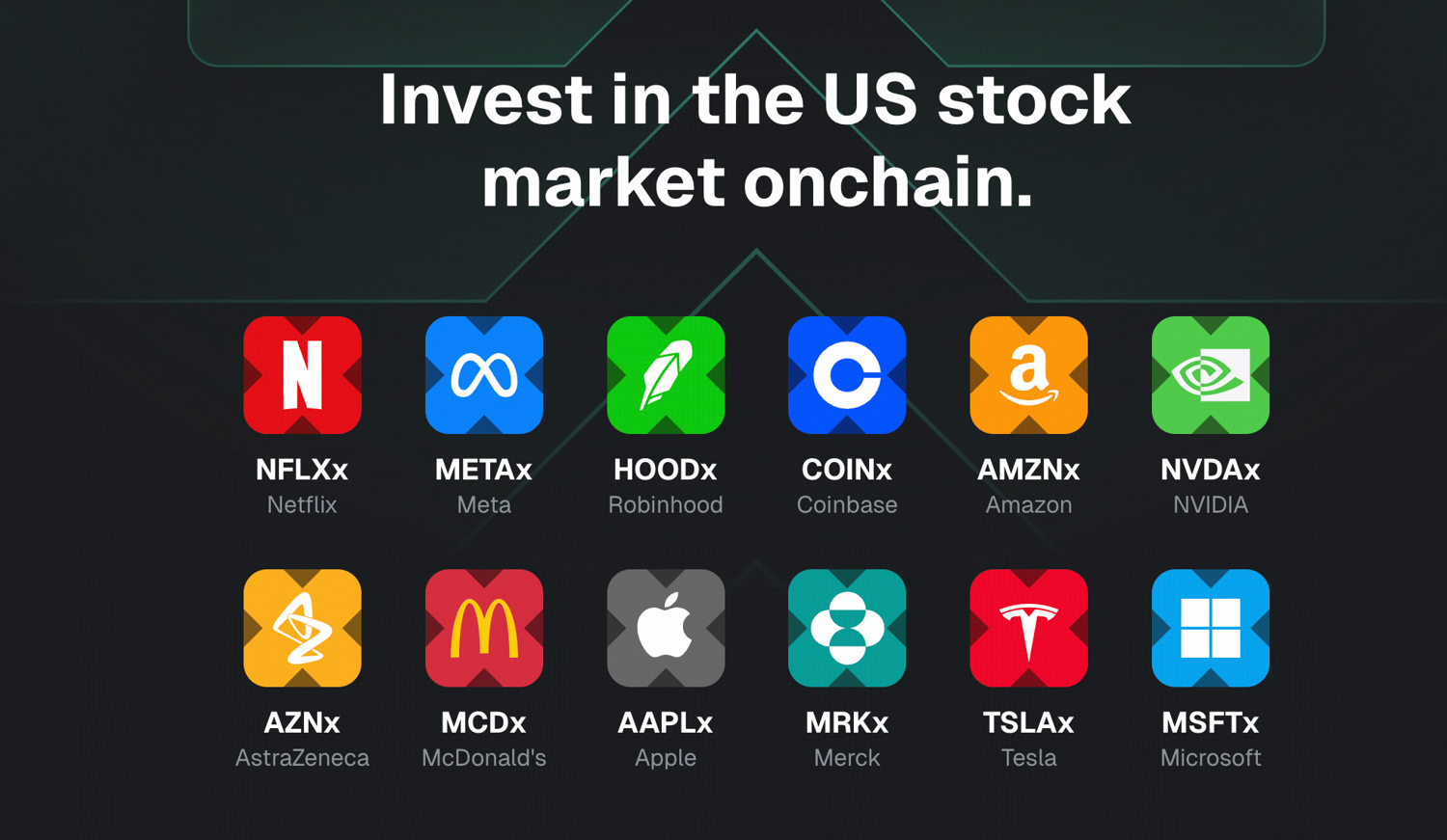
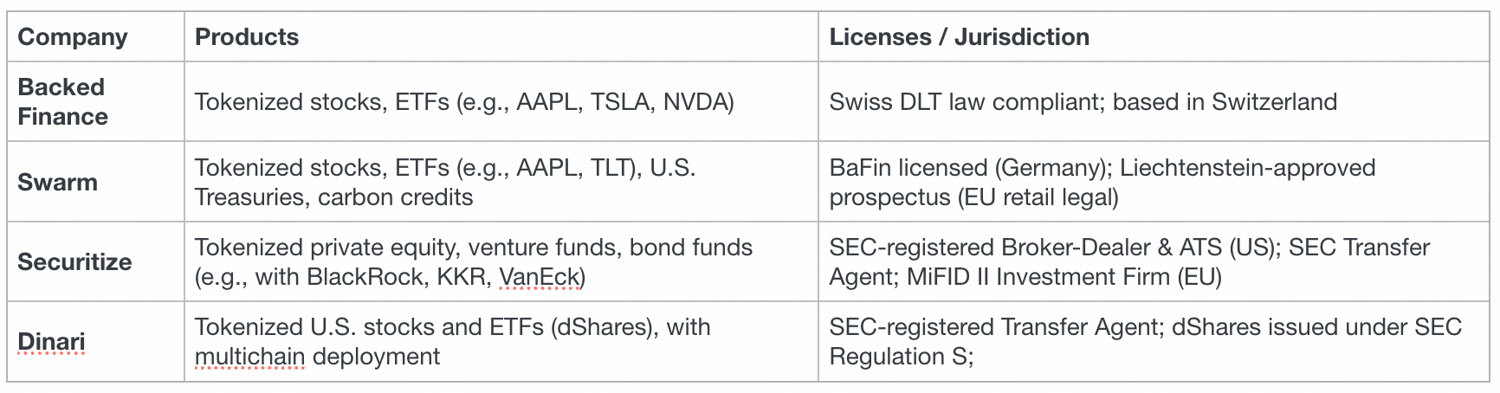
A key player in Kraken’s offering – and in the tokenized securities space – is Backed Finance. Backed Finance is a Swiss-based fintech firm that specializes in tokenizing real-world assets (stocks, bonds, indexes, etc.) into freely tradable tokens. In the Kraken initiative, Backed Finance issues the corresponding tokens on-chain. Each Backed token (such as their “APPLx” for Apple or “TSLAx” for Tesla) is fully collateralized by the underlying stock share, held by a licensed custodian.
These xStocks issued through Backed are freely transferable tokens. This means they’re not locked to a single platform, users can hold them in self-custodial wallets. Beyond basic trading on centralized exchanges, xStocks can be used across decentralized exchanges (DEXs) and integrated into lending protocols.
Source: https://backed.fi/
Operating under the Swiss DLT Act, Backed ensures that all tokenized assets comply with regulatory standards. The platform utilizes licensed custodians to hold underlying assets and has integrated Chainlink's Proof of Reserve to provide transparent verification of asset backing.
Swarm
Swarm is a European-based blockchain platform that bridges traditional finance and decentralized finance (DeFi). It allows real-world assets to be converted into digital tokens and traded 24/7 on decentralized exchange, all while remaining fully compliant with financial regulations.
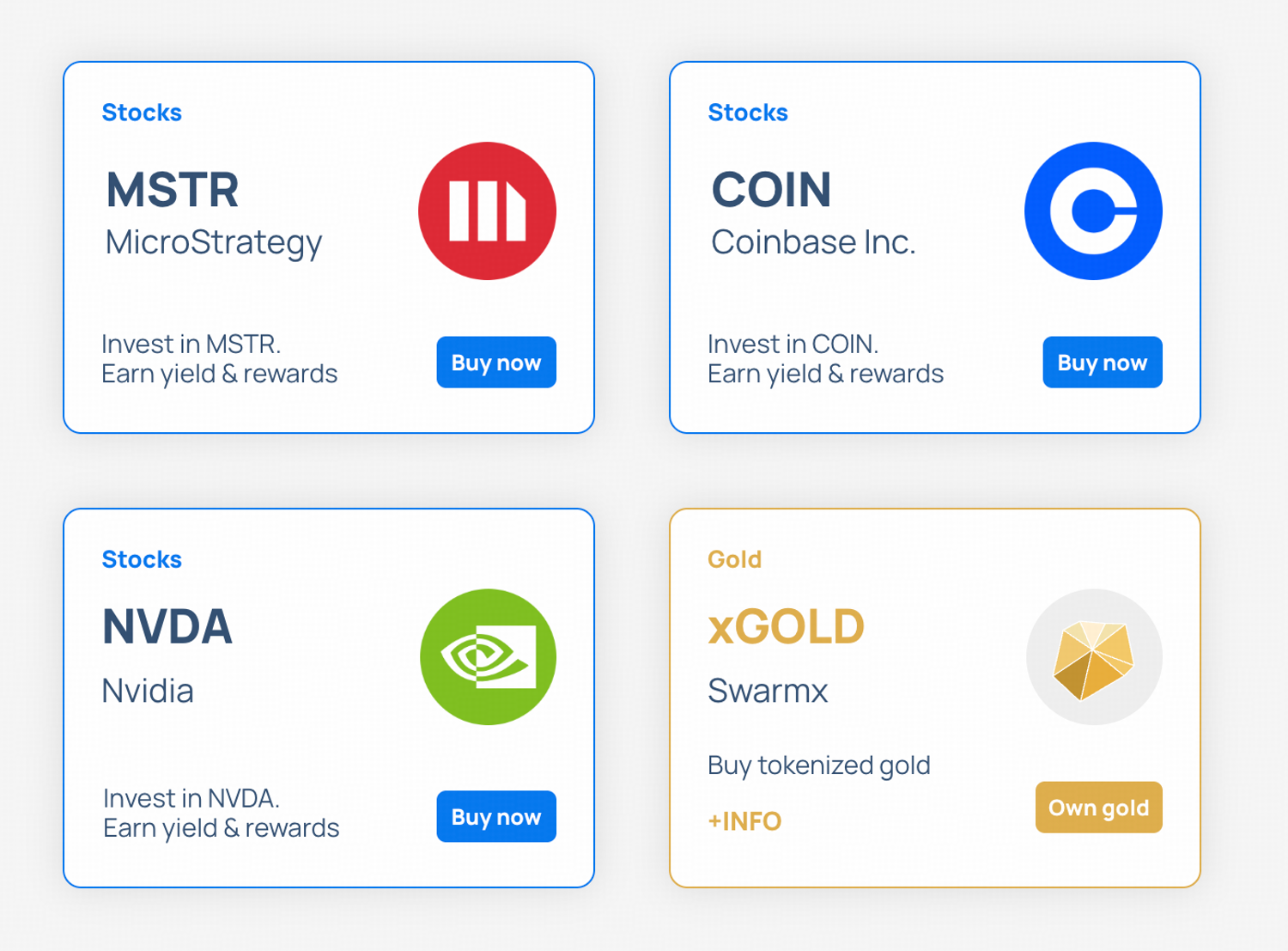
Swarm can tokenize a wide range of assets – including publicly traded stocks, bonds, real estate, and even niche assets like carbon credits. In practice, the platform has launched tokenized versions of popular tech stocks (e.g. Apple, Tesla, Intel) as well as short-term U.S. Treasury bond funds (via iShares ETF products).
Source: https://swarm.com/#:~:text=Tokenize%20your%20assets
Swarm is based in Germany and operates under the supervision of Germany’s financial regulator, BaFin. The platform’s regulatory structure is European—its tokenized securities even have an approved prospectus in Liechtenstein, enabling Swarm to offer these digital assets to retail investors across the EU with no minimum investment.
Dinari
Dinari is a U.S.-based fintech company, aiming to democratize access to U.S. equities through blockchain technology. The platform offers tokenized representations of real-world assets (RWAs), such as stocks and ETFs, allowing non-U.S. investors to engage with American financial markets seamlessly.
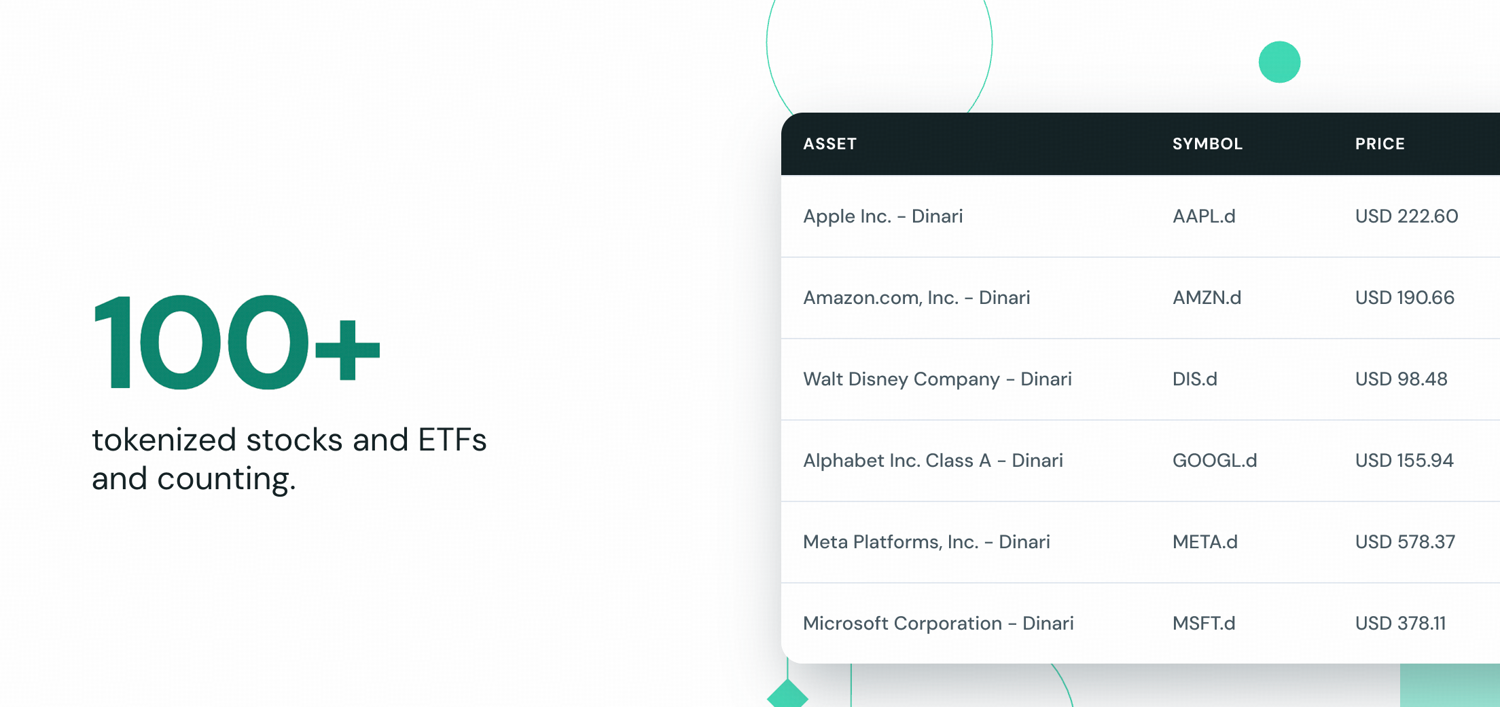
Dinari's primary offering, dShares, are ERC-20 tokens that represent fractional ownership of real-world assets, including U.S. stocks and ETFs. Each dShare is fully collateralized, maintaining a 1:1 backing with the corresponding underlying asset. The issuance and redemption of dShares are managed through automated smart contracts and partnerships with clearing services.
Source: https://dinari.com/
Dinari operates with a strong emphasis on regulatory compliance. The company is a registered Transfer Agent with the U.S. Securities and Exchange Commission (SEC), ensuring that its operations align with established financial regulations . By issuing dShares under SEC Regulation S, Dinari caters to non-U.S. investors while maintaining adherence to U.S. securities laws.
Beyond individual investors, Dinari offers solutions for businesses seeking to integrate tokenized assets into their platforms. Through its comprehensive API and developer tools, companies can incorporate dShares into their applications.
Securitize
Securitize is a U.S.-based fintech company and one of the leading platforms in tokenized securities. It provides a fully digital, regulated platform for issuing and trading digital asset securities – essentially turning traditional financial assets (like stocks, bonds, or investment fund shares) into blockchain tokens that can be easily bought and sold.
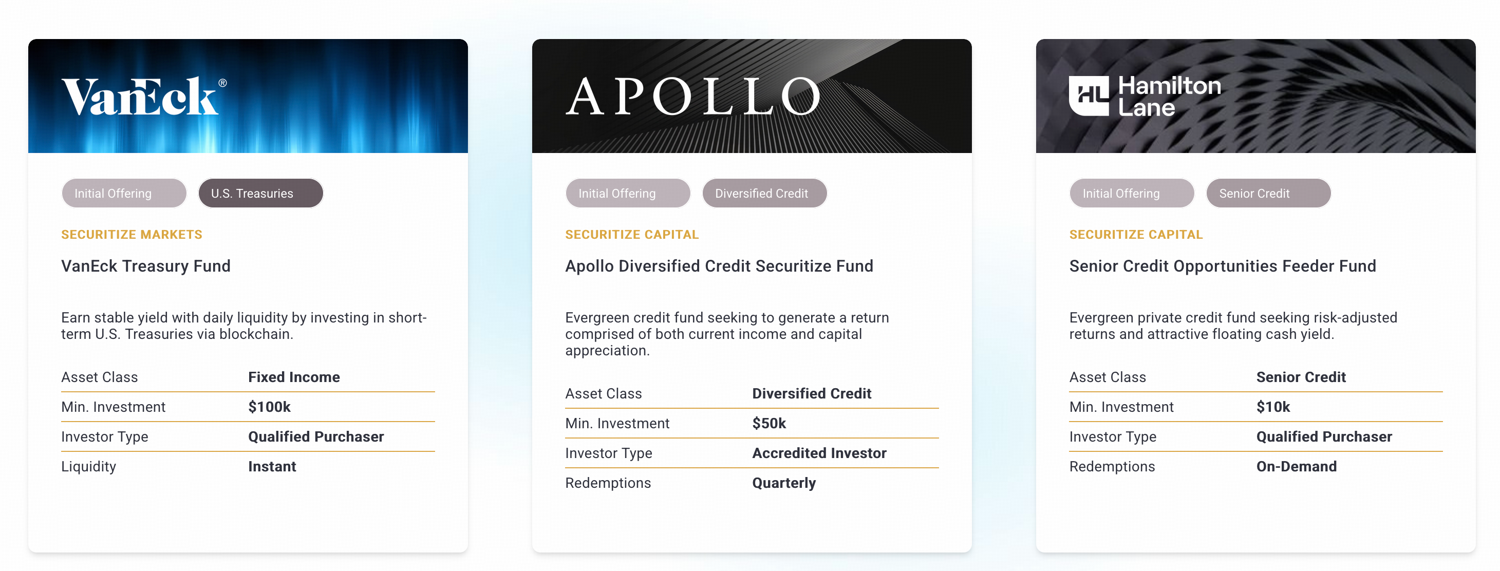
Securitize has helped tokenize a variety of financial products, often collaborating with well-known investment firms. For example, Securitize has partnered with major asset managers like BlackRock, Hamilton Lane, and KKR to launch tokenized investment funds on blockchain. These tokens give investors fractional access to assets such as private equity funds, venture capital funds, or even portfolios of stocks/bonds in a more accessible form.
Source: https://securitize.io/
Securitize and its subsidiaries hold multiple regulatory licenses to ensure all offerings and trades are legal. In the U.S., Securitize Markets LLC is registered as a broker-dealer with the SEC and operates a SEC-regulated Alternative Trading System (ATS) for secondary trading of tokenized securities. (Being a broker-dealer and ATS means Securitize can both help issue tokens and provide a marketplace for investors to trade them, under FINRA/SEC oversight.). In the EU, Securitize is now authorized under MiFID II as a regulated broker-dealer in Spain. This European license (granted by the Spanish National Securities Market Commission, CNMV) confirms that Securitize meets the stringent EU requirements to operate a trading platform for tokenized assets.
Risks and Challenges
Custody and Counterparty Risk:
When you buy a tokenized security, you are trusting that the issuer truly has the underlying asset and will act in good faith. There is a reliance on custodians and issuers that doesn’t exist with purely decentralized assets like Bitcoin. If the firm holding the real stocks on your behalf goes bankrupt, gets hacked, or even commits fraud, your token could become worthless because it’s no longer backed by anything. In short, you’re not just trusting code; you’re trusting a company to hold assets safely.
Technical and Smart Contract Risks
Tokenized securities live on blockchain networks and rely on smart contracts, so they inherit the typical crypto technical risks. Smart contracts can have bugs or vulnerabilities that hackers might exploit. There have been instances in DeFi where flaws in token contracts or protocols led to losses or theft. If a token contract is poorly written, someone might mint fake tokens. Additionally, the blockchain platform itself could pose risk – for example, if the tokens are on a less secure or less decentralized chain, there’s potential for network attacks or downtime.
Regulatory Uncertainty
By their nature, tokenized stocks are securities, which means they fall under complex securities laws. Different countries have different rules, and many regulators have not fully clarified how blockchain-based securities should be treated. In the U.S., for example, regulators like the SEC have strict requirements for offering securities to the public – and so far, no tokenized stock offerings have been approved for U.S. retail investors. Platforms often restrict tokenized securities to non-U.S. persons to avoid running afoul of U.S. law. The lack of clear global standards means uncertainty: a project might launch in a gray area and later face legal hurdles, or regulators might crack down if they believe the offering bypasses investor protections.