
Buying tokenized Apple on BloFin is straightforward: sign up and verify your account, fund your Spot wallet with USDT, open Spot trading, search for AAPLX/USDT, place a market or limit buy order, and confirm the trade to see the token in your Spot balance. Unlike a traditional brokerage, BloFin is a crypto exchange, so if your capital already sits in stablecoins, you can take Apple price exposure without moving through a separate equities account and fiat transfer flow.
AAPLX is an Apple xStock, issued by Backed Finance against real AAPL shares held 1:1 with a custodian, and on BloFin it trades like any other spot pair. This guide is written for active crypto traders and investors who want to buy tokenized Apple shares on BloFin, whether the goal is fractional exposure through spot trading or comparing that route with leveraged Apple markets.
The buying part takes about a minute, but the useful details are the ones around it: how to create and verify a BloFin account, deposit USDT, place market and limit orders for AAPLX, understand fees and risks, compare spot AAPLX with the Apple perpetual market, and see how tokenized Apple differs from owning real shares.
Tokenized stocks do not confer shareholder rights like voting, and AAPLX holders do not vote at Apple's AGM. The full rights comparison lives in the tokenized Apple vs real Apple stock article. For a deeper look at what the token actually represents, see what is tokenized Apple (AAPLX). Traders who want leverage on Apple's price can use the AAPLUSDT Perpetual, covered separately in how to trade Apple with leverage.
Before you start: account, funding, eligibility, and global accessibility
Buying AAPLX on BloFin starts with the same two prerequisites as any asset on the platform: a verified account and a funded Spot account. BloFin is primarily a cryptocurrency exchange for spot and derivatives trading, not traditional equities, so the setup differs from traditional brokerages even if the basic goal is similar. Both are general account steps, so this guide links to the dedicated walkthroughs instead of repeating them.
Create and verify your account. Sign up, complete identity verification, enable two-factor authentication, and if you use the app, tap through the onboarding flow before you deposit anything. The full walkthrough is in create a BloFin account.
Fund your Spot account. You need a balance, typically in USDT, sitting in your Spot account. Whether you fund via crypto deposit after a bank transfer elsewhere or by moving assets you already hold, the complete deposit process, including choosing the correct network and sending a small test transfer first, is in the BloFin deposit guide. Two things matter for AAPLX specifically: make sure the funds land in Spot rather than Funding or another sub-account, and hold slightly more USDT than your order size so fees and any slippage still clear.
Step-by-step: How to buy tokenized Apple stock (AAPLX) on BloFin Spot
Follow these steps on desktop or the BloFin app, with navigation supported for users on both:
Step 1: Log in to your BloFin account and hover your cursor over the Spot tab, or tap Spot in the app. Then, click Spot.
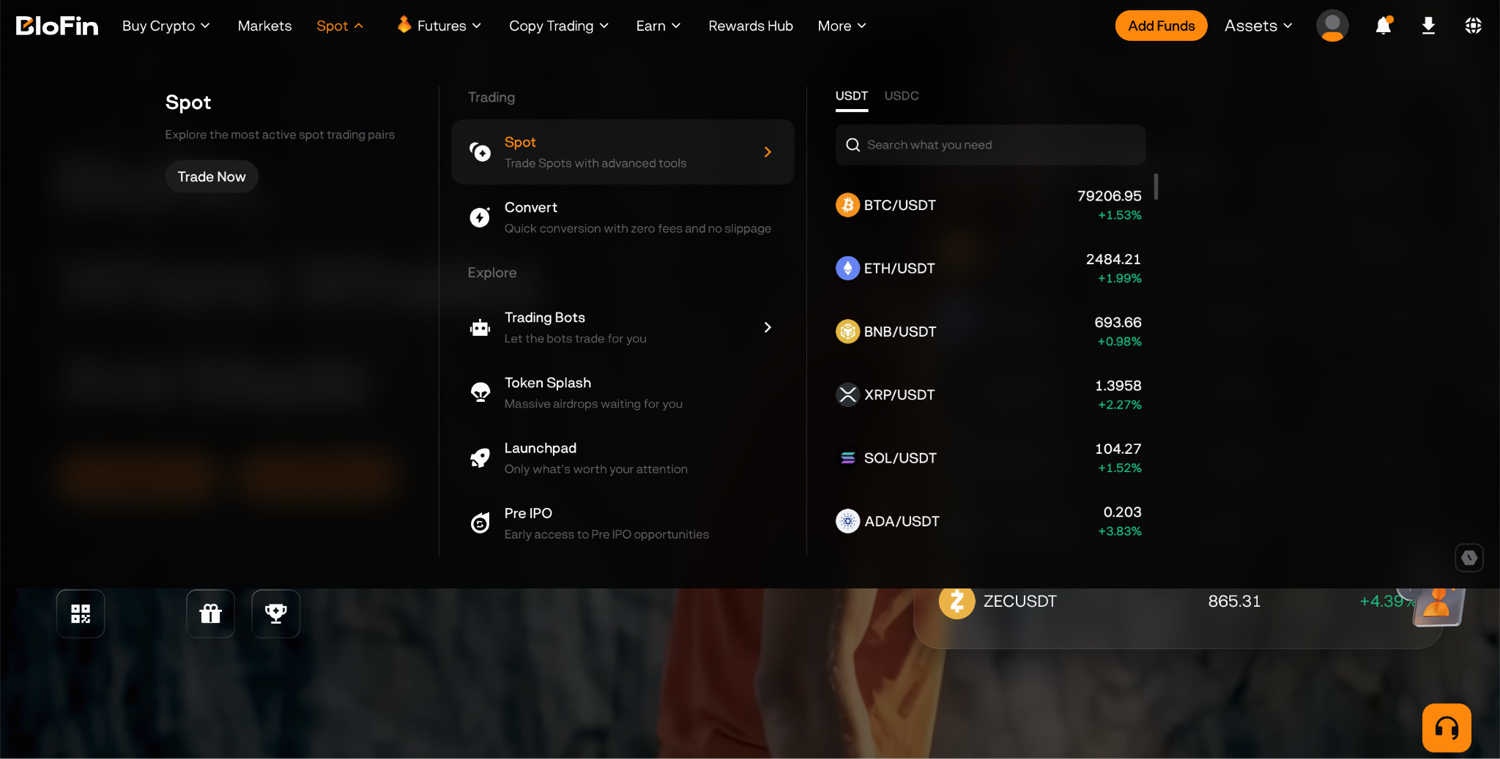
Step 2: Hover your cursor over the BTC/USDT Spot trading pair and a pop-up window will appear. Type AAPLX in the search bar.
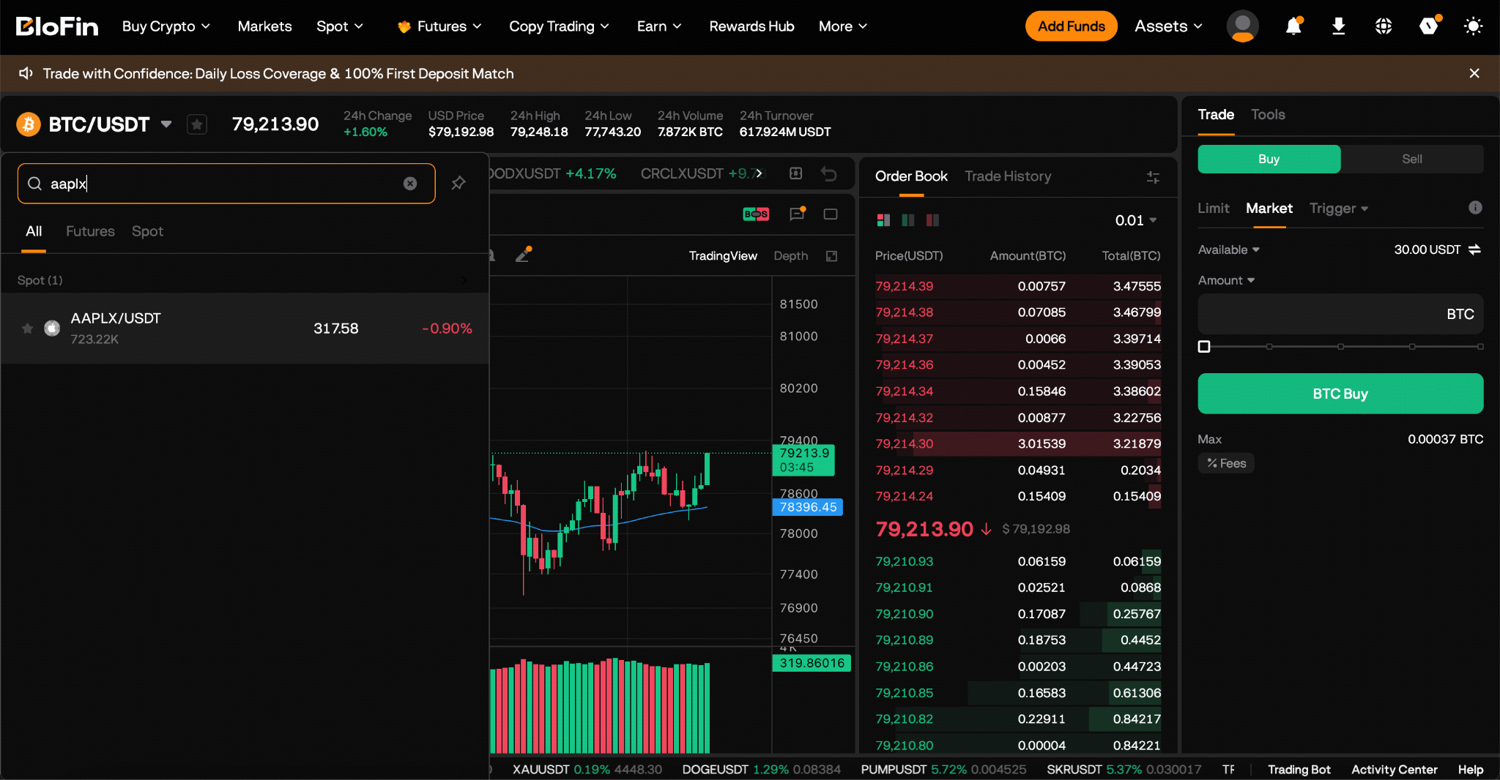
Step 3: Click AAPLX/USDT to enter the AAPLX/USDT Spot trading page.
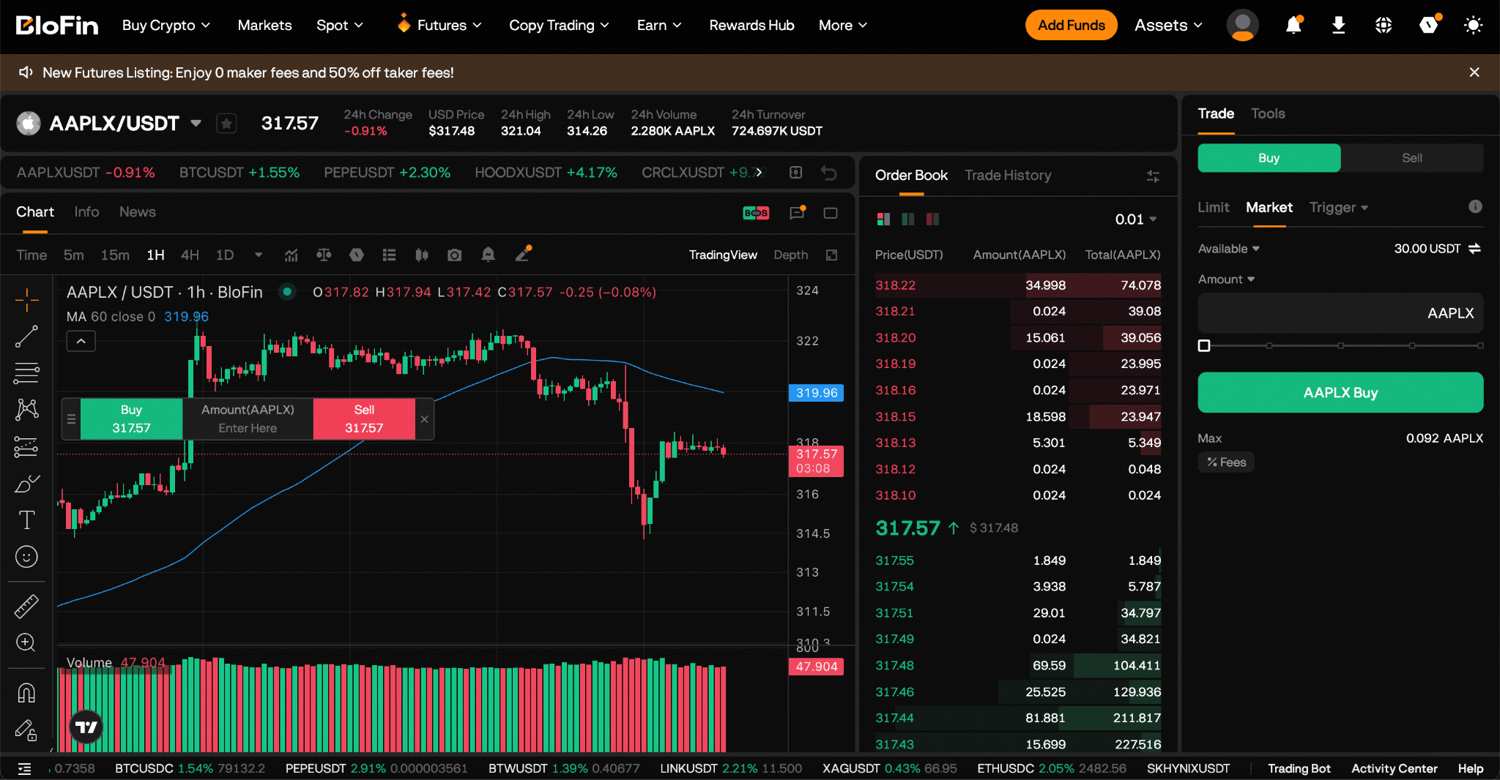
Step 4: Choose your order type. Pick Market (fills instantly at the best available price) or Limit (fills only at or below the price you set).
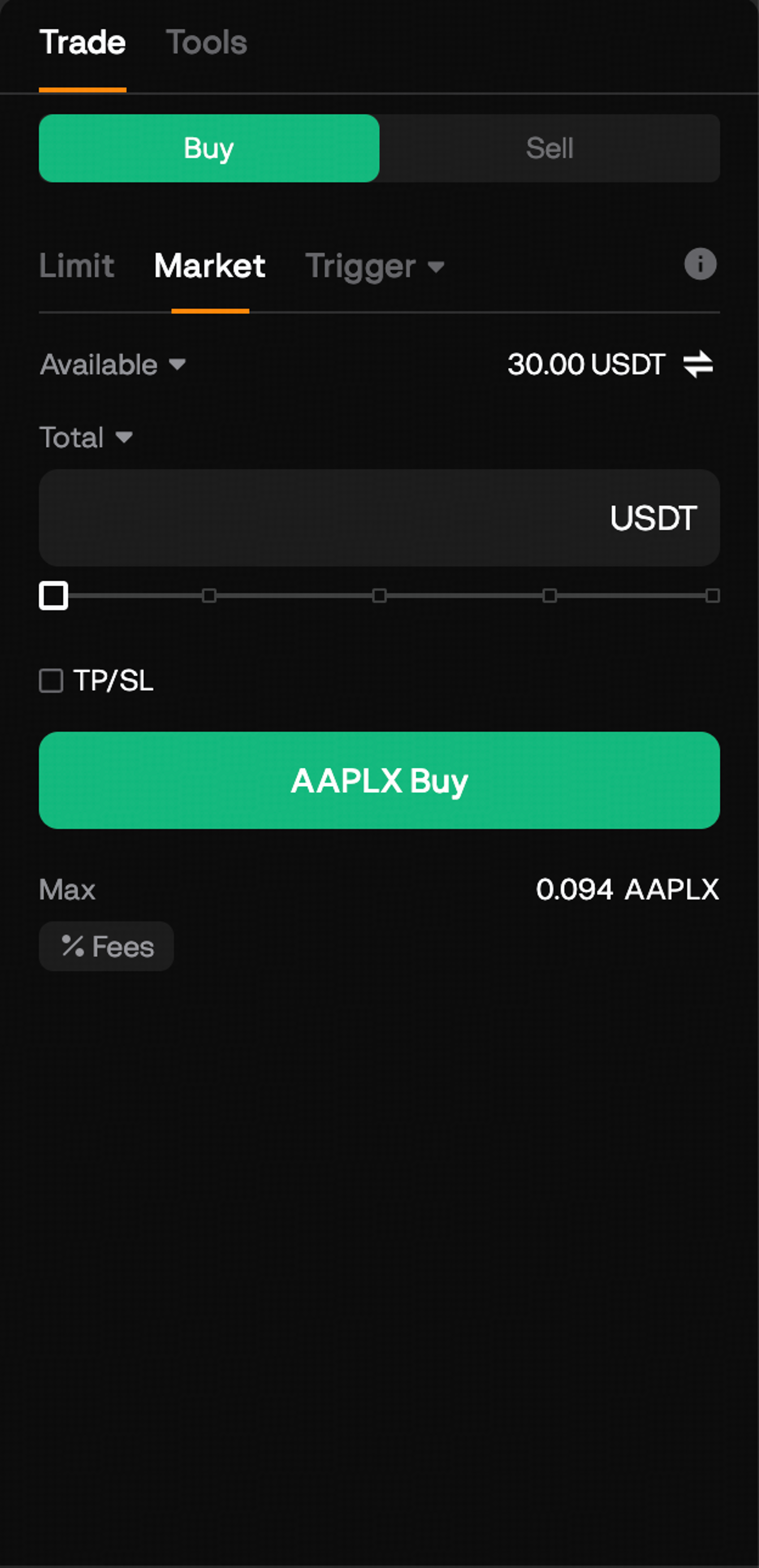
Step 5: Enter how much AAPLX you want, or enter the total USDT you want to spend by hovering your cursor over the Amount dropdown and clicking Total.
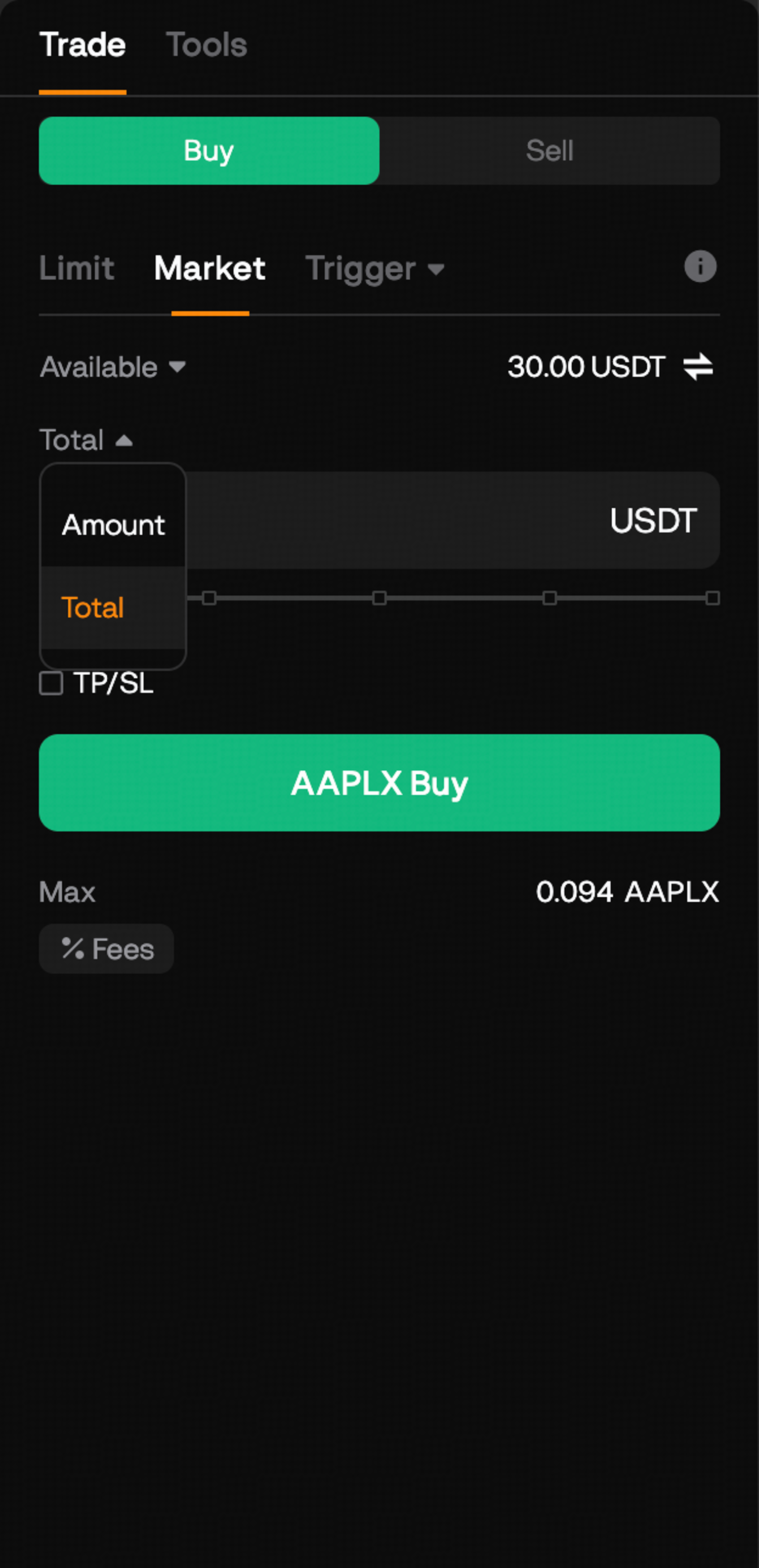
Step 6: Review and confirm. Check the estimated fee and total cost, then click AAPLX Buy.
Market orders execute immediately at the best available market price during trading. Once filled, your AAPLX balance appears under Assets > Spot. BloFin provides access to tokenized Apple through its crypto trading platform rather than through traditional stock ownership.
Tokenized stocks provide fractional ownership of real company shares, so you do not need to buy a full token. Fractional ownership means a 50 USDT balance is enough to enter a position. Tokenized stocks provide fractional ownership of real company shares, so you do not need to buy a full token: at a price near 317 USDT, a 50 USDT order buys roughly 0.157 AAPLX.
This section covers spot buying only. Leverage, margin, and liquidation mechanics belong to the leverage article.
Choosing order types when buying AAPLX
The order type changes execution price, speed, and how much slippage you absorb, so choose based on the fill quality and price movement you expect.
Market buys at the best available ask price and fills instantly. Use it when getting in matters more than the exact price.
Limit orders allow specifying the exact price you are willing to pay for tokenized Apple stock, and rest unfilled until the market reaches it. This is the better default on AAPLX, because the book is thinner than a major crypto pair: turnover on the AAPLX/USDT market ran about 725,000 USDT over the most recent 24 hours (source: BloFin), so a large market order can walk the book further than you intended. In practice, liquidity in tokenized stocks can be poor compared with traditional stocks, which increases slippage risk on larger orders.
Trigger activates an order once a nominated price prints, and suits managing an exit more than an entry. That is also one reason execution can be less efficient here than in traditional markets, where listed shares trade in deeper venues with more consistent depth. To choose between them in a given situation, market, limit and stop orders compared covers the trade-offs, and how an order book works explains why depth matters more on a thin market.
Worked example: Buying AAPLX with a small balance
AAPLX tracks AAPL, so the token trades close to the share price. Suppose it is at 317.61 USDT (source: BloFin), and you have deposited 300 USDT and want half a token.
Notional cost: 0.5 × 317.61 = 158.81 USDT
Trading fee at the Regular tier, 0.1000% on both maker and taker orders: 158.81 × 0.001 = 0.16 USDT (source: BloFin)
Total deducted: 158.96 USDT
Remaining balance: 300 − 158.96 = 141.04 USDT
Your Spot wallet now shows 0.5 AAPLX and 141.04 USDT, and your economic exposure to Apple is about 159 USDT. If Apple rises 5%, that position gains roughly 7.94 USDT before the sell-side fee, which applies again at 0.1% when you exit (source: BloFin).
Checking your position, fees, and the risks that matter
After buying, find your tokenized Apple holdings under Assets for balances, and your order history for fill history, timestamps, fees paid, and any wallet/platform record of transfers.
On the order ticket you will see fields for price (USDT), amount (AAPLX), and total (USDT). Choosing a different order type does not change the underlying asset; you still receive AAPLX in your Spot wallet regardless of how the order fills.
The 0.1% fee applies on both the buy and the sell, so a round trip costs about 0.2% before any spread (source: BloFin). The spread between best bid and best ask also affects your effective entry price, and on a market turning over a few hundred thousand USDT a day that spread is wider than on BTC/USDT.
Issuer and custodian risk is the real one. BloFin states plainly that xStocks tokens come from a third-party issuer and that it assumes no responsibility for losses arising from xStocks transactions (source: BloFin). Your claim runs to Backed Finance and its custodian alone, with the token described as backed by real shares of Apple's common stock held in custody. If the custody arrangement fails, that is your loss, and it is a risk that disappears when you hold a share at a broker.
Your rights stop at the price. AAPLX carries no vote at Apple's annual meeting, no voting rights, and your legal relationship runs to the issuer rather than the company. Dividends do reach you, but indirectly: the custodian receives the cash, reinvests it into more shares, and the issuer reflects that through an onchain rebasing mechanism called the multiplier, so balances rise proportionally, net of applicable withholding taxes (source: xStocks Docs).
Regulatory classification is still moving. The SEC's staff statement of January 28, 2026 separates securities tokenized by or for their issuer from those tokenized by unaffiliated third parties (source: SEC). AAPLX is the second kind, and treatment continues to differ across jurisdictions for tokenized shares of listed companies. Tokenized equities sit inside the broader real world asset category, where rules are being written as the products ship.
When the AAPLUSDT perpetual is the better tool
There is one difference between the two Apple markets on BloFin that decides which you should be using, and it is easy to miss.
The AAPLX spot market runs on the trading week. BloFin's xStocks risk disclosure states it under a heading called 24/5 Market Dynamics: xStocks token markets operate 24 hours a day, five days a week, weekdays only (source: BloFin). That is often marketed against round the clock trading, but it is not that: traditional stocks trade during limited hours, typically 9:30AM to 4PM, while AAPLX on BloFin extends access to 24/5 rather than 24/7.
The AAPLUSDT perpetual does not. It settled funding at 00:00, 08:00 and 16:00 on both Saturday August 29 and Sunday August 30, 2026, with Nasdaq closed (source: BloFin). A perpetual is synthetic and settles in USDT, so nothing has to move at a custodian and the market can stay open.
The practical consequence: if news breaks on Apple over a weekend, spot AAPLX is closed and the perpetual is where you can act. The perpetual also offers leverage, up to 1~20 on this contract, and the ability to short, neither of which spot provides. That leverage cuts both ways and liquidation can close a position on a move far smaller than the multiple suggests, so treat it as a different instrument with its own risk budget. In practice, some traders use the perpetual after hours or on weekends to gain exposure when the spot token is unavailable.
Selling AAPLX
Exiting your AAPLX position is the reverse of buying: place a Sell order on the AAPLX/USDT Spot market. The same order types apply. Check the order book's current spread before placing larger sell orders to avoid unnecessary slippage.
Once you hold USDT after selling, you can hold it in your BloFin account for future trades, swap it to another crypto through BloFin's spot markets, or withdraw it to an external wallet; some tokenized stocks may support DeFi integration after withdrawal on supported platforms across certain public blockchains. They may also be used in DeFi applications or liquidity pools for liquidity, depending on the available blockchain networks. If you previously withdrew AAPLX to self-custody, you may need on-chain transfers back to BloFin or another venue that supports AAPLX spot markets before selling back into USDT.
Frequently asked questions
How do I buy tokenized Apple on BloFin?
Fund your Spot account with USDT, open the Spot market, search AAPLX or filter by the xStocks tab, choose Limit or Market, enter the amount in AAPLX or the total in USDT, and confirm. The token appears under Assets once the order fills. You need a verified account first for eligible users to access this flow on desktop and app, and eligibility excludes US persons, United Kingdom persons and residents of other restricted locations. Fractional sizing lets a small balance open a position.
What is the minimum I can spend on AAPLX?
Tokenized shares divide, so you size the order by value instead of by whole shares, which lowers the capital needed to start. With AAPLX trading near 317 USDT, a 50 USDT order buys roughly 0.157 of a token, and prices move in increments of 0.01 USDT. The practical floor is whatever the market's minimum order size is at the time, shown on the order ticket. Keep slightly more USDT in Spot than your intended order so the 0.1% fee (source: BloFin) and any slippage still leave the order fillable.
What fees do I pay to buy and sell AAPLX?
At the Regular tier BloFin charges 0.1000% on spot trades, applied to both maker and taker orders, so a full round trip costs about 0.2% before spread (source: BloFin). VIP tiers reduce this as thirty-day volume or account assets rise. The bid-ask spread is the other cost and matters more here than on a major crypto pair, because the AAPLX book is thinner. Using limit orders rather than market orders is the simplest way to control that second cost.
Can I trade AAPLX 24/7?
No. BloFin's xStocks risk disclosure states that xStocks token markets operate 24 hours a day, five days a week, weekdays only, so the AAPLX spot market follows the trading week. The AAPLUSDT perpetual does run continuously, including weekends, which is why it is the instrument to use if you want to react to Apple news while Nasdaq is closed. A token held in your own wallet remains transferable on-chain at any time, which is separate from whether an exchange market is open.
Do I own Apple shares or have shareholder rights if I buy AAPLX?
No. You hold a token rather than Apple's common stock, backed 1:1 by real shares held with a custodian, which gives you price exposure while ownership stays with the custodian. Apple's annual meeting voting rights are unavailable, and your legal relationship runs to the issuer. BloFin states that xStocks tokens come from a third-party issuer and that it assumes no responsibility for losses arising from them, so your claim runs to that issuer and its custodian. Dividends do pass through, reinvested into additional shares and reflected as a balance increase, net of withholding tax, but that does not change the lack of shareholder rights.
Researched and written by the BloFin Academy editorial team with AI-assisted drafting. All facts independently verified. Primary sources include BloFin's published fee schedule, the AAPLX/USDT spot market page for live pricing, turnover and eligibility terms, BloFin's xStocks Risk Disclosure Statement for trading hours, the AAPLUSDT contract and funding-rate pages, the xStocks documentation on dividends and corporate actions, and the SEC's Statement on Tokenized Securities of January 28, 2026, current as of September 1, 2026.
Nothing in this article constitutes financial advice. Prices, turnover figures and fee tiers quoted here were accurate when checked and change continuously; confirm current values on the order ticket before you trade. xStocks are unavailable to US persons, United Kingdom persons and residents of other restricted locations, and you are required to confirm your eligibility before an order is accepted. BloFin states that xStocks tokens come from a third-party issuer and assumes no responsibility for losses arising from them: holding AAPLX means taking issuer and custodian risk that owning a share through a broker avoids, on top of the ordinary market risk of Apple stock. Tokenized Apple confers no shareholder rights, and the regulatory treatment of tokenized securities is still developing and differs by jurisdiction. The AAPLUSDT perpetual confers no ownership and can be liquidated in full by a price move far smaller than the leverage multiple suggests. Do your own research and consider your risk tolerance before you trade on BloFin.