
When a stock has almost tripled since January, some people start to think it has run too far and look for a way to profit if it falls back. Betting on a fall is called going short. You gain when the price drops and lose when it rises, and a stock that keeps climbing can cost a short seller far more than expected.
The usual route to a short runs through a stockbroker. The broker lends you shares that belong to someone else, and the loan falls under the broker's margin rules. You pay interest on it and hand over any dividend the shares pay, and because a stock can keep rising, the possible loss has no ceiling (source: Investor.gov, An Introduction to Short Sales). Many people who trade crypto have no margin account with a stockbroker.
A perpetual contract offers another way in. It tracks a price with no expiry date and settles in a stablecoin, so you can sell the price itself without borrowing a single share. The cost of holding the position becomes funding, a small payment exchanged between buyers and sellers every eight hours that can run in your favor or against you.
On BloFin, that contract is the AMDUSDT Perpetual, which follows AMD's share price through an index, and shorting AMD there means opening a sell order on it. The AMD perpetual works the same way in both directions, so a short uses the same contract as a long.
Opening a short on the AMD perpetual, step by step
To short AMD on BloFin, you’ll need to first create a BloFin account and fund it with cryptocurrency. Then, you’ll need to open a sell order on the AMDUSDT Perpetual during regular trading hours. A short gains when the price falls and loses when it rises. One contract is 0.01 AMD, and the contract offers up to 20x leverage (source: BloFin, AMDUSDT contract information).
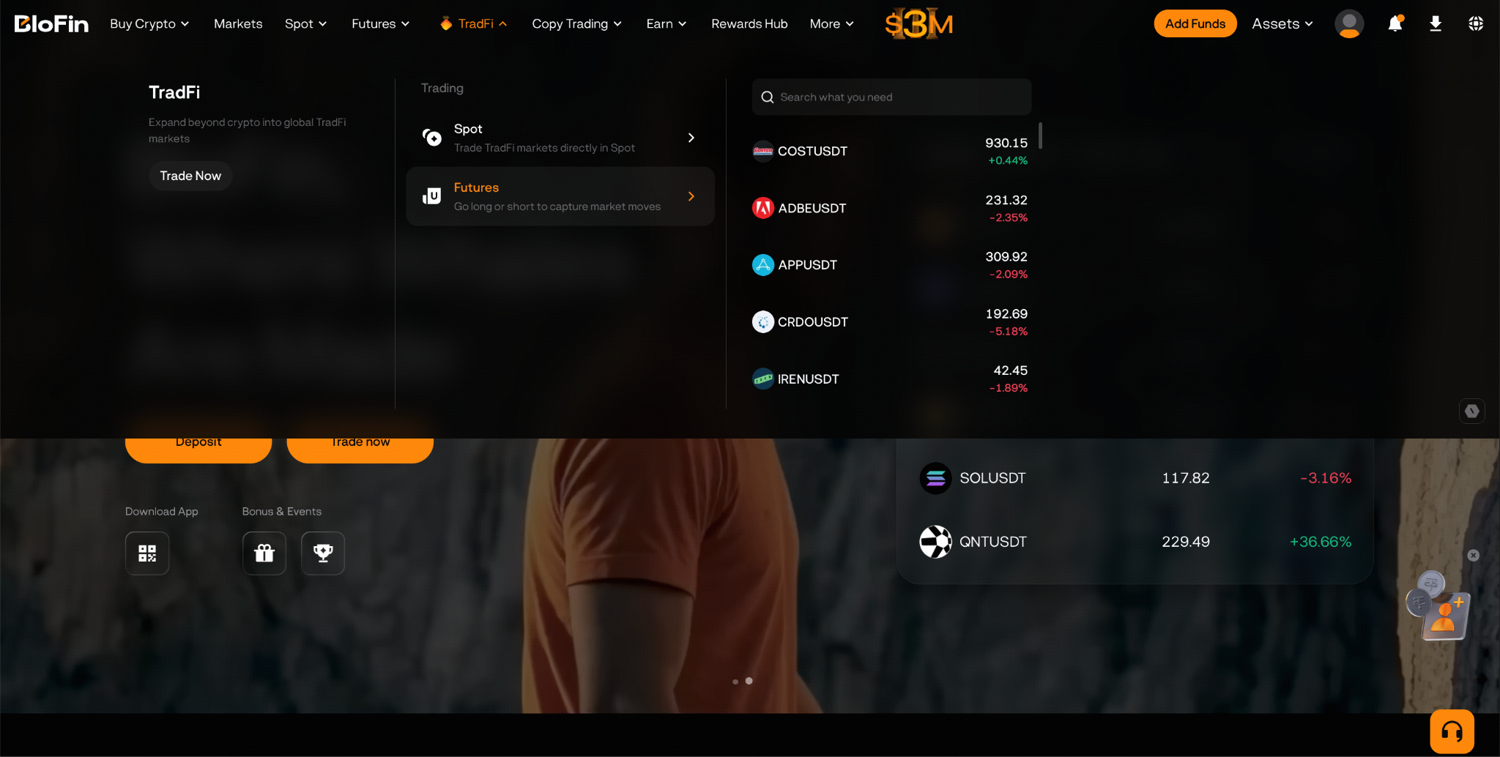
Step 1: Log in to your BloFin account and hover your cursor over the TradFi tab. Then, click Futures.
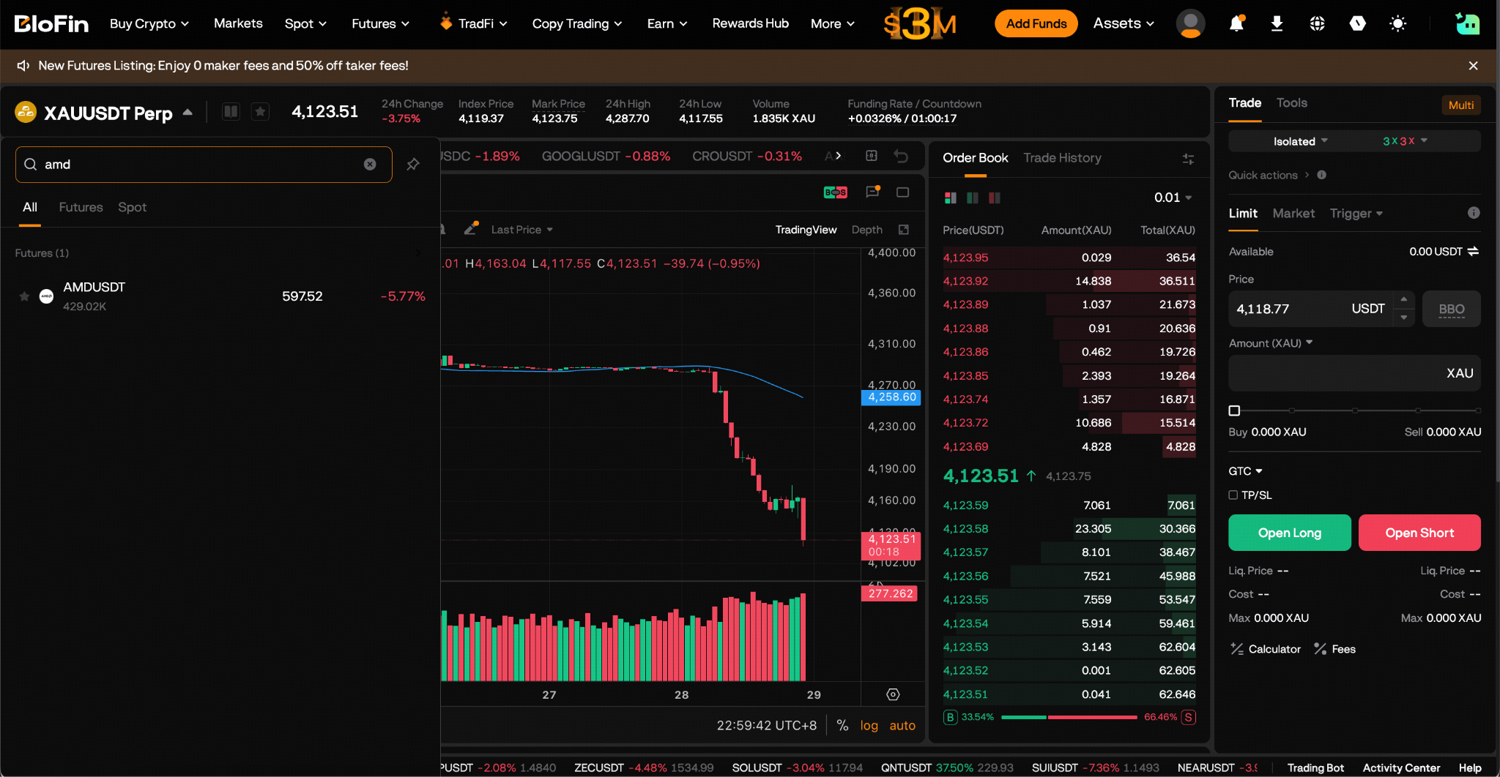
Step 2: Click XAUUSDT Perpetual and a pop-up window will appear. Type AMD and select the AMDUSDT Perpetual from the list.
Step 3: Choose your preferred margin mode. Isolated margin locks a set amount for this position, and that amount is the most it can lose. Cross margin lets every available balance in your Futures Account back it. The selector at the top of the order panel shows Cross or Isolated.
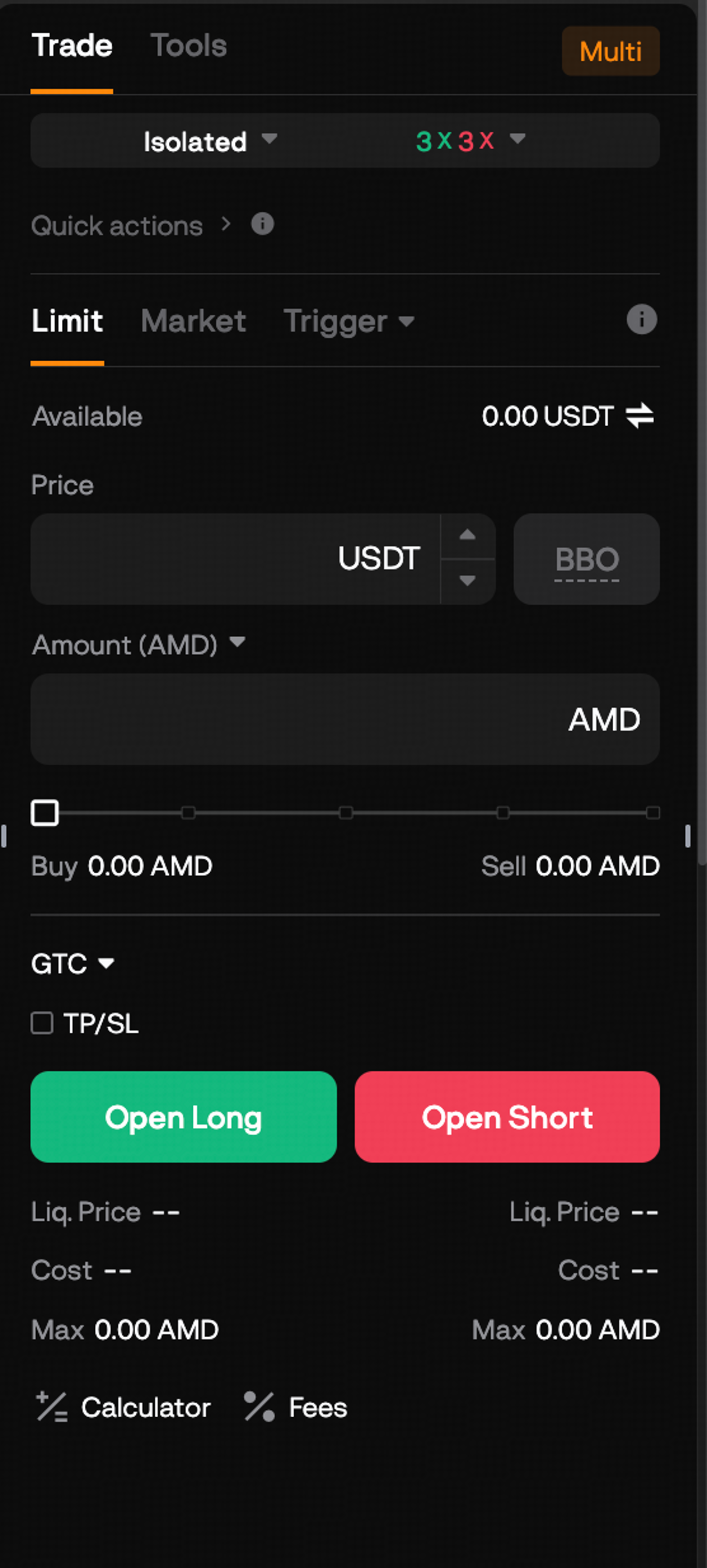
Step 4: Set your leverage. The AMDUSDT Perpetual offers up to 20x, and lower leverage puts your liquidation price farther from your entry.
Step 5: Pick your order type. A limit order lets you name your price, and a market order fills straight away at the best available price, up to 200 AMD per order. A sell limit order can be priced no more than about 3% below the index price.
Step 6: Enter the amount you would like to purchase in AMD or USDT. One contract is 0.01 AMD, so 1 AMD is 100 contracts, and the smallest order is 0.01 AMD. Size decides how much each dollar of rise costs you, so settle it before you type the number.
Step 7: Leave Reduce-only unticked: with it ticked, the order can only reduce or close a position you already hold.
Step 8: Add a take-profit and a stop-loss. Tick TP/SL and set the take-profit trigger below your entry price, at the level where you would bank the fall. Set the stop-loss trigger above your entry, because a rise is what hurts you.
Step 9: Once you’ve confirmed all the details, click Open Short.
You can then check the new position including details regarding the average entry price, the estimated liquidation price, the margin, and the running profit or loss under the Positions tab.
Before you confirm, read the estimated liquidation price, which the order panel shows as Liq. Price: the mark price at which BloFin would close the position.
The AMDUSDT Perpetual page shows the contract's live mark price, its current funding rate and the time left until the next funding settlement.
How an AMD short makes or loses money
An AMD short earns the fall in the mark price times its size in AMD, paid in USDT, and loses the same amount on a rise. Fees are charged on the position's full value at opening and at closing, and funding is paid or received every eight hours. Leverage changes the margin you post, never the profit in USDT.
BloFin works out a short's profit as the average entry price minus the latest mark price, multiplied by the position size in AMD (source: BloFin, How to Trade on BloFin Futures (APP)). The mark price is the reference price BloFin uses to value open positions and to decide liquidation, so it is the number to watch rather than the last traded price (source: BloFin, index, mark and last price). Market orders pay the taker rate of 0.06%, charged on the position's notional value each time an order executes, whatever leverage you chose (source: BloFin, How are Futures Transaction Fees Calculated?).
Say you shorted 10 AMD, or 1,000 contracts, at the end of Nasdaq's regular session on September 22, 2026, when the mark price was 623.40 USDT. By September 24 the mark had fallen to 609.78 USDT. BloFin's funding history for AMDUSDT shows four settlements in between (source: BloFin, AMDUSDT funding history).
Item | How it is worked out | Amount (USDT) |
|---|---|---|
Price gain | (623.40 − 609.78) × 10 AMD | +136.20 |
Opening fee | 0.06% taker fee on the position's value | −3.74 |
Closing fee | 0.06% taker fee on the position's value | −3.66 |
Funding, September 23, 00:00 UTC | rate −0.0120%, the short pays | about −0.75 |
Funding, September 23, 08:00 UTC | rate −0.0120%, the short pays | about −0.75 |
Funding, September 23, 16:00 UTC | rate +0.0008%, the short receives | about +0.05 |
Funding, September 24, 00:00 UTC | rate −0.0120%, the short pays | about −0.74 |
Net profit | price gain, minus fees and net funding of about 2.18 | about +126.62 |
The margin you post depends on the leverage you choose, so the same profit is a different return on each:
Leverage | Margin posted (USDT) | Return on that margin |
|---|---|---|
5x | 1,246.80 | about 10.2% |
2x | 3,117.00 | about 4.1% |
The price did nearly all the work. Fees took about 7.40 USDT and funding about 2.18 USDT, because three of the four rates were negative, and a negative rate means shorts pay longs. Leverage changed only the percentage: the same profit in USDT was a larger share of a smaller margin. Had the mark risen by 13.62 USDT instead, the same short would have lost about 136.20 USDT, plus the same fees and whatever funding came due.
Funding on an AMD short
Funding is a payment exchanged between long and short positions every eight hours. When the rate is positive, longs pay shorts, so a short receives it; when the rate is negative, the short pays. It is charged on the position's full value, so leverage leaves the amount unchanged (source: BloFin, Introduction to BloFin Futures Funding Rates).
BloFin's funding history for AMDUSDT shows both signs are common. Across the 100 settlements from 00:00 UTC on August 26 to 00:00 UTC on September 28, 2026, 52 rates were positive, 44 negative and 4 zero. The largest single rate was +0.0619%, settled at 00:00 UTC on September 21 (source: BloFin, AMDUSDT funding history). A short therefore spends some stretches being paid to stay open and others paying, and the AMD funding rate can flip sign from one settlement to the next.
The sign mattered least when the price moved hardest. Say you held a 1 AMD short through AMD's rally from September 19 to September 22, 2026. The ten settlements from 00:00 UTC on September 19 to 00:00 UTC on September 22 added up to +0.1813%. You received about 1.07 USDT in funding while the mark rose by about 67 USDT against you. From 00:00 UTC on September 23 to 00:00 UTC on September 24, as the price slipped back, three of the four rates were negative, and the same short paid a net 0.0352%. Next to a stock that can move several percent in a session, funding is a small credit or cost. It can't be relied on to pay for holding a short through a rise.
You also control when you meet it. A position closed before a settlement neither pays nor receives it (source: BloFin, Introduction to BloFin Futures Funding Rates). Funding settles at 00:00, 08:00 and 16:00 UTC, and the 16:00 UTC settlement falls inside every regular US session. A short opened and closed within one session therefore pays or receives nothing only if it opens after 16:00 UTC or closes before it (source: BloFin, Introduction to BloFin Futures Funding Rates).
AMD short hours and reduce-only windows
BloFin's stock-perpetual hours run 13:30 to 20:00 UTC on weekdays until October 30, 2026, then 14:30 to 21:00 UTC (source: BloFin, Updates to BloFin Stock Futures Trading). Outside those hours, and on weekends and market holidays, BloFin may accept only reduce-only orders, so new shorts may be refused (source: BloFin, Updates to BloFin Stock Futures Trading).
Both windows match Nasdaq's regular session of 9:30 a.m. to 4:00 p.m. New York time, before and after the clocks change, so pre-market and after-hours trading fall outside them too (source: Nasdaq, stock market schedule). A reduce-only order can only reduce or close a position you already hold. It will never open a new position or flip a short into a long, and BloFin notes that it does not guarantee execution (source: BloFin, What is Reduce Only in Futures Trading?). For a short, that means the exit stays available around the clock while the entry may depend on the time of day. News that lands after the US close, such as a quarterly results release, arrives in the hours when a new short may be turned away. That is why AMD's earnings reports and the trading hours belong in the same plan.
Say you read a headline on a Saturday that you think is bad for AMD. The perpetual still quotes a price, but an order to open a short may be refused until Monday's session begins, by which time the price may have moved. A short you opened on Friday during regular hours is different: it stays open over the weekend, keeps settling funding and can still be closed. The price you close at then depends on where the contract trades while the stock itself is shut. That exposure is the weekend gap risk every overnight short carries.
The rest of 2026 brings four more changes to AMD perpetual trading hours. BloFin's notice lists November 26 and December 25 as closed all day and November 27 and December 24 as early closes at 18:00 UTC (source: BloFin, Updates to BloFin Stock Futures Trading).
Short squeeze risk after AMD's 2026 run
A short squeeze is a sharp rise that forces short sellers to buy back their positions, and that burst of buying pushes the price higher still (source: Nasdaq, short squeeze). AMD set a record close of $630.63 on September 25, 2026, about 194% above where it ended 2025 (source: Stock Analysis, AMD price history).
That rise of about 194% is worked out from AMD's $214.16 close on December 31, 2025, and the same session also set AMD's highest intraday price, $639.00 (source: Stock Analysis, AMD price history). Five sessions in 2026 rose 9.95% or more, the largest a gain of 18.61% on May 6, and the most recent the 9.95% rise of September 21 (source: Stock Analysis, AMD price history). Because the September 25 close is higher than every close before it, a short opened at any earlier close in 2026 was losing money on that day. The climb from the year's low was steeper still. AMD's lowest close of 2026 was $190.95 on March 3, so a short opened there faced a rise of about 230% to the September 25 record, worked out from the two closes (source: Stock Analysis, AMD price history).
On a perpetual the forced buyer is different from a broker short. No lender recalls shares. Instead, BloFin compares a position's margin, with its loss counted, against the maintenance margin, the least margin that keeps a position open, plus the fee for closing it. Once the margin falls to that level, BloFin may reduce the position or liquidate it, and when the mark price reaches the liquidation price, its liquidation engine takes the position over (source: BloFin, Forced Liquidation Rules). Closing a short, whoever does it, means buying (source: BloFin, How to Trade on BloFin Futures (APP)). A stop-loss that fires on a rise adds a buy order in the same way. In a fast rally, those forced and triggered buys arrive together.
Where an AMD short liquidates in a fast rally
Say you opened a 1 AMD short in isolated margin at 559.98 USDT, the mark price at the end of regular hours on Friday, September 18, 2026, and held it into Tuesday, September 22. BloFin publishes the formula for an isolated short's liquidation price (source: BloFin, Liquidation Price Calculation). AMDUSDT's first tier covers positions of up to 200 AMD, with a 2.5% maintenance margin rate and leverage of up to 20x (source: BloFin, AMDUSDT position tiers). BloFin's own worked example uses a liquidation fee rate of 0.06% (source: BloFin, Forced Liquidation Rules). On those rates, the estimates for five leverage levels were:
Leverage on a 1 AMD short at 559.98 USDT | Margin posted | Estimated liquidation mark | Rise needed | What the mark did |
|---|---|---|---|---|
20x | 28.00 USDT | 573.30 USDT | about 2.4% | reached on Monday, September 21, 2026, before Nasdaq's regular session opened |
10x | 56.00 USDT | 600.60 USDT | about 7.3% | reached on September 21, 2026, in the hour Nasdaq opened |
5x | 112.00 USDT | 655.20 USDT | about 17.0% | never reached; the peak mark of 626.56 USDT on September 22 took about 59.4% of the margin |
3x | 186.66 USDT | 728.00 USDT | about 30.0% | never reached; the same peak took about 35.7% of the margin |
2x | 279.99 USDT | 819.00 USDT | about 46.3% | never reached; the same peak took about 23.8% of the margin |
The 20x short is the one to study. Its liquidation price was only about 13 USDT above the entry. The mark crossed it on a Monday morning before regular trading hours began, in hours when BloFin may accept only reduce-only orders. The loss stopped at the 28 USDT of margin, because in isolated mode the margin posted is the most the position can lose (source: BloFin, How to Trade on BloFin Futures (APP)). Even so, BloFin would have reduced or closed the position before the regular session opened. At 5x the same short survived the whole rally, though at the peak it was down more than half its margin.
Funding paid the short about 1.07 USDT over the same ten settlements, small beside a rise of about 67 USDT in the mark. These figures are estimates: they leave the entry fee out of the margin and rest on hourly mark prices, so the exact minute of each crossing is unknown. AMD's position tiers raise the maintenance rate to 3.33% for positions from 200.01 to 1,000 AMD (source: BloFin, AMDUSDT position tiers).
AMD short interest and funding rates
Short interest is the number of shares sold short and not yet bought back. AMD's was 39,975,696 shares at the September 15, 2026 settlement, with 2.13 days to cover (source: Nasdaq, AMD short interest). That works out to just under 2.5% of the 1,632,475,042 shares AMD reported outstanding on July 29, 2026 (source: AMD Form 10-Q, Q2 2026).
Across the four settlements from the end of July, short interest climbed into August and eased slightly by mid-September (source: Nasdaq, AMD short interest).
Settlement date | AMD shares sold short |
|---|---|
July 31, 2026 | 37,752,132 |
August 14, 2026 | 40,065,798 |
August 31, 2026 | 41,712,630 |
September 15, 2026 | 39,975,696 |
Days to cover divides the shares sold short by the stock's average daily trading volume, so it estimates how many ordinary sessions every short seller would need to buy back. Nasdaq put AMD's average daily volume for that period at 18,735,987 shares, and 39,975,696 divided by that gives the 2.13 days (source: Nasdaq, AMD short interest). The figure is a snapshot that arrives with a lag. FINRA requires its member firms to report short positions twice a month, as of the 15th and the last business day of the month. The data is released on the seventh business day after each settlement date (source: FINRA, Equity Short Interest). On that schedule, the reading dated September 15 was due out on September 24, worked out as the seventh business day after it, three sessions after AMD's 9.95% jump of September 21.
BloFin's funding sign is a faster read on the crowd holding the perpetual. A run of positive rates means long positions have been paying to stay open, and a run of negative rates means shorts have. The largest positive rate from late August to late September settled at 00:00 UTC on Monday, September 21, 2026, hours before the session in which AMD rose 9.95%. From 00:00 UTC on September 23 to 00:00 UTC on September 24, three of the four rates were negative as AMD eased (source: BloFin, AMDUSDT funding history). Short interest tells you how many shares are sold short; the funding sign tells you which side of the perpetual has been paying, and neither says when a squeeze will start.
Closing an AMD short
Closing a short is a buy. Place a buy order for the same amount of AMD with Reduce-only ticked, or use Close on the position; the profit or loss settles in USDT. Funding stops with the position, and a closing order stays allowed when BloFin limits trading to reduce-only orders, so an exit order can go in at any hour.
While the short is open, the Positions tab shows the numbers to watch: the mark price, the estimated liquidation price, the margin and the running profit or loss. The gap between the mark and the liquidation price is the rise the position can still absorb. Check it after any sharp move in AMD, and before a weekend or a results release, when the regular Nasdaq session is closed but the contract keeps trading.
You can close part of a short by buying less than its full size, which leaves the rest open. Say you hold the 10 AMD short opened at 623.40 USDT on September 22, 2026 and want to take half the profit with the mark at 609.78 USDT. A buy of 5 AMD with Reduce-only ticked closes half the position and locks in about 68.10 USDT before fees. The other 5 AMD stay short at the same entry price and keep settling funding. Close All closes the whole position with a market order, and BloFin warns that if the market moves violently, that order may not be executed (source: BloFin, How to Trade on BloFin Futures (APP)). A limit buy gives you control of the price but may not fill if AMD keeps rising, which is the moment you most want out.
Step 1: Navigate to the AMDUSDT Perpetual trading page and scroll under Positions to confirm the position size you hold in AMD.
Step 2: In the order pane on the right side of the page, choose Limit for a set price or Market to exit at once.
Step 3: Tick Reduce-only on a manual buy, so a slip in the amount can only close the short and never open a long.
Step 4: Check that the position is gone from your Positions tab and the USDT is back in your Futures Account.
Stop-loss orders on an AMD short
A stop-loss on a short is a buy order that waits above your entry price and fires when the price rises to its trigger. BloFin lets you choose the last price, the mark price or the index price as the trigger (source: BloFin, What is TP/SL order?). Choose the mark price as the trigger and set it between your entry and your estimated liquidation price. Liquidation also runs on the mark price, so the stop fires first and the decision stays yours (source: BloFin, Forced Liquidation Rules).
A stop is yours to place, move and cancel, while liquidation is BloFin's. The price can jump straight past a trigger, as it can when AMD opens far above the previous close. A stop that sends a market order then fills at the next available price, which can be well above the trigger. On the 20x short from September 18, a stop triggered by the mark price and set anywhere between the 559.98 entry and the 573.30 liquidation price would have fired first. It would have closed the trade for less than the 28 USDT that liquidation took. That window was narrow: 13.32 USDT, or about 2.4% of the entry, worked out as 573.30 minus 559.98, so a stop on a 20x short leaves little room for AMD's ordinary swings.
Shorting AMD shares vs the AMD perpetual vs buying puts
There are three common ways to bet on a fall in AMD: sell borrowed shares through a broker, sell the AMDUSDT Perpetual, or buy a put option. The most you can lose is unlimited in theory on a broker short, the margin posted on an isolated perpetual short, and the premium on a put.
Feature | Broker short sale of AMD shares | Short on the AMDUSDT Perpetual | Buying an AMD put option |
|---|---|---|---|
What you do | sell AMD shares your broker has lent you | open a sell on a contract that tracks AMD's price | buy the right to sell 100 AMD shares at a set price until a set date |
Account needed | a margin account at a stockbroker | a BloFin futures account funded in USDT | a brokerage account that trades options |
What you borrow | the shares | nothing | nothing |
Cost of holding | interest on the share loan | funding every eight hours, paid or received | nothing after the premium is paid |
Dividends | owed to the lender whenever the stock pays one | none; the contract carries no dividend rights | none owed |
Most you can lose | unlimited in theory | the margin posted, in isolated mode | the premium paid |
End date | none while the loan stays in place | none | the option's expiry date |
When it trades | during stock market sessions | around the clock, with new positions possibly limited to regular weekday trading hours | during options market sessions |
A broker short sale borrows the shares, charges interest on the loan and passes any dividend to the lender, and its losses are unlimited in theory (source: Investor.gov, An Introduction to Short Sales). A put gives its buyer the right to sell shares at the strike price for a set period. The premium is paid up front and is non-refundable, and a put that expires worthless loses the whole premium (source: Investor.gov, An Introduction to Options). BloFin's stock futures carry no right to dividends (source: BloFin, Updates to BloFin Stock Futures Trading). Dividends matter to a broker short only when the stock pays one, so check whether AMD pays dividends before you borrow.
Choosing between a short, a put and staying flat
The right route depends on what you want the position to do:
You want the worst case fixed in advance. A put caps the loss at the premium, at the cost of an expiry date and of paying for time that may pass without a fall.
You expect a quick move and can watch it. A short on the perpetual opens and closes inside regular trading hours, costs no borrow and settles in USDT, with funding the only running charge.
You hold AMD shares elsewhere and want protection. The short then becomes a hedge with the AMD perpetual, sized to the number of shares you own.
Results or a weekend are due and you are using 10x or more. Lower the leverage or wait until the release or the weekend has passed. The rises that ended the 20x and 10x shorts on September 21, 2026 were about 2.4% and 7.3%, smaller than several single days in AMD's 2026 record.
You have no strong view. Staying flat is a position too: it pays no funding, has no liquidation price and waits for a clearer setup.
Looking to short the AMDUSDT Perpetual? To get started, you'll need to first create a BloFin account, fund your account with cryptocurrency, and go to the AMDUSDT Perpetual trading page.
Frequently asked questions
How much money do you need to short AMD on BloFin?
The smallest AMD short on BloFin is one contract, 0.01 AMD (source: BloFin, AMDUSDT contract information). Priced at AMD's record close of $630.63 on September 25, 2026, one contract carries about 6.31 USDT of exposure, worked out as 0.01 × 630.63. It needs about 0.32 USDT of margin at 20x or about 1.26 USDT at 5x, plus a taker fee of well under one cent on each side (source: BloFin, How are Futures Transaction Fees Calculated?). A position that small shows the fees and funding in miniature, a practical way to test the order steps before you size up.
Is it cheaper to short AMD with a limit order or a market order?
A limit order can be cheaper. BloFin charges the maker rate of 0.02% when your limit order rests in the order book before it fills. It charges the taker rate of 0.06% when an order fills straight away, which every market order does (source: BloFin, How are Futures Transaction Fees Calculated?). On a 10 AMD short at about 630 USDT, that is about 1.26 USDT to open as a maker against about 3.78 USDT as a taker, worked out on 6,300 USDT of exposure. A limit order priced to fill at once still pays the taker rate.
What happens to an AMD short on BloFin over a weekend?
The short stays open and keeps settling funding, because funding runs every eight hours through Saturday and Sunday. A short held from Friday's US close to Monday's open in daylight time passes eight settlements, and the count stays at eight after November 2, when regular hours move to 14:30 to 21:00 UTC. On the weekend of September 19 and 20, 2026, the six settlements dated those days in UTC ranged from −0.0011% to +0.0026% (source: BloFin, AMDUSDT funding history).
Is AMD a heavily shorted stock?
AMD's short interest stayed in a narrow band through 2026. Across the twice-monthly settlements, it ranged from 30,729,466 shares on February 13 to 46,762,536 shares on June 15 (source: Nasdaq, AMD short interest). Even the high was less than 3% of the roughly 1.63 billion shares AMD had outstanding (source: AMD Form 10-Q, Q2 2026). Nasdaq rounds days to cover up to 1 whenever the figure falls between 0 and 1, so a reading of exactly 1 there can overstate how long short sellers would need to buy back (source: Nasdaq, AMD short interest).
Can an AMD short on BloFin lose more than the margin posted?
It depends on the margin mode. An isolated short can lose at most the margin locked for it. A cross short is backed by every available balance in your futures account, so a sharp rise in AMD can take money you meant for other trades (source: BloFin, How to Trade on BloFin Futures (APP)). The estimated liquidation price also shifts slightly each time a funding payment is made or collected, so it is worth rechecking on a short held for days (source: BloFin, Forced Liquidation Rules).
Can you short AMD on BloFin from any country?
BloFin's stock futures, which include the AMDUSDT Perpetual, are not available in certain jurisdictions. BloFin says users are solely responsible for making sure their use of the product complies with local laws and regulations (source: BloFin, Updates to BloFin Stock Futures Trading). Before you fund an account to short AMD, check BloFin's terms for where you live and your own country's rules on trading derivatives. The contract gives exposure to AMD's price only, with no ownership of the shares.
Researched and written by the BloFin Academy editorial team with AI-assisted drafting. All facts independently verified. Primary sources include BloFin's AMDUSDT contract information, position tiers and funding history, BloFin's help center pages on futures trading, hedge mode, fees, funding, mark and last prices, TP/SL orders, reduce-only orders, liquidation price calculation and forced liquidation, and BloFin's stock futures notice of April 21, 2026. They also include AMD's price history on Stock Analysis, Nasdaq's AMD short-interest data, its market hours schedule and its glossary definition of a short squeeze, and FINRA's equity short interest reporting rules. The rest are AMD's Form 10-Q for the quarter ended June 27, 2026 and the SEC's Investor.gov bulletins on short sales and options, current as of September 28, 2026.
Nothing in this article constitutes financial advice, and nothing in it is a recommendation to buy, sell or hold AMD in any form. A short on the AMDUSDT Perpetual loses money when AMD rises. AMD rose 9.95% or more in five sessions of 2026, and any one of them was enough to reach the liquidation price of a short at 10x or 20x. Outside regular weekday trading hours, and on weekends and market holidays, BloFin may accept only orders that reduce a position, so the price can move against an open short in hours when a new order may be refused. Funding can cost a short money every eight hours, and in cross margin a losing short draws on every available balance in your futures account. Past performance does not indicate future results. Do your own research and consider your risk tolerance before you trade on BloFin.