
Most of what gets written about a stock assumes you want it to go up. The usual trade is simple: buy, wait, and sell higher. A short position turns that around, so you gain when the price falls and lose when it rises. Because a share price can keep climbing, the loss on a short has no natural ceiling.
Taking that side of a well-known stock has usually meant a stock broker, a margin account and borrowed shares, with interest to pay for as long as the shares are out. With a stock as closely watched as Amazon, timing is the harder part. Its largest moves tend to come in one jump, often on the morning after its results.
A perpetual futures contract takes the borrowing out of the trade. It follows a price and never expires. Selling it first and buying it back later is simply the other side of the contract a buyer holds, so there is nothing to borrow or return.
For Amazon, BloFin's contract is the AMZNUSDT Perpetual. BloFin also lists tokenized Amazon (AMZNX), a token that follows Amazon's share price, as the AMZNX/USDT Spot pair. The token can only be sold once you hold it, so a bet on a fall, or a hedge for tokens you own, runs through the perpetual.
What is a short position on Amazon?
A short position on Amazon is a trade that gains when Amazon's share price falls and loses when it rises. On BloFin you open one by selling the AMZNUSDT Perpetual, a contract that follows Amazon's share price in USDT. You close it by buying the same amount back, and you keep or pay the difference.
At a stock broker, a short sale generally means selling shares you do not own, borrowed through the broker or from another lender, and buying them back later. If the price drops you profit, and if it rises you lose (source: Investor.gov short sales bulletin). The perpetual gives you the same exposure with no shares involved. It is priced in USDT, a stablecoin designed to track the US dollar, and its price follows Amazon's. Each AMZN of the contract gains or loses 1 USDT for every 1 USDT the price moves.
Say you sell 2 AMZN on the AMZNUSDT Perpetual at 249.21 USDT, a position worth about 498 USDT. If Amazon falls to 240, you buy the 2 AMZN back and keep 2 × 9.21 = 18.42 USDT before fees. If Amazon rises to 260 instead, the same buy-back costs you 2 × 10.79 = 21.58 USDT.
The two outcomes are lopsided, because the most a short can make is the full price, and only if the share falls to zero. A rising share has no upper limit, which is why an investor bulletin from the US Securities and Exchange Commission (SEC) warns that a short leaves you open to unlimited losses (source: Investor.gov short sales bulletin). On the perpetual, isolated margin caps that loss in a different way, because only the margin you assign to the position is at risk. BloFin closes the position once your margin runs low, so you lose the margin you posted and the position ends there (source: BloFin forced liquidation rules).
Can you short AMZNX on the spot market?
AMZNX/USDT is a spot market, so a sale there means selling tokens already in your spot account. BloFin's spot order form has Buy and Sell and offers no borrowing. AMZNX can therefore reduce or close an Amazon holding, while a position that makes money as Amazon falls needs the AMZNUSDT Perpetual.
BloFin's guide to spot trading describes a sale in those terms: when you hold a coin in your spot account and want USDT, you sell that coin. Selling your AMZNX turns an Amazon holding into USDT. That protects you from a further fall but earns nothing from it. BloFin's guide to what tokenized Amazon is explains what the token represents and who issues it.
The perpetual works the other way, since BloFin's stock futures track the share price and, as BloFin's notice says, convey no ownership of the shares they follow (source: BloFin stock futures trading update). Because no shares change hands, a sell order can open a position from an empty account, which is exactly what a short needs.
BloFin's AMZNUSDT contract offers leverage from 1x to 20x (source: BloFin AMZNUSDT contract details). For someone who expects Amazon to fall, the two markets differ in leverage, running cost, liquidation risk and what you own.
What you want to do | AMZNX/USDT Spot | AMZNUSDT Perpetual |
|---|---|---|
Gain if Amazon falls | Only by selling tokens you already hold | Yes, by selling the contract |
Leverage | None | 1x to 20x |
Running cost | None | Funding every eight hours, paid or received |
Can the position be liquidated? | No | Yes, if Amazon rises far enough |
What you own | A token issued by a third party | A contract, with no claim on shares |
Say you hold 10 AMZNX and turn bearish. Selling them removes your exposure, and that is all spot can do. To keep the tokens and still gain from a fall, or to gain from a fall with no tokens at all, you open the short on the perpetual.
How to open a short on the AMZNUSDT Perpetual
Before you can short Amazon on BloFin, you’ll need to first create a BloFin account, fund it with USDT, and open the AMZNUSDT Perpetual trading page.
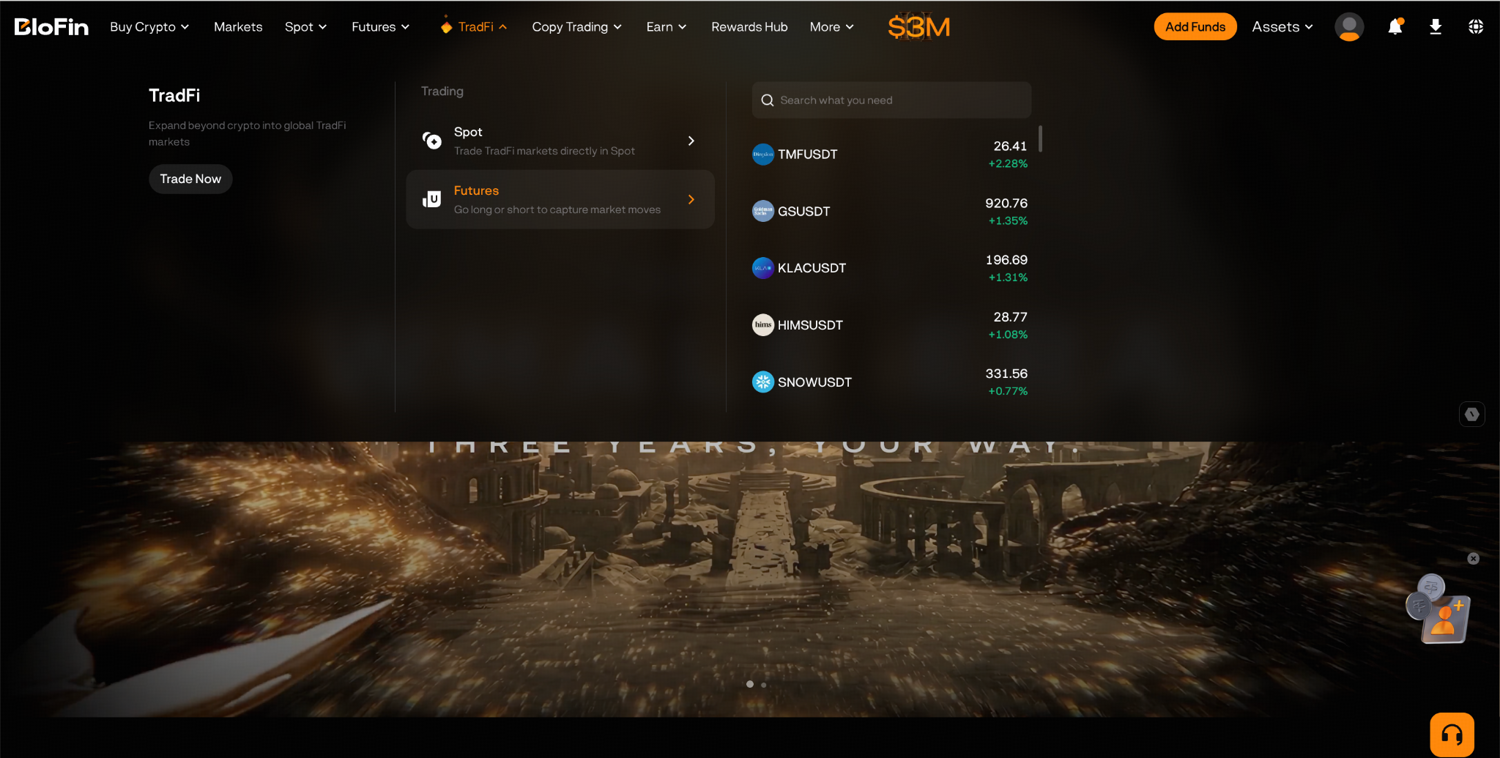
Step 1: Log in to your BloFin account and hover your cursor over the TradFi tab. Then, click Futures.
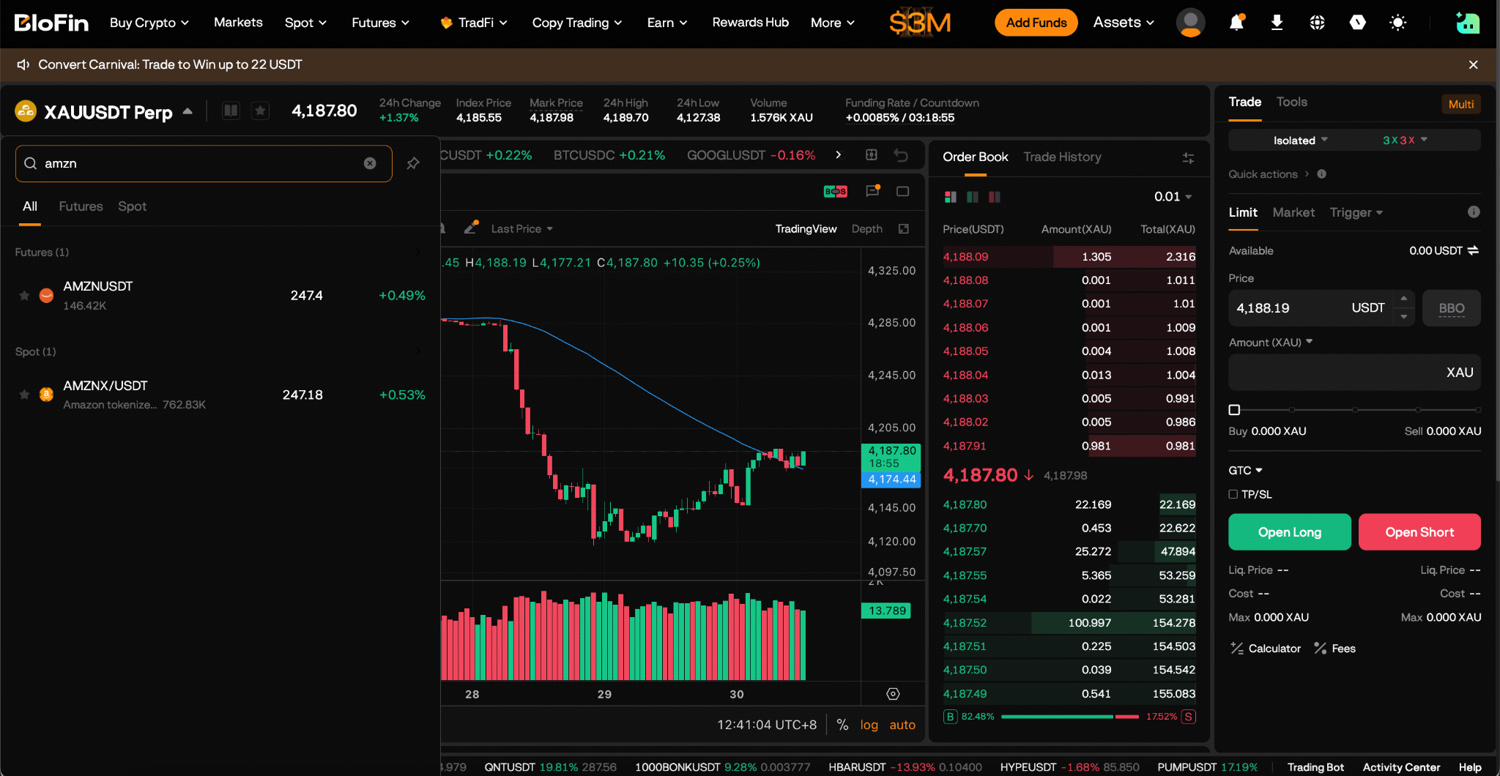
Step 2: Click on the XAUUSDT Perpetual and a pop-up window will appear. Type AMZN in the search field and select the AMZNUSDT Perpetual.
Step 3: Set the margin mode and leverage. The margin control on the order panel shows Cross 3X by default, so switch it to Isolated if preferred and pick your multiplier. BloFin allows up to 20x on the first 300 AMZN of a position (source: BloFin AMZNUSDT position tiers).
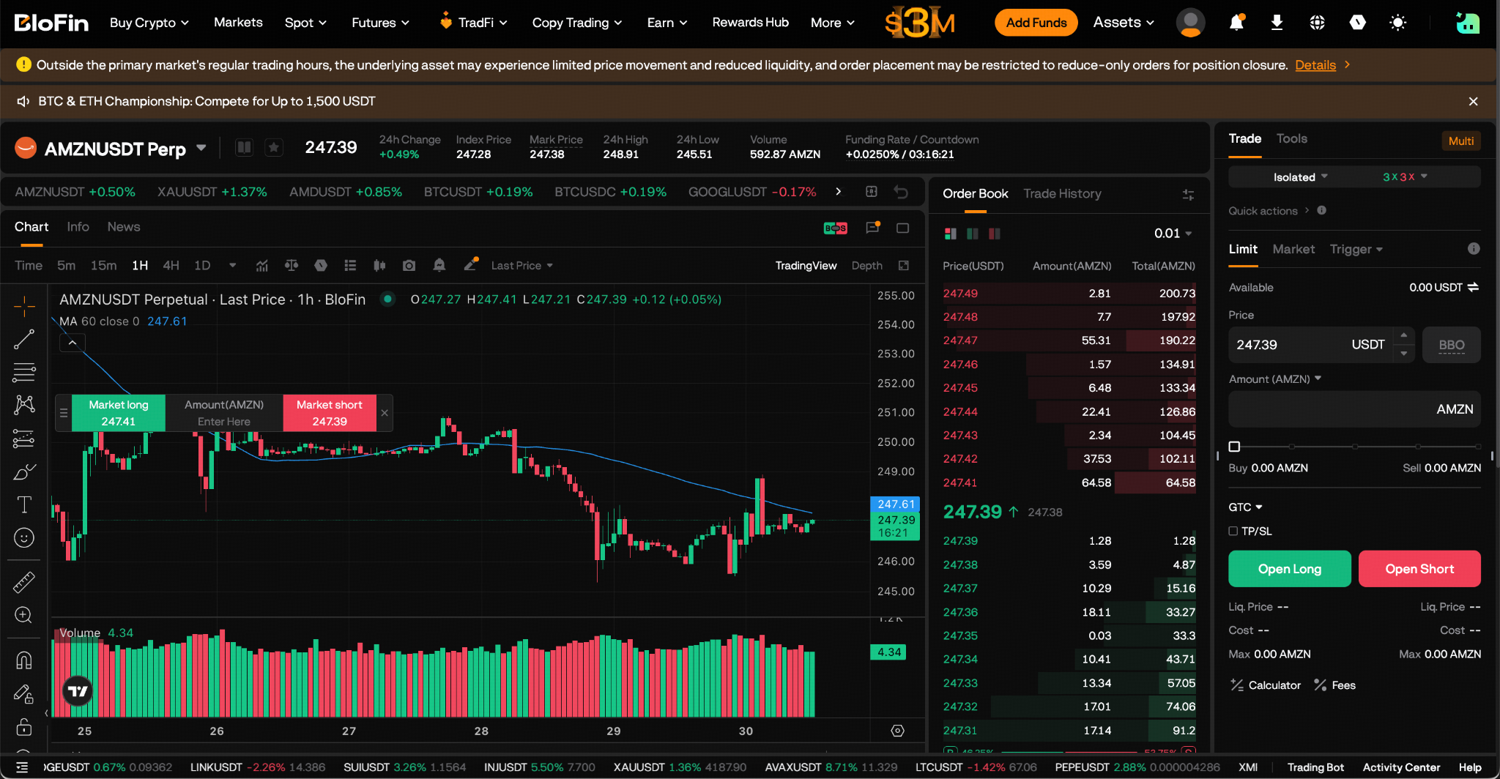
Step 4: Choose Limit, Market or Trigger, then enter the amount in AMZN. The smallest order is 0.01 AMZN, and a market order can be up to 500 AMZN and a limit order up to 5,000 (source: BloFin AMZNUSDT contract details).
Step 5: Read the Sell side. The panel shows a Liq. Price and a Cost under both Buy and Sell, and for a short the liquidation price sits higher than your entry.
Step 6: Tick TP/SL, the take-profit and stop-loss setting. On a short, the stop-loss goes higher than your entry and the take-profit lower, and the trigger can be the last price, the mark price or the index price (source: BloFin TP/SL guide).
Step 7: Once you’ve confirmed all the details, click Open Short and the short appears under Positions with its liquidation price.
Say you want to short 2 AMZN at 10x. In Isolated mode the margin is a tenth of the position, about 50 USDT at a price near 249. That 50 USDT is the most the trade can lose before fees. BloFin's guide to trading Amazon with leverage compares isolated and cross margin and shows how the leverage tiers step down on larger positions.
Where an Amazon short is liquidated
A short on the AMZNUSDT Perpetual is liquidated when Amazon's mark price rises far enough that your margin, after the loss, falls to the maintenance margin plus the closing fee. From an entry at 249.21 USDT, that takes a rise of about 2.4% at 20x, 7.3% at 10x and 17% at 5x.
The maintenance margin is the least margin BloFin requires a position to keep, and it grows with the position's value. BloFin publishes the formula for an isolated short. Add the margin to the amount times the opening price, then divide by the amount times one plus the maintenance margin rate plus the closing fee rate (source: BloFin liquidation price calculation). Liquidation starts when the mark price reaches that level (source: BloFin forced liquidation rules). The mark price is BloFin's reference price: the index price plus a moving average of the contract's premium over it, so irregular price swings are less likely to set off a liquidation (source: BloFin index price and mark price).
On the first tier the maintenance margin rate is 2.50% (source: BloFin AMZNUSDT position tiers). The closing fee in BloFin's own worked example is 0.06% (source: BloFin forced liquidation rules). That is the same as the regular taker rate on BloFin's fee schedule. For the 2 AMZN short at 10x:
Your margin = 2 × 249.21 ÷ 10 = 49.84 USDT
Liquidation price = (49.84 + 2 × 249.21) ÷ (2 × 1.0256) = 267.29 USDT
Rise needed = 267.29 ÷ 249.21 − 1 = 7.25%
The same formula at other multipliers, with the same 2.50% first-tier rate, gives these estimates for the 2 AMZN short (source: BloFin liquidation price calculation).
Leverage | Margin posted | Estimated liquidation price | Rise that liquidates it |
|---|---|---|---|
1x | 498.42 USDT | 485.98 | 95.0% |
2x | 249.21 USDT | 364.48 | 46.3% |
3x | 166.14 USDT | 323.99 | 30.0% |
5x | 99.68 USDT | 291.59 | 17.0% |
10x | 49.84 USDT | 267.29 | 7.3% |
20x | 24.92 USDT | 255.14 | 2.4% |
The percentages hold at any entry price on the first tier, because the margin scales with the position. Even at 1x a short can be liquidated, since a doubling of Amazon would cost more than everything you posted. A long at 10x from the same price would be liquidated at 230.18, a fall of 7.6%. The short goes first because its maintenance margin grows as the price rises.
BloFin calls the estimated liquidation price a reference, and it shifts when funding is paid or received or when you add margin (source: BloFin forced liquidation rules). BloFin's guide to leverage and liquidation suggests keeping the liquidation price at least one and a half to two times as far from your entry as your stop.
Amazon's biggest up days and the short squeeze
On 42 of the 183 trading sessions from January 5 to September 25, 2026, Amazon's high was at least 2.38% above the previous close, the rise that liquidates a 20x short, and seven sessions reached 5% or more. On July 31, Amazon opened 12.53% higher and closed up 15.32% (source: Yahoo Finance AMZN history).
A short squeeze happens when a rising price forces short sellers to buy back, and their buying pushes the price higher still. On a perpetual, much of that forced buying comes from liquidations. Once a short is liquidated, BloFin's engine takes over the position and closes it in the market (source: BloFin forced liquidation rules).
Yahoo Finance's daily prices from January 5 to September 25, 2026 list seven sessions whose high was 5% or more above the previous close (source: Yahoo Finance AMZN history).
Session | Previous close | High | Rise to the high | Close |
|---|---|---|---|---|
April 8 | $213.77 | $226.10 | 5.8% | $221.25 |
April 9 | $221.25 | $233.80 | 5.7% | $233.65 |
April 14 | $239.89 | $252.18 | 5.1% | $249.02 |
June 29 | $232.69 | $249.71 | 7.3% | $240.14 |
July 30 | $226.65 | $239.82 | 5.8% | $235.50 |
July 31 | $235.50 | $273.23 | 16.0% | $271.58 |
August 3 | $271.58 | $287.20 | 5.8% | $284.02 |
June 29 is the day to study. Amazon touched a 7.3% gain, then gave most of it back to close 3.2% higher. Measured on the share price itself, a 10x short opened at the previous close would have reached its estimated liquidation price at the high of a day that ended far lower. On BloFin, the AMZNUSDT Perpetual's highest trade that day was 246.88 USDT, 6.3% above its 232.18 USDT price at the previous US close. That peak was about 0.9% below the 249.02 estimated liquidation price of a 10x short opened at 232.18. From the July 30 close of $235.50 to the August 3 high of $287.20, the share rose 21.95% in two sessions, more than a 5x short can absorb (source: Yahoo Finance AMZN history).
Earnings nights cut both ways. Amazon held its earnings calls on February 5, April 29 and July 30, 2026, each at 2PM or 2.30PM Pacific time, after the US close (source: Amazon investor events). The next morning the share opened 8.98% lower in February, 3.85% higher in April and 12.53% higher in July (source: Yahoo Finance AMZN history). A short held into February's report gained, while one held into July's lost heavily. Amazon's investor calendar shows no date yet for its third-quarter 2026 results.
BloFin's guide to reading Amazon's earnings reports explains how to read the reports behind those nights. A ruling in the Federal Trade Commission's antitrust case against Amazon is another date that can move it at once.
When BloFin accepts a new Amazon short
BloFin's regular stock futures hours are 1.30PM to 8PM Coordinated Universal Time (UTC) on weekdays, or 2.30PM to 9PM UTC outside US daylight saving time. Outside them, at weekends and on holidays, BloFin may limit trading to reduce-only orders, so shorts can be closed but new ones may wait (source: BloFin stock futures trading update).
Reduce-only means an order can only shrink or close a position you already hold (source: BloFin reduce-only guide). A banner on the AMZNUSDT trading page gives the same warning: outside the primary market's regular hours, order placement may be restricted to reduce-only orders.
The calendar matters for the rest of 2026. US daylight saving time ends on Sunday, November 1, 2026, which moves the regular window an hour later, to run from 2.30PM to 9PM UTC. BloFin's stock futures notice lists the US market holidays and early closes left in 2026, and on those days, too, a new short may have to wait for the next regular session (source: BloFin stock futures trading update).
The timing matters most for results. Amazon's results arrive after the US close, just when opening orders may stop being accepted. A short meant to be in place for a report is therefore surest to be accepted if it is opened while the regular window is still running that afternoon.
Say you expect a weak quarter and want to short 2 AMZN when the numbers come out. You would place the order during the regular session on the day of the report and attach the stop at the same time. The position then sits through the release and the next morning's open, with whatever gap that brings. If you change your mind once the numbers are out, the reduce-only limit still lets you close it.
How to close or cut an Amazon short
To close a short on AMZNUSDT, place a Buy for the same amount with Reduce-only ticked. A smaller Buy closes part of it and leaves the rest open. Because the order is reduce-only, the Buy can shrink or close the short but can never turn it into a long, even if the amount you type is slightly too large.
BloFin's reduce-only guide shows the rule with a long: a reduce-only Sell of 1.5 bitcoin (BTC) against a 1 BTC long is only allowed to close the 1 BTC and never opens a 0.5 BTC short. A Buy against a short works the same way. The guide adds that an order larger than the open position may be rejected or canceled, and that the flag sets the purpose of the order without guaranteeing a fill, so a reduce-only limit order still waits for the market to reach your price (source: BloFin reduce-only guide).
A stop on a short is a buy order that triggers when the price rises to it. A stop-market order fills at the next available price once it triggers. A stop-limit order can sit unfilled if the price jumps past its limit, and neither type protects you from a gap. BloFin's stop-loss guide gives a short-cover example with the limit set a little higher than the trigger, so the order still fills in a fast rise.
Say you sold 2 AMZN at 249.21 and Amazon falls to 240. Buying 1 AMZN back with Reduce-only locks in 9.21 USDT on half the position, before fees, and leaves 1 AMZN short with its own stop still working. Buying the second one back at 238 would add 11.21 USDT.
Every open and close pays a trading fee. At BloFin's regular tier, futures cost 0.02% for a maker order, which waits in the book, and 0.06% for a taker order, which fills at once. A round trip on a 498 USDT short therefore costs about 0.20 to 0.60 USDT, and the BloFin fee schedule lists the lower rates for higher tiers.
How to hedge AMZNX with an AMZNUSDT short
To hedge AMZNX, you may want to sell as many AMZN on the AMZNUSDT Perpetual as you hold in tokens. A fall in Amazon then costs the tokens about what it earns the short. What remains is the small gap between the two prices, funding, fees, and the risk that the short is liquidated if Amazon rises.
The tokens stay in your spot account and the short sits in futures, so One-way Mode works for a hedge. Position mode only matters when you hold opposite positions on the same contract (source: BloFin hedge mode guide). The short's margin is its own, though. BloFin's leverage and liquidation guide describes isolated margin as ring-fencing the collateral you assign to one position, so a rise that lifts your tokens can still liquidate the short beside them.
That is why a hedge usually runs at low leverage. For 20 AMZNX, a 20 AMZN short at 3x needs about 1,661 USDT of margin and is liquidated after a 30% rise, while at 2x it needs about 2,492 USDT and can take a 46% rise (source: BloFin liquidation price calculation).
The two prices stay close without being identical, since BloFin's notice ties its stock futures to a basket of tokenized stock indices already in circulation (source: BloFin stock futures trading update). Across the 751 hours from August 28, 2026 to the morning of September 28, BloFin's AMZNUSDT Perpetual closed a median 0.068% above AMZNX, and on those closing prices the gap ranged from 0.10% below to 0.28% above.
Funding is the running cost or income. When the perpetual trades above spot the rate is positive and longs pay shorts, and when the rate is negative shorts pay longs, as BloFin's guide to crypto funding rates explains. BloFin settles AMZNUSDT funding every eight hours (source: BloFin AMZNUSDT contract details). On BloFin, 73 of the 90 settlements from 4PM UTC on August 29, 2026 to 8AM UTC on September 28 were positive, 16 negative and one zero. Together they came to 0.93% of the position's value, in the short's favor (source: BloFin AMZNUSDT funding history).
Say you had held 20 AMZNX with a 20 AMZN short from 1AM UTC on September 21, 2026 to early on September 28, on BloFin's prices:
20 AMZNX: 255.45 → 248.85 −132.00 USDT
20 AMZN short: 255.34 → 249.17 +123.40 USDT
Price difference −8.60 USDT
Funding received (21 settlements) about +24 USDT
Fees to open and close at 0.06% about −6 USDT
Net on about 5,000 USDT about +10 USDT
The gap between the two markets moved against you by 8.60 USDT, and funding more than paid for it that week. In a week of negative rates the same hedge would pay funding instead. BloFin's guide to hedging spot crypto covers the wider method, including a hedge smaller than the holding. If you would rather hold one Amazon position with no hedge, BloFin's guide to AMZNX versus the AMZN perpetual helps you choose between the two.
Inverse ETFs, put options and short sales at a broker
Away from BloFin, a bearish view on Amazon usually takes one of three forms at a stock broker: an inverse single-stock exchange-traded fund (ETF) such as AMZD, a put option, or a short sale of the shares. Each has its own costs and limits, and each behaves differently from a perpetual short.
AMZD, the Direxion Daily AMZN Bear 1X ETF, aims for the opposite of Amazon's performance each day, before fees. It lists a gross expense ratio of 1.26% and a net ratio of 1.02% (source: Direxion AMZU and AMZD). Because the fund resets every day, its result over weeks drifts away from the opposite of Amazon's. In the three months to August 31, 2026, Amazon's share fell 4.02%, from $270.64 to $259.77 (source: Yahoo Finance AMZN history). Over the same three months, AMZD's net asset value, the fund's assets minus its liabilities per share, rose only 0.58% (source: Direxion AMZU and AMZD).
The fund can never liquidate you and charges no funding, but it trades in stock market hours and compounds every day. A perpetual short keeps its size until you change it and settles funding every eight hours. That is why the two are different trades even when both gain as Amazon falls.
A put option gives its buyer the right to sell shares, usually 100 per contract, at a set price called the strike until the option expires. You pay a premium up front, and it is not refunded. If the share is still above the strike at expiry, the option expires worthless and the premium is gone (source: Investor.gov options bulletin). The loss is capped at what you paid, but the fall has to arrive before a fixed date.
A short sale of the shares means borrowing them through a broker, usually from its own inventory or from other clients' margin accounts. You pay interest on the loan, the margin rules apply, and the loss can grow without limit if the price keeps rising (source: Investor.gov short sales bulletin).
Who an Amazon short on BloFin suits
A short on the AMZNUSDT Perpetual might suit a trader who expects Amazon to fall, or who holds AMZNX and would like protection, over days or weeks. It also suits someone who can manage the position during US market hours. Its running costs are funding and fees, and its main risk is liquidation on a sharp rise.
The size of the position matters more than the multiplier. BloFin's guide to position sizing sets the size from the loss you can accept and the distance to your stop. Say you can accept a 25 USDT loss and place your stop 4% above your entry. The position is then about 25 ÷ 0.04 = 625 USDT, or 2.5 AMZN near 249. At 3x its liquidation price sits about 30% away, far beyond the stop. Before you press Sell, the Liq. Price shown under Sell tells you whether the distance matches your plan. BloFin also notes that access to stock futures may be restricted in certain regions (source: BloFin stock futures trading update).
Futures copy trading on BloFin covers AMZNUSDT, so if you would rather follow someone else's calls, a lead trader's Amazon shorts can be mirrored in your account. BloFin's guide to how copy trading works explains the leader-and-follower setup. If your hedge involves AMZNX, read whether tokenized Amazon is safe to see who issues the token and how it is held.
Looking to short Amazon or hedge an AMZNX holding? To get started, you'll need to first create a BloFin account, fund your account with cryptocurrency, and navigate to the AMZNUSDT Perpetual page or AMZNX/USDT Spot trading page.
Frequently asked questions
What percentage of Amazon stock is sold short?
Less than 1%. Nasdaq reported 81,440,414 Amazon shares sold short at the September 15, 2026 settlement, which would take about 2.8 days to buy back at the recent average daily volume (source: Nasdaq AMZN short interest). That is 0.76% of Amazon's roughly 10.8 billion shares outstanding and 0.83% of its float, the shares available for public trading (source: Stock Analysis AMZN statistics). The 2026 high in Nasdaq's figures was 106,566,350 shares on July 15, about two weeks before the results that sent the stock sharply higher.
How much money do you need to short a stock like Amazon?
On BloFin the smallest AMZNUSDT order is 0.01 AMZN (source: BloFin AMZNUSDT contract details). That is about 2.49 USDT of exposure at a price of 249.21, and at 20x it needs roughly 0.12 USDT of margin plus fees. At a broker, a short sale falls under the margin rules (source: Investor.gov short sales bulletin). Before margin trading, the Financial Industry Regulatory Authority (FINRA) requires a deposit of $2,000 or the full purchase price, whichever is less, and some firms ask for more (source: Investor.gov margin bulletin).
Do you pay dividends when you short Amazon?
A short seller at a broker owes any dividend the borrowed stock pays to whoever lent the shares (source: Investor.gov short sales bulletin). With Amazon that cost is zero so far, because the company says it has never declared or paid a cash dividend on its common stock (source: Amazon investor FAQs). BloFin's notice says its stock futures, the AMZNUSDT Perpetual among them, do not entitle you to any dividends (source: BloFin stock futures trading update). BloFin's guide to whether Amazon pays dividends explains why Amazon reinvests its cash instead.
Does a short on the AMZNUSDT Perpetual count in Amazon's short interest?
Amazon's short interest counts the short positions in its shares on the books of brokerage firms, which report them twice a month, around the middle and the end of each month (source: FINRA short interest guide). A short on the AMZNUSDT Perpetual sells a contract that follows Amazon's price, and BloFin's stock futures convey no ownership of the shares they track (source: BloFin stock futures trading update). No Amazon share is borrowed or sold, so a short on BloFin is not itself counted in the figure Nasdaq publishes.
Can copy trading open an Amazon short for you?
Yes, if the trader you follow goes short. BloFin's futures copy trading copies a lead trader's longs and shorts into your account and closes them when the trader closes, and the Fixed Amount and Fixed Ratio modes let you cap the leverage instead of matching it (source: BloFin futures copy trading guide). A copied AMZNUSDT short carries the same liquidation and funding rules as one you open yourself.
Researched and written by the BloFin Academy editorial team with AI-assisted drafting. All facts independently verified. Primary sources include BloFin's AMZNUSDT contract details, position tiers and funding history, BloFin's hourly AMZNUSDT and AMZNX/USDT prices, BloFin's stock futures trading update of April 21, 2026, liquidation price calculation, forced liquidation rules, index and mark price, hedge mode, TP/SL, reduce-only and spot trading guides, its fee schedule, its futures copy trading guide, Amazon's daily prices via Yahoo Finance, Nasdaq's short interest data, Stock Analysis's share statistics, Amazon's investor relations pages, Direxion's AMZD fund page, FINRA's guide to short interest and the SEC's Investor.gov bulletins on short sales, options and margin, current as of September 28, 2026.
Nothing in this article constitutes financial advice, and nothing in it is a recommendation to buy, sell or hold Amazon in any form. A short on the AMZNUSDT Perpetual loses as Amazon rises, and at 20x a rise of about 2.4% can liquidate it and take the margin behind it, as rises like July 31, 2026 show. Funding can turn against a short, a stop can fill well past its trigger in a gap, and outside regular US hours BloFin may accept only orders that reduce a position. Past performance does not indicate future results. Do your own research and consider your risk tolerance before you trade on BloFin.