
Many investors expect a large, profitable company to hand some of its cash back to the people who own it. That can come as a regular dividend paid on a schedule, or as a buyback, where the company purchases its own shares on the market and retires them.
A company that pays neither can still move value between its owners. When staff are paid in shares, each new share takes a slice of the same business, and that dilution only reverses when the company retires more shares than it creates. The headline answer to a dividend question leaves that part out.
The fuller answer sits in a company's own annual and quarterly reports. Its dividend policy, its table of buybacks and the share count printed on each report's cover show what owners actually received. Together they also show how far dilution has run since the stock began trading.
Palantir Technologies (PLTR) has published all three since it listed in 2020, and its record answers each of those questions with figures. On BloFin, the PLTRUSDT Perpetual tracks that share price through a USDT-settled perpetual contract, which comes with its own costs and risks.
Does Palantir stock pay a dividend?
Palantir stock does not pay a dividend, and Palantir Technologies has never declared or paid one on any class of its shares. Its 2025 annual report says the company plans to retain any future earnings and expects to pay none in the foreseeable future (source: Palantir 2025 Form 10-K).
That puts PLTR's dividend yield at zero. The SEC's investor glossary defines a dividend as a portion of a company's profit paid to shareholders, usually on a fixed schedule (source: Investor.gov, Dividend). Palantir has the profit, with net income of $1.6 billion in 2025, and none of it has gone out as a dividend (source: Palantir 2025 Form 10-K).
The same annual report spells out what that means for an owner: holders must rely on selling their Class A shares after the price has risen, "which may never occur". That sale is the only way to realize a gain (source: Palantir 2025 Form 10-K).
Two other things have changed what each share is worth. Palantir ran a $1.0 billion buyback from August 2023 to January 2026 and used 14.1% of it. Meanwhile, paying staff in stock lifted its share count by 34.4% from the end of 2020 to September 30, 2026 (source: Palantir 2025 Form 10-K, Palantir Q3 2026 Form 10-Q, Palantir 2022 Form 10-K).
Palantir's payouts to shareholders in the third quarter of 2026
Palantir's quarterly report for July to September 2026, filed on November 3 in the middle of earnings season, shows no dividend declared and no shares bought back. Part II, Item 2 (Unregistered Sales of Equity Securities and Use of Proceeds) reads simply "None." The equity note repeats that no dividends had been declared as of September 30 (source: Palantir Q3 2026 Form 10-Q).
The same report shows how much cash the company kept. Palantir's cash, cash equivalents and US Treasury securities added up to $10.4 billion on September 30, up from $7.2 billion at the end of 2025. Palantir also had no debt and $500 million of unused credit (source: Palantir Q3 2026 Form 10-Q, Palantir 2025 Form 10-K).
From January to September 2026, Palantir's share count climbed by 18.0 million, or 0.75%, to 2,409.2 million. The only shares the company repurchased all year were 8,452 in January, for about $1.5 million, before the buyback ended that month (source: Palantir Q3 2026 Form 10-Q, Palantir Q1 2026 Form 10-Q).
So the November filing leaves the dividend answer where it was. What it adds is scale: cash and Treasury holdings grew by about $3.2 billion in nine months, and none of that money went back to the people holding the stock.
Palantir's dividend policy
Palantir's dividend policy is to keep its earnings in the business for now. Its annual report says any future dividend is a decision for the Palantir board of directors. That decision would depend on the company's financial condition, results, capital needs, contractual limits and general business conditions, among other factors (source: Palantir 2025 Form 10-K).
One of those contractual limits is already in place. The terms of Palantir's undrawn credit facility restrict its ability to declare and pay cash dividends. The company warns that future credit agreements could add similar limits (source: Palantir 2025 Form 10-K).
A dividend, once declared, would reach every class of the stock alike. Palantir's three share classes carry identical dividend and liquidation rights and differ only in voting and conversion. Class A is the class that trades on Nasdaq under PLTR (source: Palantir 2025 Form 10-K). Class F generally lets the three founders control up to 49.999999% of all shareholder votes, as long as they keep a minimum ownership stake (source: Palantir Q1 2026 Form 10-Q). That is why who owns Palantir's shares also shapes who sits on the Palantir board that would declare any payout.
Any change would begin with a board declaration. A company that declares a dividend then sets a record date, the day an owner must be on its books to receive the payment. The ex-dividend date then follows from it under stock exchange rules (source: Investor.gov, Ex-Dividend Dates).

Palantir's share buyback program
Palantir's share buyback program was a $1.0 billion authorization its board approved in August 2023 to repurchase Class A shares. It had no expiry date and did not oblige the company to buy. Palantir ended it in January 2026 after spending about $140.7 million, or 14.1% of the amount allowed (source: Palantir 2025 Form 10-K, Palantir Q1 2026 Form 10-Q).
Palantir bought nothing under the program in 2023, the year it was approved. It spent $64.2 million in 2024 on 2.1 million shares and $75.0 million in 2025 on 600,446 shares, retiring each one at once (source: Palantir 2025 Form 10-K).
The last full quarter of buying ran from October to December 2025. Palantir retired 106,171 shares in those three months, at average monthly prices between $174.65 and $183.79, and the final 8,452 shares followed in January 2026 (source: Palantir 2025 Form 10-K, Palantir Q1 2026 Form 10-Q).
Over the whole program, Palantir retired about 2.7 million shares. That came to 0.12% of the 2,200.1 million shares outstanding at the end of 2023, and the count kept rising throughout the years of buying (source: Palantir 2025 Form 10-K, Palantir Q1 2026 Form 10-Q).
Stock-based compensation at Palantir since 2020
Stock-based compensation (SBC) is the pay Palantir gives its staff in shares, options and other equity awards. It counts as an expense even though staff receive equity rather than cash. It fell from 116.3% of revenue in 2020 to 15.3% in 2025, when it came to $684.0 million. In the first nine months of 2026 it was 13.4% (source: Palantir 2022 Form 10-K, Palantir 2025 Form 10-K, Palantir Q3 2026 Form 10-Q).
Period | Stock-based compensation ($ million) | Revenue ($ million) | SBC as % of revenue |
|---|---|---|---|
2020 | 1,270.7 | 1,092.7 | 116.3% |
2021 | 778.2 | 1,541.9 | 50.5% |
2022 | 564.8 | 1,905.9 | 29.6% |
2023 | 475.9 | 2,225.0 | 21.4% |
2024 | 691.6 | 2,865.5 | 24.1% |
2025 | 684.0 | 4,475.4 | 15.3% |
January to September 2026 | 785.7 | 5,881.5 | 13.4% |
The 2020 figure carries a one-off. The direct listing that began trading in Palantir's shares on September 30, 2020, met a vesting condition on restricted stock units (RSUs) and growth units. The company booked $777.9 million of expense that day (source: Palantir 2022 Form 10-K). That was 61.2% of the year's total, and without it SBC would still have been 45.1% of 2020 revenue.
The expense is rising again in dollars while it shrinks against sales. From January to September 2026 it grew 61.1% on the same months of 2025, but revenue grew 91.7%, so the expense slipped from 15.9% to 13.4% of sales (source: Palantir Q3 2026 Form 10-Q).
In August 2022, the Motley Fool argued that dilution was canceling out Palantir's growth. Its revenue per share, the article said, was "virtually flat" (source: The Motley Fool). The picture has shifted since then. Revenue per share, using the basic weighted-average share count, rose from $0.80 in 2021 to $1.89 in 2025. That is a rise of 135.6%, against 190.3% for revenue itself (source: Palantir 2022 Form 10-K, Palantir 2025 Form 10-K).
The difference comes from the 23.2% rise in that weighted share count over the same four years. Revenue reached 2.9 times its 2021 level, and spreading it over 1.23 times as many shares leaves 2.36 times as much revenue per share (source: Palantir 2022 Form 10-K, Palantir 2025 Form 10-K). How much the market pays for each dollar of that revenue is a valuation question, measured with multiples such as price to sales.
Palantir's share count since its 2020 listing
Palantir's share count is the number of shares outstanding across all three classes, A, B and F. It has risen in every year since the stock listed in 2020. It grew from 1,792.1 million at the end of 2020 to 2,409.2 million on September 30, 2026, an increase of 34.4% (source: Palantir 2022 Form 10-K, Palantir Q3 2026 Form 10-Q).
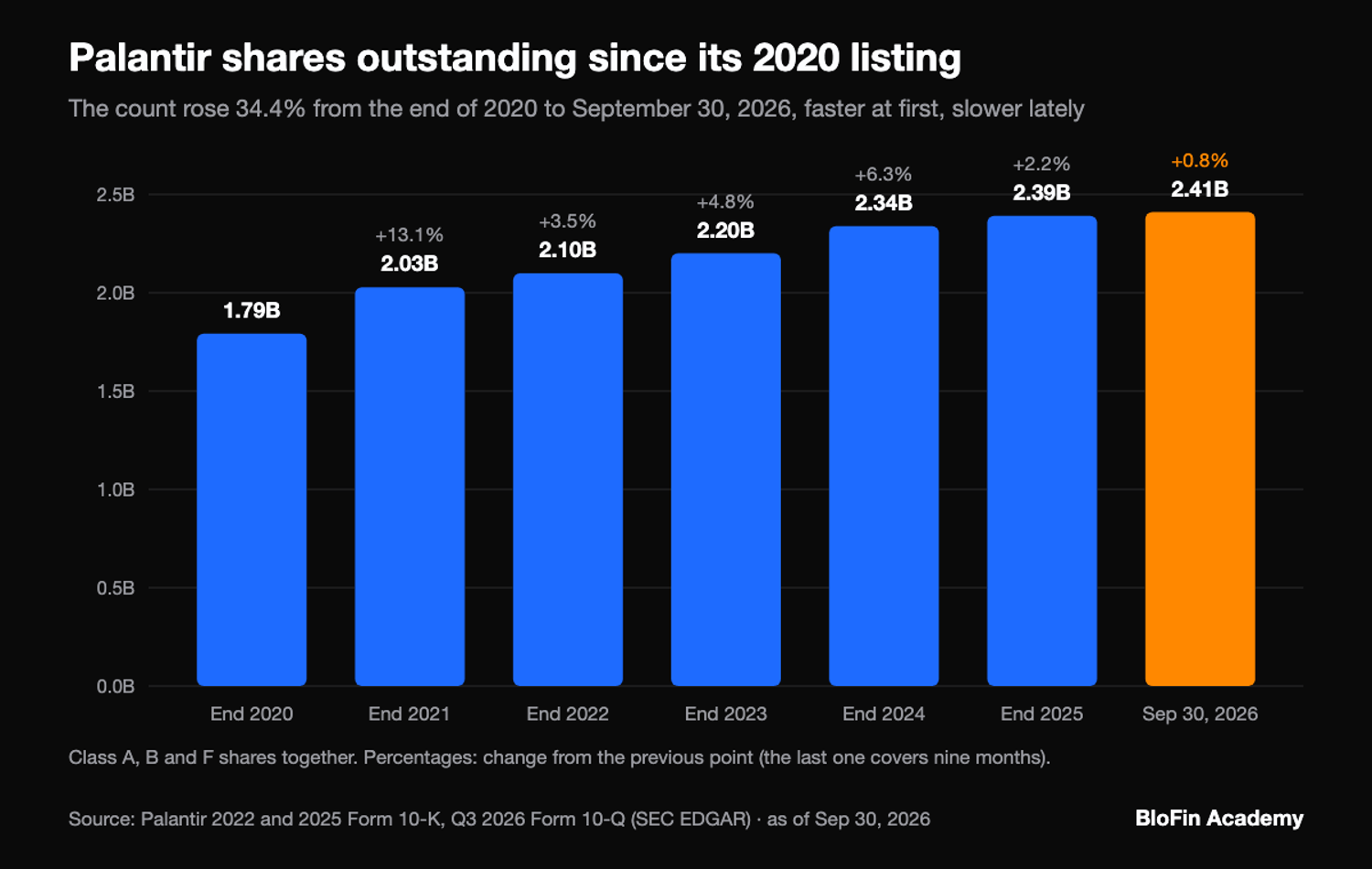
The pace has slowed since the first full year. The count rose 13.1% in 2021, 3.5% in 2022, 4.8% in 2023, 6.3% in 2024 and 2.2% in 2025. On a compound basis that works out to 5.9% a year from the end of 2020 to the end of 2025 (source: Palantir 2022 Form 10-K, Palantir 2025 Form 10-K).
Most of the 2021 jump came from staff exercising stock options. Option exercises added 178.8 million shares that year, while the count as a whole rose by 235.3 million (source: Palantir 2022 Form 10-K).
The 2024 rise had a similar source. Employees exercised options for 99.3 million shares and RSUs released another 35.6 million. Stock appreciation rights (SARs) added 5.9 million after the shares withheld for taxes (source: Palantir 2025 Form 10-K).
Buybacks against new shares at Palantir
Palantir's buybacks were far smaller than the shares it issued to staff, so they never brought its share count down. In 2025 it issued 53.0 million shares through option exercises and vested RSUs, and it retired 0.6 million it had bought back. That left 52.4 million more shares outstanding, a rise of 2.2% (source: Palantir 2025 Form 10-K).
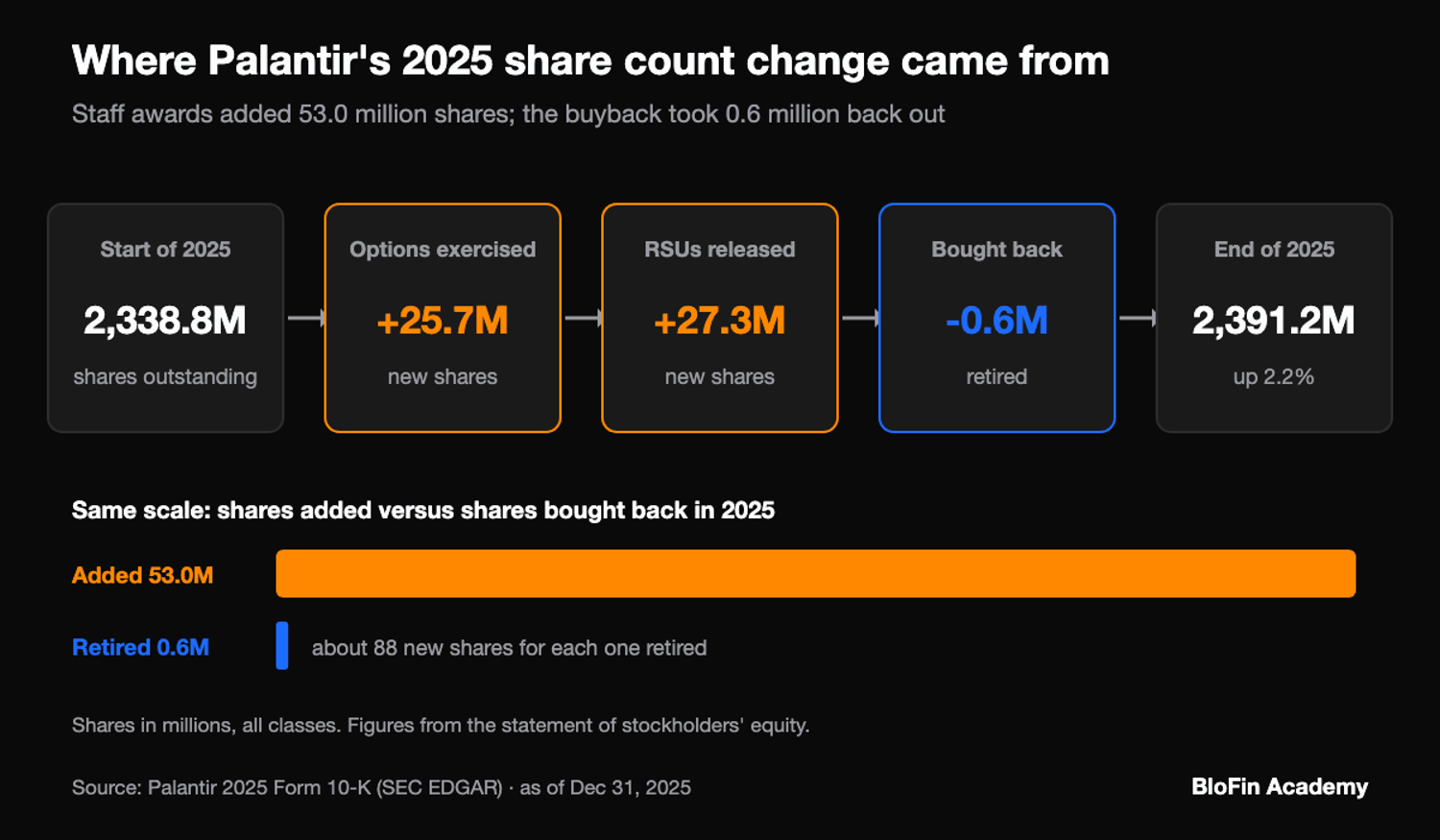
The gap was wider in 2024, when Palantir issued 140.8 million shares and retired 2.1 million, about 66 new shares for each one bought back (source: Palantir 2025 Form 10-K). Across 2024 and 2025, the 2.7 million shares bought back came to about 1.4% of the 193.8 million issued.
A larger cash outflow did more to hold the count down. When SARs and other awards pay out, Palantir can keep back some of the shares an employee is owed. It then pays that employee's tax in cash, a method known as net share settlement. Those tax payments came to $218.3 million in 2024 and $81.1 million in 2025, 2.2 times what the buyback cost over the same two years (source: Palantir 2025 Form 10-K).
Cash also flowed the other way, as employees paid Palantir $745.4 million to exercise options in 2024, 11.6 times that year's buyback spending. In 2025 they paid $129.1 million, against $75.0 million spent on repurchases (source: Palantir 2025 Form 10-K). In both years staff paid more into the company for new shares than the company spent retiring old ones.
Future dilution from Palantir's equity plan
Future dilution at Palantir comes from two places: new shares added each year to its 2020 Equity Incentive Plan, and awards already granted that have yet to become stock. On January 1, 2026, the plan grew by 119,559,591 Class A shares. Palantir registered them with the SEC on Form S-8 on February 17, 2026 (source: Palantir Form S-8, February 2026).
That yearly top-up follows a fixed formula. Each January 1 the plan grows by the smallest of three amounts. The choices are 250 million shares, 5% of all shares outstanding at the previous year's end, or a lower number the plan's administrator sets (source: Palantir Form S-8, February 2026). The 2026 increase equals 5% of the 2,391.2 million shares outstanding at the end of 2025, and 47.8% of the 250 million cap.
Shares in the plan are a ceiling on future grants. They reach the share count only when awards vest or are exercised, which is why the count moves more slowly than the plan grows.
Awards already granted are the nearer source, and Palantir's staff held 201.0 million of them on September 30, 2026, equal to 8.3% of the shares then outstanding. Options made up 146.8 million of them, with an average exercise price of $10.16, and SARs, RSUs and performance RSUs made up the rest (source: Palantir Q3 2026 Form 10-Q). The option pile has shrunk by 55.1% from 326.9 million at the end of 2022 (source: Palantir 2022 Form 10-K).
Equity can also be sold for cash, and Palantir's annual report says it may seek more equity or debt financing "on an as needed or opportunistic basis". Growth and any deals to buy or invest in other businesses are the reasons it gives (source: Palantir 2025 Form 10-K).
Where Palantir's cash goes
Palantir's cash has mostly stayed on its balance sheet. Between January and September 2026, operations brought in $3.3 billion, while purchases of property and equipment took only $30.0 million. Cash, cash equivalents and US Treasury securities rose to $10.4 billion by September 30 (source: Palantir Q3 2026 Form 10-Q).
That pattern held through 2025 as well, when operating cash flow was $2.1 billion and the buyback used 3.5% of it. The tax paid on net share settlement used another 3.8%, and equipment purchases took $33.9 million (source: Palantir 2025 Form 10-K).
The largest fixed claim on future cash is cloud hosting. A cloud services contract, amended in March 2026, binds Palantir to a minimum of $5.6 billion across ten contract years ending in February 2036. Its yearly floors run from $268 million up to $979 million (source: Palantir Q1 2026 Form 10-Q).
The company lists its main cash requirements as leases for its facilities and those cloud hosting commitments (source: Palantir Q3 2026 Form 10-Q). Its annual report adds that future capital needs depend on growth, on spending to market and develop its products, and on any acquisitions (source: Palantir 2025 Form 10-K).
Does the PLTR perpetual pay dividends?
The PLTRUSDT Perpetual pays no dividends, because a BloFin stock perpetual tracks Palantir's price without giving its holder a stake in the company. BloFin's notice on stock futures states that the contracts convey no ownership interest and carry no dividends, interest, voting rights or other shareholder rights (source: BloFin stock futures notice).
Holding the contract brings a payment of its own, the funding payment, which settles three times a day on its normal schedule, at 12AM, 8AM and 4PM UTC. The PLTR perpetual's funding rate decides which side pays (source: BloFin PLTRUSDT market data).
One contract is worth 0.01 PLTR and the maximum leverage is 20x, so a small move against a position can trigger liquidation. Trading may be restricted to reduce-only orders on weekdays before and after regular US market hours, and on weekends and public holidays. Those orders can only cut a position you already hold (source: BloFin PLTRUSDT market data, BloFin stock futures notice). Votes, custody and holding period are the other differences between holding the PLTR perpetual and owning shares.
Last price, mark price and a countdown to the next funding settlement all appear on the PLTRUSDT Perpetual page.
How to check Palantir's dividend and share count yourself
You can check Palantir's dividend status and share count yourself in its filings on EDGAR (Electronic Data Gathering, Analysis, and Retrieval), the SEC's public filing database. Every annual and quarterly report carries the same few items. These are the share count on its cover page, the equity note and a table of the company's own share purchases.
Step 1: Go to SEC EDGAR, search for Palantir Technologies, and pick the newest 10-Q or 10-K report in its list of filings.
Step 2: Read the cover page, which gives the number of shares outstanding in each class on a stated date, about a week before filing.
Step 3: Search the report for dividends to reach the stockholders' equity note, which states whether any have been declared up to the report's closing date.
Step 4: Search for repurchase to find the company's own share purchases. They sit under Part II, Item 2 of a quarterly report or Item 5 of an annual report.
Step 5: Divide the stock-based compensation line on the cash flow statement by total revenue. Then compare the share count with the previous report's to see how fast it is growing.
The S-8 filings in the same list show how many shares each yearly increase added to the equity plan, and the 2026 one was filed on February 17. Setting four years of cover-page counts side by side shows the trend faster than any single report.
Looking to trade Palantir? To get started, you'll need to first create a BloFin account, fund your account with cryptocurrency, and go to the PLTRUSDT Perpetual trading page.

Frequently asked questions
What is Palantir's dividend yield?
Palantir's dividend yield is 0%, since it pays no dividend at any share price. Its own accounts use the same figure. When it values the equity awards it grants, Palantir sets the expected dividend yield at zero, since it has never paid dividends and has no plans to (source: Palantir Q3 2026 Form 10-Q).
Has Palantir ever paid a special dividend?
Palantir has never paid a special dividend, or a cash dividend of any other kind, on its capital stock (source: Palantir 2025 Form 10-K). Investor.gov describes special or extra dividends as unscheduled payments that a company can make at any time outside its regular schedule (source: Investor.gov, Dividend). Palantir's third-quarter 2026 report states that no dividends had been declared as of September 30, 2026 (source: Palantir Q3 2026 Form 10-Q).
Why did Palantir end its share buyback?
Palantir's filings record that the program ended in January 2026 but give no reason for it. At the end of 2025, $860.8 million of the $1.0 billion approval was still unused, and the last 8,452 shares, bought that January, cost an average of $177.45 each (source: Palantir 2025 Form 10-K, Palantir Q1 2026 Form 10-Q).
Does Palantir still grant stock options?
Palantir's annual report says it granted no stock options in 2023, 2024 or 2025, and its third-quarter 2026 report shows none granted in 2026 to September 30 (source: Palantir 2025 Form 10-K, Palantir Q3 2026 Form 10-Q). Newer equity pay comes as RSUs and SARs, including 7.9 million SARs granted in 2026.
Does stock-based compensation cost Palantir cash?
Stock-based compensation costs Palantir little cash up front, because staff are paid in equity, and the cash flow statement therefore adds it back to profit. In 2025 that add-back was $684.0 million, equal to 32.0% of the year's operating cash flow (source: Palantir 2025 Form 10-K). The cost reaches existing holders through the extra shares.
Researched and written by the BloFin Academy editorial team with AI-assisted drafting. All facts independently verified. Primary sources include Palantir's 2022 and 2025 Form 10-K annual reports, its first- and third-quarter 2026 Form 10-Q reports and its February 2026 Form S-8, all on SEC EDGAR, with definitions from Investor.gov and commentary from The Motley Fool. BloFin facts come from its stock futures notice and its own PLTRUSDT market data, current as of November 10, 2026.
Nothing in this article constitutes financial advice, and nothing in it is a recommendation to buy, sell or hold Palantir in any form. Palantir pays no dividend, so any return from its shares depends on the price, and its share count has risen in every year since 2020. The PLTRUSDT Perpetual carries no shareholder rights, and at leverage of up to 20x a smaller price move can liquidate a position. Past performance does not indicate future results. Do your own research and consider your risk tolerance before you trade on BloFin.