
For most of recorded history, people paid for bread, rent and taxes with pieces of metal, and across much of the world that metal was silver. The coins in a modern pocket hold none of it, and the change came within the lifetime of many people alive today.
Silver became money by law, and it left money by law too. Those laws explain why people still call it a money metal, long after it left their pockets.
Read by law and date, the story has a clear shape. Silver was coined, then written into law as the measure of a country's money. In the United States it left everyday coins once the metal in them was worth more than the coin. In 2026, Texas and Florida made silver stamped with its weight and purity legal tender, though no one has to accept it.
On BloFin, you can trade silver's price on the XAGUSDT Perpetual, where gains and losses land in USDT, each unit tracks one troy ounce, and no metal changes owner. Knowing how silver lost its place in coins helps you judge the claim that silver is still real money, while the contract itself moves only with today's price.
How was silver used as money?
Silver was used as money in coins of a set weight and purity, and later as the legal measure of a currency. The US Coinage Act of 1792 defined the dollar as 371.25 grains of pure silver (source: Coinage Act of 1792). Silver then left everyday US coins between 1965 and 1970.
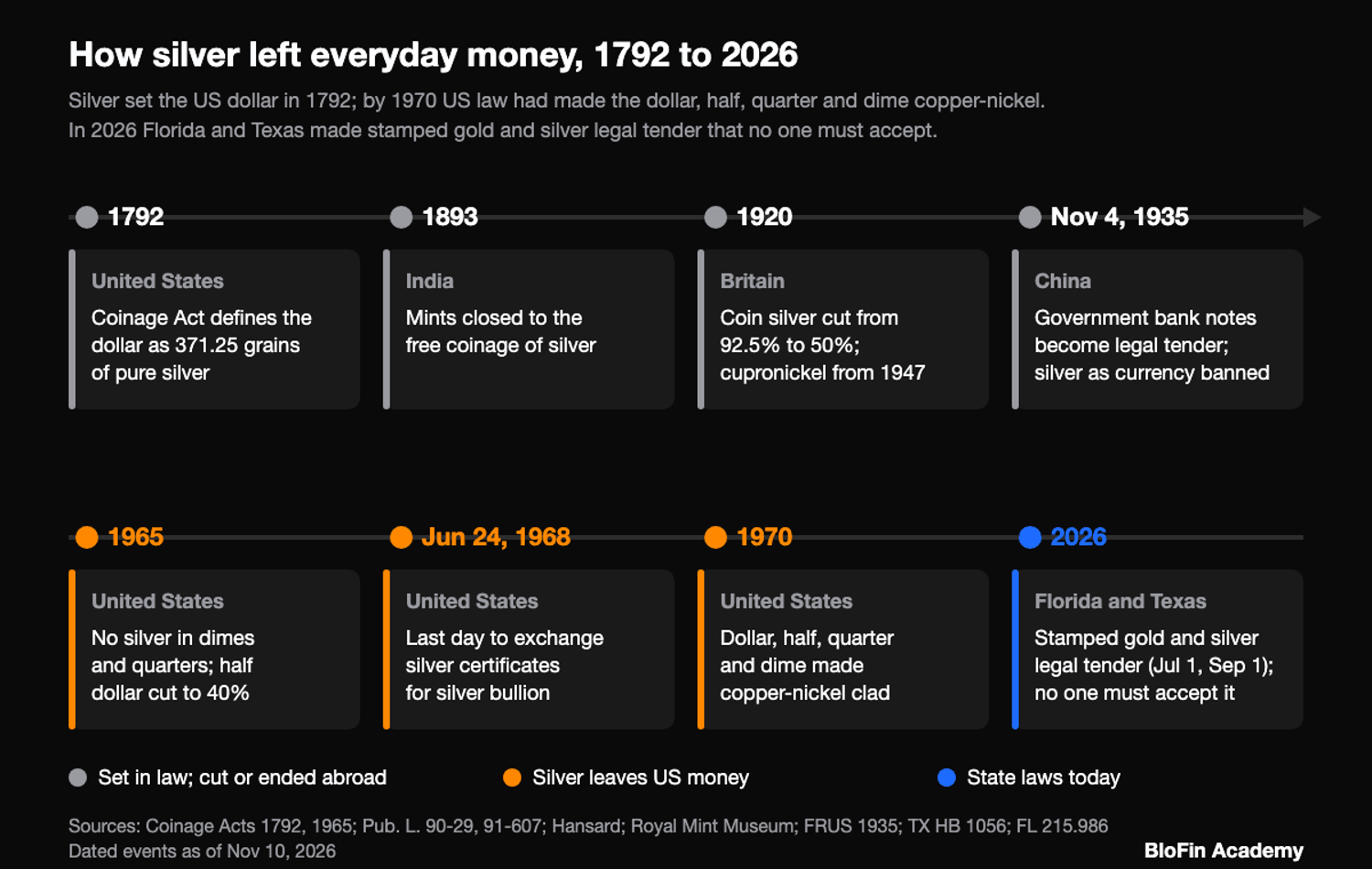
Silver is still a market today, bought by industry and by investors, and silver as a tradable asset has its own price, quote and contract terms. Its long past as money is one reason so many people still ask whether silver is a good investment.
Why silver became money
Silver became money because it does what money needs to do. It lasts for centuries, it splits into small, equal pieces, and a small weight of it carries a useful amount of value. It is worth more than copper and less than gold, so it suited the many small payments of daily trade.
A silver coin from Athens, a tetradrachm struck around 430 BC, survives in the Australian National University's Classics Museum and weighs 16.60 grams. The people who made it were probably more concerned with getting the weight right than with fitting the whole design on the coin (source: ANU Classics Museum). A coin was, at bottom, a weight of metal with a stamp to vouch for it.
A US law of 1792 shows that middle place in numbers. A dollar's worth of copper cents held about 71 times as much metal by weight as the pure silver in a silver dollar. Gold was valued at 15 times silver, weight for weight (source: Coinage Act of 1792).
Roman silver coins and the debasement of the denarius
Roman silver coins show what happens when a government puts less silver into its money. The denarius was close to pure silver under Augustus and lost part of its silver in a reform of AD 64 (source: Butcher and Ponting, University of Warwick). About two centuries later, the silver coin that had taken its place was made almost entirely of copper (source: CNRS, Roman Imperial Coinage project).
The later denarii of Augustus, struck at Lyon, were essentially pure silver by Roman standards, with no other metal added on purpose (source: Butcher and Ponting, University of Warwick). The size of the AD 64 cut under the emperor Nero is disputed, and figures vary by study. A 1976 study by David Walker put the new silver content at about 93%. Newer tests by Kevin Butcher and Matthew Ponting put it at about 80%. They also found a last issue late in that reign at about 90% (source: Butcher and Ponting, University of Warwick).
The later fall was much steeper, and it began with a new coin. The emperor Caracalla created a new silver coin, the antoninianus, in 215. In one 30-year stretch of the third century, the silver in each coin fell from about 2.2 grams to less than 0.1 gram, a drop of more than 95% (source: CNRS, Roman Imperial Coinage project). When Claudius II came to power in 268, the coin was made almost entirely of copper.
Later rulers tried to bring back a sound coin. Aurelian marked his coins to show they held 5% silver, and in 294 Diocletian brought back a pure silver coin, the argenteus, at the old weight standard of the AD 64 reform. In September 301 the government doubled the face value of its coins without changing them. Shortly after, the Edict on Maximum Prices cut the price of a pound of silver to 6,000 denarii and of a pound of gold to 72,000. That valued gold at 12 times silver (source: CNRS, Roman Imperial Coinage project).

Where the words dollar, pound and sterling come from
Several money words still in use come from silver coins. The British pound of 240 pence goes back to a pound weight of silver pennies, and the word sterling may come from that strong, steady penny (source: Royal Mint Museum). The word dollar comes from a silver coin first struck in a Bohemian mining valley after 1519 (source: Perth Mint).
Counting in pounds of 20 shillings and 240 pence began in the Frankish kingdom and reached England early, perhaps in the seventh century. England's first pennies varied in weight, so 240 of them only sometimes weighed a pound. Under William I the penny's weight became much more even, and the Royal Mint Museum dates the pound of 240 pence as a unit of money from that time (source: Royal Mint Museum).
From late in William I's reign, the penny stayed at 22.5 grains for two centuries. A pound of 240 such pennies weighed 5,400 grains, or about 350 grams. The museum calls the source of the word sterling unclear. The coin expert Philip Grierson linked it to the Middle English word ster, meaning strong or fixed, which fits a coin that kept its weight (source: Royal Mint Museum).
The word dollar has a clearer history. It goes back to Joachimsthal in Bohemia, where the Perth Mint dates the silver find to 1519, and the large coins struck there became known as Joachimsthalers, then thalers for short. Spain's silver coins of eight reales, made at its mints in the Americas, became known as Spanish dollars, and the first US dollars were similar to them (source: Perth Mint).
How Spanish silver reached China
Spanish silver from the Americas reached China mainly across the Pacific through Manila, which Spain took in 1571, and also by European trade routes. China's busy trading economy needed silver, and it drew the metal in from Japan as well as the Americas. Estimates of how much arrived differ widely, and figures vary by study (source: von Glahn, Revista de Historia Económica).
The founding of Manila opened a route for American silver across the Pacific on galleons sailing from Acapulco. In 1575, more than a dozen Chinese junks made port at Manila. In 1593, the Spanish Crown, afraid that too much silver was leaving its American colonies for China, limited the galleon trade between Manila and Acapulco to two ships a year (source: von Glahn, Revista de Historia Económica).
The historian Richard von Glahn compares six published estimates of China's silver imports from 1550 to 1645, from Liang in 1939 to Li in 2005. Counting the Pacific route alone, the share from the Americas runs from about 12% to about 42% by study. Only Zhuang and von Glahn also count silver that came by the Atlantic, which lifts their shares to about 33% and about 49% to 51% (source: von Glahn, Revista de Historia Económica).
Study | From the Americas by the Pacific (tons) | From the Americas by the Atlantic (tons) | All silver imports (tons) | Share from the Americas |
|---|---|---|---|---|
Liang (1939) | 948 | none given | 3,743 | about 25% |
Yamamura and Kamiki (1983) | 1,320 | none given | 8,670 to 10,780 | about 12% to 15% |
Lin (1990) | 675 | none given | 2,509 | about 27% |
Zhuang (1995) | 2,250 | 1,013 | 9,800 | about 33% |
von Glahn (1996 and 2013) | 2,481 | 1,230 | 7,345 to 7,536 | about 49% to 51% |
Li (2005) | 4,688 | none given | 11,250 | about 42% |
The totals run from 2,509 to 11,250 tons, more than four times apart, so the answer depends on whose estimate you take (source: von Glahn, Revista de Historia Económica). Most scholars agree that Japan sent China far more silver than Spanish America did in this period, while von Glahn himself puts the two at roughly equal amounts.
The Spanish coin left a lasting mark in China. The country adopted a new unit for keeping accounts, the yuan, based on the Spanish silver peso, and the renminbi is still counted in yuan today (source: von Glahn, Revista de Historia Económica).
The US Coinage Act of 1792
The US Coinage Act of 1792 set the dollar equal in value to a Spanish milled dollar and defined it as 371.25 grains of pure silver, about 24.06 grams. It made the dollar the unit for keeping public accounts and court records (source: Coinage Act of 1792).
Ten silver dollars held 3,712.5 grains of pure silver, exactly 15 times the 247.5 grains of pure gold in the $10 gold eagle. Silver made every coin from the half dime (5 cents) to the dollar, and gold made the $2.50, $5 and $10 pieces (source: Coinage Act of 1792).
The Act gave each dollar 416 grains of silver alloy in all, so the coin was about 89.24% pure silver (source: Coinage Act of 1792). The New York Fed put the dollar's 371.25 grains at 0.7734 of an ounce, so one ounce of pure silver was worth about $1.2929 at that rate (source: Federal Reserve Bank of New York, Monthly Review, August 1967). A 1967 US law later called $1.292929292 per troy ounce the monetary value of silver (source: Pub. L. 90-29).
Setting both gold and silver at a fixed legal ratio is called bimetallism. It only works while the market prices the two metals close to that ratio, because otherwise people spend the coin that is worth less as metal and keep the other. The 1792 Act is an early US example.
The Act treated a debased coin as a grave crime. Any mint officer or employee who debased the gold or silver coins for profit or by fraud, or who embezzled the metal, was guilty of a felony and was to suffer death (source: Coinage Act of 1792). Rome's cuts came mostly by official reform, while the 1792 law aimed its penalty at mint staff who cheated.
How the silver standard ended
Silver lost its place as money country by country between 1893 and 1935. India closed its mints to silver in 1893 (source: UK Parliament, Hansard, June 26, 1893), and Britain cut the silver in its coins to 50% in 1920 (source: UK Parliament, Hansard, February 23, 1937). China banned the use of silver as currency in November 1935, the year after a US law started large purchases of silver.
India's 1893 closure of its mints to silver
On June 26, 1893, the House of Lords heard a message from the Viceroy of India. India's legislative council had passed a law closing the Indian mints to the free coinage of silver, so the public could no longer bring silver to be made into rupees (source: UK Parliament, Hansard, June 26, 1893).
The mints would instead issue rupees for gold at 16 pence per rupee, and the government said it planned to bring in a gold standard. Gold itself would not become legal tender at that point (source: UK Parliament, Hansard, June 26, 1893).
Britain's Coinage Act 1920 and cupronickel coins
Britain's silver coins were 92.5% silver, or 37 parts in 40, until the Coinage Act 1920 cut them to 50% (source: UK Parliament, Hansard, February 23, 1937). By 1937, about 95% of the silver coins in use were at the 50% standard.
The Second World War ended circulating silver coins in Britain. The silver was needed for industry and to repay the 88 million ounces Britain had borrowed from the United States, so the Coinage Act 1946 brought in cupronickel. All of the new cupronickel coins were dated 1947, to make a clean break (source: Royal Mint Museum, Second World War).
The Silver Purchase Act of 1934 and China in 1935
The US Silver Purchase Act, signed on June 19, 1934, made it US policy that silver should make up a quarter of the money value of the country's gold and silver stocks. It told the Treasury to buy silver until it did, and it let the Treasury control or ban silver exports through licenses (source: Silver Purchase Act of 1934).
Milton Friedman described China as then the only major country still on a silver standard (source: Friedman, Journal of Political Economy). A US telegram from Shanghai quotes the Chinese currency decree of November 1935. From November 4, 1935, the notes of three government banks became full legal tender, and using silver coins or bars as money was banned (source: US State Department, Foreign Relations of the United States, 1935).
How far the US law caused that step is disputed. Milton Friedman argued in 1992 that the US silver buying caused severe deflation in China and forced it off silver (source: Friedman, Journal of Political Economy). Loren Brandt and Thomas Sargent had argued in 1989 that China's own government forced it off silver, to capture the gain from silver's higher price (source: Brandt and Sargent, Journal of Monetary Economics). A 2024 study by Huachen Li and James Nason concluded that neither the US law nor a design flaw ended China's silver standard (source: Li and Nason, ANU CAMA working paper 64/2024).
How the United States took silver out of its coins
The United States took silver out of its coins in steps from 1965 to 1970, because the metal was becoming worth more than the coins. At about $1.29 an ounce, the silver in a silver dollar was worth one dollar, and at about $1.38, melting dimes and quarters for their silver started to pay (source: Federal Reserve Bank of New York, Monthly Review, August 1967).
The Treasury had to start selling silver again in 1963 to stop people hoarding silver certificates and coins as the market price neared $1.29 an ounce (source: Federal Reserve Bank of New York, Monthly Review, August 1967).
Congress acted in stages. A law of June 4, 1963, PL 88-36, repealed the Silver Purchase Act of 1934 and let the Federal Reserve issue $1 and $2 notes (source: Pub. L. 88-36, 77 Stat. 54). The Coinage Act of 1965, signed on July 23, 1965, made dimes and quarters from layers of copper-nickel on a copper core. It also cut the silver in the half dollar to 4.6 of its 11.5 grams, or 40% (source: Coinage Act of 1965).
The New York Fed's figures show the size of the problem. In 1965, the non-communist world used about 376 million ounces of silver for coins, 1.75 times the 215 million ounces that its mines produced that year. US coins alone took 320 million ounces. As the new coins without silver came in, US coin use fell to 54 million ounces in 1966, a drop of about 83% (source: Federal Reserve Bank of New York, Monthly Review, August 1967).
The Treasury held the price at $1.29 by selling from its own stock. On July 14, 1967, it stopped selling silver to US buyers at that price (source: Federal Reserve Bank of New York, Monthly Review, August 1967). A law of December 31, 1970, Pub. L. 91-607, made the dollar, half dollar, quarter and dime from copper-nickel on a copper core. It still allowed up to 150 million dollar coins of 40% silver, made with 25.5 million ounces from the national stockpile and showing Dwight Eisenhower (source: Pub. L. 91-607).
When silver certificates stopped being paid in silver
Silver certificates were US paper money that the holder could swap for silver. On March 25, 1964, the Treasury announced that silver certificates would no longer be redeemed in silver dollars. A 1967 law then allowed them to be swapped for silver bullion for one more year only, until June 24, 1968 (source: Bureau of Engraving and Printing, archived fact sheet).
The notes date from a law of February 28, 1878, which let the public exchange them for silver dollars (source: Bureau of Engraving and Printing, archived fact sheet). The 1967 law, PL 90-29, signed on June 24, 1967, set the one-year window. It also set a minimum sale price for Treasury silver of about $1.29 an ounce and a defense reserve of at least 165 million ounces (source: Pub. L. 90-29).
Is silver legal tender in the US today?
Laws in Texas and Florida make gold and silver stamped with their weight and purity legal tender. Neither makes anyone accept it or covers US coins, which federal law already makes legal tender (source: 31 USC 5103). The Texas section took effect on September 1, 2026 (source: Texas Legislature, HB 1056 enrolled text). Florida's law covers debts taken on from July 1, 2026 (source: Florida Senate, Section 215.986).
The US Constitution sets the limits. Article I, Section 10 bars states from coining money, issuing bills of credit, a form of paper money, or making anything but gold and silver coin a tender in payment of debts (source: US National Archives, Constitution transcript). The Texas law applies only "to the extent authorized by" that clause (source: Texas Legislature, HB 1056 enrolled text). Florida defines legal tender as an offer of payment to a creditor that agrees to receive it (source: Florida Senate, Section 215.986).
Texas House Bill 1056 adds Section 2116.101 to the state's Government Code. It makes qualifying gold and silver legal tender in Texas, as far as the Constitution allows, and it says that no person may be required to offer or accept it. The rest of the law, beyond that section, takes effect on May 1, 2027 (source: Texas Legislature, HB 1056 enrolled text). From then, the state comptroller may set up electronic payments backed by gold and silver held in the state's bullion depository.
Florida's statute, Section 215.986, makes gold and silver coin legal tender for debts taken on from July 1, 2026. The silver can be rounds, bars, ingots or bullion coins stamped with their weight and purity, at least 99.9% pure. No person or government body may be made to offer or accept it (source: Florida Senate, Section 215.986).
Silver's currency code, XAG
Silver still has a currency code of its own, even though no country issues it. Under ISO 4217, the international standard for currency codes, silver is XAG, with the number 961, and it sits on the same list as gold (XAU), platinum (XPT) and palladium (XPD) (source: SIX, ISO 4217 list one).
BloFin's listing notice ties one XAG to one troy ounce of silver. On that basis, the pure silver in a 1792 dollar comes to about 0.7734 XAG, a little over three quarters of an ounce. You can follow silver's price in USDT on the XAGUSDT Perpetual trading page.
How silver trades on BloFin today
Silver trades on BloFin as the XAGUSDT Perpetual, a USDT-margined contract on the silver price. BloFin's listing notice says the symbol stands for silver priced in US dollars, one troy ounce per unit, with each contract worth 0.01 XAG (source: BloFin, XAGUSDT listing notice). The contract has no expiry date, and it pays out profit and loss in USDT only.
Taking 53.34 USDT, the contract's last traded price as read on November 10, 2026 at about 5.37AM UTC, one contract was worth about 0.5334 USDT. BloFin lists it as trading 24/7, and funding paid between long and short positions is settled every 4 hours.
A perpetual gives you price exposure only, with no silver to store, spend or redeem, which is how a perpetual differs from spot trading.
The listing notice also sets two limits. BloFin builds its price index from third-party data sources, and if those sources go quiet, the index freezes at the most recent figure. In the hours when the primary market is closed for regular trading, BloFin warns that orders "may be restricted" to reduce-only orders that close positions.
Leverage changes the risk far more than history does. A leveraged position can be closed by force at its liquidation price on a move of a few percent, whatever silver did over the centuries.
Looking to trade silver? To get started, you'll need to first create a BloFin account, fund your account with cryptocurrency, and navigate to the XAGUSDT Perpetual trading page.

Frequently asked questions
Where did ancient Athens get its silver?
Athens mined its silver at Laurion, near the city, where the mines are thought to have been worked from about 520 BC. After new deposits were found around 483 BC, the extra silver went into many more of the city's owl coins, which paid for a navy before the expected Persian invasion (source: ANU Classics Museum).
When did Britain stop counting in pounds, shillings and pence?
Britain used the pounds, shillings and pence system, written £sd, until 1971. The £ sign grew out of the letter L, for the Latin word libra, a pound of money, while the s and d stand for the Latin solidus and denarius, both Roman in origin (source: Royal Mint Museum).
Are silver pennies still made in Britain?
Yes, as Maundy money. After 1660, silver pennies were made in any real number only for the Maundy set, a tradition that still exists today. The coins go to pensioners at the Maundy Thursday service, and their number matches the age of the current monarch (source: Royal Mint, The Evolution of the Penny).
Are old silver certificates still legal tender?
Yes. Federal law makes US coins and currency legal tender for all debts, and silver certificates still outstanding can be spent at face value, like a Federal Reserve note (source: 31 USC 5103, Bureau of Engraving and Printing, archived fact sheet). They are no longer printed and can no longer be exchanged for silver (source: Bureau of Engraving and Printing, archived fact sheet).
Did the US ban melting silver coins?
It did, in May 1967. After a burst of speculative buying that month, the Treasury stopped selling silver to buyers other than "legitimate domestic concerns". It also used its legal power to ban the melting and export of silver coins (source: Federal Reserve Bank of New York, Monthly Review, August 1967).
Researched and written by the BloFin Academy editorial team with AI-assisted drafting. All facts independently verified. Primary sources include the Coinage Act of 1792 (World Gold Council transcription), the Coinage Act of 1965, the Silver Purchase Act of 1934 and Public Laws 88-36, 90-29 and 91-607 at govinfo.gov, 31 USC 5103, the Federal Reserve Bank of New York's Monthly Review of August 1967, the Bureau of Engraving and Printing, UK Parliament's Hansard, the Royal Mint and the Royal Mint Museum, the US State Department's Foreign Relations of the United States, the Texas Legislature and the Florida Senate, the US National Archives, the ISO 4217 list published by SIX, the CNRS Roman Imperial Coinage project, the ANU Classics Museum, the Perth Mint, and peer-reviewed studies by Butcher and Ponting, von Glahn, Friedman, Brandt and Sargent, and Li and Nason, current as of November 10, 2026.
Nothing in this article constitutes financial advice, and nothing in it is a recommendation to buy, sell or hold silver in any form. Silver's long history as money says nothing about where its price goes next: the US took it out of coins because its price moved, and the state legal tender laws oblige no one to accept it. On the XAGUSDT Perpetual, leverage can liquidate a position on a small move, and funding can cost a position every four hours. Past performance does not indicate future results. Do your own research and consider your risk tolerance before you trade on BloFin.