
People who put money into silver often picture a coin in a drawer or a bar in a home safe. Much silver investment looks quite different, because the metal sits in a vault you will never visit, and what you hold is an account balance, a fund share or a contract whose value follows the price.
That gap is what the phrase "paper silver" points at, and it usually comes with a warning that paper silver has nothing behind it. Some of these holdings own real bars, listed one by one with their serial numbers. Others are agreements that settle in cash. Lumping them together makes it hard to see what you own, who holds the metal and what you could claim if the firm in the middle failed.
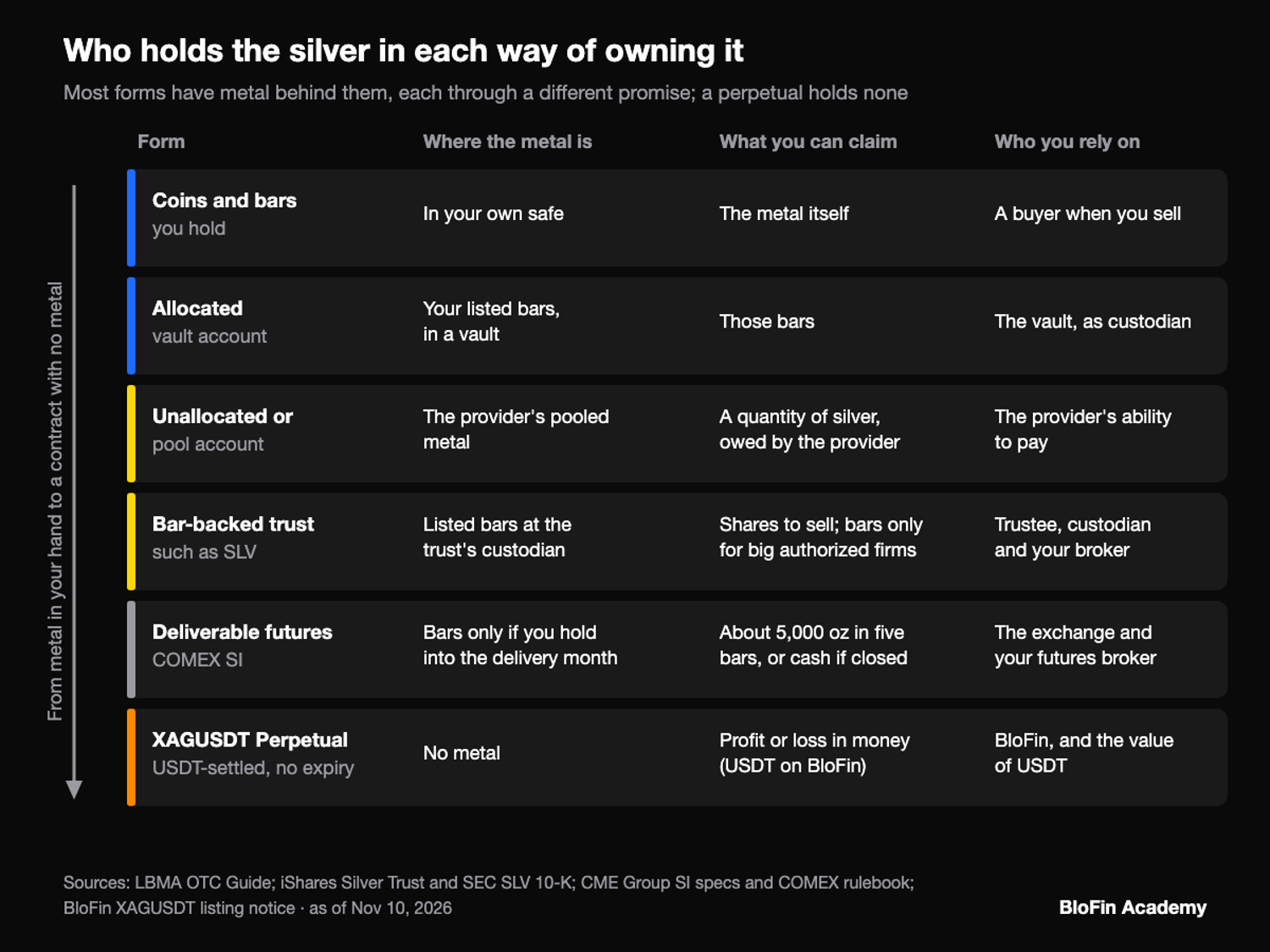
Every way of owning silver answers three questions: where the metal is, whether you can ask for it, and whose promise you rely on until then. The costs differ as well: a coin carries a dealer markup when you buy and a lower price when you sell back, and a vault charges more to store a dollar of silver than one of gold.
On BloFin, silver comes as the XAGUSDT Perpetual, a USDT-settled contract that trades 24/7 and tracks an index of silver prices. It sits at the far end of that range. It gives you the price, with leverage if you choose it, and leaves the metal out entirely.
What is paper silver?
Paper silver is any holding that tracks the silver price without putting a specific bar in your name. It includes unallocated and pool accounts, fund shares, futures contracts and perpetual contracts. The term covers very different backing, from trusts that hold listed bars to contracts that only ever settle in money.
An explainer on Gold Price Forecast uses the phrase as a verdict, describing paper silver as "not backed by real metal." It lists silver certificates, pool accounts, futures accounts and "most exchange traded funds (ETFs)" as examples (source: Gold Price Forecast, paper silver). That definition puts a fund that publishes a list of its bars in the same group as a futures account. The same page later advises choosing funds whose shares are fully backed by silver.
Physical silver is the metal itself, in your hands or held for you as specific bars. Between that and a pure price contract sit the forms most investors use, and each one mixes metal and promise in its own way.
What counts as physical silver?
Physical silver is metal you own outright: coins and bars you hold yourself, or specific bars kept for you in a vault and recorded in your name. Owning it gives you the details of each bar, such as its weight, purity and serial number. It also leaves you to arrange storage, insurance and, one day, a buyer.
Private buyers often start with one-ounce coins and small bars from a dealer, while the wholesale market works in much larger units. Silver in the London bullion vaults comes in bars of about 1,000 ounces, so a buyer of allocated metal there deals in multiples of roughly that size (source: LBMA, The OTC Guide).
Holding the metal yourself removes every firm from the middle and adds three chores: a safe place, insurance and a buyer when you sell. Fake coins and bars are the risk you carry until a buyer checks your metal. In March 2025, the Canadian Association of Numismatic Dealers warned its members about fake silver bars that scanned as pure on XRF tests and weighed as marked. A US collector who had bought seven of them later found they had lead-filled cores (source: Canadian Coin News).
Allocated and unallocated silver accounts
An allocated silver account holds specific bars in your name, each listed by number, weight and fineness, and it can never be overdrawn. An unallocated account is a balance the provider owes you: a claim to a quantity of silver rather than to any particular bar, and that claim is only as strong as the provider (source: LBMA, The OTC Guide).
Unallocated is the normal way the wholesale market settles. Banks and dealers trade silver directly with each other, in what is called the over-the-counter (OTC) market. The London Bullion Market Association (LBMA) estimates that probably more than 90% of precious metals traded this way clear over unallocated accounts in London. It likens a credit balance to money in a current account, a claim on the institution that keeps it (source: LBMA, The OTC Guide). LBMA puts the appeal down to convenience, since an unallocated balance can be any size, while allocated silver comes in whole bars.
Retail versions exist too, and the Kitco Pool account records silver as unallocated, with the metal held in bulk for pool customers and kept apart from the holdings of the firm itself (source: Kitco Pool). At 2.37AM UTC on November 10, 2026, the Pool page showed silver at $55.96 an ounce to buy and $50.87 to sell, a spread of 9.1% of the purchase price.
The two kinds of account can be swapped. LBMA says London clearers aim to switch a balance between unallocated and allocated no later than the spot date, in most cases on the day the instruction arrives, though this can vary with market conditions. Unallocated accounts carry a maintenance fee and allocated ones a storage fee. Unless the account agreement says otherwise, the owner of allocated metal arranges its insurance (source: LBMA, The OTC Guide).
Does paper silver have metal behind it?
Some paper silver has metal behind it and some has none. Bar-backed trusts and allocated accounts hold listed bars, an unallocated account is a claim on pooled metal, and a deliverable futures contract can end in bars. Cash-settled futures and perpetual contracts settle in money only, so the "no metal" claim fits them alone.
The London vaults show where most of the bars are. At the end of October 2026 they held 28,889 tonnes of silver, about 928.8 million ounces worth $46.5 billion. That is roughly 962,975 bars, and 0.33% less than a month earlier (source: LBMA, London vault data). Funds held most of the London stock when the October 2025 squeeze came. The World Silver Survey 2026 reports an estimate by the consultancy Metals Focus that physically backed products held 83% of the London stock at the end of September 2025, leaving a free float of about 136 million ounces. By the end of February 2026, the same report says, 24% of the London stock was not allocated to those products (source: Silver Institute, World Silver Survey 2026).
That free float is where paper and physical silver meet. The same report says daily spot trading averaged roughly 450 million ounces in 2025, according to LBMA data, about 3.3 times that end-September float, and most such trades clear as transfers between unallocated accounts (source: Silver Institute, World Silver Survey 2026, LBMA, The OTC Guide). In October 2025, strong Indian demand pulled bars out of London by air. The shortage of free metal then sent lease rates, the cost of borrowing silver, soaring. Metal allocated to funds was, in the words of the report, "inaccessible for day-to-day operations and leasing" (source: Silver Institute, World Silver Survey 2026). So the strain in that squeeze fell on the free metal, the part of the London stock that no fund had claimed.
Silver ETFs and the bars in the trust
A bar-backed fund, the kind the largest silver ETFs are, is the clearest case against the "no metal" line. The iShares Silver Trust (SLV) held 504,630,049.40 ounces on November 9, 2026, and iShares posts the bar list and the inspection letters behind that figure (source: iShares Silver Trust). At most 1,100 ounces of the silver in the trust may sit in unallocated form. The custodian, the London branch of JPMorgan Chase Bank, may keep the bars in London, New York or other approved places, and any sub-custodian it uses must be an LBMA member (source: SEC, SLV 10-K). The insurance of the custodian covers the custodian, not the trust (source: SEC, SLV 10-K). A shareholder owns a slice of the trust. Only authorized participants can hand back blocks of 50,000 shares for silver, so a private investor sells shares on the exchange instead (source: SEC, SLV 10-K).
Futures contracts and delivery
A futures contract fixes today the price of silver to be bought or sold on a future date. On the COMEX exchange of CME Group, whether metal changes hands depends on the contract. The 5,000-ounce Silver futures contract (SI) is deliverable, in silver of at least 999 fineness, on any business day of the delivery month (source: CME Group, Silver futures contract specs). The 100-Ounce Silver futures contract is financially settled, so it ends in a cash payment (source: CME Group, 100-Ounce Silver futures contract specs).
A deliverable contract still behaves like paper for most of its life. A long who keeps an SI position into its delivery month can receive about 5,000 ounces, in five bars of about 1,000 ounces each (source: CME Group, COMEX Rulebook Chapter 112). One who closes or rolls the position before then settles the gain or loss in dollars and never sees the metal.
How the XAGUSDT contract tracks silver in USDT
The XAGUSDT Perpetual gives you the silver price with no metal at any stage. It is a perpetual futures contract, which has no expiry date. The BloFin listing notice describes it as silver priced in US dollars, "representing 1 troy ounce of silver" per XAG. The contract size is 0.01 XAG, settlement is in USDT and trading runs 24/7 (source: BloFin XAGUSDT listing notice). That ounce is a unit for the price. Profit, loss and margin are all paid in USDT, and you never receive a bar, a vault allocation or a delivery date.
The contract tracks an index of silver quotes from third-party data vendors (source: BloFin XAGUSDT listing notice), and BloFin runs liquidation on the mark price. The mark price and last price can differ for a while.
Position tiers set how much leverage each size of position can use, and they sit among the XAGUSDT Perpetual terms along with the price limits. To compare the index, mark and last prices in one place, open the XAGUSDT Perpetual.
What physical silver costs to store and sell
Physical silver costs money three times: a dealer markup when you buy, storage and insurance while you hold, and a lower price when you sell back. Kitco and Hero Bullion priced the same one-ounce coin less than an hour apart, and buying it and selling it straight back would have cost about 14% to 16% of the price paid.
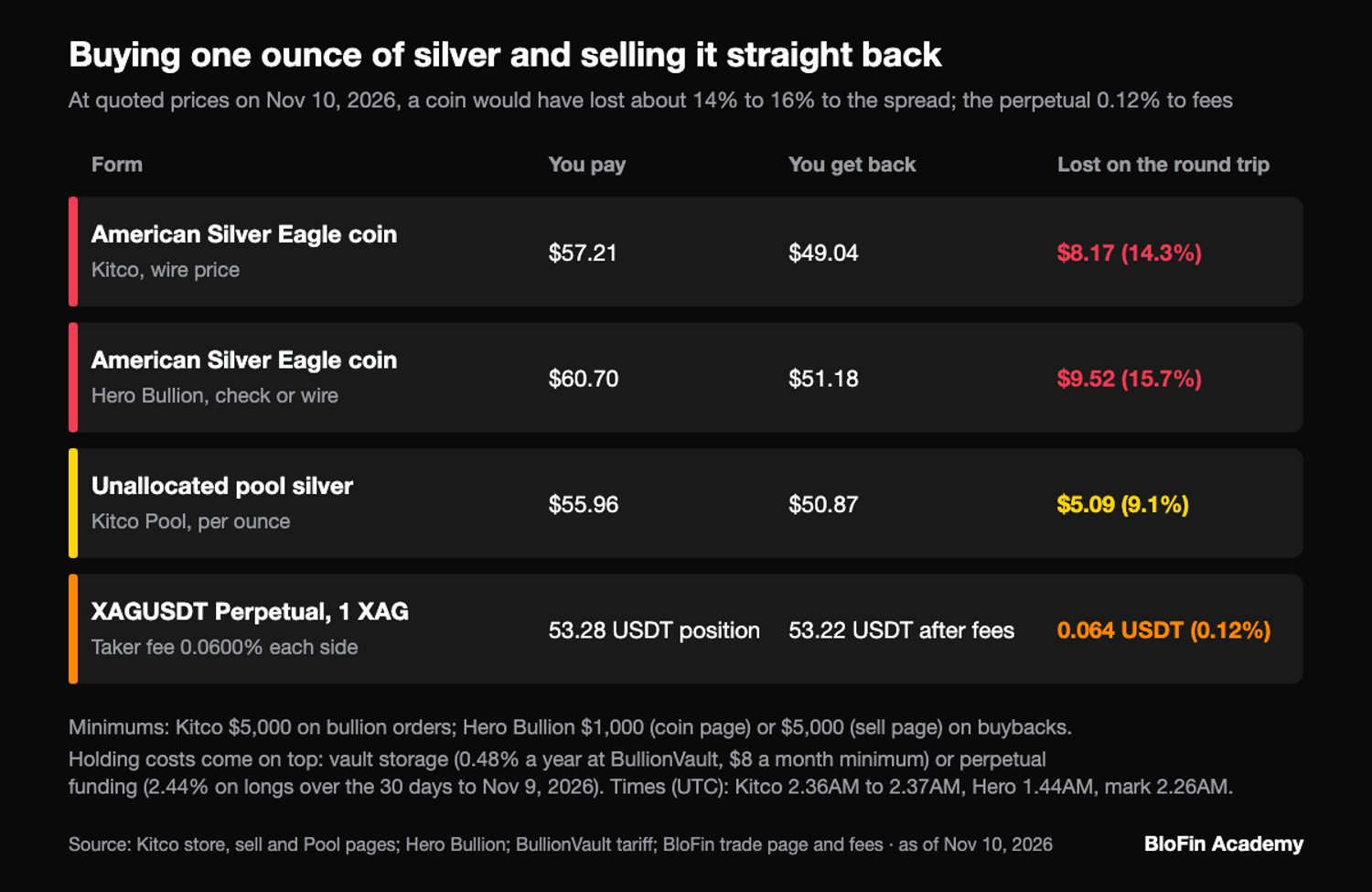
The coin was the one-ounce American Silver Eagle. Kitco asked $57.21 by wire at 2.36AM UTC on November 10, 2026, against a spot ask of $53.23 on the same page, and a minute later offered $49.04 to buy the coin back (source: Kitco, silver coins, Kitco, sell to Kitco). Kitco requires physical bullion orders of at least $5,000 (source: Kitco, silver coins). Hero Bullion asked $60.70 by check or wire and listed a sell-to-us price of $51.18. Its coin page sets a $1,000 minimum on buybacks, and its sell-to-us page a $5,000 minimum per transaction (source: Hero Bullion, American Silver Eagle, Hero Bullion, sell to us). Both Hero Bullion prices come from its coin page as updated at 1.44AM UTC, 52 minutes before the Kitco prices.
Selling straight back would have cost $8.17 a coin at Kitco, 14.3% of what you paid, and $9.52 at Hero Bullion, or 15.7%. The Kitco price was 7.5% over spot and the Hero Bullion price 14.0%. Suppose each dealer moved its buyback price in step with silver. The price would then have to climb about 16.7% at Kitco, or 18.6% at Hero Bullion, before the coin sold back for what it cost (source: Kitco, sell to Kitco, Hero Bullion, American Silver Eagle). The unallocated pool account, at 9.1%, cost less to enter and leave.
Storage is the second cost, and silver pays more for it than gold. BullionVault charges 0.48% a year for silver, including insurance, with a monthly minimum of $8. Gold costs 0.12% a year on the same tariff (source: BullionVault, tariff). For a small holding the minimum sets the rate. The $96 yearly minimum is 1.80% of 100 ounces at the $53.23 spot ask, and the 0.48% rate takes over only from about $20,000 of silver (source: BullionVault, tariff). LBMA explains that the lower value of silver per ounce makes its storage costs greater relative to the metal (source: LBMA, The OTC Guide).
Paper forms swap the spread for other costs. On the XAGUSDT Perpetual, a one-ounce position (100 contracts), valued at the 53.28 USDT mark price shown at about 2.26AM UTC that morning, pays the 0.0600% taker fee on each side. That is about 0.064 USDT for the round trip at the regular BloFin futures rate (source: BloFin fees). Holding it costs funding payments instead of storage: in the 30 days ending 4PM UTC on November 9, 2026, funding on longs came to about 2.44% of the position's value, settled every 4 hours (source: BloFin XAG funding history).
Counterparty risk in each form of silver
Counterparty risk is the chance that a firm you depend on fails to deliver what it owes you. Coins in your own safe carry none, though they carry theft and fake risk instead. Every other form adds at least one firm between you and the metal, or replaces the metal with the promise of that firm to pay.
An allocated vault account depends on the vault operator as custodian of bars that stay yours. An unallocated or pool account depends on whether the provider can settle your balance, the credit exposure LBMA describes (source: LBMA, The OTC Guide). A bar-backed trust depends on its trustee and custodian, and on the broker who holds your shares. An SI futures position depends on the exchange and your futures broker until it settles or delivers.
The XAGUSDT Perpetual depends on BloFin and on USDT. Each USDT perpetual on BloFin has its own insurance fund. If that fund runs short or falls fast, BloFin can close opposing positions at the mark price through auto-deleveraging (ADL) (source: BloFin, auto-deleveraging FAQ). That makes the exchange itself the thing to check, starting with whether BloFin is safe and how its proof of reserves works.
Every payment on the contract is in USDT, so it helps to know how to read stablecoin reserve reports too.
Choosing between physical and paper silver
The choice comes down to what you want silver to do for you. Metal in your hand needs no firm behind it but costs a wide spread and storage. Bar-backed funds and allocated accounts hold metal for you through a custodian, for a yearly fee. Futures and perpetual contracts let you trade the silver price, including its falls, with little or no metal.
You want metal you could hold, move or spend: coins, bars or an allocated vault account. On a one-ounce coin, the quoted prices at two dealers imply a round trip of 14.3% to 15.7%, and both dealers set minimums larger than one coin, on orders at Kitco and on buybacks at Hero Bullion. Storage weighs less as your holding grows.
You want silver held for you and sold easily: a bar-backed trust such as SLV, or an allocated account, with a custodian you rely on.
You want to trade silver moves, go short or use leverage: a futures contract or the XAGUSDT Perpetual. You hold no metal, and at high leverage a normal silver day can take a large share of your margin.
Every form follows the same silver price, so the route changes what you own and pay but leaves the price risk in place. Before choosing, weigh whether silver is a good investment for you at all.
Looking to trade silver? To get started, you'll need to first create a BloFin account, fund your account with cryptocurrency, and navigate to the XAGUSDT Perpetual trading page.

Frequently asked questions
Is there more paper silver than physical?
By trading volume, yes. Daily spot trading in London averaged roughly 450 million ounces in 2025, according to LBMA data, about 3.3 times the 136 million ounces of free float that funds had not claimed at the end of September 2025. Most of those trades clear as transfers between unallocated accounts (source: Silver Institute, World Silver Survey 2026).
Can you turn an unallocated silver balance into coins or bars?
Usually you can, at a cost. Kitco says Pool balances can be exchanged for physical bullion, subject to fabrication, shipping and insurance fees (source: Kitco Pool). Those charges come on top of the gap between the Pool buy and sell prices.
Does BloFin sell physical silver or a silver token?
BloFin lists no silver coin, bar, token or tokenized silver fund. Its only metal listing of that kind is a gold token, Tether Gold (XAUT). Tokens that claim vaulted silver come from other issuers, each with its own redemption terms. On BloFin, the XAGUSDT Perpetual is the one way to trade silver, priced and settled in USDT.
How long does it take to sell silver coins back to a dealer?
It depends on the dealer and on demand. At Hero Bullion, you get a quote from a trader by phone or email, confirm the sale by phone and then ship the coins. They are inspected for quality, accuracy and authenticity on arrival, with any adjustments reported back to you. Payment by ACH or bank wire generally comes 1 to 3 business days after the dealer has the coins in hand, though it can take longer in times of extreme demand (source: Hero Bullion, sell to us, Hero Bullion, American Silver Eagle).
How are vault storage fees for silver calculated?
Fees vary by account operator. In the London bullion market, LBMA says clearers once charged per bar held but now tend to charge a number of basis points on the value of the metal, assessed daily and billed quarterly in arrears. Whether a switch between unallocated and allocated carries a charge depends on the individual clearer (source: LBMA, The OTC Guide).
What happens to an unallocated balance if the provider fails?
An unallocated holder becomes one of the firm's creditors. An allocated holder, LBMA says, could in theory collect the bars from the vault if the account operator defaulted. LBMA likens allocated metal to a safe deposit box, though it says collecting the bars would in practice be rather more complicated in such a high-security site (source: LBMA, The OTC Guide).
Researched and written by the BloFin Academy editorial team with AI-assisted drafting. All facts independently verified. Primary sources include the LBMA OTC Guide and London vault data, the Silver Institute World Silver Survey 2026, iShares and SEC filings for the iShares Silver Trust, CME Group contract specifications, dealer prices from Kitco and Hero Bullion, the BullionVault tariff and the BloFin XAGUSDT Perpetual listing notice and funding history, current as of November 10, 2026.
Nothing in this article constitutes financial advice. A coin bought and sold straight back at two dealers' quoted prices would have lost about 14% to 16% of its price to the spread, and stored metal can be stolen, faked or costly to insure. A fund or account adds a custodian or provider you depend on, and the XAGUSDT Perpetual holds no silver at all, so leverage can liquidate your margin on an ordinary move. Past performance does not indicate future results. Do your own research and consider your risk tolerance before you trade on BloFin.