
For most of history, people who wanted to keep wealth outside a bank chose a metal that was hard to dig up. In the last two decades a second option has appeared: a digital coin whose supply is set by its software. The two are now compared all the time. Both are sold on the same promise, that something scarce should hold its value when paper money loses some of its own.
A fair comparison is harder than it sounds. One is a metal that factories use up and investors hoard. The other is a network that never closes. Their prices are recorded on different calendars, and their total values are counted in different ways. Whether they move together also depends on which months you look at.
To compare them fairly, you need one footing for both. That means returns over the same dates, volatility and drawdowns measured the same way, and market value from one provider on one day. Correlation is best read over rolling windows, so that one good or bad run of months cannot decide the answer.
On BloFin you can buy bitcoin itself on spot, and you can trade silver's price through the XAGUSDT Perpetual, a contract on XAG, the market code for silver, priced and settled in USDT. Seeing how they differ tells you whether holding both gives you something that holding one alone does not.
What is the difference between silver and bitcoin?
Silver and bitcoin differ in where their scarcity comes from. Silver is a physical metal. Most of it is mined as a by-product of lead, zinc, copper and gold, and industry uses part of it up (source: Silver Institute, factors that determine the silver price). Bitcoin is a digital asset. Its new supply is fixed by software and halves about every four years (source: PlanB, Modeling Bitcoin's Value with Scarcity).
The Silver Institute describes a metal with two roles, one precious and one industrial. So its price sometimes follows the dollar and interest rates, as gold's does, and at other times follows factory output and economic growth. Silver also has large stocks above ground, as bullion and fabricated products, and some of that metal comes back for sale when the price moves (source: Silver Institute, factors that determine the silver price). Bitcoin has no factory demand. New coins come only from the reward paid for each block. That reward started at 50 bitcoins and halves every 210,000 blocks, about every four years (source: PlanB, Modeling Bitcoin's Value with Scarcity).
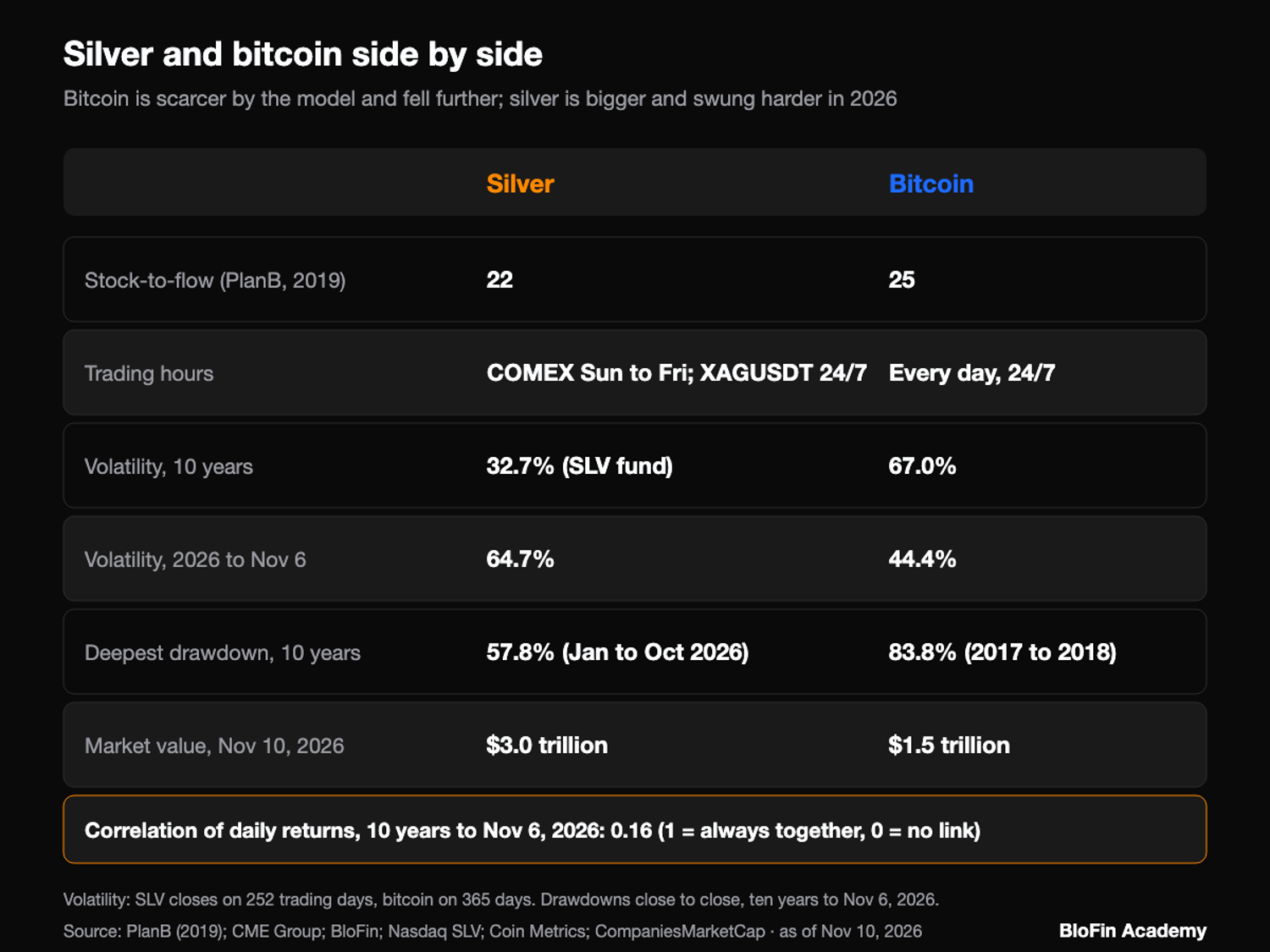
Bitcoin and the XAGUSDT Perpetual trade through weekends. COMEX silver futures stop from 10PM UTC Friday to 11PM UTC Sunday in winter, an hour earlier in summer. The London Bullion Market Association (LBMA) Silver Price comes from a single London auction at 12PM UTC in winter (source: BloFin, XAGUSDT listing notice, CME Group, silver futures contract specs, ICE, LBMA Silver Price).
Digital gold and digital silver
"Digital gold" is the name bitcoin's supporters give it. Its supply is capped and grows on a fixed schedule, much as gold is scarce and slow to mine. "Digital silver" is a label given to litecoin. Its creator, Charlie Lee, announced it on October 9, 2011 as a coin meant to be "silver to Bitcoin's gold" (source: Charlie Lee, Litecoin launch post).
That label describes litecoin's place next to bitcoin, as a lighter and quicker version of the same design. It says nothing about silver itself. Litecoin holds no metal, and its price has no link to the silver price. The case for bitcoin as digital gold rests on a fixed supply and on a store of value that no government issues. The same hopes get attached to silver, because the metal has played that part for thousands of years.
A nickname is a shorthand, and it can mislead both ways. Calling bitcoin digital gold invites you to expect gold's calm, yet silver has spent much of 2026 swinging harder than bitcoin. Only the prices show whether bitcoin really behaves like either metal.
Stock-to-flow for silver and bitcoin
Stock-to-flow divides the amount of an asset that already exists by the amount added each year. A higher figure means a scarcer asset. In PlanB's 2019 model, gold scored 62, silver 22 and bitcoin 25. That put bitcoin beside the two metals, in the group its author called monetary goods (source: PlanB, Modeling Bitcoin's Value with Scarcity).
PlanB, a pseudonymous analyst, argued that scarcity measured this way drives market value. He used silver as a benchmark, with a stock-to-flow of 22 and a market value of $308 billion at the time. He noted that bitcoin's figure was 22 at the December 2017 peak, when its $230 billion market value came close to silver's. A halving cuts new supply in half, so he expected bitcoin's figure to double to 50 after the May 2020 halving. The model put bitcoin's value after that at $1 trillion, or about $55,000 a coin (source: PlanB, Modeling Bitcoin's Value with Scarcity).
Set against what happened, the model got that call right and then broke. Bitcoin's daily reference rate, Coin Metrics' once-a-day bitcoin price, first closed above $55,000 on February 19, 2021. The model's later projection of more than $100,000 by the end of 2021 never arrived. The highest daily rate that year was $67,542 on November 8, about a third short, and the year ended at $46,355 (source: Coin Metrics, bitcoin reference rate, Decrypt, June 21, 2022). By November 9, 2022, the rate was down to $15,758.
In June 2022, Ethereum co-founder Vitalik Buterin called the theory that halvings push bitcoin's price up "unfalsifiable". His point was that any later price can be read as support for it. He also said models that give people false certainty about a price are harmful. PlanB replied that some people look for scapegoats after a crash (source: Decrypt, June 21, 2022).
Silver raises a separate problem for the model. Its yearly flow counts mine output, but most silver is mined as a by-product, so the prices of the metals it is mined with matter more to that output than silver's own price. The Silver Institute finds no meaningful relationship between yearly changes in mine output and yearly changes in the silver price. Two parts of supply do answer to silver's price. One is the smaller group of mines that produce mainly silver. The other is the large stock of bullion and fabricated silver held above ground, which can come back to the market when the price moves (source: Silver Institute, factors that determine the silver price). The stock is uncertain too, because estimates of how much silver has been mined include metal since lost in industrial use (source: CompaniesMarketCap, silver market cap). Bitcoin's new supply halved again with block 840,000 in April 2024, so its stock-to-flow has kept rising since the paper (source: Blockchain.com, bitcoin block 840,000). Issuance keeps halving until it stops at a total of 21 million bitcoins (source: Bitcoin.org, FAQ).

Silver and bitcoin market cap
On November 10, 2026, CompaniesMarketCap put the value of all the silver ever mined at about $3.0 trillion and bitcoin at about $1.5 trillion, so silver was close to twice as big (source: CompaniesMarketCap, top assets by market cap). The two have swapped places several times since 2024, so the bigger one has to be read on the day, from one provider.
The silver figure is built in a particular way. CompaniesMarketCap multiplies the silver price, $53.20 an ounce at the read, by an estimate of all the silver mined so far. That estimate is 1,751,000 tonnes, from CPM Group's 2019 Silver Yearbook. The site's own page calls the result an approximation and says a large amount of that silver has been lost in industrial use (source: CompaniesMarketCap, silver market cap). So the total is every ounce estimated to have been mined, not only the bars and coins that could be sold today.
The crossings are dated events, reported by two different providers. Decrypt reported that bitcoin's market value passed silver's on the evening of November 11, 2024, at $1.8 trillion against $1.7 trillion. It called that the second crossing that year, after one in March, citing Infinite Market Cap (source: Decrypt, November 12, 2024). A report published on September 11, 2025 put silver back ahead on CompaniesMarketCap, at about $2.4 trillion against $2.2 trillion. The same report said bitcoin had briefly overtaken silver in July 2025 (source: BeInCrypto via FXStreet, September 11, 2025).
In September 2025 silver led by about 6% (source: BeInCrypto via FXStreet, September 11, 2025). By early November 2026 the lead had grown to about 99%. The iShares Silver Trust (SLV), a fund that holds silver, rose 24.0% from September 11, 2025 to November 6, 2026, while bitcoin's daily rate fell 34.3%. Those two moves account for almost all of the change (source: CompaniesMarketCap, top assets by market cap, Nasdaq, SLV historical prices, Coin Metrics, bitcoin reference rate).
How volatile are silver and bitcoin?
In the decade to November 6, 2026, bitcoin's annualized volatility was 67.0%, about twice the silver fund's 32.7%. In 2026 the order flipped, and silver became the wilder of the two. From the start of 2026 to November 6, silver's volatility was 64.7% against 44.4% for bitcoin (source: Nasdaq, SLV historical prices, Coin Metrics, bitcoin reference rate).
Both figures scale the spread of daily price moves up to a full year. The fund's closes count 252 trading days a year and bitcoin's count 365, because bitcoin trades every day. In 2025 bitcoin swung more, at 41.9% against 32.4% for silver. From August 11 to November 6, 2026 they came back close together, at 42.0% for bitcoin and 40.0% for silver (source: Nasdaq, SLV historical prices, Coin Metrics, bitcoin reference rate).
Taken one month at a time, silver swung harder than bitcoin in eight of the ten months of 2026 so far, against 16 of 119 months across the whole decade (source: Nasdaq, SLV historical prices, Coin Metrics, bitcoin reference rate). The old rule that bitcoin swings twice as hard as silver held for most of the decade and failed for most of this year. For today's move, check the live mark price and the 24-hour range on the XAGUSDT Perpetual page.
Silver and bitcoin drawdowns
A drawdown is the drop from a high to the lowest point before a new high. In the decade to November 6, 2026, bitcoin's deepest drawdown on daily prices was 83.8%, from its December 16, 2017 high to its low a year later. The silver fund's deepest was 57.8%, from January 28, 2026 to October 30, 2026 (source: Nasdaq, SLV historical prices, Coin Metrics, bitcoin reference rate).
Bitcoin also fell hard far more often. Counting every fall of 30% or more from a closing high to the lowest close before a new high, bitcoin had seven in the decade and the silver fund had three. At the November 6 close, neither had recovered its latest fall. The silver fund was 55.6% under its January 28 close, and bitcoin was 39.3% under its October 2025 high (source: Nasdaq, SLV historical prices, Coin Metrics, bitcoin reference rate).
Bitcoin's seven big falls in the decade (source: Coin Metrics, bitcoin reference rate):
High | Low | Fall | High regained |
|---|---|---|---|
January 4, 2017 | January 11, 2017 | 30.5% | February 23, 2017 |
June 11, 2017 | July 16, 2017 | 35.8% | August 5, 2017 |
September 1, 2017 | September 14, 2017 | 34.0% | October 12, 2017 |
December 16, 2017 | December 15, 2018 | 83.8% | November 30, 2020 |
April 13, 2021 | July 20, 2021 | 53.1% | October 19, 2021 |
November 8, 2021 | November 9, 2022 | 76.7% | March 4, 2024 |
October 6, 2025 | June 30, 2026 | 53.1% | Not yet |
The silver fund's three big falls in the decade (source: Nasdaq, SLV historical prices):
High | Low | Fall | High regained |
|---|---|---|---|
September 4, 2019 | March 18, 2020 | 38.9% | July 20, 2020 |
August 10, 2020 | September 1, 2022 | 39.3% | May 15, 2024 |
January 28, 2026 | October 30, 2026 | 57.8% | Not yet |
Past falls took years to repair. Bitcoin needed until November 2020 to regain its December 2017 high. The silver fund took until May 2024 to regain its August 2020 close, and it has not yet regained its January 2026 high (source: Nasdaq, SLV historical prices, Coin Metrics, bitcoin reference rate).
On BloFin's own prices since the XAGUSDT Perpetual listed in January 2026, silver has fallen further than bitcoin. The perpetual's daily close fell 58.0%, from 117.72 on January 28 to 49.40 on October 30. The BTCUSDT Perpetual's daily close fell 39.5% at most, from January 14 to June 30 (source: BloFin XAGUSDT Perpetual and BTCUSDT Perpetual daily candles). A fall that deep takes a far bigger rise to undo: from 49.40, the price would have to rise about 138% to regain 117.72, the same recovery arithmetic that applies to drawdowns in a crypto portfolio.
Silver and bitcoin returns over the same dates
Which one did better depends almost entirely on the dates you choose. In the decade to November 6, 2026, bitcoin rose about 10,600% and the silver fund 171.1%. Over the latest five years the fund rose 109.7% against 23.4% for bitcoin, and both have fallen in 2026 (source: Nasdaq, SLV historical prices, Coin Metrics, bitcoin reference rate).
Returns differ sharply from one window to the next (source: Nasdaq, SLV historical prices, Coin Metrics, bitcoin reference rate).
Window to November 6, 2026 | Silver (SLV) | Bitcoin |
|---|---|---|
Ten years (from November 7, 2016) | +171.1% | +10,637.5% |
Five years | +109.7% | +23.4% |
Three years | +122.3% | +116.5% |
One year | +7.6% | -25.1% |
2026 to date | -27.2% | -13.4% |
Each window runs from the last close on or before its start date to the last close on or before November 6, 2026, and uses the fund's closing prices and bitcoin's daily reference rate (source: Nasdaq, SLV historical prices, Coin Metrics, bitcoin reference rate). The fund's figures are after its fees, so they run slightly under the metal's own return. A week's shift in dates moves the answer too. On month-end prices for the five years to October 30, 2026, the window used to judge whether silver is a good investment, the fund returned 101.9% and bitcoin 29.5% (source: Nasdaq, SLV historical prices, Nasdaq, BTC historical prices).
Calendar years tell the same story from another side. From 2017 to 2025, the silver fund beat bitcoin in three years out of nine. In 2018 it fell 9.2% while bitcoin lost 73.5%. In 2022 it gained 2.4% while bitcoin lost 64.4%, and in 2025 it rose 144.7% while bitcoin slipped 6.3%. In 2018 and 2022, silver's lead came mostly from bitcoin's crash (source: Nasdaq, SLV historical prices, Coin Metrics, bitcoin reference rate).
On BloFin's own closes, the XAGUSDT Perpetual fell 32.6% from January 8 to November 8, 2026, and the BTCUSDT Perpetual fell 17.9% over the same days (source: BloFin XAGUSDT Perpetual and BTCUSDT Perpetual daily candles).
Do silver and bitcoin move together?
Silver and bitcoin have moved together only loosely. In the decade to November 6, 2026, the correlation of the silver fund's daily returns with bitcoin's was 0.16. On that scale, 1 is perfect lockstep and 0 is no link. A rolling 63-trading-day measure, about 90 calendar days, was positive 77.4% of the time (source: Nasdaq, SLV historical prices, Coin Metrics, bitcoin reference rate).
The measure uses bitcoin's daily rate on the fund's trading days, so a weekend's bitcoin move counts on the Monday. Of 2,451 rolling windows, 1,896 were positive and 555 negative. The readings ran from -0.37 in the window ending December 5, 2023 to 0.67 in the window ending September 1, 2026. Every window ending in 2026 has been positive, with the latest at 0.55 on November 6 (source: Nasdaq, SLV historical prices, Coin Metrics, bitcoin reference rate). Correlation in a crypto portfolio works the same way: a reading near zero means one asset says little about the other, and a reading near 1 means they tend to rise and fall at the same time.
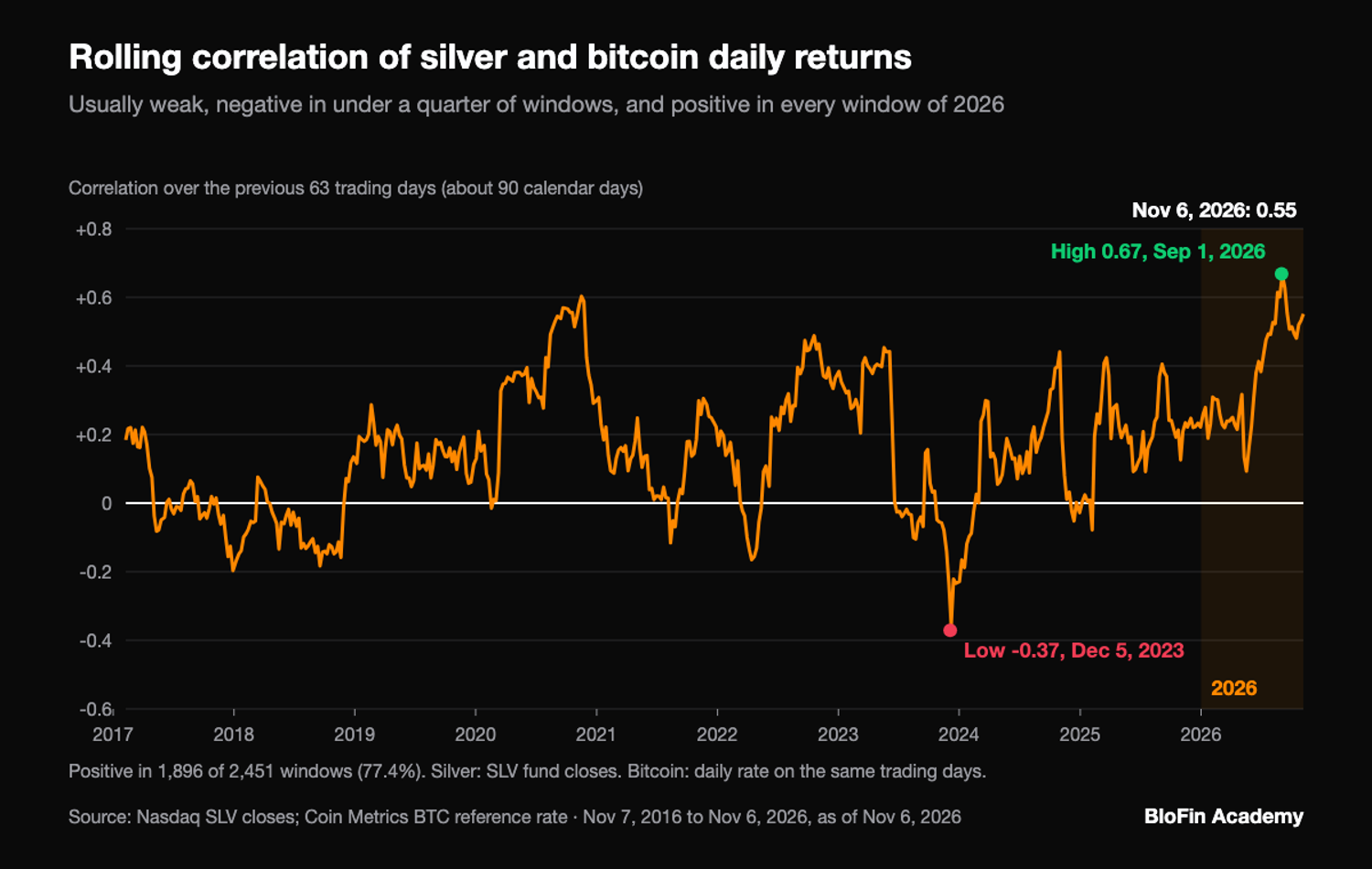
BloFin's own prices give the same reading, and both of these trade every day. On the daily closes of the XAGUSDT Perpetual and the BTCUSDT Perpetual, the correlation since January 2026 was 0.46. All 215 rolling 90-day windows from April 8 to November 8 were positive, ranging from 0.18 to 0.67 (source: BloFin XAGUSDT Perpetual and BTCUSDT Perpetual daily candles).
Next to silver's other neighbors, bitcoin is the loosest link. Measured the same daily way, these are the silver fund's correlations with gold, copper, US stocks and bitcoin (source: Nasdaq, SLV historical prices, Nasdaq, GLD historical prices, Nasdaq, CPER historical prices, Nasdaq, SPY historical prices, Coin Metrics, bitcoin reference rate):
Silver fund's daily returns against | Decade to November 6, 2026 | 2026 to November 6 |
|---|---|---|
Gold (GLD fund) | 0.79 | 0.86 |
Copper (CPER fund) | 0.45 | 0.69 |
US stocks (SPY fund) | 0.24 | 0.42 |
Bitcoin | 0.16 | 0.33 |
Gold is silver's closest partner by a wide margin, and copper, the other big industrial metal, comes next. All four links were tighter in 2026 than across the decade.
A positive daily link is far from moving in step over a month. In 2026 the two perpetuals ended a calendar month in the same direction only 3 times in 10 on BloFin's daily closes. From the January 8 listing to the end of January, silver rose 11.0% and bitcoin fell 13.6%. Even in October, when both fell, silver lost 18.2% and bitcoin 7.2% (source: BloFin XAGUSDT Perpetual and BTCUSDT Perpetual daily candles). In the March 2020 sell-off they did fall together: from February 21 to March 18, the fund lost 35.1% and bitcoin 44.4% (source: Nasdaq, SLV historical prices, Coin Metrics, bitcoin reference rate). Periods like that decide whether silver can hedge a crypto portfolio.
Choosing between silver and bitcoin
Choosing between silver and bitcoin means choosing between two kinds of risk. Over the decade bitcoin returned more and fell further. Silver fell hard less often, yet it swung harder than bitcoin in 2026 and now sits further under its high. Their daily link has been positive all year, yet they ended 7 of 10 months in opposite directions.
What each one is for decides most of the answer. Silver gives you a metal with factory demand and thousands of years as money, plus a large stock above ground that can come back to the market when the price moves. Bitcoin gives you a supply fixed by software and a market open every hour of the week. It also brings a record of falls of 75% and more that took years to repair (source: Coin Metrics, bitcoin reference rate).
The questions to ask yourself are practical. How large a fall could you hold through without selling, given 83.8% for bitcoin and 57.8% for the silver fund in the last decade (source: Nasdaq, SLV historical prices, Coin Metrics, bitcoin reference rate)? If you want the second asset to move differently from the first, note that the two moved the same way on 140 of 214 trading days in 2026 (source: Nasdaq, SLV historical prices, Coin Metrics, bitcoin reference rate). And are you after the metal, or only its price?
Trading silver and bitcoin on BloFin
On BloFin, bitcoin can be bought and held on spot. Silver comes only as the XAGUSDT Perpetual, a contract that tracks the silver price in USDT and gives you no metal and no right to redeem any. BloFin lists no silver token, and Tether Gold (XAUT) is its only metal token.
Bitcoin trades on BloFin's spot market at a 0.1000% maker and taker fee on the Regular tier, as BloFin's guide to spot trading sets out. On the XAGUSDT Perpetual, one XAG stands for one troy ounce, and each contract is worth 0.01 XAG (source: BloFin, XAGUSDT listing notice). Leverage goes up to 100x on the first position tier, from 0 to 400 XAG (source: BloFin, XAG position tiers). Higher leverage puts the liquidation price nearer your entry price.
Long positions pay funding every 4 hours when the rate is positive, and all 180 XAGUSDT settlements in the 30 days through 4PM UTC on November 9, 2026 were positive, 2.4444% in total (source: BloFin, XAGUSDT funding history).
Looking to trade silver? To get started, you'll need to first create a BloFin account, fund your account with cryptocurrency, and navigate to the XAGUSDT Perpetual trading page or the BTCUSDT Perpetual page.

Frequently asked questions
Did silver mining rise when the price jumped in 2025?
Only a little. The Silver Institute's World Silver Survey 2026 reports that mine production rose 3% in 2025, to 846.6 million ounces, while the average London silver price rose 42% (source: Silver Institute, World Silver Survey 2026). That small response fits a supply that comes mostly as a by-product of other metals.
How much did silver and bitcoin fall on January 30, 2026?
On January 30, 2026, the silver fund's close fell 28.5% and the XAGUSDT Perpetual's daily close fell 26.8%. Bitcoin moved far less that day: its daily reference rate fell 0.6%, and the BTCUSDT Perpetual's daily close fell 0.5% (source: Nasdaq, SLV historical prices, Coin Metrics, bitcoin reference rate, BloFin XAGUSDT Perpetual and BTCUSDT Perpetual daily candles).
When was bitcoin's most recent halving?
Bitcoin's most recent halving came with block 840,000, mined at 12.09AM UTC on April 20, 2024, when the reward for mining a new block fell from 6.25 to 3.125 bitcoins. The next comes 210,000 blocks later (source: Blockchain.com, bitcoin block 840,000, PlanB, Modeling Bitcoin's Value with Scarcity).
Is litecoin backed by silver?
Litecoin is a cryptocurrency with no silver behind it, and the "digital silver" name comes from its creator's description of it as "silver to Bitcoin's gold". Its October 2011 launch post scheduled about 84 million litecoins, roughly four times as many coins as bitcoin, with an average block time of 2.5 minutes against bitcoin's 10 (source: Charlie Lee, Litecoin launch post).
How many bitcoins existed when the stock-to-flow model was published?
When PlanB published his model in March 2019, about 17.5 million bitcoins existed and about 0.7 million were being added each year. Dividing one by the other gives the stock-to-flow of 25. At the prices of that time, the whole network was worth about $70 billion (source: PlanB, Modeling Bitcoin's Value with Scarcity).
How big is gold's market value next to silver and bitcoin?
On November 10, 2026, CompaniesMarketCap valued gold at about $28.7 trillion. That is about 9.6 times silver's $3.0 trillion and about 19.1 times bitcoin's $1.5 trillion, which leaves both a long way short of gold (source: CompaniesMarketCap, top assets by market cap).
Researched and written by the BloFin Academy editorial team with AI-assisted drafting. All facts independently verified. Primary sources include the Silver Institute, Bitcoin.org, Nasdaq's SLV, GLD, CPER and SPY price histories, Coin Metrics' bitcoin reference rate, PlanB's 2019 stock-to-flow paper, CompaniesMarketCap, CME Group and BloFin's XAGUSDT Perpetual and BTCUSDT Perpetual candles, current as of November 10, 2026.
Nothing in this article constitutes financial advice. Silver and bitcoin have each lost more than half their value from a high in the last decade, bitcoin by as much as 83.8%. The XAGUSDT Perpetual adds leverage and funding costs to silver's swings, so a position can be liquidated well before a fall that size ends. The silver fund and bitcoin moved the same way on 140 of 214 trading days in 2026, so holding both has not reliably cushioned either one. Past performance does not indicate future results. Do your own research and consider your risk tolerance before you trade on BloFin.