
From a Market for Itself to a Market for Everything Else
Every crypto bull market has had a dominant narrative.
Earlier cycles were largely about crypto itself: Bitcoin as digital money, smart-contract platforms, DeFi, NFTs, and new applications built around crypto-native assets. Capital entered the ecosystem, rotated between tokens, and created new forms of speculation and financial activity. Even when the technology had broader ambitions, most of the economic activity remained inside the crypto economy.
The next bull market could look very different.
For the first time, several of crypto's fastest-growing areas point in the same direction: crypto is evolving from an isolated asset class into a parallel market structure for the broader financial world.
The opportunity is increasingly larger than creating new tokens to trade. Crypto infrastructure is beginning to provide the rails through which existing assets, information, and financial risk can move.
Stablecoins are becoming the settlement currency of this system. Tokenization brings traditional assets onto programmable rails. RWA perpetuals create a trading layer around those assets, allowing global participants to express views and take leveraged exposure. Prediction markets turn real-world outcomes, from elections and economic data to policy and corporate events, into tradable prices. And buybacks, token burns, and other value-accrual mechanisms determine whether the economic activity created by these systems ultimately reaches token holders.
These are often discussed as separate crypto narratives. We think it is more useful when viewed as different layers of the same emerging stack.
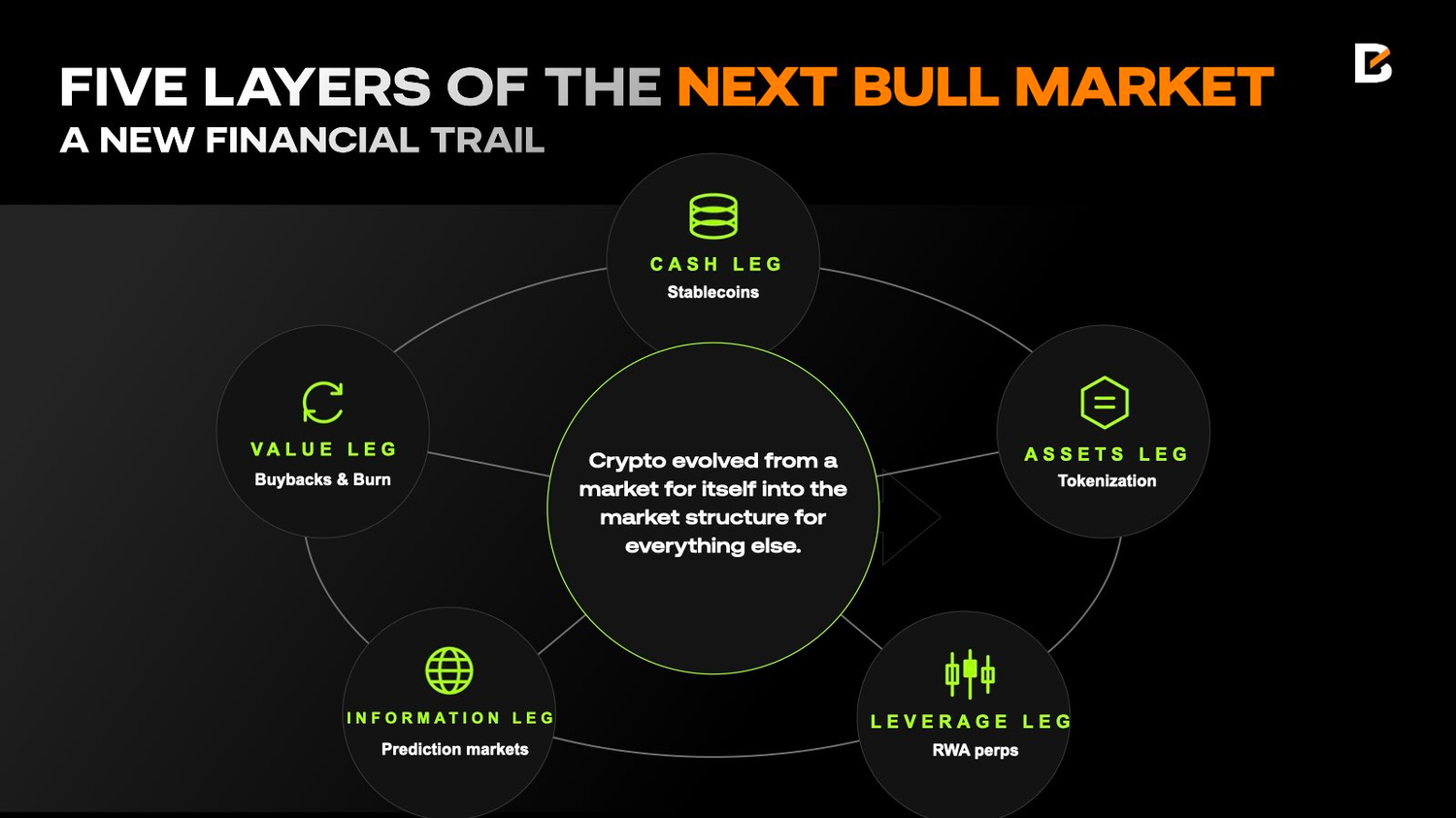
Together, they describe a financial system that increasingly resembles a parallel market infrastructure: global, programmable, continuously open, and built around blockchain settlement.
That is why the next bull market may be defined less by a single new application category and more by the convergence of these five layers. The cycle may therefore be remembered as the point when crypto stopped functioning primarily as a market for itself and started becoming a market structure for everything else.
Cash Leg: Stablecoins
Stablecoins are becoming the settlement layer of the new financial stack, expanding from crypto-native markets into real-world payments and, increasingly, machine-to-machine commerce. Their advantage is straightforward: dollar-denominated value can move 24/7 across programmable, internet-native rails.
Stablecoins first established this role inside crypto, providing a common settlement asset across exchanges, trading venues and on-chain markets. That same model is now moving into real-world financial infrastructure. U.S. legislation (the GENIUS Act in 2025) provided a clearer framework for payment stablecoins, accelerating institutional interest.
Adoption is already scaling.
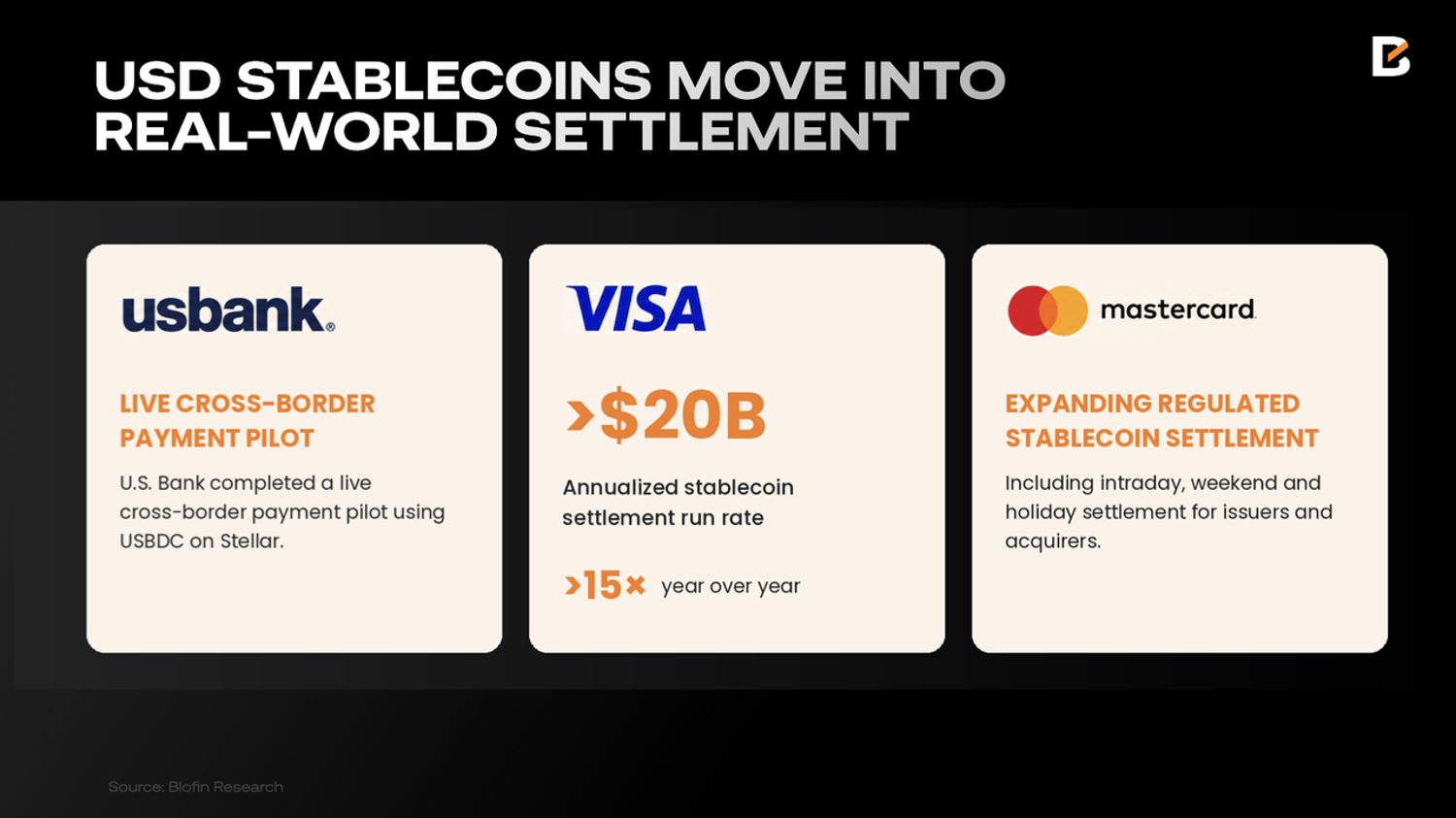
Visa’s stablecoin settlement volume has surpassed a $20 billion annualized run rate, up more than 15x year over year. Mastercard is also expanding regulated stablecoin settlement across its global payments network, including intraday, weekend and holiday settlement options for issuers and acquirers. Dollar stablecoins are increasingly becoming a settlement option inside the payment infrastructure already connecting banks, payment providers and businesses globally.
The next expansion is toward machine settlement. AI agents increasingly need to autonomously pay for APIs, data, compute and other digital services, creating demand for money that is programmable, always available and native to the internet.
x402 enables agents to make USDC payments directly over the web, while Amazon Bedrock AgentCore has integrated x402 and Coinbase infrastructure to support autonomous USDC payments on Base and Solana. Circle has also launched Agent Stack, giving AI agents tools to hold funds, discover services and transact programmatically with USDC.
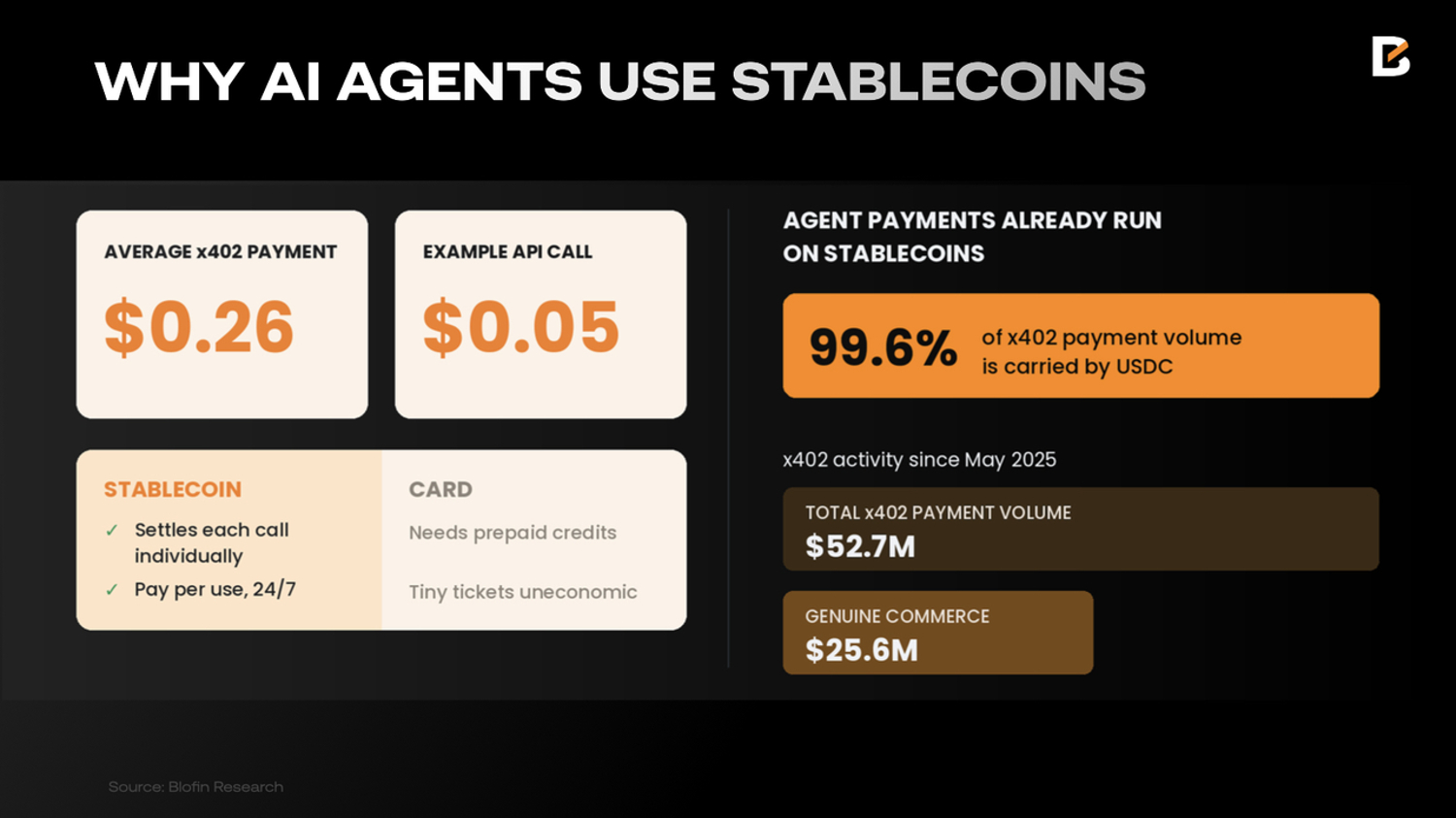
The infrastructure is arriving ahead of the volume, but the direction is clear: Stablecoins started as the cash layer of crypto and are increasingly becoming an internet-native settlement asset for businesses, payment networks and machines.
Asset Leg: Tokenization
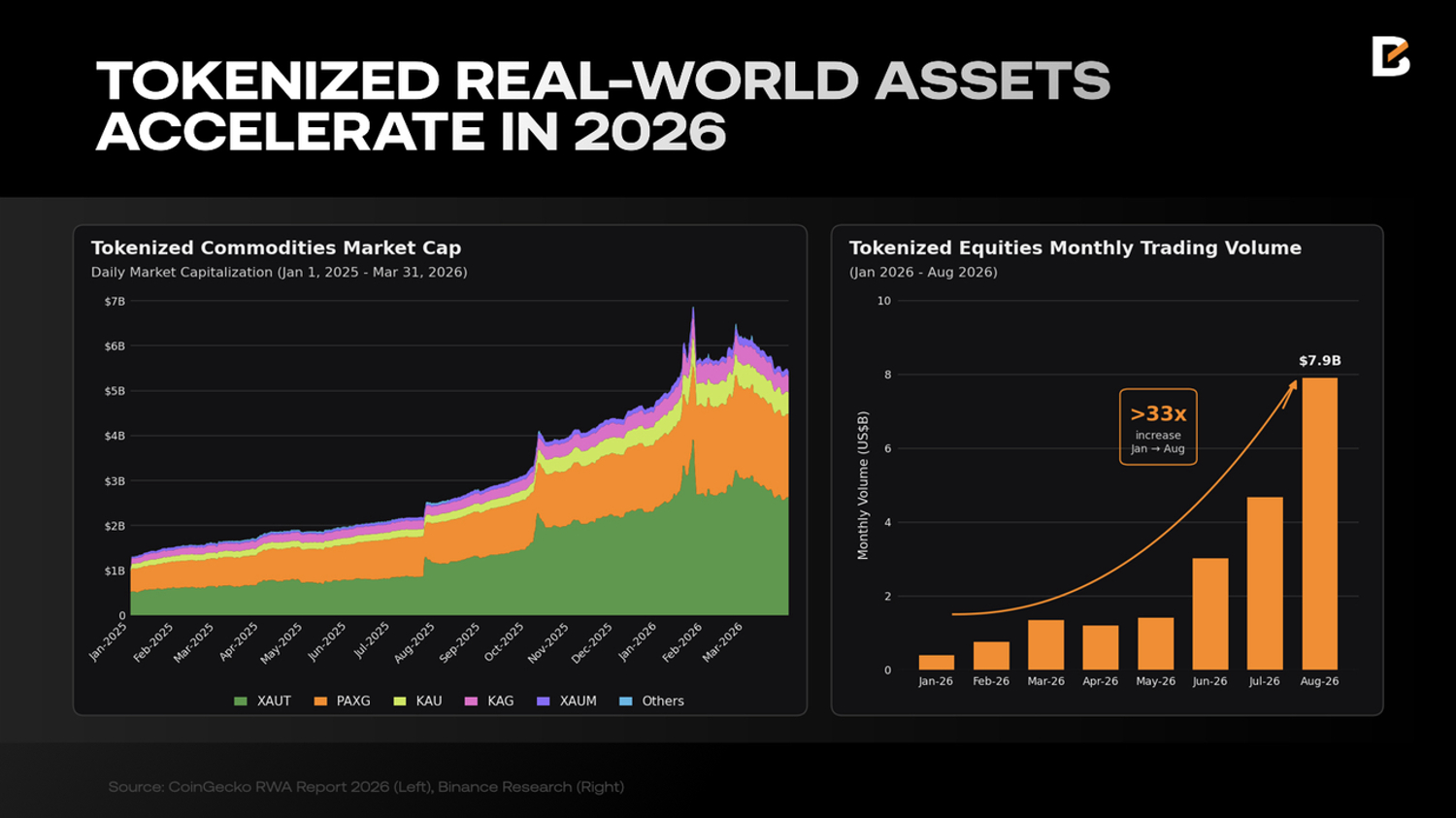
Tokenization is becoming the asset layer of the next crypto bull market as real-world ownership is becoming programmable and increasingly usable across on-chain financial markets. In 2026, the story has expanded beyond tokenized Treasuries. Commodities and equities are now among the fastest-growing parts of the on-chain asset base.
Tokenized commodities reached $5.55 billion by the end of Q1, up 289% since the start of 2025, led largely by tokenized gold. Equities accelerated later and even faster, growing 390% YTD to $4.43 billion by mid-September. Trading activity has grown faster still: monthly tokenized-equity volume increased from $237 million in January to $7.9 billion in August.
More importantly, once assets move on-chain, they can begin to participate in DeFi.
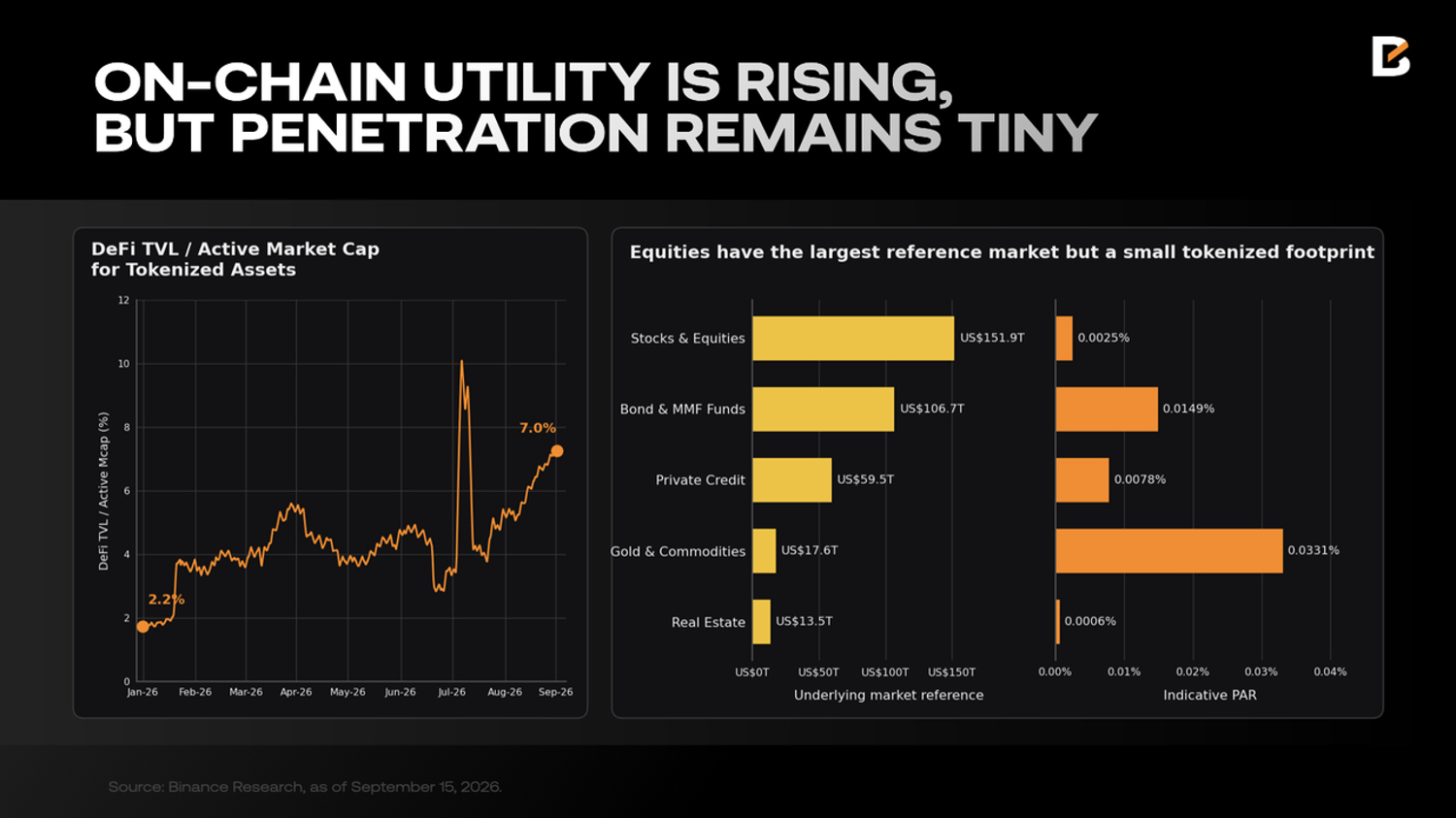
Tokenized equities are increasingly functioning as programmable assets. DeFi Active TVL has risen from $21.6 million to $289.1 million this year, with 65.4% deployed in liquidity pools and 28.1% in lending. Tokenized stocks are beginning to function as liquidity and collateral inside on-chain markets.
This is still early. Only about 0.0029% of the $151.9 trillion global listed-equity market is currently tokenized, even after this year’s rapid growth. The migration of real-world ownership on-chain has barely begun, leaving substantial room for tokenized assets to expand as distribution, liquidity and collateral use deepen.
Regulation is also beginning to open the rails. In September, the SEC’s Innovation Exemption created a temporary framework allowing eligible tokenized U.S. stocks to trade through permissioned AMMs and liquidity pools. Importantly, eligible tokenized stocks must provide holders the same rights and privileges as the underlying traditional shares, keeping this market distinct from synthetic stock exposure and RWA perps.
The next phase of tokenization is not simply putting more real-world assets on-chain. It is making those assets usable on-chain.
Leverage Leg: RWA Perps
The perpetual futures contract, usually shortened to “perp,” allows traders to take long or short exposure to an asset without an expiry date. Instead of purchasing the underlying asset, the trader posts collateral and gains leveraged exposure to its price. A funding mechanism helps keep the contract aligned with its reference market, while margin requirements and liquidations control the risk taken by each position.
Perps first became popular as a way to trade Bitcoin and crypto tokens. The same market structure is now being extended to equities, commodities, exchange-traded funds, indices, currencies and even pre-IPO company valuations.
This is the leverage leg of crypto’s emerging financial stack. Stablecoins provide the collateral. Oracles import external prices. Exchange venues provide execution, margin and liquidation. Together, they make traditional market risk tradable through crypto-native infrastructure.
The underlying share, barrel of oil or ounce of gold can remain inside the traditional financial system. Its price risk can trade continuously.
Tokenization moves the asset. Perps move the risk.
RWA perps offer synthetic price exposure to real-world assets without putting the underlying asset or a legal ownership claim onchain.
Equity perps are one example. They track the price of a listed share, with traders exchanging profit and loss as the reference price moves. The position carries no voting rights, dividends or direct claim on the company. The same principle can extend to other RWAs: traders gain exposure to the price of the asset without owning the underlying instrument.
That narrower structure gives RWA perps a major speed advantage. Tokenizing a real-world asset requires legal structuring, custody, investor eligibility and mechanisms for settlement or corporate actions. An RWA perp market mainly requires a reliable price feed, sufficient liquidity, collateral, risk parameters and an effective liquidation system.
That helps explain why synthetic exposure can scale faster than tokenized ownership.
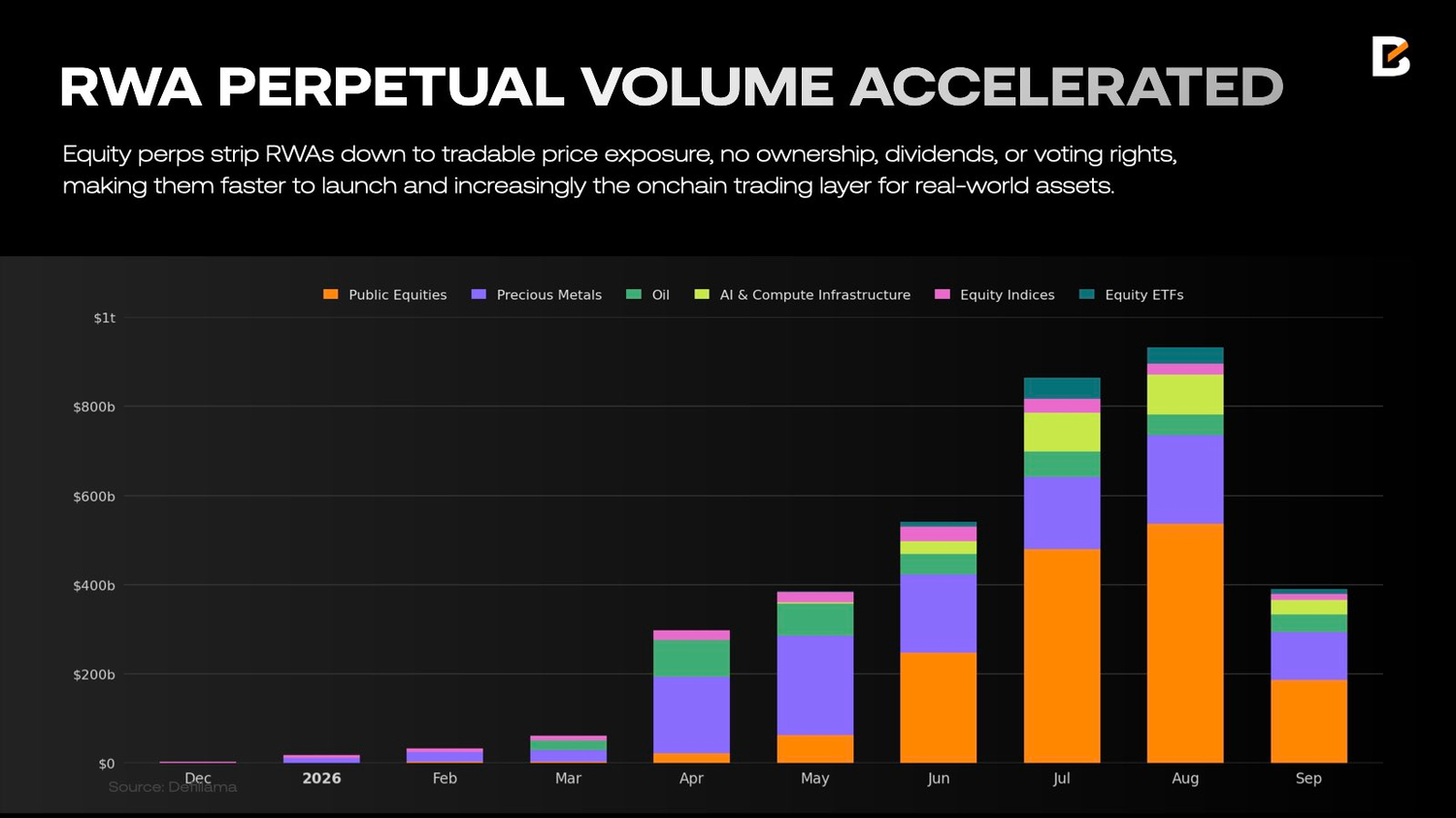
Defillama estimates the total RWA-perps volume (including both centralized exchanges and decentralized exchanges) reached $122 billion in Q1 2026, and rose 10x to $1.24 trillion billion in Q2, and rose another 77% to $2.2 trillion in Q3.
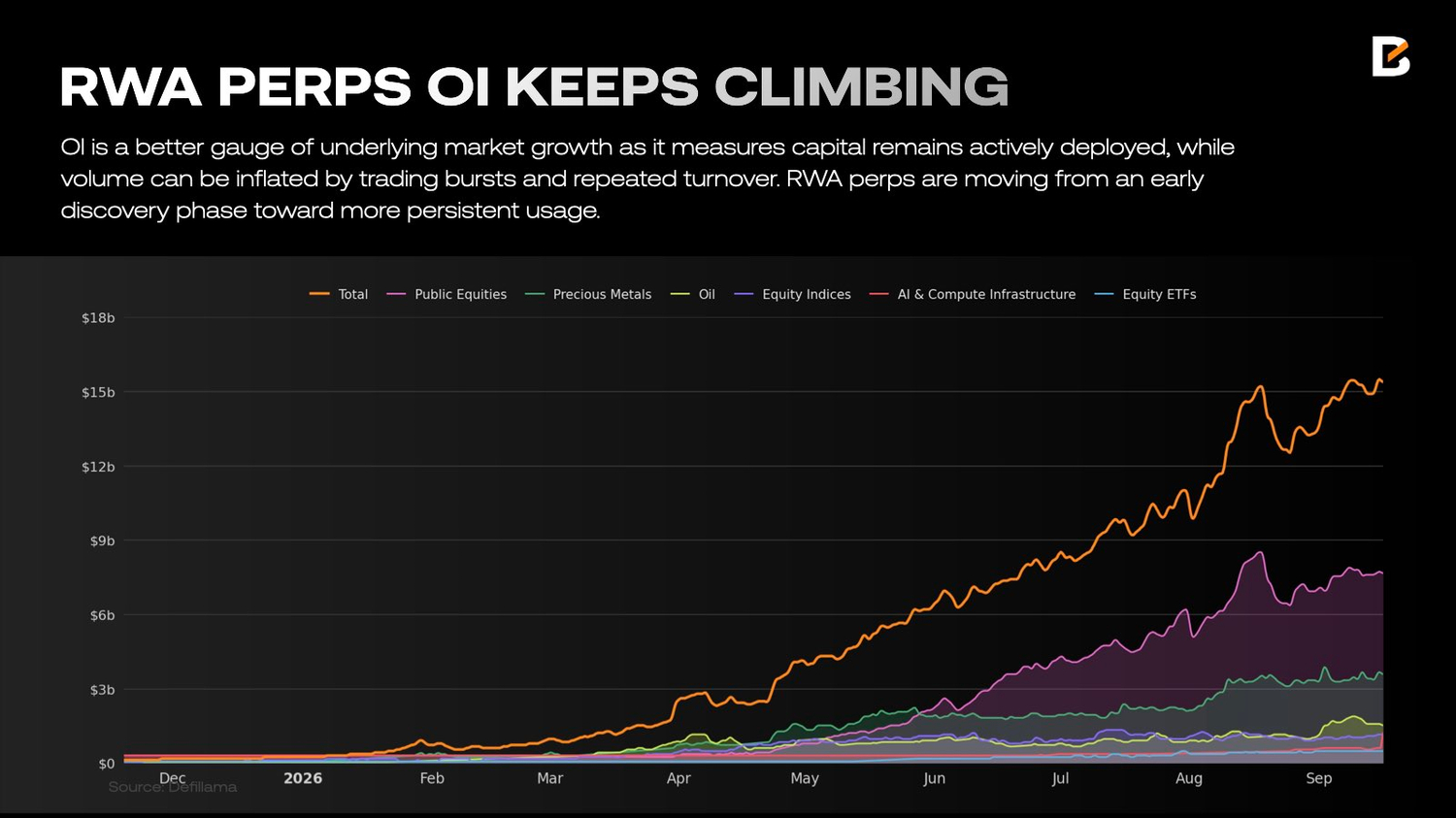
The moderation from Q2 to Q3 happened because that initial hype cooled off. Even with the slower growth rate, the absolute numbers are still massive, Q3 volume still crushed Q2 overall, and open interest has been in a growing trend with now over $15.3 billion. It's maturing from explosive discovery phase to steadier usage.
Perp indicators could become a new input for equity pricing
If equity perps continue to scale, their market data could become increasingly relevant to traditional equity analysis, especially outside regular trading hours.
A perp trading above its reference price after major corporate news may signal that the equity will reprice higher when the primary exchange opens. Funding rates can reveal whether that move is supported by heavily crowded positioning, while open interest shows whether traders are committing new exposure or simply closing existing positions.
These signals could eventually complement pre-market trading, options activity and futures positioning when assessing near-term equity pricing. Their usefulness will, of course, depend on liquidity: thin perp markets can produce noisy or manipulated signals, while deep markets with broad participation could become credible 24/7 indicators of global equity demand.
Information Leg: Prediction Markets
Prediction markets are becoming the information layer of the next crypto bull market. They turn scattered opinions, news and expectations into continuously priced probabilities, creating real-time signals that can be read by both people and machines.
Unlike polls or social-media consensus, prediction-market probabilities are backed by participants putting capital at risk and continuously reprice as new information arrives.
Ahead of the 2026 FOMC meetings, probabilities on Kalshi and Polymarket shifted with changing economic data and policy expectations, then gradually converged with CME FedWatch as each decision approached. These probability moves provide a real-time signal of how market expectations are changing, allowing users to extract information from prediction markets rather than simply trade the final outcome.
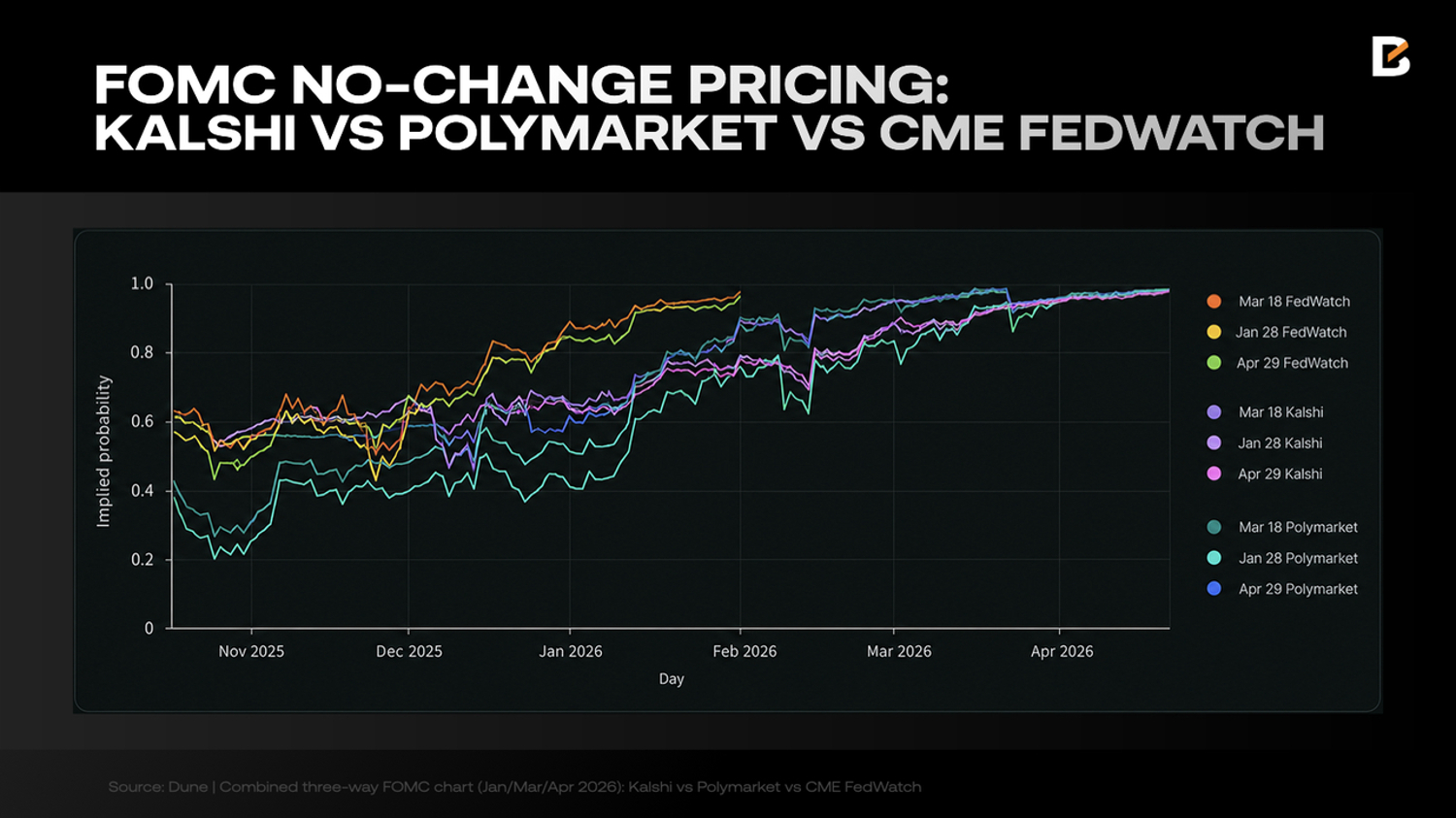
The bigger shift is that uncertainty itself can now be expressed as a continuously priced probability time series.
During the 2026 Hormuz crisis, for example, Polymarket’s probability of disruption could be tracked alongside Brent crude. This turned a difficult-to-quantify geopolitical risk into a live market signal that could be compared directly with the price of an asset exposed to that risk.
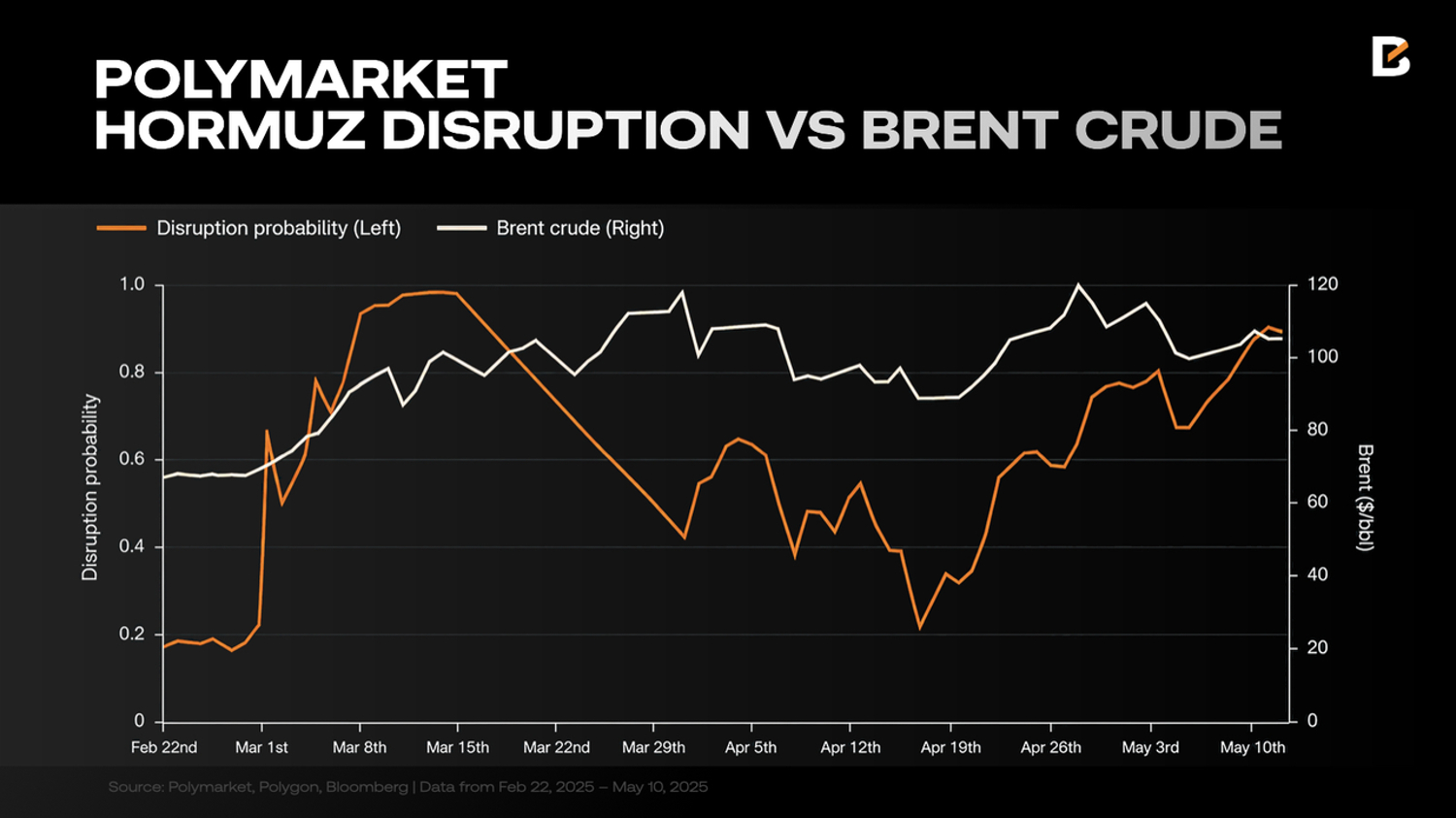
These probability feeds are also becoming increasingly machine-readable. Their structure is naturally standardized: event, probability, timestamp and price history. They can be consumed through APIs and incorporated into models or AI agents as live external signals.
Polymarket has already released an open-source framework that connects prediction-market data with news sources, web search, RAG and LLMs, allowing AI agents to analyze information and interact with prediction markets programmatically.
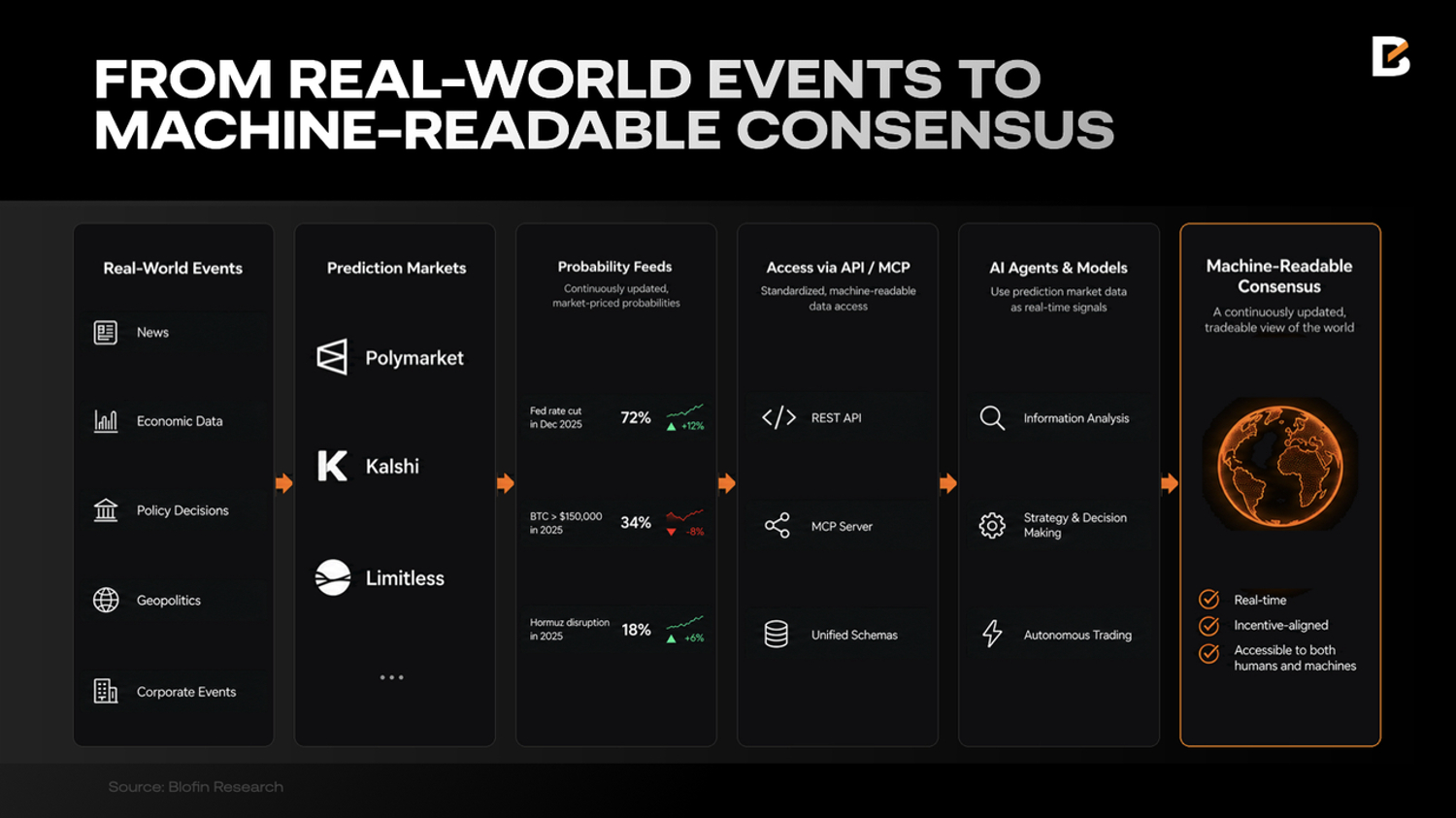
Prediction markets are increasingly becoming a source of information in their own right. Users can read capital-backed probabilities and their movements as real-time signals of how market expectations are changing, not simply use them to trade an eventual outcome.
Value Leg: Token Value Accrual
Value accrual is the final test of the bull market: usage is important, but the token needs a credible mechanism that converts usage into holder value.
The old model: the token as the subsidy
The first generation of crypto applications often launched before they had a sustainable business model. Fees were too small to finance liquidity, user acquisition, and operating costs, so protocols used their own tokens as a substitute for cash.
The loop worked like this:
- Launch an application that does not yet earn enough fees.
- Issue a token and distribute it to traders, liquidity providers, referrers, and early adopters.
- Introduce staking, vote-escrow, loyalty programs, or long locking periods to keep rewards away from the market.
- Lower circulating supply creates the appearance of scarcity, while token emissions are presented as yield.
- A rising token price increases the dollar value of the rewards, attracting more farmers and lockers.
- The token price becomes the protocol’s effective profit-and-loss statement, even when the protocol itself captures little revenue.
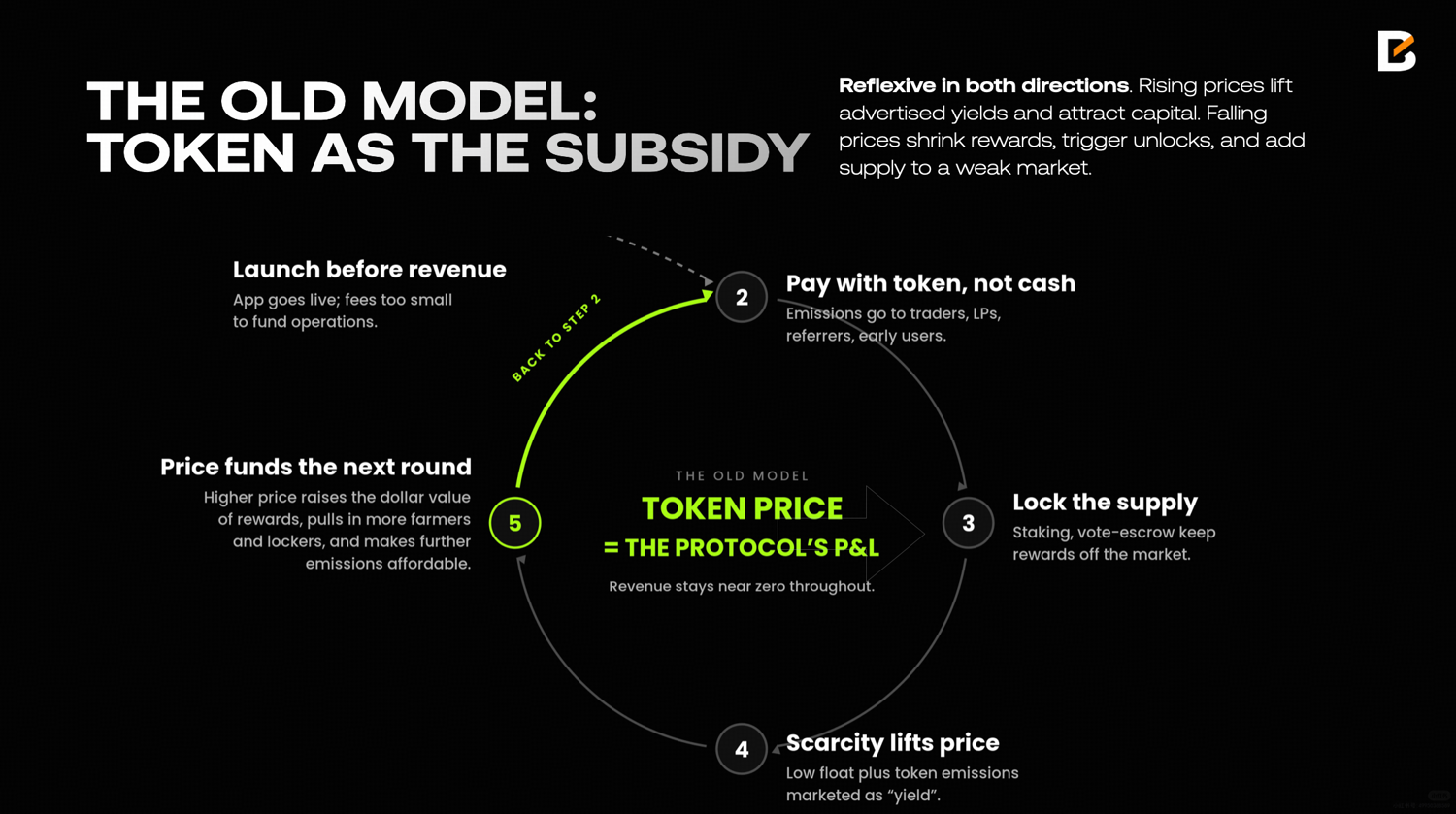
Users experience this as appreciation from holding or staking. Economically, their return depends on continued emissions, restricted float, and a steady supply of new buyers. The token provides no durable residual claim on the application’s cash generation.
This mechanism is reflexive in both directions. Rising prices increase advertised yields and attract more capital. Falling prices reduce the dollar value of emissions, encourage users to unlock, and add supply to a weakening market.
By 2025–2026, participants had learned the sequence: farm the rewards, monitor the vesting calendar, and sell when liquidity becomes available.
The marginal buyer also changed.
The emissions model has lost credibility. Locks can delay supply, yet every reward eventually requires a buyer. Crypto participants now understand the sequence: farm the token, wait for liquidity, and sell into the next wave of demand. Once that behavior becomes widely anticipated, emissions are valued as future dilution and the circular mechanism begins to unwind.
The investor base has also changed. Traditional financial institutions are becoming more active in crypto, bringing an investment framework built around revenue, margins, cash flow, and capital returns. A token whose value depends primarily on emissions and restricted float does not fit that framework. These investors need a measurable connection between protocol usage and token-holder value.
As TradFi capital becomes more important to crypto valuations, protocols increasingly need an economic model that can be explained in one sentence: users pay fees, the protocol captures revenue, and part of that revenue accrues to the token.
The new value-accrual chain
The new model creates a measurable connection:
Usage → fees → protocol revenue → buybacks, burns, distributions, or productive treasury growth
This moves crypto closer to a framework traditional investors already understand. A protocol provides a service, charges users, retains part of the revenue, and decides how to allocate the resulting cash flow. That allocation may take the form of buybacks, burns, staking distributions, treasury accumulation, or reinvestment in growth.
The token does not need to receive every dollar immediately. A protocol may create more long-term value by investing in security, liquidity, product development, or distribution. The essential requirement is a credible connection between the protocol’s economic success and the token.
That connection must survive three stages.
- First, the activity must generate organic fees. Volume created primarily by token incentives can disappear when rewards decline.
- Second, the protocol must capture part of those fees. High trading volume or total fees can still produce weak token economics when most of the value flows to liquidity providers.
- Third, the protocol must allocate its retained revenue in a way that benefits the token. Revenue sitting in a treasury creates only potential value. A defined buyback, burn, or distribution policy turns that potential into an economic mechanism investors can evaluate.
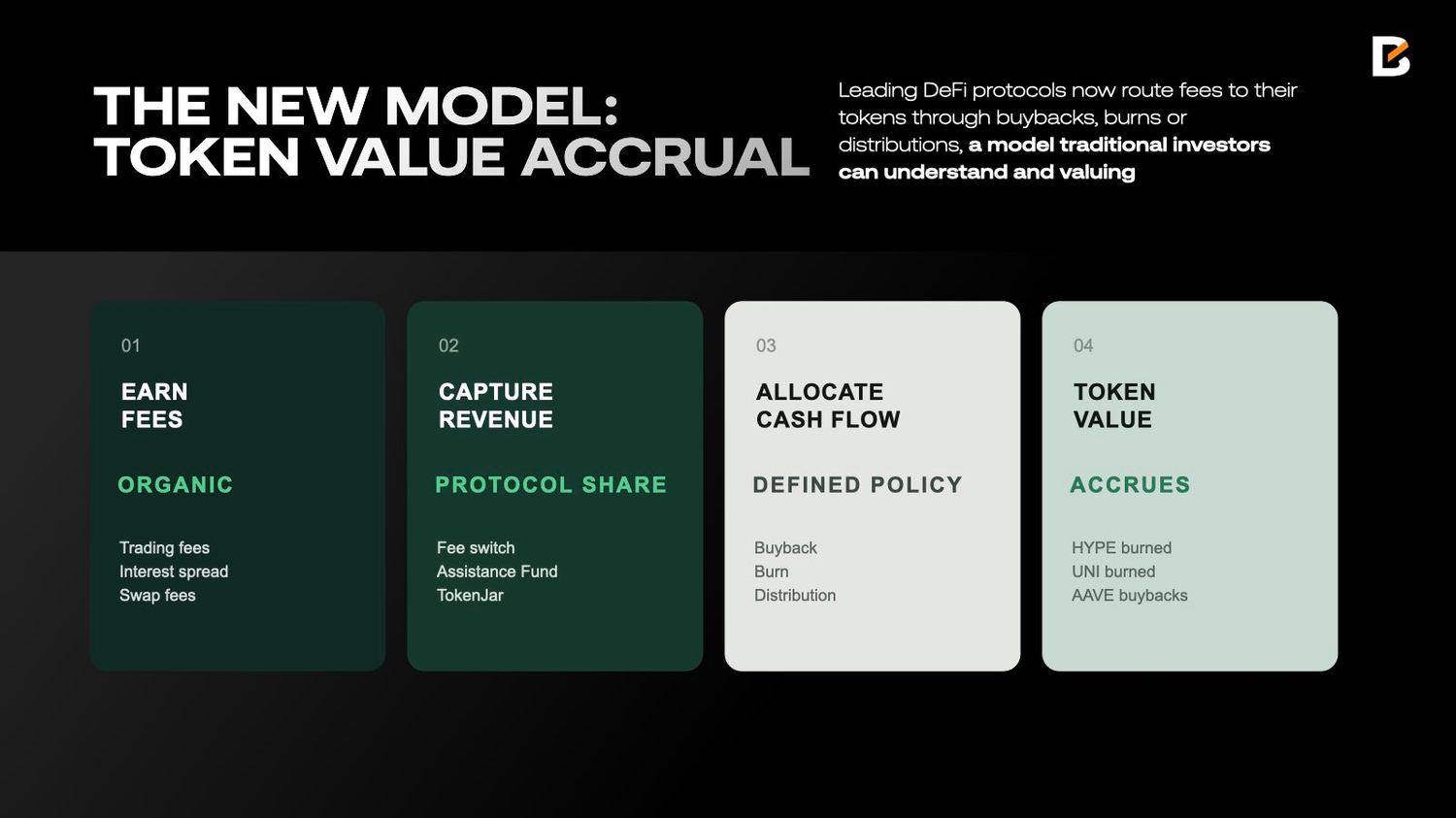
Top DeFi Protocol all started Token Value Accral
Protocol | Primary fee engine | Value Accrual |
Hyperliquid | Perpetual and spot trading fees | The Assistance Fund converts fee revenue into HYPE and burns the acquired tokens |
Uniswap | Swap fee on trade inside an AMM pool | Protocol swap fees into TokenJars that is withdrawn only by burning an equivalent amount of UNI |
Aave | Interest spread on loans | Revenue flows to the DAO, which can fund AAVE buybacks |
Hyperliquid provides the shortest path. Trading generates fees, the Assistance Fund converts those fees into HYPE, and the acquired tokens are burned. The process is embedded in the network’s execution, making the relationship between activity and supply reduction highly visible.
Uniswap has turned on protocol fees and connected them to UNI burns through the TokenJar–Firepit mechanism. By July 2026, protocol fees were live across v2 and v3 pools on 11 chains, followed by the first stage of v4 fee activation. The central challenge is balancing token-holder value with liquidity-provider returns.
Aave represents a capital-allocation version. Revenue from lending, GHO, and Aave-branded products flows into the DAO, which must divide capital among buybacks, development, security, liquidity, and reserves.
Together, these examples show that there is no single mechanism for token value accrual. Hyperliquid emphasizes automation. Uniswap converts an existing network into a fee-generating asset. Aave treats revenue as capital that must be allocated between current holders and future growth.
The layers reinforce each other
Stablecoins are the collateral for perps and the settlement asset for tokenized securities. Tokenized assets and RWA perps both take their prices from traditional markets, but they serve different needs: tokenization carries ownership, while perps carry leveraged price exposure. Together they let holders own an asset on-chain and hedge or add exposure to it with the same stablecoin collateral. Perps data and prediction-market probabilities become information that traders, models and AI agents can use. The fees from all of this activity feed the value leg.
Past bull markets depended mostly on capital moving between crypto assets. This cycle draws on activity from outside crypto: payments, equities, commodities, macro events and machine-to-machine commerce. Crypto is supplying the rails, and it no longer needs to be the only thing trading on them.
Disclaimer: The information provided herein does not constitute investment advice, financial advice, trading advice, or any other sort of advice, and should not be treated as such. All content set out below is for informational purposes only.