
Backwardation Structures: Two Different Types
Generally, backwardation structures can be categorised into two main scenarios. The first is a situation of physical scarcity, which is highly prone to developing into a 'Super Backwardation' structure. The second is a bearish future outlook, where the spread curve formed by the futures contracts is typically less steep. The shapes of these two scenarios can be broadly illustrated in the figure below.

Intuitively, scarcity refers to a state of insufficient physical supply, where the spot market experiences demand exceeding supply. In this situation, sellers have more pricing power than buyers in the spot market. Generally, this means "producers" hold more pricing power than "consumers".
As shown below, the closer the contracts are to the delivery or settlement day, the wider the spreads between them. However, when major players hoard inventory to drive up prices, the front-month spread can become extremely large, and the spot market may exhibit a phenomenon of being 'quote-only' (i.e., quoted prices exist but no goods for sale), which is highly conducive to the emergence of a 'Super Backwardation' phenomenon. Typical scenarios of "super backwardation" were observed in 2021, including oil, natural gas, copper, and soybeans, reflected in the Bloomberg Commodity Index.
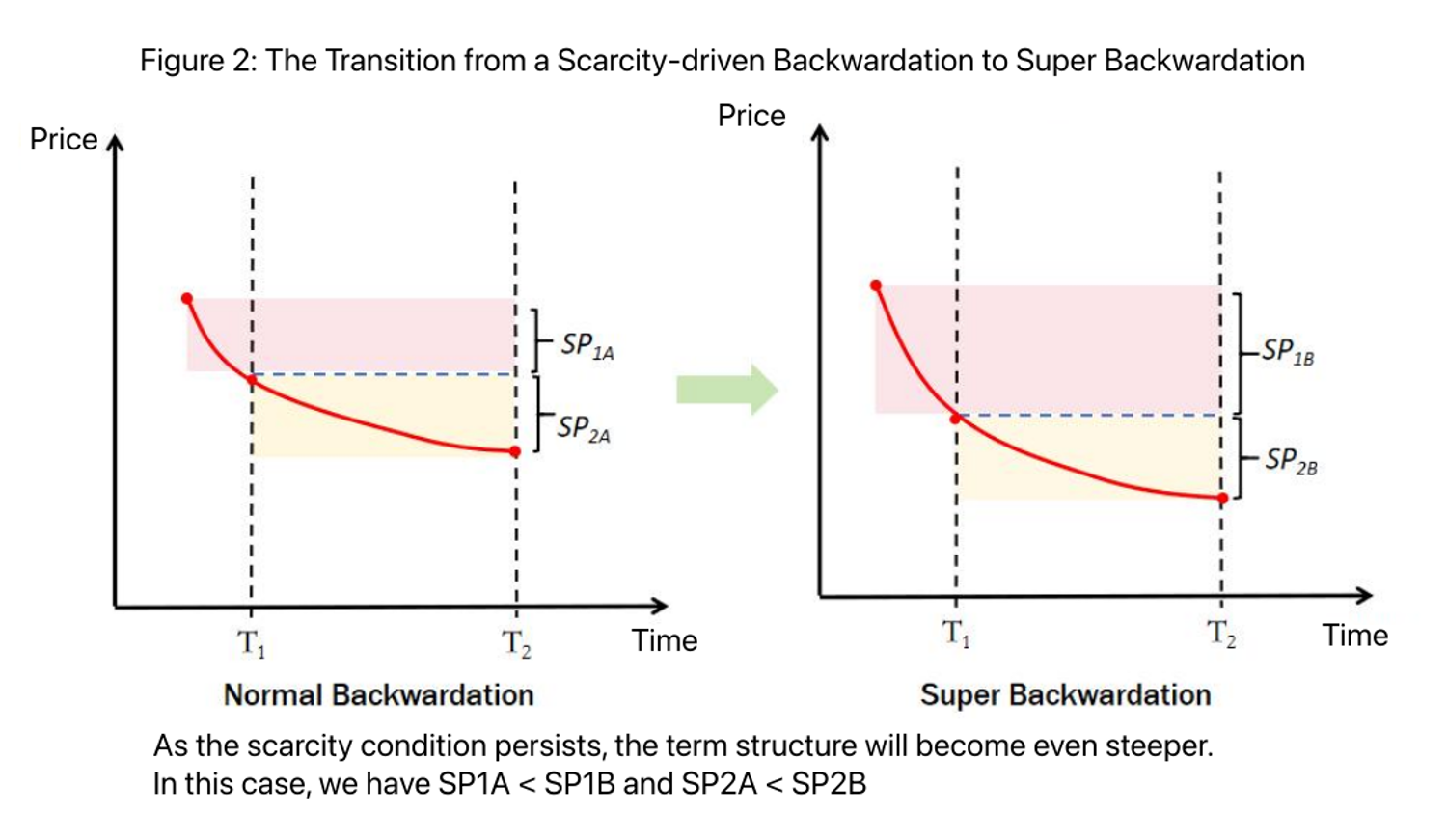

The driver of high prices in front-month contracts is the buying interest created by the scarcity of supply. This means that even during a slight pullback in spot prices, there are still sufficient willing buyers. The trend only ends once these buyers have completed their purchases. (Editor's note: The phenomenon of "super backwardation" has also occurred in the cryptocurrency market, as seen in the demand triggered by the ETH fork airdrop during the 2022 ETH Merge.)
The backwardation with a bearish outlook also presupposes a degree of scarcity. As shown in Figure 1-A, the spread between the front-month futures is relatively small, while the spreads between far-month futures are larger. Typically, this type of structure emerges as a market weakens following a period of "Super Backwardation".
In practice, due to liquidity constraints and the decay in the pricing efficiency of far-month contracts for new information (known as the Samuelson effect), it is rare to observe a distinct phenomenon where front-month futures spreads are smaller than those of far-month futures in most commodity futures. In contrast, backwardation with a bearish outlook appears more readily in markets such as stock indices and live cattle, which involve cash settlement or are based on perishable goods.
(Editor's note: In cross-markets such as exchange rate futures, the probability of backwardation with a bearish outlook is relatively high, because exchange rate futures imply the no-arbitrage principle and are more sensitive to market expectations. Of course, we can also use the futures of different underlying assets to synthesise the exchange rate futures term structure, which assists in judging market expectations, such as the exchange rate term structure of ETH/BTC.)

Source: BloFin Research
Convenience Yield & Backwardation Structure
If "Full Carry" is the key to understanding the contango structure, then "Convenience Yield" is the core concept for understanding the backwardation structure in futures. Convenience yield represents a type of 'convenience' that the holder of a physical commodity (such as a corporation) gains from holding inventory (as the theory states, "stocks of all goods possess a yield"). Holding inventory allows a business to maintain stable production and operations, as the common saying suggests, "Grain in hand, peace of mind." Purchasing managers, tasked with 'securing supply', will have a deep understanding of this principle. In essence, the convenience yield is a form of numerical 'price'.
Since convenience yield is derived from the inventory maintained by businesses, what is the relationship between its value and the level of inventory? Furthermore, how does its value influence the formation of the backwardation curve? How do changes in inventory levels affect the backwardation curve? These are key questions to consider when trying to understand the backwardation structure.
For a manufacturing or processing enterprise, maintaining a certain level of 'safety inventory' is necessary to ensure the regular delivery of products against orders. In physical manufacturing industries, this is often measured in 'days of production'. Additionally, businesses may build up 'excess inventory' based on their judgment of future price trends. This typically occurs in a rising market, where downstream consumers (or speculative traders) fear that procurement costs will continue to rise, and therefore build up excess inventory in advance. The relationship between safety inventory, excess inventory, and convenience yield can be represented by the figure below:

As shown in Figure 3 above, when a company's inventory level falls significantly below the safety stock level (Point A), the convenience yield provided by the remaining inventory becomes extremely high. Under the pressure of "regular delivery", companies are willing to pay a higher "premium" for the commodity.
The lower a company's (the buyer's) inventory, the greater the pressure to maintain normal operations, and thus the higher the premium the company is willing to pay. In this scenario, sellers dominate pricing, and the spot market may even see changes in payment terms (such as fixed prices, shortened payment periods, or sales rationing). Conversely, as inventory levels rise, the inventory held by the company may depreciate with market fluctuations, and any inventory exceeding the safety level will result in a negative convenience yield.
Under balanced supply and demand conditions, the level of safety inventory in a regional market generally tends to be consistent. However, in certain macroeconomic conditions, such as logistical uncertainties, the level of safety inventory maintained by an industry can also be altered. (Editor's note: refer to the crude oil market in the Israel-Iran conflict)
Theoretically, the upper limit of convenience yield can be huge, in stark contrast to the clear limit of full carry, which leads to a significant asymmetry in the potential magnitude of spreads between contango and backwardation structures.
How to Trade Backwardation?
Let us first understand how inventory changes affect the backwardation curve, as shown in the table below.

Notably, when the price is falling with a backwardation structure, there can be phases where the spread strengthens. In such cases, one must carefully consider whether downstream inventories are sufficient to withstand pressure from the upstream for physical delivery as time passes and inventories are consumed. Additionally, one must assess whether the basis (the spread between the front-month contract and the spot price) provides a sufficient safety margin for short positions.
Generally, in the backwardation scenario, during the phase when the commodity is moving from upstream to downstream, if downstream inventories are below safety levels, the pressure to restock makes it a suitable time to buy the front-month and sell the far-month. Conversely, during a prolonged bear market focused on capacity reduction, continuously selling the front-month futures and buying the far-month futures is often a suitable strategy.
For certain commodities with high import dependency and high upstream concentration, buying the front-month and selling the far-month can offer a very favourable risk-reward ratio. The underlying reason is that the supply chain is more susceptible to shocks, allowing the upstream segment to "ask for" more convenience yields from the downstream segment.
The views and thoughts of this article are from an author who has worked as an agricultural futures researcher and trader in institutions such as CME Group and Cargill. With nearly 10 years of work experience in the global futures market, he has accumulated rich theoretical and practical knowledge, and has a deep understanding and attainments in the operation of the futures market. If you want to discuss and communicate with him, please get in touch with him through the following email: [email protected]