
- The SEC has approved generic listing standards that streamline crypto ETF launches, clearing the way for a surge of spot altcoin products.
- Google has expanded its Agent2Agent Protocol to support stablecoin payments, creating a common standard for AI agents to exchange value and paving the way for automated, auditable, and programmable commerce across the AI-driven web.
- Plasma, a new blockchain built for stablecoin transactions, will launch its mainnet beta with $2B in liquidity, and a zero-fee USDT transfer feature, joining a wave of specialized Layer-1s aiming to reshape stablecoin settlement.
SEC Streamlines Crypto ETF Listings With Generic Standards
The U.S. Securities and Exchange Commission has approved generic listing standards that let exchanges such as Nasdaq, NYSE, and Cboe list commodity-based exchange-traded products (ETPs), including cryptocurrencies, without requiring case-by-case SEC approval.
The change eliminates the lengthy 19(b) rule filing process, which could take up to 240 days, allowing issuers to bring crypto ETFs to market more efficiently if they meet the new standards. SEC Chair Paul Atkins said the move is designed to reduce barriers to regulated digital asset products and keep U.S. markets at the forefront of innovation.
Alongside the rule change, the SEC approved the Grayscale Digital Large Cap Fund, tracking BTC, ETH, XRP, SOL, and ADA, as well as options tied to the Cboe Bitcoin U.S. ETF Index and its mini version, expanding the toolkit of regulated crypto-linked derivatives.
Key Take
The SEC’s new listing standards clear the path for a wave of spot altcoin ETFs, with analysts calling it the long-awaited framework that could trigger a surge of new crypto ETP launches in the coming weeks and months.
When the SEC adopted the “ETF Rule” in 2019 for traditional assets, annual ETF launches tripled from 117 to 370, if similar generic listing standards now apply to crypto, the market could see a comparable surge in new spot ETF products this fall.
With the SEC’s new listing standards and approval of the Grayscale Digital Large Cap ETF (BTC, ETH, XRP, SOL, ADA), the crypto ETF wrapper will become the key bridge between TradFi and DeFi.
Google Brings Stablecoins to Agent-to-Agent Payments
Google has unveiled an open-source protocol that enables AI applications to send and receive payments, including stablecoin transactions, highlighting the growing role of dollar-pegged crypto in the AI-driven web.
The initiative builds on Google’s Agent2Agent Protocol, first introduced in April, and is being launched in partnership with Salesforce, American Express, and more than 60 other companies, with input from the Ethereum Foundation. The upgrade allows AI agents, autonomous programs capable of decision-making, to exchange not just information, but also value.
If AI agents become routine shoppers, brokers, and back-office bots, standardized payments with stablecoin support could significantly expand crypto’s utility beyond trading. It would also enable verified, auditable transactions among software agents and across corporate systems, blending blockchain transparency with AI automation.
Key Take
The internet is moving toward a future where autonomous agents handle payments directly. Just as websites evolved into APIs that let software share data automatically, agents go a step further, they can make and manage transactions on behalf of people or companies.
Today’s payment systems don’t have a common standard, which means autonomous agents can’t easily send payments across the internet. AI agents have no reliable way to coordinate payments, making agent-to-agent commerce impossible.
By setting a standard with stablecoin included, an AI travel agent could automatically book your flight and hotel, then pay instantly in stablecoins without needing your credit card, with all receipts logged onchain. This makes transactions faster, programmable, and fully auditable.
Plasma Chain to Launch With $2B Stablecoin Liquidity
Plasma, a blockchain designed specifically for stablecoin transactions, is scheduled to launch its mainnet beta on Sept. 25 along with its native token, XPL.
According to the team, the network will start with over $2 billion in stablecoin liquidity from more than 100 partners, with the goal of serving as an infrastructure layer for stablecoin transfers. Plasma introduces a new consensus system, PlasmaBFT, which is built to support fast and composable transactions. At launch, users will be able to transfer USDT with no fees through the platform’s dashboard.
Backing the project are several well-known crypto and venture investors, including Framework Ventures, Peter Thiel, and Tether CEO Paolo Ardoino.
Key Take
Stablecoins are moving into a new phase as major issuers like Circle, Stripe, and Tether affiliates build custom Layer-1 blockchains tailored for stablecoin transactions, reducing reliance on networks such as Ethereum, Tron, and Solana.
In the immediate future, Ethereum and Tron are unlikely to lose their dominance overnight. They have large established user bases, integrations with exchanges and wallets, and liquidity deep in DeFi and CeFi.
Looking further out, these new L1s could significantly alter the market share in stablecoin settlement. If chains like Arc, Stable, Tempo, and Plasma achieve their goals, a growing chunk of stablecoin transactions (especially high-volume and enterprise transactions) may relocate off Ethereum and Tron onto these specialized chains.
Find out more analysis: The Rise of Stablecoin-Focused Blockchains
Weekly Market Chart: Tokenized Gold Surges to Record Highs
The amount of tokenized gold in circulation, measured in troy ounces, has climbed nearly 36% since April 2025, reaching record levels onchain. The surge coincides with gold prices climbing to all-time highs, amplifying demand for digital gold exposure as investors seek both safety and flexibility.
The rise comes as the World Gold Council (WGC) announced new initiatives to expand how gold can be traded globally, including digital formats designed to improve accessibility and settlement efficiency. The World Gold Council's new Gold247 initiative includes launching a Pooled Gold Interests (PGI) token to digitalize gold ownership, trading, and use as collateral, alongside other efforts like Gold Bar Integrity for tracking and a Standard Gold Unit to standardize digital gold.
These moves are part of a broader trend to modernize the gold market, long dominated by ETFs and futures, by introducing tokenized alternatives that offer 24/7 liquidity and programmable features.
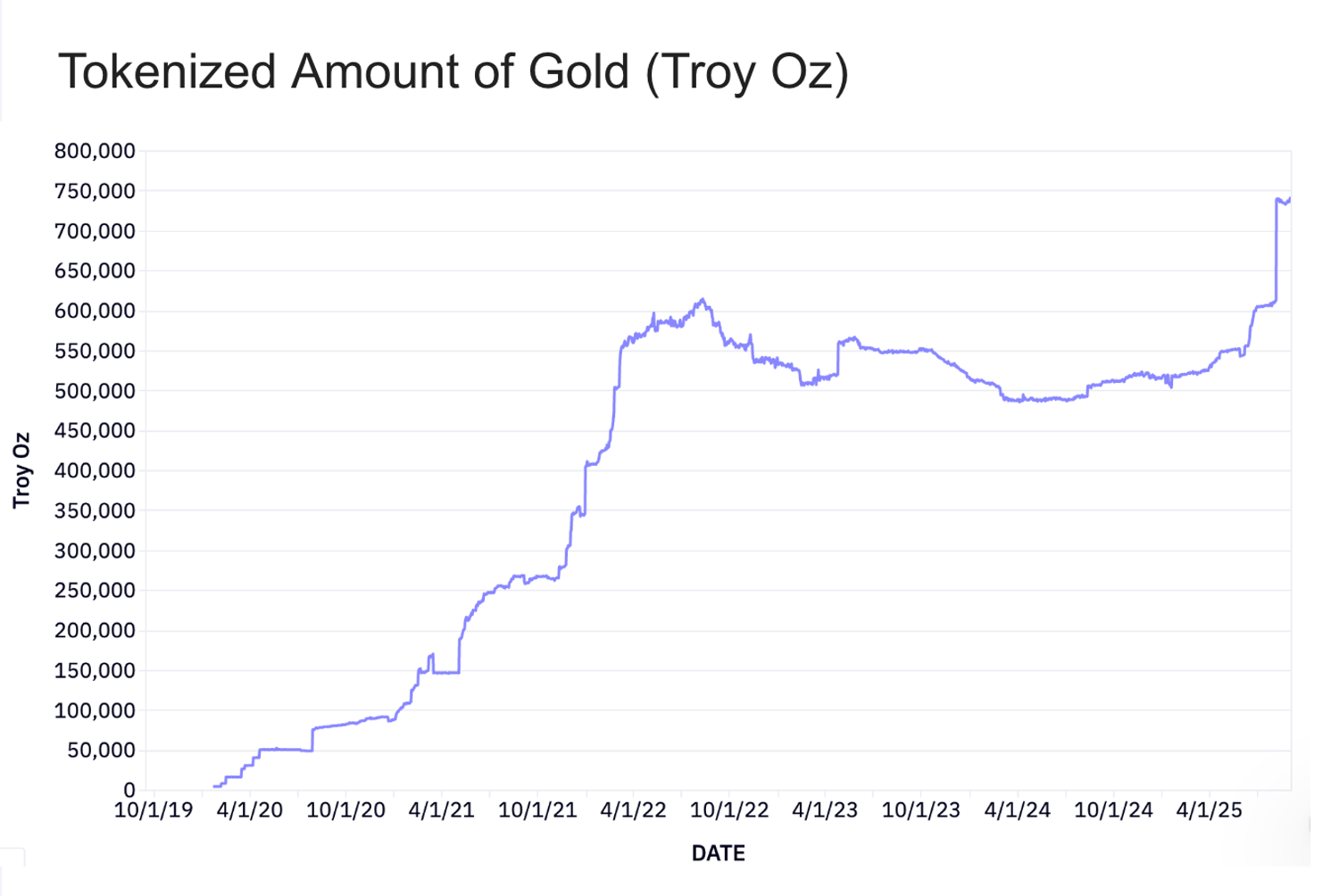
Source: Artemis
Disclaimer: The information provided herein does not constitute investment advice, financial advice, trading advice, or any other sort of advice, and should not be treated as such. All content set out below is for informational purposes only.