
- The CFTC is exploring treating stablecoins like USDC and USDT as cash-equivalent collateral in derivatives markets, a move that could embed them into the core of U.S. financial infrastructure.
- Ethereum’s upcoming Fusaka upgrade on Dec. 3 extends its roadmap of lowering transaction fees and scaling rollups, but while this benefits users and adoption, it highlights the ongoing challenge of limited value capture for ETH.
- Centrifuge has launched SPXA, the first licensed tokenized S&P 500 index fund, giving crypto investors 24/7 on-chain access to one of the world’s most important and proven long-term wealth preservation benchmarks.
CFTC Eyes Stablecoins as Tokenized Collateral
The U.S. Commodity Futures Trading Commission (CFTC) is launching an initiative to explore using stablecoins as tokenized collateral in derivatives markets, according to acting chair Caroline Pham.
Pham, who has been leading the agency’s “crypto sprint,” called collateral management the “killer app” for stablecoins and said the CFTC will work closely with industry stakeholders to design a framework. If implemented, stablecoins like USDC and Tether would be treated similarly to traditional collateral like cash or US Treasurys in regulated derivatives trading.
The effort comes as Pham continues to push forward crypto policy in the absence of a confirmed permanent chair, coordinating with SEC Chair Paul Atkins on broader digital asset initiatives.
With derivatives markets representing trillions in daily exposure, recognizing stablecoins as eligible collateral could significantly expand their role in traditional finance and accelerate their integration into regulated U.S. markets.
Key Take
Collateral is central to the functioning of derivatives markets, and if the CFTC eventually recognizes stablecoins like USDC, USDT as eligible collateral, it would effectively connect crypto markets with the world’s largest derivatives clearing system, a major step toward mainstream financial integration.
The message is clear, this isn’t just about crypto. Stablecoins are no longer just a crypto phenomenon, but are being formally invited into the core of the U.S. financial system as part of its foundational market architecture.
A potential new model of “on-chain collateral, off-chain trading” could emerge, where users post stablecoins like USDC on-chain to open positions on venues such as CME, and eventually even settle CME products on-chain, marking a true fusion of DeFi and TradFi.
Ethereum Sets Fusaka Upgrade for December
Ethereum’s developers have scheduled the Fusaka upgrade for Dec. 3, pending smooth testing in October. The move is part of Ethereum’s ongoing effort to make the network faster and cheaper, following earlier upgrades like Dencun in March and Pectra in May.
The focus of Fusaka is on “blobs”, a new way of storing large batches of transaction data. Blobs were introduced in March to help layer-2 networks (like Arbitrum, Optimism, and Base) post their transaction data on Ethereum more efficiently, which lowers costs for end users.
Fusaka itself won’t immediately change blob settings, but in the weeks after, two follow-up Blob Parameter Only (BPO) forks will gradually more than double blob capacity. This means Ethereum will be able to handle much larger volumes of rollup transactions, further reducing congestion and keeping transaction fees low.
Key Take
The Fusaka upgrade continues Ethereum’s long-term strategy of driving transaction fees lower. From Dencun to Pectra and now Fusaka, every major upgrade has been about scaling throughput and reducing costs for end users, especially Layer-2 rollups.
Lower fees are great for adoption, but they weaken ETH’s value capture. Even if Ethereum becomes the backbone for RWA and institutional tokenization, cheap transactions mean little additional revenue for ETH. Furthermore, tokenizing trillions in assets doesn’t automatically add value if those assets move infrequently, since fee generation is tied to activity, not nominal value locked.
We’ve written about Ethereum’s value capture problem and its evolving narrative, you can find the link below to read more.
Related Reading:
Centrifuge Launches First Tokenized S&P 500 Index Fund
Real-world asset protocol Centrifuge has unveiled the SPXA, the first S&P 500 index fund to be licensed and launched directly on blockchain rails. Live on Base network, the fund is managed by Janus Henderson in partnership with Centrifuge’s Anemoy, and allows investors to trade exposure to the S&P 500 around the clock with transparent, on-chain holdings.
This marks a significant step in the tokenization of traditional finance: one of the world’s most recognized equity benchmarks is now available on-chain. Backed by anchor investment from FalconX and with Wormhole enabling cross-chain expansion, SPXA highlights how blockchain infrastructure is evolving to provide liquidity, accessibility, and operational efficiency for traditional financial products.
Key Take
The S&P 500 is one of the world’s most important financial benchmarks, representing roughly 80% of U.S. equity market capitalization and serving as the primary gauge of American corporate performance.
The S&P 500 is not only a leading market benchmark but also a proven long-term vehicle for wealth preservation and growth, and now, crypto investors can access it directly without off-ramping capital into traditional finance.
We’ve written about strategies for preserving wealth after taking profits from crypto, including ways such as index fund such as S&P500 and gold, you can read more here: Wealth Preservation After Selling Bitcoin Top
Weekly Market Chart: Kalshi Overtakes Polymarket in Prediction Market Volume
Kalshi’s September 2025 performance represents a watershed moment for prediction markets. Surpassing Polymarket in monthly volume, signals both rapid platform growth and a reshaping of market leadership.
Kalshi’s surge reflects the success of its new distribution strategy. The integration with retail brokers such as Robinhood and Webull has proven decisive. By embedding prediction markets into familiar trading apps, Kalshi lowered onboarding friction, exposing millions of retail investors to markets beyond traditional equities. This seamless access, coupled with Kalshi’s breadth of 16,000 active markets across politics, sports, and nontraditional topics, widened appeal and accelerated adoption.
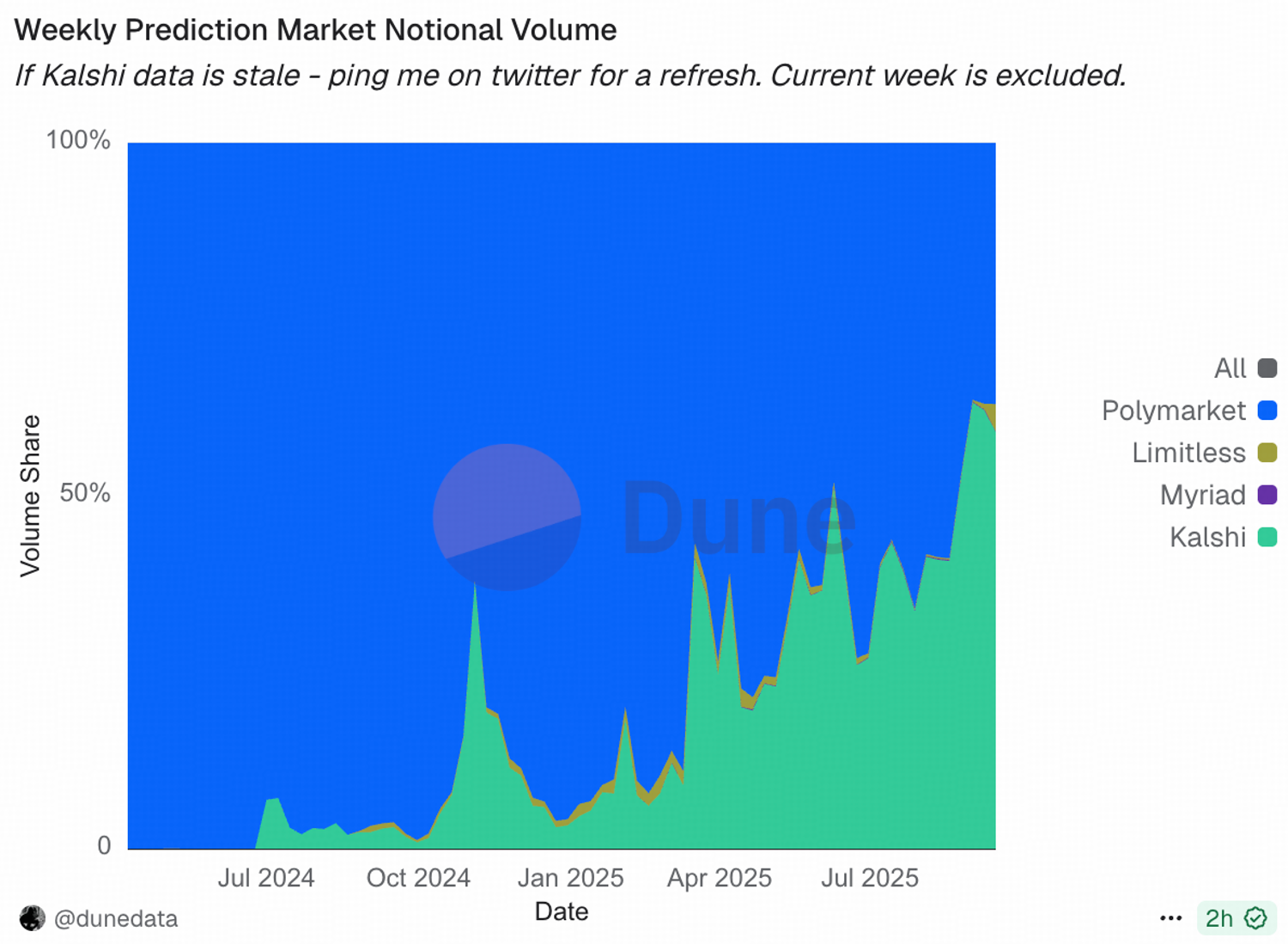
Source: Dune https://dune.com/dunedata/prediction-markets
Regulation remains Kalshi’s competitive edge. Operating under CFTC oversight, it offers compliance and legal clarity, though at the cost of KYC and fiat-only access. By contrast, Polymarket retains a strong global, crypto-native user base and permissionless design but remains constrained in the U.S.
Disclaimer: The information provided herein does not constitute investment advice, financial advice, trading advice, or any other sort of advice, and should not be treated as such. All content set out below is for informational purposes only.