
- Three main categories of sellers in the current market: (1) short-term investors in Bitcoin ETFs who are quick to reduce exposure during downturns, (2) long-term holders (whales) distributing some of their massive gains now that ample liquidity lets them cash out with minimal slippage, and (3) traders influenced by the four-year cycle theory, preemptively selling in anticipation of a cycle peak.
- Selling pressure is likely to only ease when long-term holders finish profit-taking, ETF investors turn reactive buyers on market stabilization, and four-year cycle believers complete their exits.
Bitcoin has recently faced a wave of selling pressure, pushing its price to drop below the 50-week moving average, which is a key indicator often used to gauge whether a bull market remain intact. Many are now claiming the bull market starting 2024 has now ended in line with the traditional four-year bitcoin cycle.
During this cycle, Bitcoin has seen significant adoption from traditional finance. We witnessed waves of demand from Bitcoin treasury companies, ETFs, and institutional investors entering into the market. This has prompted a key question for investors: who is now doing the selling?
In this article, we explore how different cohorts of Bitcoin holders (from bitcoin treasuries companies to exchange-traded fund investors to long-term “HODLers”) are behaving, and what it might mean for the market’s trajectory.
Different Behaviors: Bitcoin Treasury Companies and ETF Investors
Two of the biggest drivers of Bitcoin demand in the past year are 1) public companies adding Bitcoin to their treasuries and 2) Bitcoin exchange-traded funds (ETFs).
As of Nov 2025, public companies have collectively accumulated over 1 million bitcoins as their corporate treasury asset, almost 5% of the total bitcoin supply. While there have been isolated reports of smaller bitcoin treasury companies selling holdings due to financial pressure, the majority of Bitcoin treasury companies are not selling any of their holdings. Although the buying activity has slowed considerably, Bitcoin treasury companies like Strategy are still actively accumulating bitcoin in the $90-$100K range.
Bitcoin held by Public Companies
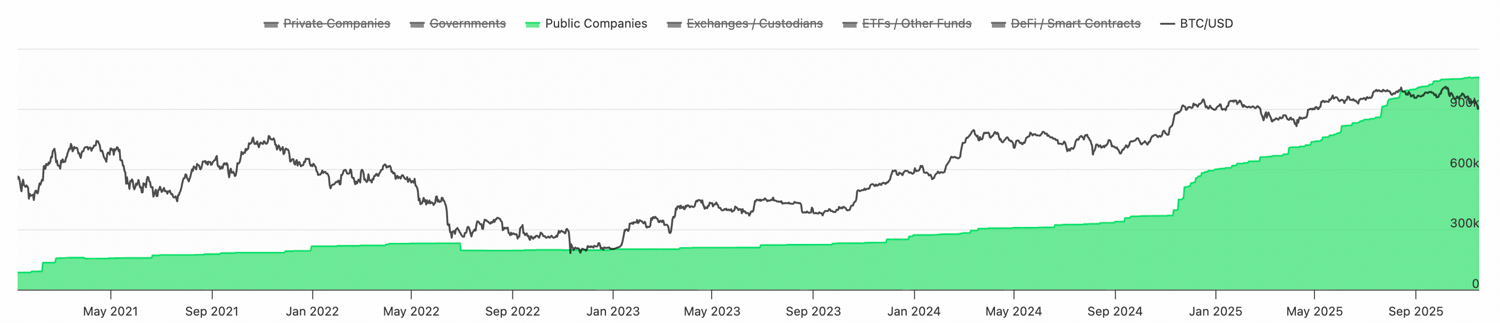
Source: https://bitcointreasuries.net/
By contrast, ETF investors are more short-term oriented. They helped propel Bitcoin’s price to a peak of around $126,000 in October 2025 with record inflows, but they are also quick to redeem shares (and thus force Bitcoin sales) when sentiment turns.
Bitcoin ETF Weekly inflow & outflow
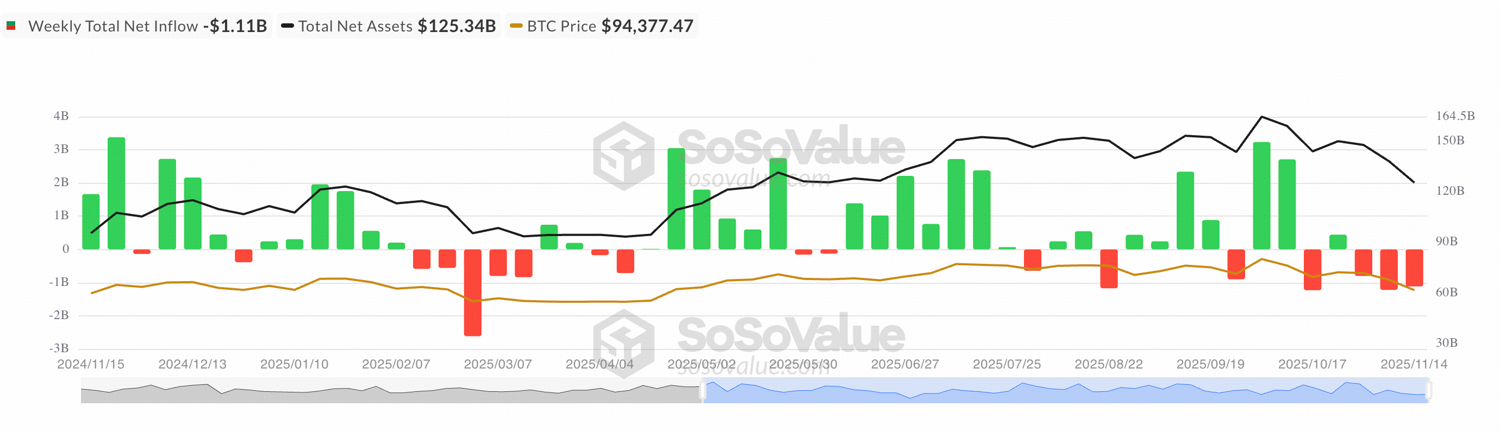
In our prior article, Beyond the Benefits: Downsides of Bitcoin Spot ETFs, we have highlighted ETF investors tend to be more reactive to market sentiment.
While Spot Bitcoin ETFs may enhance market liquidity and facilitate broader adoption of Bitcoin, they also introduce this new dynamics that could lead to increased volatility. The interaction between ETF trading and Bitcoin prices could result in a more reactive market, where price movements are influenced not only by fundamental factors but also by the trading behaviors of ETF investors.
Long-Term Holders Cashing Out Into Liquidity
In addition to ETF investors, another major source of selling is coming from long-term Bitcoin holders. In previous Bitcoin cycles, long-term holders have followed a relatively predictable pattern. They tend to accumulate when Bitcoin appears undervalued, typically during bear markets or extended consolidation periods, and take profits when prices become overextended, often coinciding with euphoric market tops. This cyclical behavior has historically been one of the strongest signals of market sentiment and phase transitions.
Long term holders selling at every cycle top
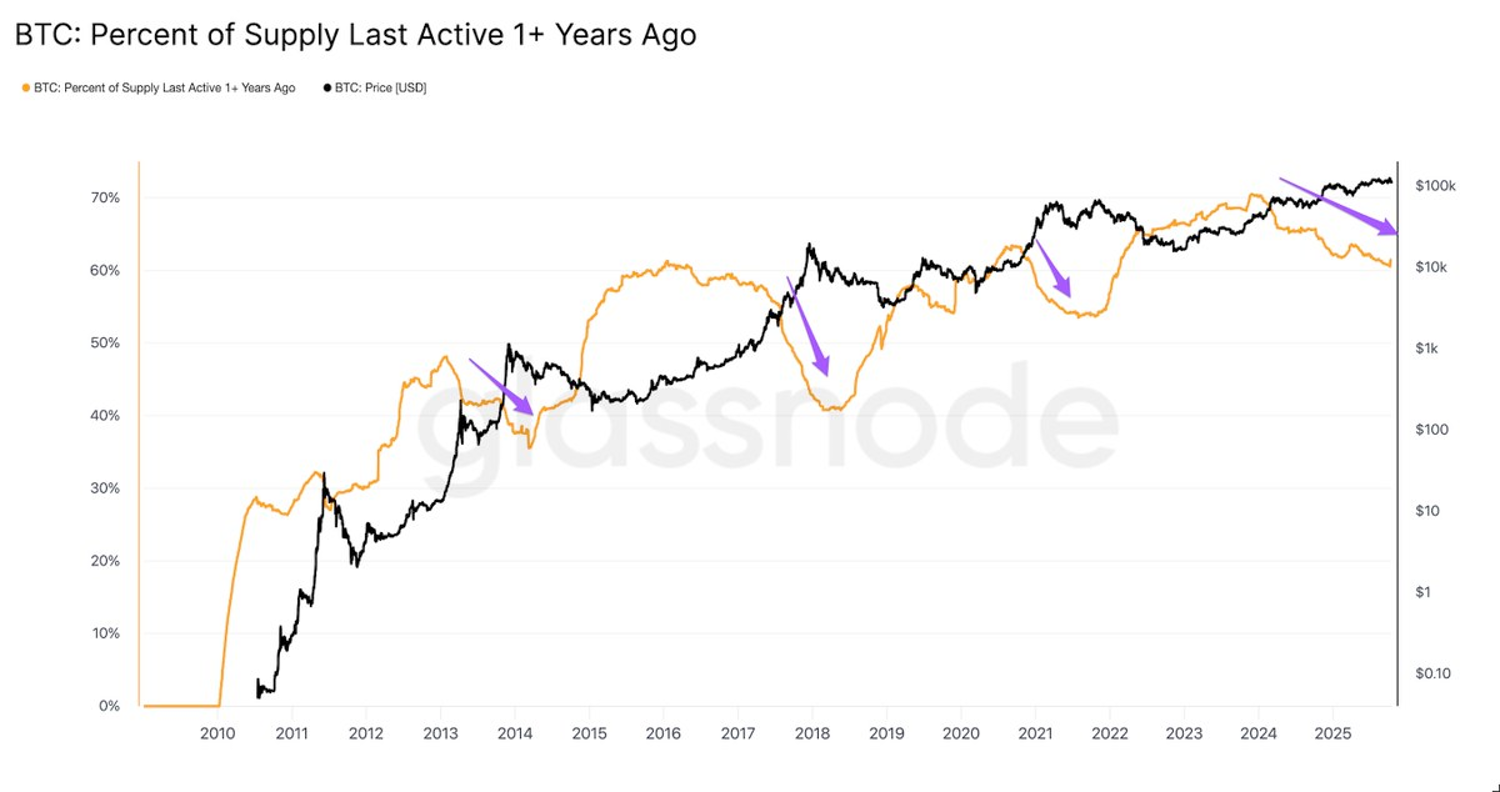
This time, however, the pattern has changed. In the current cycle, long-term holders (defined as address not moved over 1 year on the above chart) have been selling steadily throughout the rally, rather than waiting for a parabolic peak. With spot ETFs, Bitcoin treasuries companies, and digital asset funds as continuous accumulators, liquidity has improved dramatically. This has given long-term holders the flexibility to sell to the market and realize profits gradually, without overwhelming the market or relying on retail-driven manias to exit positions.
Are these long-term holders turning bearish on Bitcoin? Probably not. Most of them are simply sitting on substantial unrealized gains after holding BTC through multiple market cycles. It’s understandable that they would want to rebalance their portfolios, take some profits, or redirect capital toward other opportunities or personal needs.
The Four-Year Cycle and a Self-Fulfilling Prophecy
Another factor contributing to Bitcoin selling is the powerful market narrative of the four-year cycle. Bitcoin price has been following cyclical waves roughly aligned with its halving schedule (every four years the mining reward is halved). While there is no fundamental law that requires Bitcoin to peak on a four-year rhythm, many market participants believe in this cycle, and trade accordingly.
Historically, major peaks occurred in late 2013, late 2017, and late 2021, each roughly 12–18 months after a halving. By that pattern, many investors eyed late 2025 (about 1.5 years after the 2024 halving) as a likely time for a cycle top.
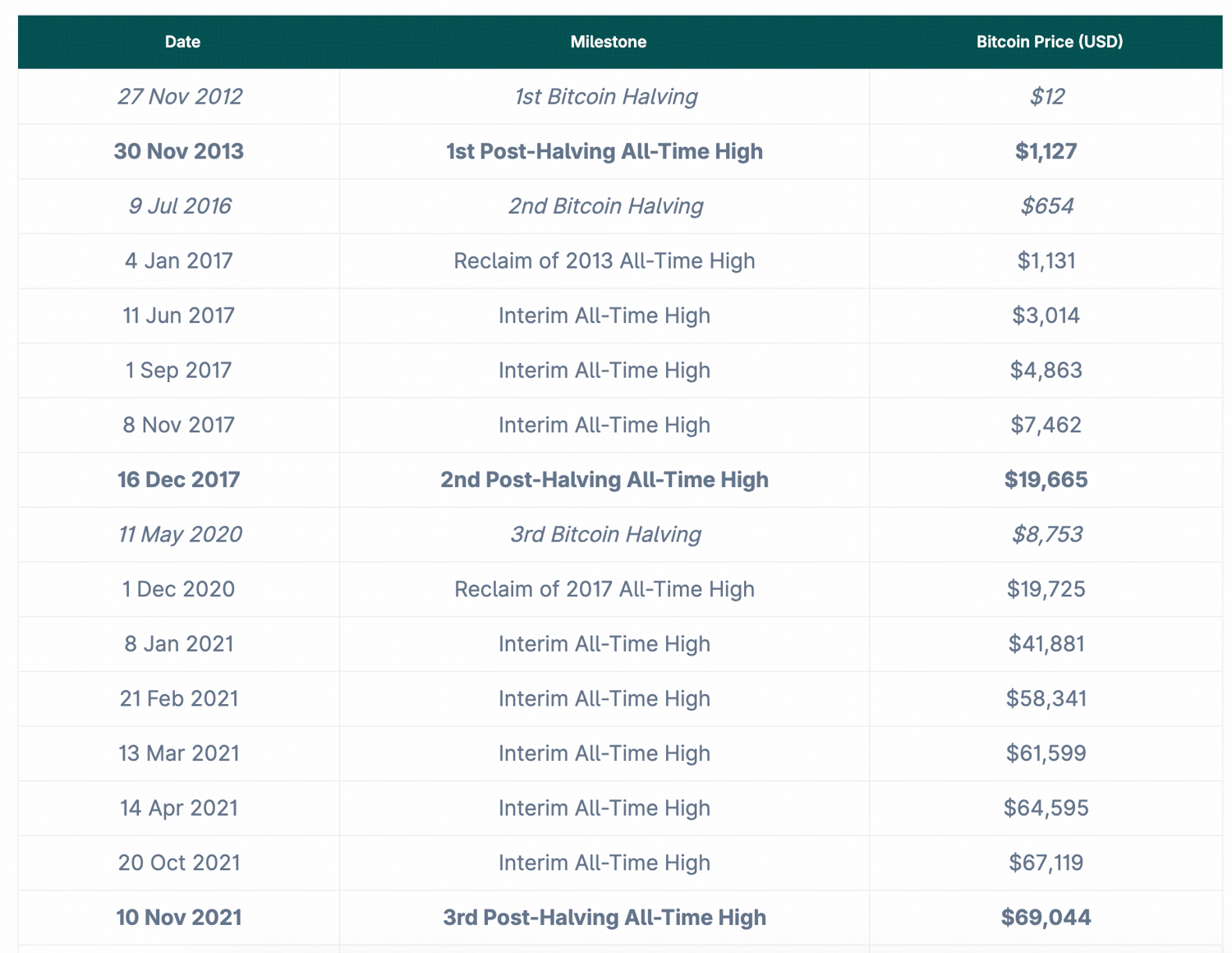
This belief alone can become a self-fulfilling prophecy: if a critical number of traders sell in Q4 following a halving year (because previous cycles peaked around Q4), that coordinated profit-taking can indeed cause a top.
When Will They Stop Selling?
In summary, the three main categories of sellers in the current market are: (1) short-term investors in Bitcoin ETFs who are quick to reduce exposure during downturns, (2) long-term holders (whales) distributing some of their massive gains now that ample liquidity lets them cash out with minimal slippage, and (3) a swath of traders influenced by the four-year cycle pattern, preemptively selling in anticipation of a cycle peak.
Will they stop selling? Long-term holders typically sell into strength and slow down once their desired profit-taking is achieved or once price momentum wanes.
For ETF investors, they are just reactive to market. If Bitcoin stabilizes and macro conditions remain favorable, ETF investors could flip back to net buyers very quickly.
As for four-year cycle believers, there’s little that can be do to change their mindset and behavior until their selling is complete. The flip side is that once this cohort finishes its presumed Q4 profit-taking, the artificial ceiling on Bitcoin’s price may lift, allowing the uptrend to resume.
Disclaimer: The information provided herein does not constitute investment advice, financial advice, trading advice, or any other sort of advice, and should not be treated as such. All content set out below is for informational purposes only.