
The x402 protocol has suddenly become one of crypto’s most talked-about narratives, but what exactly does “402” refer to, and do x402-related tokens actually hold any real value?
In the crypto industry, most new narratives follow a familiar cycle of “hype, infrastructure building, and real-world adoption.” Yet only a few manage to progress beyond the hype phase, most fail to evolve into real infrastructure and eventually fade from market attention.
The Return of HTTP 402 Payment Required and x402
From “404 Not Found” to “402 Payment Required”
Every time you browse the internet, your browser and the website’s server communicate using a common language, HTTP (HyperText Transfer Protocol). This protocol relies on status codes to indicate what’s happening behind the scenes. Some of these codes have become internet legends:
- 200 OK means your request succeeded — the page loads as expected.
- 404 Not Found means the resource doesn’t exist — the infamous “broken link” message everyone has seen.
- 500 Internal Server Error signals something went wrong on the server side.

But tucked away in this same family of codes is one that has remained largely unused, HTTP 402: Payment Required. When the web was first being designed, this code was intended to enable built-in online payments, allowing websites to charge users directly for access to digital content or services. However, because the infrastructure for digital payments didn’t exist at the time, 402 was never implemented and sat dormant for decades.
x402: Reviving the Web’s Payment Code
x402 is a modern revival of HTTP 402, a way to bring payments directly into the web protocol itself.
In simple terms, x402 lets a web service ask for crypto payment when a client (a user or an AI agent) requests a resource, and then process that payment on the spot. It enables instant, automatic stablecoin payments directly over HTTP.
Here’s how it works: when a server responds with a 402 status, it can include a price and payment request. The client then pays directly on-chain, often using stablecoins like USDC, and automatically retries the request once payment is confirmed. The entire process happens seamlessly within the HTTP flow, no logins, no credit cards, no subscriptions.
Why x402 Matters?
One of the driving forces behind x402 is the rise of autonomous AI agents, software bots that can make decisions and perform tasks for users. These AI agents might book services, gather data, or purchase digital goods on their own. However, until now they’ve been missing a crucial ability: handling payments.
Legacy payment rails (cards, bank APIs) are built for people, not machines, they require logins, two-factor prompts, human confirmation, etc. This friction makes it nearly impossible for an AI agent to pay a few cents to an API or buy a digital product without a human in the loop.
x402 changes that. It provides a universal payment language for machines. An AI agent that’s x402-aware can discover a priced service, receive a 402 Payment Required response, and autonomously complete a crypto payment in seconds to get what it needs.
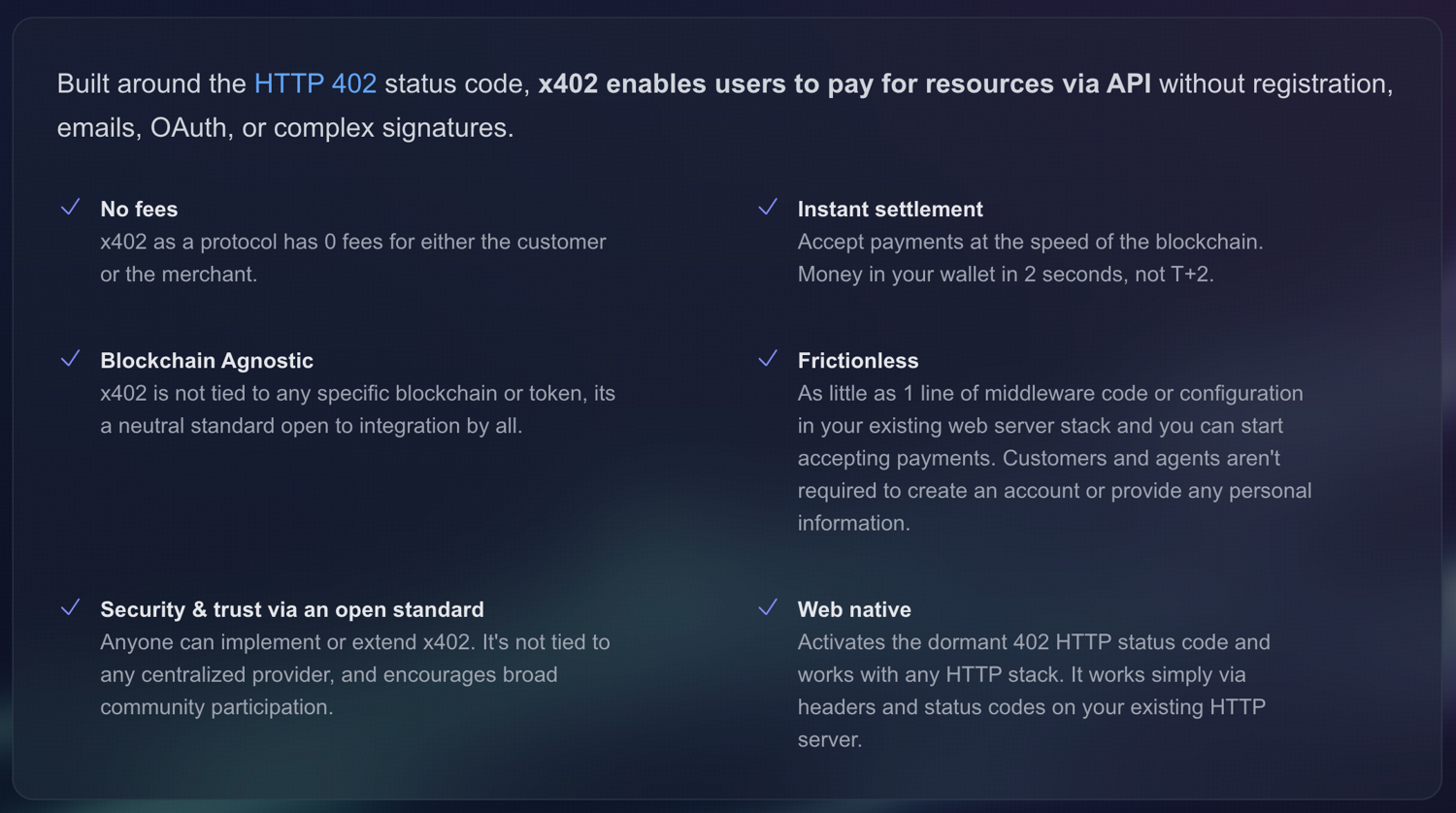
Source: https://www.x402.org/
x402 Protocol Payments vs. Standard Stablecoin Payment
Unlike standard stablecoin transfers, which simply move tokens between blockchain addresses, the x402 protocol integrates payment logic into the HTTP layer itself.
Traditional stablecoin transfers are one-off events, the x402 protocol automates the entire payment lifecycle, from invoicing to settlement to content delivery. Once a machine or AI agent requests restricted content, x402 handles authentication, payment verification, and access release automatically.
This automation extends beyond efficiency, it enables machine-to-machine (M2M) commerce and micropayments for digital goods, APIs, and services. For instance, autonomous AI agents can pay per data request or per-use service call, enabling new business models that replace traditional subscriptions with dynamic, pay-as-you-go access.
The x402-themed Tokens
As the x402 protocol begins to gain traction, it’s almost inevitable that new x402-themed tokens emerge, each attempting to position itself as the “native currency” of this next-generation payment layer. These tokens could take several different forms, each aligning with a distinct part of the emerging x402 narrative.
Utility-Tied Tokens for API Access
The first possible model involves APIs requiring clients to pay specifically with a dedicated protocol token, rather than with stablecoins. This design mirrors the “gas token” logic seen in many blockchain ecosystems, but extends it to the web’s machine economy. Such tokens could, in theory, represent access rights or usage credits within the x402 framework, granting an appearance of necessity and utility. However, without broad standardization or adoption across APIs, these tokens risk being siloed and fragmented.
Facilitator Tokens for Transaction Services
Another direction involves facilitators or intermediaries within the x402 ecosystem issuing their own tokens, used to pay service fees or gain prioritized transaction processing. This model already exists in DeFi and cloud payment networks, yet its attractiveness remains limited: it often adds friction without delivering proportional value. Unless these facilitator tokens confer meaningful benefits, such as reduced latency, fee rebates, or integration perks, they may struggle to sustain long-term demand beyond early speculation.
The Pure Speculative Play
The third, and arguably most likely, scenario is the rise of purely speculative x402 tokens, with little or no intrinsic link to actual protocol usage. This would closely mirror the AI token boom of the previous market cycle, when the mere association with artificial intelligence sent token valuations soaring into the billions, despite a lack of tangible utility. The emerging “x402 coin” narrative feels strikingly similar: a token built not for necessity, but for narrative appeal.
Disclaimer: The information provided herein does not constitute investment advice, financial advice, trading advice, or any other sort of advice, and should not be treated as such. All content set out below is for informational purposes only.