
U.S. Dollar: Technical Rebound Likely, but Structural Downtrend May Persist
Dollar Index at Key Support: Technical Rebound Imminent
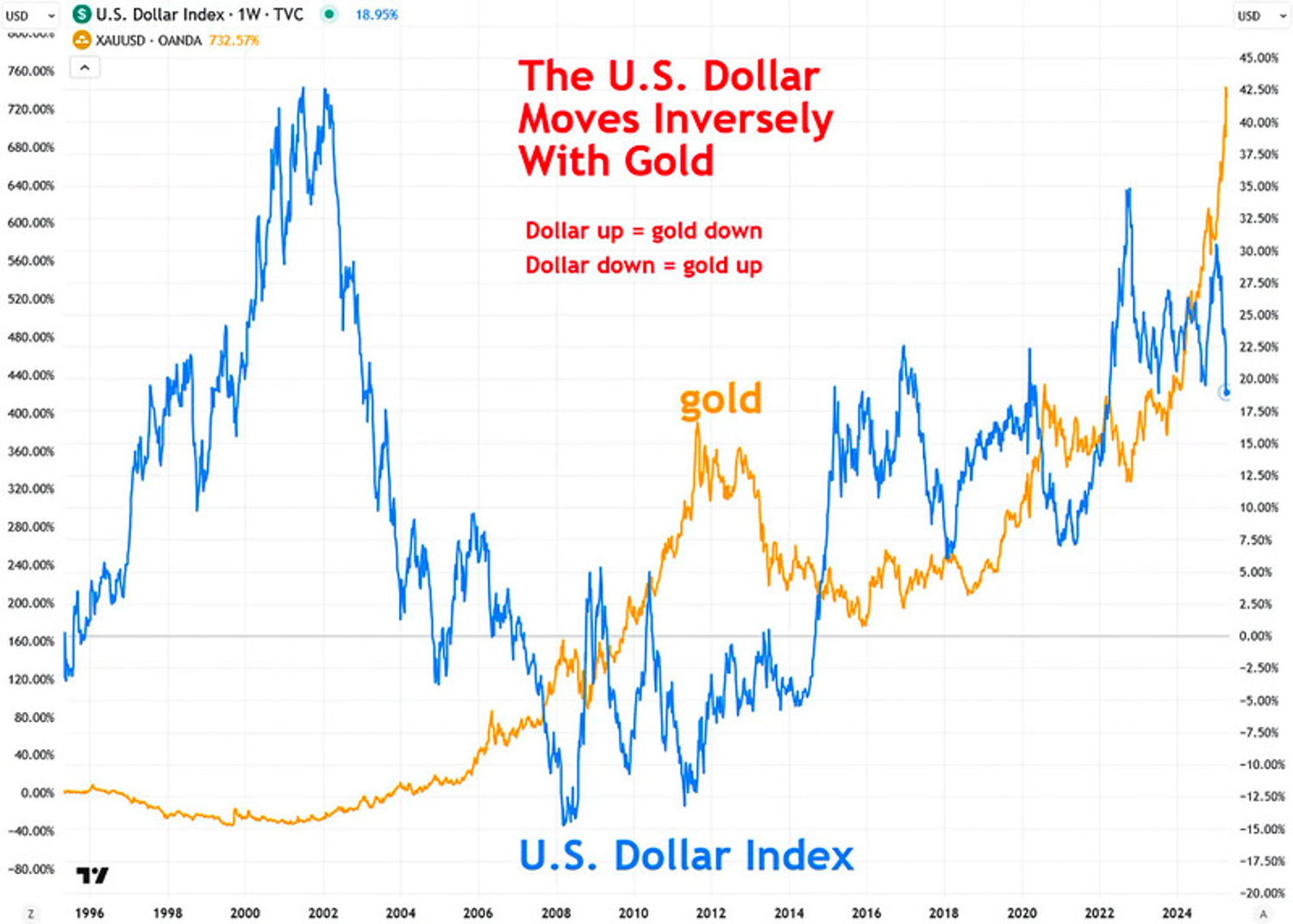
The U.S. dollar is currently at a crossroads, caught between technical pressure and weakening fundamentals. Since the beginning of 2025, the U.S. Dollar Index (DXY) has steadily declined and is now approaching a critical long-term support level around the 100 mark. Historically, this threshold has triggered strong rebounds, such as the temporary stabilisation seen in September 2024, which briefly weighed on commodity prices. From a technical perspective, if the dollar holds this support level, a short-term rebound may follow, potentially placing downward pressure on gold. However, a decisive break below this key threshold could mark the onset of a new dollar bear market, opening up additional downside potential for the greenback while creating upward momentum for metals, commodities, and emerging market assets.
Macro Fundamentals Under Strain: Long-Term Dollar Outlook Remains Bearish
Beyond technicals, the dollar faces mounting pressure from a deteriorating macroeconomic backdrop. The Federal Reserve has signalled the start of an easing cycle later this year, which is expected to compress real interest rate differentials further. At the same time, the Trump administration’s renewed tariff policies have heightened global trade tensions and undermined foreign investor confidence in U.S. assets. Recent data indicates that foreign investors are reducing their holdings of U.S. Treasuries and unwinding dollar-denominated positions, contributing to rising capital outflows.
More critically, from a long-term valuation perspective, the dollar is now viewed as “extremely overvalued” relative to other major currencies. Based on a 120-year historical analysis, the current overvaluation ranks just behind the pivotal years of 1933 and 1985, both of which preceded multi-year dollar depreciation cycles. This historical context suggests a significant risk of sustained weakness ahead for the greenback.
Capital Rotation Accelerates: Gold Replacing the Dollar as the Preferred Safe Haven
Amid this blend of macroeconomic and structural headwinds, global capital flows are undergoing a fundamental reallocation. Traditionally, the dollar–Treasury combination has served as the go-to safe-haven play during periods of market stress. However, in today’s environment of elevated debt levels, persistent inflation, and geopolitical uncertainty, investors are increasingly favouring gold, a debt-free, credit-risk-free asset, as the ultimate safe haven.
Recent data shows that the negative correlation between gold, the U.S. dollar, and Treasury yields has reached multi-year highs. This divergence is not just a temporary pricing anomaly but reflects a substantive shift in asset allocation behaviour across global portfolios. Gold is no longer seen merely as a short-term hedge against volatility—it is now emerging as a more reliable, longer-term store of value in a world defined by systemic risk. As such, it is progressively supplanting the dollar’s historical role as the cornerstone of capital preservation.
Forward Outlook: Mean Reversion Meets Structural Trends
In the short term, while gold continues to exhibit strong momentum, technical indicators are beginning to signal overbought conditions, suggesting the possibility of a near-term pullback. After testing record highs, gold prices have entered a phase of consolidation at elevated levels, with increased profit-taking pressure from short-term investors. Simultaneously, the U.S. Dollar Index is hovering near a critical support level around 100. Should the index hold this threshold, the likelihood of a technical rebound would rise, potentially exerting downward pressure on gold prices. Furthermore, if the PBoC and other emerging market central banks were to temporarily slow the pace of gold accumulation, market expectations for official sector demand could be revised downward in the short run, adding further downside risk to gold. As such, in the coming weeks, gold may enter a high-level consolidation phase or experience a limited technical correction.
However, from a medium- to long-term perspective, the structural bull case for gold remains intact. The global trend of “de-Americanization” has become increasingly entrenched, particularly amid persistent U.S. fiscal deficits and the Federal Reserve’s frequent recourse to monetary stimulus tools. Against this backdrop, international confidence in the dollar’s credibility is eroding. In response, gold is reasserting its role as a “debt-free anchor” and a more credible store of value in a reconfigured global monetary system.
Central bank demand—especially China’s sustained and large-scale gold purchases over the past two years—continues to provide robust long-term support for gold prices. As the centre of official gold reserves shifts from West to East, gold’s status within international reserves is rising in strategic importance. Looking ahead over the next 2–3 years, if geopolitical tensions persist and the dollar enters a prolonged downtrend, gold could potentially break above $4,000 per ounce, emerging as a core allocation in the diversification of global reserve assets.
Gold is no longer merely a hedge against volatility—it is steadily returning to its foundational role as “official money.”
Investment Strategy
Against the backdrop of a structural decoupling between gold and the U.S. dollar, investors are advised to adopt a dual approach combining short-term tactical responses with medium- to long-term strategic positioning.
Gold: Tactical Pullback, Strategic Opportunity
Despite gold’s significant rally, current price action indicates potential for a technical pullback, offering long-term investors a compelling opportunity to accumulate positions on dips. We recommend a gradual, staggered allocation into physical gold or low-cost gold ETFs to capture the upside of the ongoing structural bull market. Gold ETFs, in particular, offer a suitable vehicle for risk-averse investors to engage in trend-based trading while enabling more efficient position management in volatile market conditions.
Gold Miners: High Beta with Upside Potential
Gold mining equities—such as constituents of the GDX index—have demonstrated higher sensitivity and greater upside than spot gold. With valuations still in a recovery phase, high-quality mining companies present dual potential for earnings growth and multiple expansion. Investors are advised to consider selective accumulation during pullbacks, focusing on fundamentally strong miners with attractive cost structures and reserve bases.
U.S. Dollar Assets: Cautious, Short-Duration Focus
We recommend a cautious stance toward long-term allocations in U.S. dollar-denominated assets. While technical support may prompt a short-term rebound in the Dollar Index, the broader macroeconomic outlook suggests a prolonged structural decline. Investors should prioritise high-liquidity, short-duration USD instruments to tactically navigate potential short-term opportunities without taking on excessive long-term currency exposure.
Commodities: Copper and Silver in Focus
Beyond gold, select commodities—especially those tied to economic recovery and manufacturing cycles, such as copper and silver—warrant close attention. With the U.S. dollar potentially entering a new depreciation cycle, these metals offer not only inflation-hedging characteristics but also strong demand prospects tied to inventory restocking and the global energy transition. Investors may consider allocating to relevant ETFs, spot contracts, or leading commodity producers to gain exposure to this “resource security”-driven rotation theme.
In summary, current market dynamics reflect a clear positioning bias: bullish on gold and commodities, defensive on U.S. dollar assets. Investors are encouraged to dynamically adjust portfolio composition to align with the evolving global capital reallocation narrative, seizing new configuration opportunities while maintaining disciplined risk controls.
Conclusion: Gold Is Reshaping the Global Monetary Order
We are witnessing a pivotal moment in history. Gold is shedding its long-held role as a temporary crisis hedge and re-establishing itself as the foundational asset of the global financial system. In stark contrast, the U.S. dollar is facing mounting challenges; its credibility is being questioned, and its status as the cornerstone of international reserves is being reassessed. The decades-old, dollar-centric monetary framework is gradually giving way to a more diversified system—one increasingly anchored by tangible, real assets.
This gold bull market is far more than a price rally; it represents a profound transformation in how the world anchors value, rebuilds monetary trust, and rebalances global economic power. As a borderless, debt-free, and intrinsically valuable asset, gold is becoming the shared safe haven for both sovereign nations and global capital in an age of uncertainty.