
[NEW] Whale Monthly Edge Report - October 2026
The early-November midterm results brought fresh macro relief, with expectations of fiscal gridlock helping lower yields and support Bitcoin’s rebound, while adding uncertainty to U.S. crypto legislation. That followed an October marked by geopolitical tensions, sticky inflation and an AI-led equity selloff alongside ETF outflows. Venue-wide perpetual traders kept paying to stay long, with funding positive on all 10 contracts and BloFin funding above Binance on BTC, ETH, and SOL. BloFin VIPs took the other side, ending the period net short on all five tracked assets.

Part 1: Executive Summary
Key Market Takeaways
- Midterm gridlock supported BTC’s rebound, while crypto-policy uncertainty increased. Democrats regained both chambers of Congress, creating divided government. Expectations that legislative gridlock would constrain additional tax cuts and deficit expansion helped lower yields and weaken the dollar, supporting BTC’s recovery above $80,000. The immediate reaction appeared macro-driven; closer congressional scrutiny and potential delays to CLARITY remain medium-term risks.
- Geopolitics drove Oct's largest single shock. Middle East tensions pushed oil higher and triggered a crypto selloff on Oct 7–8, liquidating nearly $1.9B in leveraged positions over two days, $1.7B of it longs. The imbalance confirms the book was positioned long into the event.
- Inflation kept tightening risk live. September CPI came in at 3.7% against a 3.6% forecast. Following September’s hike, markets now price another 25bp before year-end, with December the likely window.
- Institutional spot demand broke with the AI trade. U.S. spot BTC ETFs shed $635M on Oct. 22, their largest single-day outflow since June, as the Nasdaq fell 2.6% on AI capex concerns and BTC’s 21-day correlation with the Nasdaq-100 reached 0.67, nearly double its 63-day reading.
BloFin Whale Read
- One-Month Funding: Average funding was positive across all 10 contracts, with carry concentrated in alts. NEAR, PEPE, AVAX, and LINK recorded the highest readings, all above 0.015% per 8h. BTC carried the lowest average funding in the set, below 0.005%.
- 8-Week Net Delta: VIPs rotated fully defensive, with no asset left long. All five tracked assets ended the period net short. BTC held positive through W5 before reversing to −11.23% by W8. SOL stayed net short across all eight weeks. ETH and HYPE remained consistently negative, and ZEC lost its earlier positive bias over the final three weeks.
- BloFin vs Binance: Cautious VIPs sit opposite an expensive long book. BloFin VIPs were underweight relative to Binance’s top traders on BTC, ETH, and SOL, while venue-wide funding exceeded Binance’s by roughly 22–23 bps on all three.
What to Watch
- Watch whether the post-midterm relief can last. Lower yields and a softer dollar supported BTC’s rebound. A sustained recovery will depend on whether those moves persist and spot demand strengthens. ETF flows will help indicate whether institutional buyers are returning.
- Inflation and Fed expectations remain the key macro tests. November’s inflation and employment releases will shape expectations for a December hike. Renewed yield pressure could challenge the recovery, while AI earnings and geopolitical developments remain additional sources of volatility.
- Cycle timing supports a more constructive outlook. Bitcoin is now roughly a year past its October 2025 peak. Previous major bear markets found their lows around 12–13 months after the peak, placing this period within the historical window for a transition toward a new bull market.
Part 2: Market Context
October saw a broad crypto pullback, with weakening spot demand, heavy long liquidations and rising BTC dominance pointing to fading risk appetite. Open interest also began rebuilding, signaling renewed positioning activity. The US midterms in early November then added a new macro variable after the data cutoff.
Latest Update | U.S. Midterms
- Midterms: fiscal gridlock supported BTC’s rebound (post-cutoff)
Democrats regained both chambers of Congress, leaving markets to weigh fiscal restraint against greater uncertainty over crypto legislation. BTC initially fell toward $75,600 before recovering to above $80,000.
The rebound was consistent with expectations of fiscal gridlock: with the White House and Congress controlled by different parties, major legislation becomes harder to pass. Investors can welcome that constraint because it reduces the likelihood of sweeping changes to taxes, spending and regulation. Lower expectations for additional tax cuts and deficit expansion helped ease pressure on Treasury yields and the dollar, supporting risk appetite.
Although Democrats are often perceived as less supportive of crypto, that concern primarily relates to regulation and the legislative outlook. Bitcoin’s immediate response appeared more closely tied to improving macro conditions. Lower yields, a weaker dollar and easing inflation concerns can support prices even as policy uncertainty increases.
Over the medium term, a Democratic Congress could bring closer scrutiny and further negotiations over legislation such as CLARITY. Bipartisan support remains possible, but the timing and direction of U.S. crypto policy have become less certain.
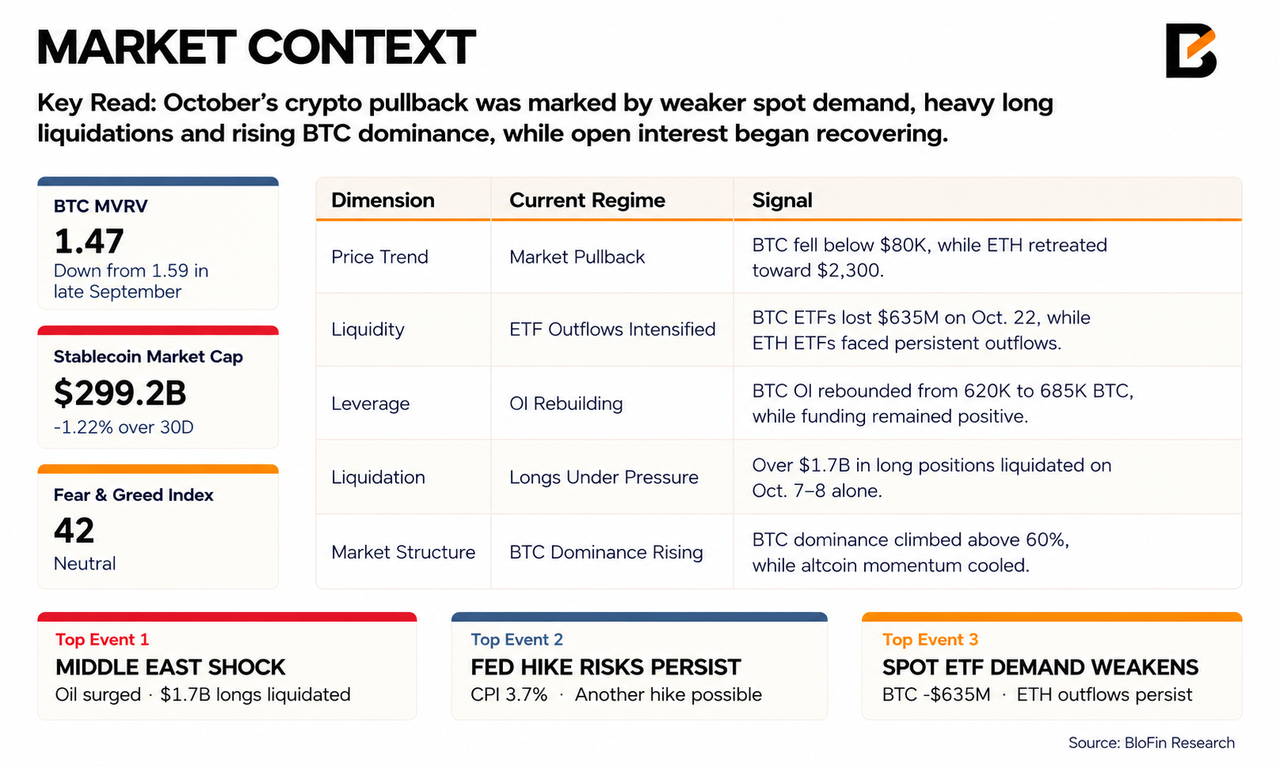
October’s Key Market Events
- Middle East tensions triggered a major crypto selloff.
Rising geopolitical tensions pushed oil prices higher and weighed on crypto markets on Oct. 7–8. Nearly $1.9B in leveraged positions were liquidated over two days, including $1.7B in longs. Further developments in the Middle East and oil prices remain key risks to watch.
- Persistent inflation kept Fed tightening risks alive.
September CPI rose to 3.7%, above the 3.6% forecast. Following September’s rate hike, markets increasingly expect another 25bp hike before year-end, with December emerging as the more likely window. Further tightening could keep pressure on crypto and other risk assets.
- Institutional spot demand broke with the AI trade
U.S. spot BTC ETFs recorded $635M in net outflows on Oct. 22, their largest single-day withdrawal since June. ETH ETFs faced more persistent selling pressure throughout October. The Oct 22 ETF outflow was not crypto-specific: the Nasdaq fell 2.6% the same day on AI capex concerns, with Meta down 7% and chipmakers off 4–8%. BTC’s 21-day correlation with the Nasdaq-100 reached 0.67, nearly double its 63-day reading.

Read the full report
Log in to access your Free Pass and VIP reports.