
A company that keeps most of its money in one asset still has bills to pay. If that asset earns no income, the company has two ways to pay them. It can raise new money from investors, or it can sell a little of what it holds. Shareholders watch that choice closely, because each sale leaves less of the asset behind every share.
The record of those sales is easy to blur. Headlines round the numbers, and the day a report was filed is often taken for the day the coins were sold. For a listed company, the reliable record is its reports to the Securities and Exchange Commission (SEC). Those reports also say what the money was for.
Strategy (MSTR), formerly MicroStrategy, built its share price on owning bitcoin. In 2026 it started selling small amounts of it. BloFin lists the stock among its tradfi assets as the MSTRUSDT Perpetual, a contract on the share price that settles in USDT.
Strategy gave a year-to-date count of the sales with its third-quarter results on October 29, 2026. By its count, bitcoin sales had raised about $431.8 million so far that year, money that went to preferred dividends and to buying back shares of its STRC preferred stock (source: Strategy Q3 2026 earnings release). Its holdings report of November 16, 2026 points the other way. It shows 485 bitcoin bought between November 9 and 15, with no sale that week (source: Strategy Form 8-K filed November 16, 2026).
Has Strategy sold bitcoin?
Yes, Strategy has sold bitcoin. Its 8-K filings report 6,948 coins sold for roughly $431.8 million in 2026, in five sale periods from May 26 to August 9, most of them under its BTC Monetization Program. The money paid preferred dividends, refilled its cash reserve and bought back STRC shares. Before 2026, its filings report one sale, in December 2022.
A Form 8-K is a short report that a US-listed company files with the SEC between its quarterly reports. Strategy uses them to report changes in its bitcoin holdings, usually on a Monday. Four of its 2026 filings report a sale, on June 1, July 6, August 3 and August 10 (source: Strategy Form 8-K filed June 1, 2026, Strategy Form 8-K filed July 6, 2026, Strategy Form 8-K filed August 3, 2026, Strategy Form 8-K filed August 10, 2026). A full-text search of Strategy's filings on EDGAR, the SEC's filing database, finds a BTC Sold column in those four and in none filed since (source: SEC EDGAR full-text search).
The sales are small next to the buying. Over the first nine months of 2026, Strategy added about 182,113 bitcoin. It sold about 6,947 in the same months and ended September holding 847,666 (source: Strategy Form 10-Q for the third quarter of 2026). By November 15 it held 850,849 coins (source: Strategy Form 8-K filed November 16, 2026).
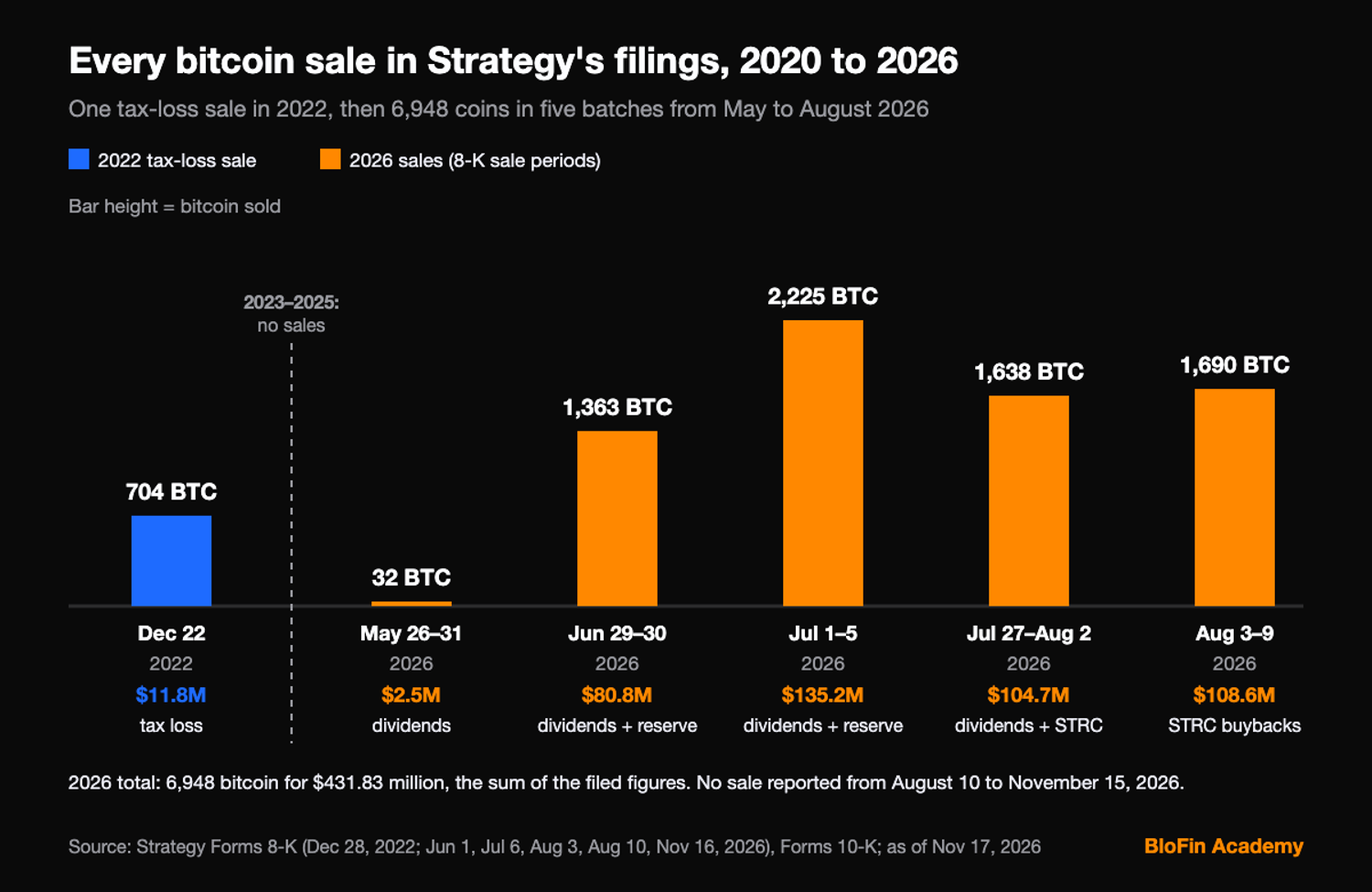
Every Strategy bitcoin sale, 2022 to 2026
Strategy's filings report six sale periods in all, one in 2022 and five in 2026. Each 2026 filing gives the coins sold in a stated window and the total received after fees. It also gives the average price per coin, and a footnote says where the money went.
Sale period | Bitcoin sold | Proceeds ($ million) | Average sale price | 8-K filed | What the money paid for |
|---|---|---|---|---|---|
December 22, 2022 | about 704 | about 11.8 | about $16,776 | December 28, 2022 | a tax loss to carry back against earlier gains |
May 26 to 31, 2026 | 32 | 2.5 | $77,135 | June 1, 2026 | distributions on preferred stock (expected) |
June 29 to 30, 2026 | 1,363 | 80.8 | $59,256 | July 6, 2026 | preferred distributions and a USD Reserve top-up |
July 1 to 5, 2026 | 2,225 | 135.2 | $60,773 | July 6, 2026 | preferred distributions and a USD Reserve top-up |
July 27 to August 2, 2026 | 1,638 | 104.73 | $63,957 | August 3, 2026 | 52.4 of dividends and 52.3 of STRC buybacks |
August 3 to 9, 2026 | 1,690 | 108.6 | $64,262 | August 10, 2026 | STRC buybacks |
2026 total | 6,948 | 431.83 | about $62,152 |
Source: Strategy Forms 8-K filed December 28, 2022, June 1, July 6, August 3 and August 10, 2026. The 2026 totals are the sum of the filed figures.
The first 2026 sale was disclosed on June 1, in that day's 8-K. The 32 coins were sold between May 26 and May 31. The filing said the money was expected to fund distributions on preferred stock (source: Strategy Form 8-K filed June 1, 2026). Strategy still held 843,706 bitcoin on May 31.
The July 6 filing reports one run of selling: 3,588 coins for about $216.0 million between June 29 and July 5. It splits the run at June 30, the last day of Strategy's second quarter, so the run fills two lines of the record. Strategy used the money for preferred dividends, partly by topping the USD Reserve back up after it had paid them. The USD Reserve is the cash Strategy keeps aside for preferred dividends and debt interest, and it held about $2.6 billion on July 5 (source: Strategy Form 8-K filed July 6, 2026).
The two August filings are the latest sale reports. The July 27 to August 2 money was split almost evenly between dividends and STRC buybacks. The August 3 to 9 sale went entirely to STRC buybacks (source: Strategy Form 8-K filed August 3, 2026, Strategy Form 8-K filed August 10, 2026). Proceeds in every 2026 filing are net of fees and expenses.
The December 2022 tax-loss sale
On December 22, 2022, Strategy's wholly owned subsidiary MacroStrategy LLC sold about 704 bitcoin for about $11.8 million. That came to about $16,776 a coin after fees. Strategy said it meant to use the loss to offset capital gains from earlier years, where federal tax law allowed, which could lower its taxes. Two days later, on December 24, it bought about 810 bitcoin for about $13.6 million, so the holding ended the week larger (source: Strategy Form 8-K filed December 28, 2022). A tax-loss sale sells an asset for less than it cost, to record a loss that can cut a tax bill.
The annual reports fill in the years around it. The 2020 report lists about 70,469 bitcoin bought that year and the same number held at year end (source: Strategy Form 10-K for 2020). The 2022 report says no bitcoin was sold in 2021. It also gives a slightly different average for the December sale, about $16,786 (source: Strategy Form 10-K for 2022). The 2024 report says none was sold in 2023 or 2024, and the 2025 report says none was sold in 2025 (source: Strategy Form 10-K for 2024, Strategy Form 10-K for 2025). So from its first purchases in 2020 to May 2026, the filings report only the December 2022 sale.

Why Strategy started selling bitcoin in 2026
Strategy started selling bitcoin in 2026 to raise cash for its bills and, from late July, to buy back STRC shares. Its preferred stocks pay cash dividends and its debt carries interest, but bitcoin produces no income. Until May 2026 it paid those bills from share sales and from its USD Reserve, which held $900 million on May 31 (source: Strategy Form 8-K filed June 1, 2026). The sales added a third source.
The idea came up before it happened. Executive Chairman Michael Saylor raised it on the first-quarter 2026 earnings call. "We will probably sell some bitcoin to pay a dividend just to inoculate the market and send the message that we did it," he said, as CoinDesk reported (source: CoinDesk on Strategy's first 2026 sale). Weeks later, the 32-coin sale paid for preferred distributions. That fits his picture of a small first sale made to show it could be done.
Chief executive Phong Le put the choice down to arithmetic. "I believe in math over ideology," he told CNBC in May 2026, as The Block reported (source: The Block on Saylor and Le's comments). He said Strategy would sell bitcoin when that is better for bitcoin per share than selling equity to pay a dividend. Bitcoin per share is Strategy's count of coins behind each share, and both ways of paying a dividend lower it.
The rules came next, on June 29, 2026, when the board set up a BTC Monetization Program as part of a wider plan for its reserve, its dividends and its buybacks (source: Strategy Form 8-K filed June 29, 2026). The 3,588-coin run began the same day, the first sales reported after the program was announced (source: Strategy Form 8-K filed July 6, 2026). Since then, bitcoin sales have sat alongside the sales of shares and preferred stock that pay for most of Strategy's bitcoin buying.
What Strategy's board allows its bitcoin sales to pay for
Strategy's board allows bitcoin sales for three purposes: building up its USD Reserve, paying preferred dividends and debt interest, and buying back its own securities. Only the reserve purpose names a dollar amount of bitcoin sales, $1.25 billion. The third-quarter release lists the three in the company's own words (source: Strategy Q3 2026 earnings release).
"Fund the USD Reserve up to $1.25 billion of bitcoin sales".
"Fund preferred stock dividends and interest expense as they become payable, or to replenish the USD Reserve after such payments".
"Fund repurchases of MSTR or Digital Credit Securities under our repurchase programs".
Digital Credit Securities is Strategy's name for its preferred stocks. The June 29 filing adds the conditions. Sales for dividends and interest are allowed when management judges them a better deal than selling Class A shares or raising other capital. Selling for any other reason, or beyond these limits, would take a new vote of the board. Strategy is under no duty to sell under the program, which runs with no set end and can be changed, paused or ended at any time (source: Strategy Form 8-K filed June 29, 2026).
The cap covers only that first purpose. Matthew Sigel, head of digital asset research at VanEck, said Strategy "has more BTC selling capacity than [the] '$1.25B' headline suggests," The Block reported (source: The Block on analysts' views of the 3,588 BTC sale). His point was that sales made to pay dividends sit outside the reserve cap. Sales for buybacks run under the board's repurchase programs, which have dollar limits of their own, and any sale beyond these authorizations needs a further board decision (source: Strategy Form 8-K filed June 29, 2026). None of the filings says how much Strategy will sell or when.
How the 8-K sale figures match the 10-Q
The weekly 8-Ks and the quarterly 10-Q count the 2026 sales almost the same way. Added up, the 8-Ks give 6,948 bitcoin for $431.83 million. The third-quarter 10-Q gives approximately 6,947 bitcoin and $431.763 million for the nine months to September 30 (source: Strategy Form 10-Q for the third quarter of 2026). Both dollar totals round to the release's $431.8 million.
Period | Bitcoin, added up from the 8-Ks | Proceeds from the 8-Ks ($ million) | Bitcoin in the 10-Q or release | Proceeds in the 10-Q ($ million) |
|---|---|---|---|---|
Second quarter (May 26 to June 30) | 1,395 | 83.3 | 1,395 (10-Q and release) | 83.205 (10-Q) |
Third quarter (July 1 to August 9) | 5,553 | 348.53 | about 5,552 | 348.558 |
January to September | 6,948 | 431.83 | about 6,947 | 431.763 |
Source: Strategy Forms 8-K filed June 1, July 6, August 3 and August 10, 2026, Strategy Form 10-Q for the third quarter of 2026, Strategy Q3 2026 earnings release.
The one-coin gap sits in the third quarter. The second quarter matches exactly once the June 29 to 30 part of the July 6 sale is counted there. The 32 coins sold in May plus 1,363 in late June make the 1,395 the release reports. The July 1 to 5 part, 2,225 coins, belongs to the third quarter. Added to the two August sales, it makes 5,553, against approximately 5,552 in the 10-Q. The 8-Ks round proceeds to $0.1 million or $0.01 million, which explains the small gaps in dollars. The release also gives an average sale price for each quarter: about $59,663 a coin in the second quarter and about $62,780 in the third (source: Strategy Q3 2026 earnings release).
The two documents split the third-quarter money in different ways. Counting the July 1 to 5 money, which paid distributions and refilled the reserve spent on them, as dividend money, the 8-K footnotes give about $187.6 million for dividends and $160.9 million for STRC buybacks (source: Strategy Form 8-K filed July 6, 2026, Strategy Form 8-K filed August 3, 2026, Strategy Form 8-K filed August 10, 2026). The release credits the third-quarter sales with $239.9 million of dividend payments and $108.6 million of STRC repurchases (source: Strategy Q3 2026 earnings release). Its split matches counting the whole July 27 to August 2 sale as dividend money. Neither document explains the difference.
Did Strategy sell its bitcoin at a loss?
Yes, in four of its five 2026 sale batches Strategy sold below the average price it had paid for its bitcoin. The gap was $11,123 to $16,322 a coin. Those sales averaged $59,256 to $64,262, while the average purchase price in each filing sat between $75,385 and $75,578 (source: Strategy Form 8-K filed July 6, 2026, Strategy Form 8-K filed August 3, 2026, Strategy Form 8-K filed August 10, 2026).
Against the average purchase price, the first sale was the exception. The 32 coins sold in May averaged $77,135, above the average purchase price of $75,699 at the time (source: Strategy Form 8-K filed June 1, 2026).
The 10-Q also gives the original cost of the coins actually sold: about $120,500 a coin in the second quarter and about $104,900 in the third, well above the average for the whole holding. On that basis the sales in both quarters came in below cost, and the coins sold had cost about $318.7 million more than they fetched (source: Strategy Form 10-Q for the third quarter of 2026).
The accounting measures a loss in another way. Strategy carries its bitcoin at fair value, meaning the market price at each reporting date. It books gains and losses on sales in the same line as the changes in value (source: Strategy Form 10-Q for the third quarter of 2026). Because every coin is valued again each quarter, much of its fall below the purchase price has already shown up in earlier results as an unrealized loss by the time it is sold.
That is why the realized figure is small. In the second quarter of 2026, Strategy reported an $8.3 billion loss on digital assets. Only $0.9 million of it was realized, and the rest was unrealized (source: Strategy Form 8-K filed July 6, 2026). The same filing said the cost of its bitcoin was above the coins' fair value on June 30. The third-quarter 10-Q reports one combined gain or loss line for its bitcoin, though it records a $91.5 million tax asset from the capital losses on its bitcoin sales (source: Strategy Form 10-Q for the third quarter of 2026).
How Strategy's stance on selling bitcoin changed
Strategy's stance moved from keeping every coin to selling some while buying more. Executive Chairman Michael Saylor's advice to holders had been "never sell your bitcoin", a phrase he quotes as his own (source: The Block on Saylor and Le's comments). In May 2026, before the first sale, he recast it. On May 7 he posted on X: "Buy more bitcoin than you sell" (source: Crypto Briefing on Saylor's post).
Days later, in a podcast interview, he explained what he had meant. "When I said 'never sell your bitcoin,' I mean make sure if you were to spend it on something, you replenish in the time you spend it," he said (source: The Block on Saylor and Le's comments). He also said that in such periods Strategy would be buying 10 to 20 bitcoin for every one it sold.
The filings show how that worked out. Over the first nine months of 2026, purchases outran sales by about 26 coins to 1 (source: Strategy Form 10-Q for the third quarter of 2026). In the third quarter alone, when most of the selling happened, Strategy bought 7,218 and sold about 5,552. That is about 1.3 coins bought for each one sold (source: Strategy Form 10-Q for the third quarter of 2026, Strategy Q3 2026 earnings release). It stayed a net buyer in both periods, but by a far smaller margin in the quarter of the sales.
What a bitcoin sale does to bitcoin per share
A bitcoin sale lowers Strategy's bitcoin per share, because the coin count falls while the share count stays the same. Strategy works out the figure as its gross bitcoin holdings divided by its assumed diluted shares outstanding (source: Strategy Q3 2026 earnings release). That share count includes the shares its convertible notes and convertible preferred stock could turn into.
BTC Yield measures, in percent, how much bitcoin per share rose or fell over a period (source: Strategy Q3 2026 earnings release), so a sale pulls it down too. The other way of paying a dividend pulls the same way. Selling new MSTR shares leaves the coins alone but spreads them over more shares, which also lowers bitcoin per share. Le's test is to compare the two and use whichever costs each share less bitcoin.
The 2026 sales are small next to the holding. The 6,947 coins sold through September equal about 0.82% of the 847,666 Strategy held on September 30 (source: Strategy Form 10-Q for the third quarter of 2026). Keeping them, with nothing else changed, would have left bitcoin per share that much higher. The release puts BTC Yield for 2026 at negative 3.7% up to October 25 (source: Strategy Q3 2026 earnings release). That figure mixes the sales with share issuance and does not separate the two. So Strategy's BTC Yield alone cannot show how much bitcoin per share a sale cost.
To see how the stock trades when the next holdings report comes out, the MSTRUSDT Perpetual trading page shows the contract's live price. Trading with leverage on the contract makes the gain or loss from such a move larger.
Do Strategy's bitcoin sales move the bitcoin market?
Measured against daily trading, each 2026 sale was small. The biggest share was the June 29 to 30 batch: $80.8 million against about $63.6 billion of bitcoin traded over those two days, or roughly 0.13%. The five sale periods together come to $431.8 million against about $690.6 billion traded, about 0.06% (source: CoinMarketCap bitcoin historical data).
The sale figures come from the 8-Ks, and the volumes are CoinMarketCap's daily totals in UTC days. The holding itself is the bigger number. Strategy's 850,849 bitcoin on November 15, 2026 equal about 4.05% of the 21 million bitcoin that can ever exist (source: Strategy Form 8-K filed November 16, 2026). Everything it sold in 2026 comes to about 0.03% of that supply (source: Strategy Form 8-K filed June 1, 2026, Strategy Form 8-K filed July 6, 2026, Strategy Form 8-K filed August 3, 2026, Strategy Form 8-K filed August 10, 2026). Each weekly filing reports how many bitcoin Strategy owns, so that share can be worked out again each week.
The first sale report shows how hard a price move is to read. On June 1, 2026, the day the 32-coin sale was filed, MSTR closed at $149.78 on Nasdaq. That was down 5.85% from $159.09 on May 29 (source: Nasdaq MSTR historical prices). Bitcoin's UTC daily close for June 1 was about $71,390, down 3.07% from about $73,650 the day before (source: BloFin BTC-USDT market data). CoinDesk linked bitcoin's drop that day both to the sale news and to Iran halting talks with the US (source: CoinDesk on Strategy's first 2026 sale). The sale itself, $2.5 million spread over May 26 to 31, was about 0.001% of bitcoin's trading in those six days (source: CoinMarketCap bitcoin historical data).
The worry about future selling, often called an overhang, is really a worry about the policy. Gabe Selby, head of research at CF Benchmarks, pointed to the case where "selling bitcoin stops being a choice and becomes a recurring requirement for maintaining the capital structure" (source: The Block on analysts' views of the 3,588 BTC sale). The company's answer sits in its filings and in its chairman's words. The program does not oblige any sale (source: Strategy Form 8-K filed June 29, 2026). Saylor has also said that "You want to end every year with more bitcoin than you started the year" (source: The Block on Saylor and Le's comments). What a deep fall in bitcoin could force depends on Strategy's debts and its dividend bill.
How to spot a new Strategy bitcoin sale
You can spot a new sale in the BTC Update table of Strategy's weekly holdings 8-K. In a sale week its columns read BTC Sold, Aggregate Sale Price and Average Sale Price instead of the usual purchase columns. A footnote says what the money paid for (source: Strategy Form 8-K filed August 3, 2026). All four 2026 sale filings came on a Monday: June 1, July 6, August 3 and August 10.
The quarterly results release then confirms the quarter's total and how the money was used. The 10-Q follows with the count for the year so far. Reading each 8-K against the 10-Q is the quickest way to catch a figure that a headline has rounded or misdated. A sale week's filing is one of the dated events traders plan for when trading MSTR around earnings and 8-Ks.
On BloFin, the MSTRUSDT Perpetual tracks the MSTR share price and has no expiry date, because it is a perpetual contract. Positions settle in USDT, with leverage from 1x up to 20x (source: BloFin MSTR contract details). Longs and shorts normally swap funding payments every eight hours, with the payments falling at 4PM, 12AM and 8AM UTC. In US standard time, the Nasdaq session from 9.30AM to 4PM ET equals 2.30PM to 9PM UTC. Outside those hours, and all weekend and on public holidays, trading in BloFin's stock futures, this contract too, may be limited to reduce-only orders, its notice says (source: BloFin stock futures notice). Such an order is only allowed to close a position or make it smaller.
Worried that Strategy's bitcoin sales could drag down MSTR or bitcoin? To get started, you'll need to first create a BloFin account, fund your account with cryptocurrency, and go to the MSTRUSDT Perpetual trading page.

Frequently asked questions
Does Strategy have to sell bitcoin to pay its preferred dividends?
Strategy's USD Reserve held about $4.8 billion on November 15, 2026, next to $151.2 million of other cash it calls USD Cash (source: Strategy Form 8-K filed November 16, 2026). Its October 29 release said the reserve, then also about $4.8 billion, and $242.4 million of USD Cash represented about 3.4 years of coverage for preferred dividends and debt interest (source: Strategy Q3 2026 earnings release). The board's sale program allows bitcoin sales for those payments, and it requires none.
Did Strategy sell bitcoin to buy back its convertible notes?
In May 2026, Strategy agreed terms to repurchase about $1.5 billion of its 2029 convertible notes for an estimated $1.4 billion in cash. The filing named three possible sources for the cash: its reserves, at-the-market sales of its securities, and money from selling bitcoin (source: Strategy Form 8-K filed May 15, 2026). None of the 2026 sale filings, and none of the uses in the third-quarter release, names the notes as a use of sale money.
When did Strategy last sell bitcoin?
Strategy's last reported sale covers August 3 to 9, 2026, when it sold 1,690 bitcoin to fund STRC buybacks. It held 840,447 coins after that sale (source: Strategy Form 8-K filed August 10, 2026). No 8-K filed since then reports a sale (source: SEC EDGAR full-text search). By November 15 it held 850,849, an increase of 10,402 coins, all of it from purchases (source: Strategy Form 8-K filed November 16, 2026).
Did Strategy's 2026 bitcoin sales use up its $1.25 billion reserve allowance?
The reserve allowance was untouched after the biggest batch. Strategy's July 6, 2026 filing said the full $1.25 billion of capacity to sell bitcoin for the USD Reserve was still available on July 5, after it had sold 3,588 coins. Those sales were made to pay preferred distributions and refill the reserve used for them, which the program treats as a separate purpose (source: Strategy Form 8-K filed July 6, 2026).
How can you find Strategy's bitcoin sale filings on EDGAR?
Strategy files with the SEC under the central index key (CIK) 1050446, the number EDGAR uses to identify a company. A full-text search on EDGAR for the column name BTC Sold in Strategy's 2026 filings returns its four sale 8-Ks of June 1, July 6, August 3 and August 10, plus one investor presentation (source: SEC EDGAR full-text search). The quarterly 10-Q then confirms each quarter's count.
Researched and written by the BloFin Academy editorial team with AI-assisted drafting. All facts independently verified. Primary sources include Strategy's Forms 8-K filed December 28, 2022, May 15, June 1, June 29, July 6, August 3, August 10 and November 16, 2026, its Form 10-Q for the third quarter of 2026, its third-quarter 2026 earnings release and its Forms 10-K for 2020, 2022, 2024 and 2025. Other sources are CoinDesk on Strategy's first 2026 sale, The Block on Saylor and Le's comments and on analysts' views of the 3,588 BTC sale, Crypto Briefing on Saylor's post, Nasdaq's MSTR historical prices, CoinMarketCap's bitcoin historical data and SEC EDGAR full-text search. BloFin's sources are its BTC-USDT market data and its MSTR contract details and stock futures notice, current as of November 19, 2026.
Nothing in this article constitutes financial advice, and nothing in it is a recommendation to buy, sell or hold Strategy in any form. A Strategy bitcoin sale lowers the bitcoin behind each MSTR share, and news of one can move the stock and the coin in the same day, often for more than one reason. On the MSTRUSDT Perpetual, a sharp move around a holdings filing can liquidate leveraged margin, funding payments can cost you money while you hold, and outside Nasdaq hours you may only be able to cut a position. Past performance does not indicate future results. Do your own research and consider your risk tolerance before you trade on BloFin.