
Most companies keep their spare cash in a bank account or in short-term bonds. There it earns a little interest and stays put. A handful of listed companies have made a scarce, volatile asset their main holding instead, and they keep selling new shares and bonds to buy more of it. For their shareholders, the number to watch is how much of that asset stands behind each share.
That makes the funding as important as the asset itself. Every new share spreads the holding across more owners. Every bond or preferred share puts a claim in front of the people who already own the stock. So the same purchase can leave existing owners better or worse off, depending on the price the new securities fetch.
Strategy (MSTR), formerly MicroStrategy, runs the largest version of this model. Crypto traders can follow its shares on BloFin through the MSTRUSDT Perpetual, one of the tradfi assets available on BloFin.
The latest weekly filing shows how the machine runs now. On November 15, 2026, Strategy's holding stood at 850,849 bitcoin, bought at an aggregate cost of $64.2 billion. Between November 9 and 15, 2026, Strategy raised $244.7 million after costs by selling 2,087,040 new MSTR shares. It spent $33.4 million of that on 485 bitcoin and $206.3 million on buying back shares of STRC, one of its preferred stocks, and it kept the last $5.0 million as cash (source: Strategy Form 8-K filed November 16, 2026). In other words, about 84% of that week's share money went to the preferred stock and about 14% went to bitcoin.
What is Strategy's bitcoin strategy?
Strategy's bitcoin strategy is a loop of raising money and buying bitcoin with it. The company sells new common shares, convertible notes and preferred stock, then spends the proceeds on bitcoin. It aims to grow the bitcoin behind each share faster than its share count grows, which its annual report describes as building its holdings in a way it believes is accretive to shareholders over the long term (source: Strategy Form 10-K for 2025).
Accretive means each existing share ends up with more bitcoin behind it after a deal than before. Dilutive means it ends up with less. The 10-K describes the plan as "acquiring and holding bitcoin, including with the proceeds of capital raising transactions." It adds that its capital markets strategy generally involves issuing Class A common stock and preferred securities (source: Strategy Form 10-K for 2025). So the business works more like a funding operation than a shop: what it sells is its own securities, and what it buys is bitcoin.
Strategy tracks the result as bitcoin per share. Its third-quarter 2026 release defines that as gross bitcoin holdings divided by assumed diluted shares outstanding (source: Strategy Q3 2026 earnings release). A diluted count adds shares that could be created later, for example when convertible notes are swapped for stock. If you are new to the stock itself, what MSTR stock is explains what one share represents.
Holding has also included some selling in 2026. From January through September 2026, Strategy bought about 182,113 bitcoin and sold about 6,947. That took its holdings from 672,500 coins at the end of 2025 to 847,666 on September 30, 2026 (source: Strategy Form 10-Q for the third quarter of 2026). The running total since then is tracked week by week in how many bitcoin Strategy owns.
How Strategy raises money for bitcoin
Strategy raises the money in three main ways: selling new common shares through at-the-market offerings, borrowing through convertible notes, and selling preferred stock. In the first nine months of 2026, its at-the-market sales brought in $21.2 billion after costs. About 64.5% came from MSTR common stock and 35.5% from its STRC preferred stock (source: Strategy Form 10-Q for the third quarter of 2026).
An at-the-market (ATM) offering lets a company sell new shares a little at a time at the going market price. Banks act as its sales agents. Each new share adds to the count, and that is dilution: every existing share then owns a smaller slice of the company and of its bitcoin. A Strategy 8-K reports each week's ATM sales and how much each program can still sell (source: Strategy Form 8-K filed November 16, 2026). Those weekly figures drive MSTR's share count and dilution.
A convertible note is a bond that pays little or no interest but lets the holder swap it for shares at a set conversion price. Strategy's six outstanding series carry rates from 0% to 2.25%. Their initial conversion prices run from $149.77 to $672.40 a share, and their principal came to $6.71 billion on September 30, 2026 (source: Strategy Form 10-Q for the third quarter of 2026). The company issued no new series in the first nine months of 2026. In May it bought back $1.5 billion of its 2029 notes for $1.4 billion, so the debt side of the model shrank that year. When each series can come due is set out in Strategy's debt and maturities.
Preferred stock is a class of shares that pays a stated dividend and ranks ahead of common stock. Strategy sells four series through at-the-market programs: STRF, STRC, STRK and STRD. Its filings call them Digital Credit Securities (source: Strategy Form 8-K filed November 16, 2026, Strategy Form 8-K filed June 29, 2026). A July 7, 2025 investor presentation pitched STRF at "income-focused investors" and STRK at "growth-oriented income investors" (source: Strategy free writing prospectus filed July 7, 2025). An August 2026 presentation lists among its BTC principles: "Issue innovative fixed income securities backed by BTC" (source: Strategy free writing prospectus filed August 3, 2026). The terms of each series are covered in Strategy's preferred stock. The ticker STRK causes confusion here. STRK-USDT on BloFin is Starknet, a crypto token, and none of Strategy's preferred stock trades on BloFin.
The mix changed during 2026. In the first half, the ATM programs brought in $8.2 billion from common stock and $7.5 billion from STRC. The third quarter then brought $5.4 billion from common stock and nothing from any preferred series (source: Strategy Form 10-Q for the third quarter of 2026).

How Strategy buys and reports its bitcoin
Strategy places its bitcoin orders with trading desks linked to the firms that hold its coins. It reports each week's purchases afterwards in a Form 8-K. Its 2025 annual report names three custodians: Anchorage Digital Bank, Coinbase Custody Trust Company and Fidelity Digital Assets (source: Strategy Form 10-K for 2025).
Large orders are spread out so that the buying itself moves the price less. In 2020, Coinbase Prime was the main execution partner for MicroStrategy's $425 million of bitcoin purchases. It bought the first $250 million over five days, The Block reported (source: The Block on Coinbase's 2020 role). That was the company's start as a bitcoin buyer, and why MicroStrategy bought bitcoin covers the decision behind it.
Payment can follow the purchase. The 10-Q explains that Strategy can buy first and pay its trading partners shortly afterwards, and that some of its bitcoin has been pledged to them while those short loans were open. On September 30, 2026, no trade credit was outstanding (source: Strategy Form 10-Q for the third quarter of 2026).
The weekly 8-K is where the results show up. A Strategy 8-K lists the bitcoin bought, the total spent, the shares sold under each ATM program, and how the money was used. That is how the November 9 to 15 split between bitcoin and STRC buybacks became public. Each filing also gives the new total holding and its aggregate cost.
Why the model depends on the mNAV premium
In general, selling new common shares is expected to add bitcoin per share while MSTR trades above the bitcoin behind each share, if the prices of bitcoin and the stock stay put. In its simplest form, the mNAV figure, short for multiple of net asset value, measures that gap: market value over bitcoin value. Over 1, each new share buys more than a share's worth of bitcoin, and under 1, less.
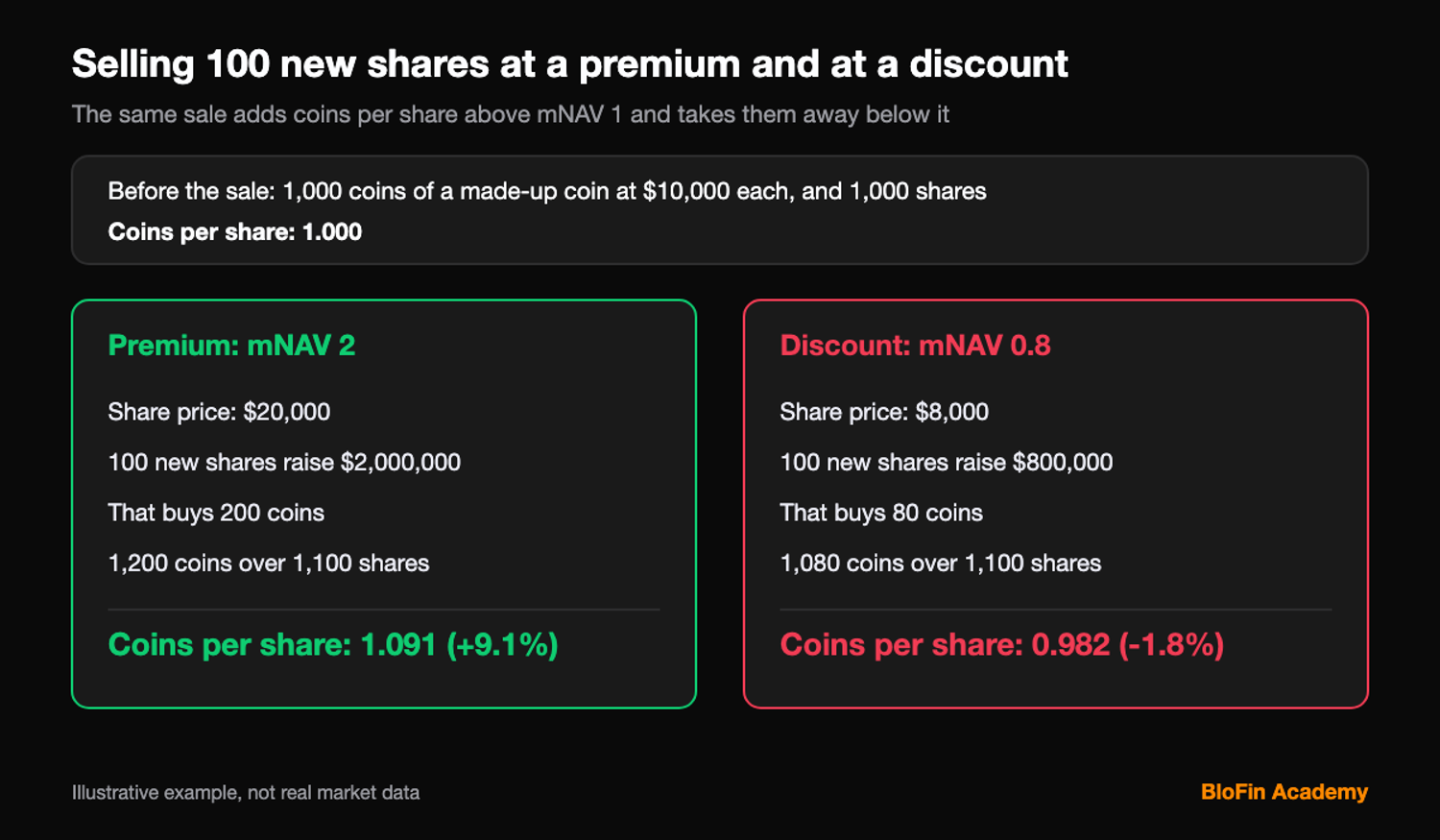
Here is a worked example using made-up round numbers. Picture a company that holds 1,000 coins of a made-up coin priced at $10,000, and has 1,000 shares. Each share stands for one coin. If its shares trade at $20,000, an mNAV of 2, then selling 100 new shares raises $2 million and buys 200 coins. The company now has 1,200 coins over 1,100 shares, or 1.091 coins a share, up 9.1%.
Now say the shares trade at $8,000, an mNAV of 0.8. The same 100 shares raise $800,000 and buy 80 coins. That leaves 1,080 coins over 1,100 shares, or 0.982 coins a share, down 1.8%. Selling the same number of shares was accretive in the first case and dilutive in the second. The only thing that changed was the price investors paid for the stock.
Preferred stock works differently, because selling it adds coins without adding common shares at the time of the sale. The cost is a dividend bill that has to be paid in cash. It also puts a claim ahead of the common shareholders, and those dividends shaped Strategy's 2026 funding changes.
Strategy reports the outcome as BTC Yield, the percentage change in bitcoin per share across a given period. The third-quarter release put Strategy's BTC Yield at minus 3.7% for 2026 through October 25 (source: Strategy Q3 2026 earnings release). That means the shares and share equivalents added that year grew faster than the coins bought. How the premium itself is measured, and how often it has dropped under 1, is the subject of MSTR's mNAV.
Strategy's capital stack
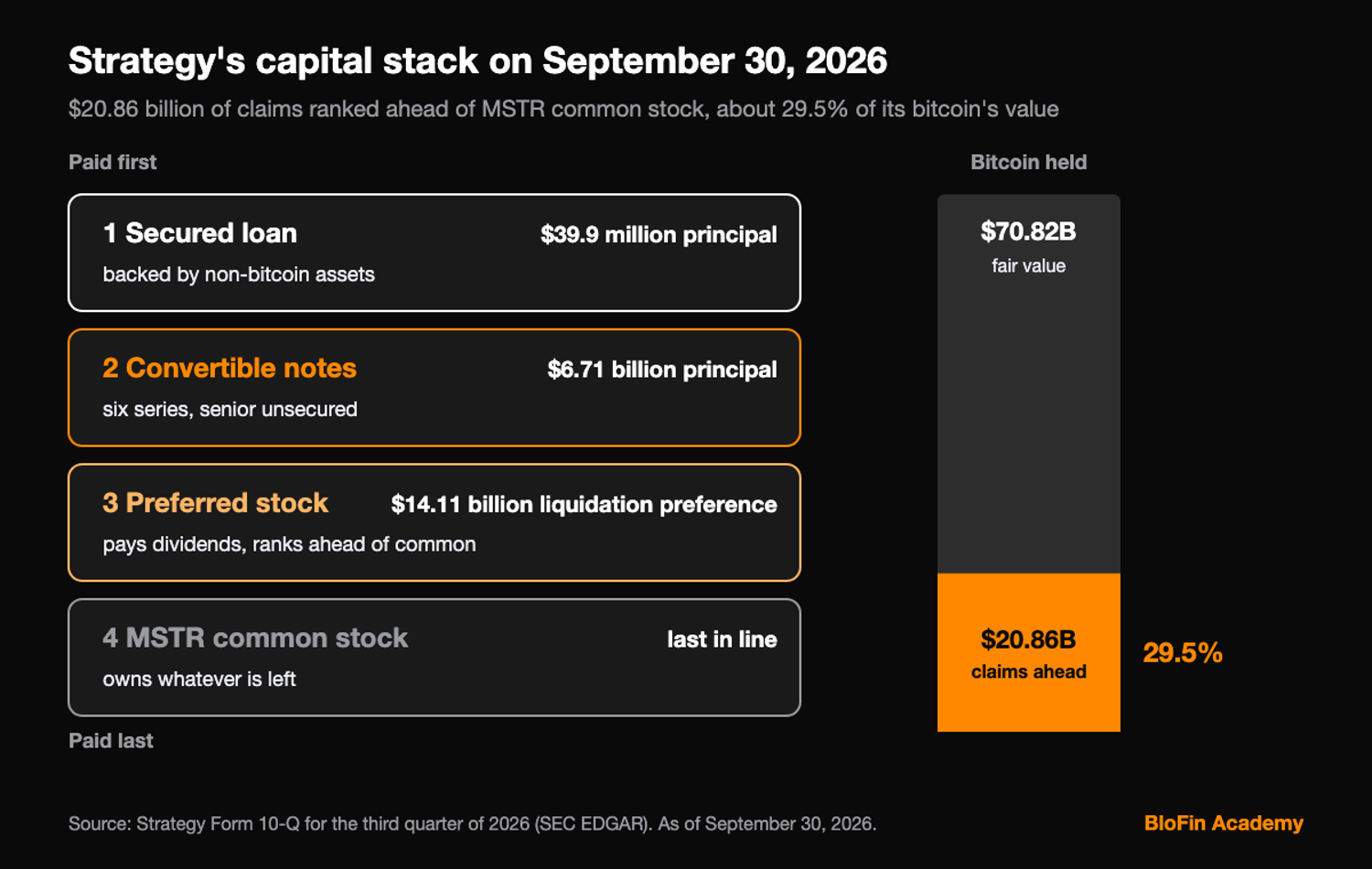
Strategy's capital stack has four layers, ranked from first claim to last: secured debt, unsecured convertible notes, preferred stock and common stock. On September 30, 2026, $39.9 million of secured debt and $6.71 billion of convertible notes ranked ahead of $14.1 billion of preferred stock. MSTR's common shares came last in line (source: Strategy Form 10-Q for the third quarter of 2026).
The secured layer is small: two loans, $39.9 million in all, backed by company assets other than bitcoin. The 10-Q calls the convertible notes senior unsecured obligations, which means no specific asset is pledged behind them. If the company failed, secured lenders would be repaid from their collateral before noteholders saw any of it (source: Strategy Form 10-Q for the third quarter of 2026). The notes' carrying amount, their principal less issuance costs not yet written off, was $6.68 billion. That is slightly under the $6.71 billion of principal the company will owe.
The preferred layer is measured by its liquidation preference. That is what preferred holders must be paid before common shareholders get anything if the company winds up. Each series has its own dividend and its own place among the others, set in that series' terms. Add the debt principal and the liquidation preference together, and $20.86 billion of claims ranked ahead of the common stock on September 30, 2026. Bitcoin on the books was worth $70.8 billion that day, so those claims came to about 29.5% of it.
The preferred layer is also being trimmed. STRC is the preferred series Strategy sold most in 2026. By October 25, 2026 the company had bought back 20,980,508 STRC shares with a notional value of $2.1 billion for about $2.0 billion, so it paid less than face value (source: Strategy Q3 2026 earnings release).
The 21/21 plan and the 42/42 plan
The 21/21 plan was Strategy's October 30, 2024 goal of raising $42 billion over three years to buy more bitcoin, $21 billion from equity and $21 billion from fixed-income securities (source: Strategy Q3 2024 earnings release). The 42/42 plan, unveiled on its first-quarter 2025 earnings call, doubled the target to $84 billion, which The Block reported as running through 2027 and the 10-K calls a medium-to-long-term plan (source: The Block on the 42/42 plan, Strategy Form 10-K for 2025).
The 2024 release came with Strategy's third-quarter 2024 results. Chief executive Phong Le said the company planned to use the extra capital "to buy more bitcoin as a treasury reserve asset" (source: Strategy Q3 2024 earnings release). Fixed-income securities are instruments that pay a set return, such as interest on a bond or a fixed dividend on a preferred share.
The new plan split its $84 billion evenly between common equity and fixed income, The Block reported. By the time it arrived, about $15 billion of the original $42 billion target was left (source: The Block on the 42/42 plan). That means roughly $27 billion had been raised in about six months. A Strategy investor presentation filed on July 7, 2025 called it the 42/42 Capital Raising Plan and showed it 38% complete (source: Strategy free writing prospectus filed July 7, 2025).
Strategy's 2026 filings use neither plan's name. Its 10-K for 2025, filed on February 19, 2026, does mention the goal without the name, in the words "In May 2025, we announced a capital plan to raise $84 billion" (source: Strategy Form 10-K for 2025). Its June 29, 2026 Form 8-K and its third-quarter 2026 release describe a "Digital Credit Capital Framework" instead. Neither says the 42/42 plan was completed or replaced (source: Strategy Form 8-K filed June 29, 2026, Strategy Q3 2026 earnings release). Read the 42/42 figure as a 2025 target, and the weekly 8-K filings as the record of what is actually being raised.
What changed in Strategy's funding in 2026
In 2026 Strategy's model started sending money out as well as bringing it in. The company grew a cash reserve for dividends and interest, announced a Digital Credit Capital Framework on June 29, 2026, and began selling small amounts of bitcoin. It also spent share money on preferred buybacks and sold no new preferred stock in the third quarter.
The reserve came first. On December 1, 2025, Strategy set up a USD Reserve of $1.4 billion, funded by selling Class A shares through its ATM program. The money is there to support dividends on its preferred stock and interest on its debt. The company said it meant to keep at least twelve months of dividends in it, with a goal of 24 months or more (source: Strategy Form 8-K filed December 1, 2025). The reserve was drawn down to $900 million by May 31, 2026, then rebuilt to $2.6 billion by June 28, 2026 (source: Strategy Form 8-K filed June 1, 2026, Strategy Form 8-K filed June 29, 2026). It was $4.83 billion on October 25, 2026 and $4.75 billion on November 15, 2026 (source: Strategy Q3 2026 earnings release, Strategy Form 8-K filed November 16, 2026).
The June 29, 2026 framework has five parts. They are a board-approved USD Reserve policy, a revised STRC dividend policy, a buyback program for its preferred stock, a buyback program for its Class A common stock, and a BTC monetization program. The policy reserves the money for preferred dividends and interest. It is meant to hold at least 12 months of those expected payments, and going below that floor, or spending it on anything else, needs the board's approval (source: Strategy Form 8-K filed June 29, 2026). The monetization program lets Strategy sell bitcoin from time to time for set purposes.
Sales had already begun before the framework. Strategy sold 32 bitcoin between May 26 and May 31, 2026, and said it expected the money to fund distributions on its preferred stock (source: Strategy Form 8-K filed June 1, 2026). In the third quarter it sold about 5,552 more. The proceeds funded $239.9 million of preferred dividends and $108.6 million of STRC buybacks, and by October 25 its 2026 bitcoin sales came to about $431.8 million (source: Strategy Q3 2026 earnings release). The timing and size of each sale are covered in whether Strategy has sold bitcoin.
Strategy also changed how it measures itself. Since July 23, 2026, its mNAV has meant the MSTR share price on Nasdaq divided by net bitcoin per share in US dollars. The company warns that the ratio alone cannot show whether a given deal added to or diluted each share's bitcoin (source: Strategy free writing prospectus filed August 3, 2026). Decrypt reported that the company also recast its "amplification" figure as an equity multiplier. The August filing still calls that ratio Amplification, defined as BTC Reserve divided by Net Reserve (source: Decrypt on Strategy's new metrics, Strategy free writing prospectus filed August 3, 2026).
Executive Chairman Michael Saylor summed up the stance in a May 2026 podcast interview: "You should be a net accumulator of bitcoin," The Block reported (source: The Block on Saylor's comments). From January through September, Strategy bought about 26 coins for every one it sold (source: Strategy Form 10-Q for the third quarter of 2026).
If you follow MSTR through weeks when its premium narrows, the cost of each trade is part of the picture. BloFin's fee page lists it before you open the MSTRUSDT Perpetual.
The premium loop and its reverse
The premium loop runs in three steps. A high mNAV lets Strategy sell shares that buy more than their own worth of bitcoin. Bitcoin per share rises, and that rise is what investors pay the premium for. In reverse, a low mNAV makes new shares dilutive, so the company leans on preferred stock, debt, its reserve or bitcoin sales.
Each turn of the loop depends on two prices the company does not set: the bitcoin price and the price investors will pay for MSTR. When both rise together, selling shares at a premium adds coins per share and supports the case for paying the premium. When they fall together, the premium can shrink just as the coins lose value. Then the common-stock route that funded most of 2026 becomes the expensive one (source: Strategy Form 10-Q for the third quarter of 2026).
The loop describes how the pieces connect, not where the price goes next. What a sharp fall in bitcoin would force, and what it would leave alone, is worked through in what happens to Strategy if bitcoin falls. How MSTR's share price has moved since 2020 is set out in MSTR stock price history.
Strategy among other treasury companies
Strategy's annual report describes it as the first Bitcoin Treasury Company and the largest one anywhere (source: Strategy Form 10-K for 2025). Twenty One Capital, Strive, Tesla and BitMine Immersion Technologies each hold far less bitcoin. Strategy's 850,849 bitcoin on November 15, 2026 compare with 43,514 at Twenty One Capital on September 30, 2026 and 43,124 at Strive on October 30, 2026.
Twenty One Capital reported its 43,514 bitcoin in its quarterly report for the period ended September 30, 2026 (source: Twenty One Capital Form 10-Q). The Strive 10-Q for the same quarter gives about 28,000 bitcoin on September 30, and 43,124 on October 30, 2026 in its note on later events. It also records Strive's merger with Semler Scientific, another bitcoin-holding company, completed on January 16, 2026 (source: Strive Form 10-Q).
Some companies hold bitcoin alongside a large operating business. Tesla held 11,509 bitcoin at an acquisition cost of $386 million on September 30, 2026. Its digital assets were worth $962 million at fair value (source: Tesla Form 10-Q).
The same model also exists for ether. BitMine Immersion Technologies held 5,901,837 ether and 211 bitcoin on August 31, 2026, the end of its fiscal year (source: BitMine Form 10-K). These dates differ by up to eleven weeks, so the figures show scale at a point in time, not a live ranking.
What Strategy's model means for MSTRUSDT traders
For MSTRUSDT traders, Strategy's model means the share price answers to three things at once. They are the bitcoin price, the premium investors pay over the coins, and how much new stock the company sells. The weekly 8-K updates the coin count and the share sales, while the premium moves every minute the market is open.
That mix is why MSTR often moves differently from bitcoin, and that gap is what trading MSTR against bitcoin is built around. The software side of the company, which still earns revenue of its own, is covered in what Strategy does.
On BloFin, the MSTRUSDT Perpetual is a contract on Strategy's share price with no expiry date. It settles in USDT and offers 1x to 20x leverage. Funding is normally exchanged every day at 12AM, 8AM and 4PM UTC (source: BloFin MSTR contract details). Outside regular US market hours, and at weekends and on holidays, BloFin may restrict MSTRUSDT to reduce-only orders, which can only shrink a position (source: BloFin stock futures notice). Nasdaq trades MSTR from 9.30AM until 4PM ET each weekday, which is 2.30PM until 9PM UTC when the US is on standard time.
Watching whether Strategy's bitcoin model holds up if the premium disappears? To get started, you'll need to first create a BloFin account, fund your account with cryptocurrency, and go to the MSTRUSDT Perpetual trading page.

Frequently asked questions
Has Strategy bought back any MSTR shares?
Strategy has not bought back any Class A common stock under the program its board approved on June 29, 2026. That program allows up to $1.0 billion, and the filing says those buybacks will not be paid for from the USD Reserve (source: Strategy Form 8-K filed June 29, 2026). As of November 15, 2026, the full $1.0 billion was still available and no shares had been repurchased (source: Strategy Form 8-K filed November 16, 2026).
How much stock can Strategy still sell through its ATM programs?
As of November 15, 2026, Strategy could still sell $18.1 billion of MSTR common stock through its at-the-market program. The preferred programs had $17.5 billion of STRC, $4.0 billion of STRD, $2.1 billion of STRK and $1.6 billion of STRF left (source: Strategy Form 8-K filed November 16, 2026). Those are limits on what it may sell. The company decides each week how much to use.
What is Strategy's BTC monetization program?
The BTC monetization program is the board's go-ahead for Strategy to sell bitcoin for three jobs. The first is adding up to $1.25 billion to the USD Reserve. The other two are covering preferred dividends and interest, and paying for buybacks of its preferred or common stock. Nothing forces a sale, and the program runs until the board ends it. Bitcoin goes toward dividends and interest only when management judges a sale cheaper for the company than issuing new shares or raising money some other way (source: Strategy Form 8-K filed June 29, 2026).
What is net bitcoin per share?
Net bitcoin per share is Strategy's measure of the bitcoin behind each MSTR share after certain claims that rank ahead of the common stock. It starts with the company's bitcoin and subtracts the notional amount of its out-of-the-money convertible notes, other debt-like instruments and perpetual preferred stock, with those claims first reduced by its USD Reserve. What is left is divided by a fully diluted share count (source: Strategy free writing prospectus filed August 3, 2026).
How did Coinbase help MicroStrategy buy bitcoin in 2020?
Coinbase Prime broke MicroStrategy's 2020 purchase into many small trades. It used a time-weighted average price algorithm, which spreads buying evenly over a set period. Coinbase's software split the buying into roughly 200,000 small fills, each well under one bitcoin on average, The Block reported (source: The Block on Coinbase's 2020 role). Splitting an order that finely keeps any single trade from pushing the price up much.
Researched and written by the BloFin Academy editorial team with AI-assisted drafting. All facts independently verified. Primary sources include Strategy's Form 10-K for 2025, its Form 10-Q for the third quarter of 2026, its earnings releases for the third quarters of 2024 and 2026, its Forms 8-K filed December 1, 2025, June 1, 2026, June 29, 2026 and November 16, 2026, and its free writing prospectuses filed July 7, 2025 and August 3, 2026. Other sources are The Block on the 42/42 plan, on Saylor's comments and on Coinbase's 2020 role, Decrypt on Strategy's new metrics, and the Forms 10-Q of Twenty One Capital, Strive and Tesla and the Form 10-K of BitMine Immersion Technologies. BloFin's sources are its MSTR contract details and stock futures notice, current as of November 17, 2026.
Nothing in this article constitutes financial advice, and nothing in it is a recommendation to buy, sell or hold Strategy in any form. Strategy's common share sales are expected to add bitcoin per share only while its shares trade at a premium, and a shrinking premium, a falling bitcoin price and $20.86 billion of claims ranked ahead of common stock can all reduce what each MSTR share is worth. On the MSTRUSDT Perpetual, leverage can liquidate your margin when the price moves against you, funding payments can cost you money while you hold, and outside Nasdaq hours you may only be able to cut a position. Past performance does not indicate future results. Do your own research and consider your risk tolerance before you trade on BloFin.