
Most listed companies are easy to sum up in a sentence: they make or sell something, and the profit from it drives the share price. A few have built up one asset that is now far bigger than the business they started with. For those firms, the plain question of what the company actually does gets harder to answer than it sounds.
That gap matters to anyone who trades the shares. The name and the sales may point one way while the asset sets the price from week to week. If you read the stock as one kind of business when it acts like another, a big move can catch you off guard.
Companies that hold bitcoin as their main treasury asset are the clearest case. They file the same reports as any other listed firm, with revenue, costs and profit. But one quarter's change in the value of their coins can swamp everything else in those reports.
The largest of them is Strategy, formerly MicroStrategy, whose Class A shares are listed on Nasdaq under the ticker MSTR. BloFin lists them as the MSTRUSDT Perpetual, next to other traditional assets you can trade on BloFin. Before you trade it, it pays to know how Strategy splits its money between software and bitcoin, and which side carries the weight.
What does Strategy do?
Strategy (formerly MicroStrategy) runs two businesses. It buys and holds bitcoin, which it pays for mainly with new shares and preferred stock and in the past also with debt. It also sells analytics software to large companies. The bitcoin side is far bigger: it made up about 92% of the company's total assets on September 30, 2026 (source: Strategy Form 10-Q for the third quarter of 2026).
Strategy's annual report for 2025 puts the two in that order. Its first line on the business calls Strategy the first and largest "Bitcoin Treasury Company" in the world. Only then does it present the software arm, as "an industry leader in AI-powered enterprise analytics software" (source: Strategy Form 10-K for 2025). The same report says Strategy raises money mostly by issuing Class A stock and preferred shares through at-the-market programs, which sell new shares into the market bit by bit at the going price.
The two businesses share one management team. Phong Le is President and Chief Executive Officer, and Michael Saylor is Chairman of the Board and Executive Chairman (source: Strategy 2026 proxy statement). For how much of the company Saylor and the big funds hold, and how the votes work, see the guide to MSTR's shareholders.
Strategy's bitcoin treasury company label
Bitcoin Treasury Company is the name Strategy gives itself in its filings and press releases. Strategy uses it for a business that buys bitcoin and holds it as its main asset. The company also has a second label of its own, digital credit, for its preferred stock.
The label is still in Strategy's newest documents. The company description at the end of its third-quarter release, dated October 29, 2026, uses the same words as the annual report (source: Strategy Q3 2026 earnings release). Its Form 8-K filed November 16, 2026 talks about cash kept for Bitcoin Treasury Company purposes (source: Strategy Form 8-K filed November 16, 2026).
The 2025 annual report says Strategy issued five classes of preferred stock that year, and it calls them "digital credit" as a group (source: Strategy Form 10-K for 2025). In the October 29, 2026 release, Executive Chairman Michael Saylor put the whole digital credit market at $16 billion in notional value across ten listed securities, and said Strategy held 84% of it (source: Strategy Q3 2026 earnings release). Those preferred shares pay dividends of their own.
One ticker catches crypto traders out. On BloFin, STRK-USDT is Starknet, a crypto token, while Strategy's STRK is a preferred stock that only shares the ticker. None of Strategy's preferred stocks is listed on BloFin (source: BloFin spot and futures market data).

Strategy's bitcoin treasury business
Strategy's bitcoin treasury business buys bitcoin and holds it as the company's main asset. Between November 9 and 15, 2026, the company added 485 bitcoin for about $33.4 million, paid for with money from selling MSTR shares, which took its holdings to 850,849 coins (source: Strategy Form 8-K filed November 16, 2026).
Those coins cost Strategy $64.2 billion altogether, or $75,452 a coin on average once fees are included (source: Strategy Form 8-K filed November 16, 2026). In the same week, the company sold 2,087,040 new MSTR shares for $244.7 million after commissions, and $206.3 million of that went on buying back its STRC preferred stock (source: Strategy Form 8-K filed November 16, 2026). Each sale like this spreads the coins across more shares, so the share count matters as well as the coin count.
The company also sells coins at times. In the third quarter of 2026 it sold about 5,552 bitcoin and bought about 7,218 (source: Strategy Form 10-Q for the third quarter of 2026).
Its borrowing includes convertible notes, a type of debt that can be swapped for shares (source: Strategy Form 10-K for 2025, Strategy Form 10-Q for the third quarter of 2026). Together with share sales and preferred stock, those notes are part of how Strategy's bitcoin strategy works.
Until the second quarter of 2026, Strategy reported its software as its only business segment. Before that, its bitcoin activity, which began when MicroStrategy first bought bitcoin, sat in a category called "Corporate & Other" (source: Strategy Form 10-Q for the third quarter of 2026).
Strategy's analytics software business
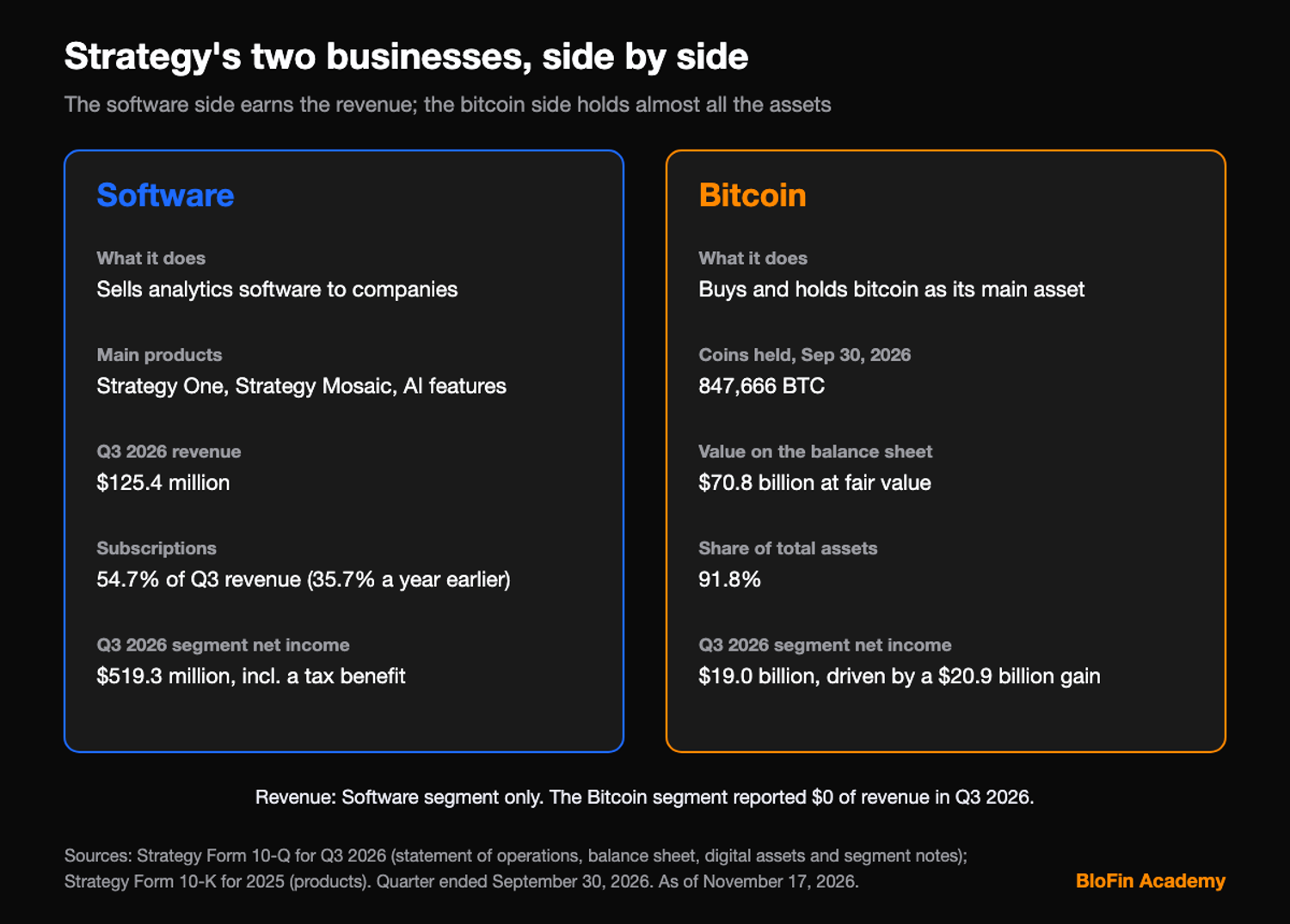
Strategy's software business sells data analytics tools to large companies. Its main product is Strategy One, which the 10-K calls a cloud-native analytics platform. Next to it sits Strategy Mosaic, which pulls a company's data into one shared source, and generative AI features run across the range (source: Strategy Form 10-K for 2025). The business brought in $125.4 million in the third quarter of 2026.
Strategy reports that revenue in four lines, and its 10-Q shows how far the mix has moved in a year (source: Strategy Form 10-Q for the third quarter of 2026).
Revenue line | Q3 2026 ($ million) | Q3 2025 ($ million) | Share of Q3 2026 revenue |
|---|---|---|---|
Subscription services | 68.6 | 46.0 | 54.7% |
Product support | 37.7 | 51.1 | 30.0% |
Other services | 15.3 | 14.2 | 12.2% |
Product licenses | 3.8 | 17.4 | 3.1% |
Total revenues | 125.4 | 128.7 | 100% |
Subscription services is now the biggest line. It made up 54.7% of the quarter's revenue, up from 35.7% a year earlier, while product licenses fell 78.0% and product support fell 26.3%. This is the shift the 10-K describes, as customers move from licenses paid for up front to cloud subscriptions. Strategy books a subscription's revenue evenly over its term, and cloud deals typically run for 36 months (source: Strategy Form 10-K for 2025).
The switch changes when revenue shows up. Because subscription revenue is spread over the contract, a new deal adds little in its first quarter and keeps adding for years after, the 10-K explains. The same report warns that the move could lead more customers to leave, and that license and support revenue could keep shrinking (source: Strategy Form 10-K for 2025).
Over the whole of 2025, total revenue was $477.2 million, up 3.0% from $463.5 million in 2024. Subscription services grew 64.5% between the two years, to $175.7 million (source: Strategy Form 10-K for 2025). That is fast growth for the subscription line, but the software business as a whole is small next to the bitcoin.
How big each business is in Strategy's accounts
Bitcoin dominates Strategy's accounts. On September 30, 2026, its 847,666 coins were valued at $70.8 billion, which was 91.8% of total assets of $77.2 billion. In the third quarter, the coins rose in value by $20.9 billion, about 167 times the $125.4 million of revenue the software business brought in (source: Strategy Form 10-Q for the third quarter of 2026).
Strategy records its bitcoin at fair value, so the balance-sheet figure moves with the coin's price every quarter (source: Strategy Form 10-Q for the third quarter of 2026). If you divide $70.8 billion by 847,666 coins, you get about $83,550 per coin at September 30. The stake at September 30 was worth 565 times the quarter's software revenue, and 148 times the software revenue for all of 2025.
Strategy's two reporting segments
Since the second quarter of 2026, Strategy has reported two operating segments, called Software and Bitcoin. Its chief executive judges each one by its net income (source: Strategy Form 10-Q for the third quarter of 2026). In the third quarter, the Bitcoin segment reported net income of $19.0 billion, driven by a $20.9 billion gain on its coins and reduced by income tax. All $125.4 million of revenue sat in the Software segment.
That split shows why a headline profit says little about the software. Strategy's net income for the third quarter was $19.5 billion, and the Bitcoin segment made up 97% of it (source: Strategy Form 10-Q for the third quarter of 2026). Because the coins are carried at fair value, a quarter in which bitcoin falls shows up as a loss on digital assets, whatever happens to software sales.
The holdings have kept growing since the quarter ended. Strategy held 3,183 more coins on November 15, 2026 than on September 30, after weeks of buying like the one in mid-November (source: Strategy Form 10-Q for the third quarter of 2026, Strategy Form 8-K filed November 16, 2026). If you trade MSTR as a stock that moves with its coins, you can check the cost of opening and closing an MSTRUSDT position on BloFin's fee page.
Is Strategy an operating company or an investment fund?
Strategy is not registered as an investment company under the Investment Company Act of 1940, and it runs a software business that reports revenue every quarter (source: Strategy Form 10-K for 2025). Its own annual report warns, though, that a change in how US regulators treat bitcoin could get it classed as an investment company, which would bring heavy extra rules.
The 1940 Act is the law that governs mutual funds and other investment companies. It covers a company that is mainly in the business of investing in securities. One of its tests asks whether investment securities make up more than 40% of a company's total assets (source: Investment Company Act, Section 3 (15 USC 80a-3)). Strategy's main asset is bitcoin, so the question turns on whether bitcoin counts as a security.
That is the risk the 10-K spells out. Senior SEC officials do not treat bitcoin as a security, it points out. If the SEC changed its view, Strategy could fall under the 1940 Act, with much tighter rules and possibly a different way of running the business (source: Strategy Form 10-K for 2025). The same section says Strategy is not subject to the rules that apply to mutual funds and exchange-traded funds.
Index providers ask a similar question from the accounts. MSCI announced on November 11, 2026 that the first use of its Non-Operating Companies methodology deletes Strategy's Class A stock from the MSCI ACWI IMI, with effect from the close on November 30, 2026 (source: MSCI November 2026 review summary). Strategy's 10-Q has treated bitcoin as an operating segment since the second quarter, but MSCI's new methodology still classed Strategy as a non-operating company (source: MSCI November 2026 review summary). Nasdaq and S&P Dow Jones Indices run their own rules, and those decide MSTR's status in the S&P 500 and the Nasdaq-100.
What Strategy's two businesses mean for MSTR traders
For a trader, Strategy's two businesses mean MSTR is mostly a claim on a company full of bitcoin. The software arm adds about $125 million of revenue a quarter. When you read a Strategy report, the gain or loss on digital assets tells you about the coins, and the subscription line tells you how the software is doing.
The per-share view matters too. Strategy sells new MSTR shares to pay for coins, so the share count grows along with the holdings, and any figure per share needs a date. Older prices need one more step, because Strategy split its shares 10-for-1 in 2024 and split-adjusted trading began at the market open on August 8, 2024, the date set in the company's July 11, 2024 announcement (source: Strategy's stock split announcement). MSTR's stock split shows what that does to older charts.
On BloFin, you trade Strategy's share price through the MSTRUSDT Perpetual. The contract has no expiry date, uses USDT for margin and settlement, and offers leverage of 1x up to 20x (source: BloFin MSTR contract details). BloFin lists no Strategy spot token, so this perpetual is how you follow the share price there (source: BloFin spot market data). The guide to the MSTR perpetual covers its terms, funding and pricing, and the MSTR stock explainer gives the wider picture.
Timing matters, because the share and the coin keep different hours. When Nasdaq's regular session is closed, including weekends and holidays, BloFin's notice says trading in stock futures in those windows "may be limited to reduce-only orders" (source: BloFin stock futures notice). The MSTRUSDT Perpetual still printed trades over the weekend of November 14 and 15, 2026, while Nasdaq was shut. So its price can move at times when you may only be able to cut your position (source: BloFin MSTRUSDT market data). Leverage makes a move like that hit your margin harder, so work out your liquidation price before you size a trade.
Trading Strategy for its bitcoin more than its software? To get started, you'll need to first create a BloFin account, fund your account with cryptocurrency, and go to the MSTRUSDT Perpetual trading page.

Frequently asked questions
Why would you buy MicroStrategy instead of bitcoin?
Buying MSTR gives you bitcoin exposure through a share that also carries Strategy's debt, preferred stock and software business. On September 30, 2026, its balance sheet carried $6.7 billion of debt. Its preferred stock had a $14.1 billion liquidation preference, the amount preferred holders are owed ahead of common shareholders if the company is wound up (source: Strategy Form 10-Q for the third quarter of 2026). Some buyers want that mix. The share can sit in an ordinary brokerage account, and because debt and preferred stock are fixed in dollars, a change in the coin's price moves the value left for common shareholders by more, in either direction. MSTR versus bitcoin weighs those claims against holding the coin itself.
Does Trump own MicroStrategy?
Donald Trump's own financial disclosures report trades in Strategy's Class A stock. His periodic transaction report on OGE Form 278-T lists a sale on July 8, 2026 and purchases on July 24 and July 27, 2026. The largest of the three was valued at $50,001 to $100,000, and the US Office of Government Ethics certified the report on September 18, 2026 (source: Donald J. Trump OGE Form 278-T, September 2026). The report gives a value range for each trade, not share counts or a remaining balance, so it does not show the current holding. Trump is not among the directors, officers or holders above 5% in Strategy's 2026 proxy statement (source: Strategy 2026 proxy statement).
How many employees does Strategy have?
Strategy had 1,539 employees on December 31, 2025, of whom 448 were in the United States and 1,091 elsewhere, so about 71% worked outside the US. That comes to about $310,000 of 2025 revenue per employee. The head office is at 1850 Towers Crescent Plaza in Tysons Corner, Virginia (source: Strategy Form 10-K for 2025).
Does Strategy earn income from its bitcoin?
Strategy's bitcoin earns no revenue of its own, so the Bitcoin segment's result comes mainly from changes in the coins' fair value each quarter. Holding the coins also costs money: in Q3 2026 the segment paid $4.6 million in digital asset custody fees, the cost of having the coins held for it (source: Strategy Form 10-Q for the third quarter of 2026).
Is Strategy's software business profitable?
In the third quarter of 2026, the Software segment reported net income of $519.3 million, but $503.5 million of that was an income tax benefit. Its income before that tax line was about $15.8 million, on $125.4 million of revenue. Sales and marketing, at $27.4 million, was the segment's largest cost (source: Strategy Form 10-Q for the third quarter of 2026).
Researched and written by the BloFin Academy editorial team with AI-assisted drafting. All facts independently verified. Primary sources include Strategy's Form 10-K for 2025, its Form 10-Q for the third quarter of 2026, its Form 8-K filed November 16, 2026, its third-quarter 2026 earnings release and its 2026 proxy statement. Other sources are Strategy's 2024 stock split announcement, Section 3 of the Investment Company Act (15 USC 80a-3) at Cornell's Legal Information Institute, MSCI's November 2026 review summary and Donald J. Trump's OGE Form 278-T (September 2026). BloFin's sources are its MSTR contract details, spot and futures market data and stock futures notice, current as of November 17, 2026.
Nothing in this article constitutes financial advice, and nothing in it is a recommendation to buy, sell or hold Strategy in any form. Strategy's assets are almost all bitcoin, so a fall in the coin cuts the value behind each share, and its debt and preferred stock are owed ahead of common shareholders. On the MSTRUSDT Perpetual, leverage can liquidate your margin in a fast move, funding payments can cost you money while you hold, and outside Nasdaq hours you may only be able to reduce a position. Past performance does not indicate future results. Do your own research and consider your risk tolerance before you trade on BloFin.