
Some share prices move with a market that never closes. When a company's main asset is bitcoin, its stock reacts to a coin that trades every hour of every day. The shares themselves only change hands while the stock exchange is open, so a Saturday-night move in the coin has to wait until Monday before the stock can answer it.
Crypto exchanges fill that gap with contracts that pay out on a share price's movement and settle in a stablecoin. The most common kind is a perpetual future. It has no expiry date, and a regular payment between buyers and sellers, called funding, keeps it close to the stock. Each of these contracts sets its own order limits, leverage, fees and rules for the hours when the stock market is shut, and those terms decide what a trade on it really does.
Strategy, formerly MicroStrategy, is a company in exactly that position. Its Class A common stock is listed on the Nasdaq Global Select Market as MSTR (source: Strategy Form 10-Q for the third quarter of 2026), and it held 850,849 BTC as of November 15, 2026 (source: Strategy Form 8-K filed November 16, 2026). BloFin follows that share price with the MSTRUSDT Perpetual, while the company itself, from the bitcoin to the software business, is covered in what MSTR stock is.
What is the MSTR perpetual on BloFin?
The MSTR perpetual is a USDT-margined perpetual futures contract on BloFin, listed as MSTRUSDT, that tracks Strategy's share price. It has no expiry date and delivers no shares. You post USDT as margin, open a long or a short, and your profit or loss is how far the price moves multiplied by the size you hold (source: BloFin MSTR contract details).
The contract is linear, which is easiest to see with numbers. One contract equals 0.01 MSTR, so 100 contracts make a position of 1 MSTR. If the price rises by 1 USDT, that position gains exactly 1 USDT, a 10 MSTR position gains 10 USDT, and a 10 MSTR short loses 10 USDT. Margin, profit, loss, fees and funding are all counted in USDT. MSTRUSDT went live on February 9, 2026, at 3.30PM UTC, or 10.30AM ET, an hour into that day's Nasdaq session (source: BloFin MSTRUSDT market data).
Having no expiry is what makes it "perpetual". A dated future ends on a set day, so a trader who wants to stay in has to move into the next contract. A perpetual never reaches a settlement day, so something else has to hold its price close to the market it follows. That job falls to funding (source: IG on funding rates), and the academy's comparison of perpetual and dated futures sets the two designs side by side.
Leverage on MSTRUSDT runs from 1x to 20x. At 10x, a 1,000 USDT position needs 100 USDT of margin, and a 1% move in the price of a Strategy share changes that margin by 10%. With isolated margin, a liquidation is limited to the margin committed to that one position; in cross margin, your whole futures balance backs every open position, so a large enough loss can reach all of it (source: CoinMarketCap Academy on cross and isolated margin). The multiplication works in both directions. That is why the contract's terms, tiers and safety mechanisms matter as much as the price.
MSTRUSDT contract terms
MSTRUSDT's contract terms fix the size of one contract, the smallest and largest single orders, the leverage range and how close to the index an order must be priced. One contract is 0.01 MSTR, the smallest order is one contract, and one order can reach 7,000 MSTR as a limit order or 700 MSTR as a market order (source: BloFin MSTR contract details).
Term | MSTRUSDT Perpetual |
|---|---|
Underlying | Strategy Class A common stock (Nasdaq: MSTR) |
Margin and settlement | USDT |
Contract size | 0.01 MSTR |
Smallest order | 0.01 MSTR (one contract) |
Largest limit order | 7,000 MSTR |
Largest market order | 700 MSTR |
Tick size | 0.01 USDT |
Leverage | 1x to 20x |
Price-limit band | ±3% around the index |
Funding | normally every eight hours |
Expiry | none |
Listed | February 9, 2026, 3.30PM UTC |
The order caps are easier to judge in USDT. BloFin's contract page showed a mark price of 97.68 USDT at about 3.50PM UTC on November 17, 2026 (source: BloFin MSTR contract details). One contract was then worth about 0.98 USDT. The largest market order came to about 68,376 USDT and the largest limit order to about 683,760 USDT. The caps apply to each order separately, so a bigger position has to be opened in several orders, and each one fills at its own prices.
The ±3% price-limit band
The price-limit band keeps an order's price within 3% of the index. A buy limit order cannot sit more than 3% over it, and a sell limit order cannot sit more than 3% under it. In some conditions, the contract page adds a two-minute average premium to the band (source: BloFin MSTR contract details).
Take an index of 100 USDT, a round number for illustration. The highest buy price you could enter would be 103 USDT, and the lowest sell price 97 USDT. In practice, the band stops a mistyped price from entering the book far from the index. It limits what you can type, though, and the index itself can still travel far more than 3% over a weekend and take your position with it.
Position tiers and parameter changes
The 20x maximum applies only in tier 1, positions of up to 600 MSTR, where the maintenance margin rate is 2.50%. Bigger positions move into higher tiers, where the maximum leverage falls and the rate rises, until the largest tier allows only 1x (source: BloFin MSTRUSDT position tiers). At the 97.68 USDT mark, the first tier held positions up to about 58,608 USDT. Sizing within those tiers is the subject of MSTR perpetual leverage and position sizing.
Any of these settings can change. BloFin's contract page says it adjusts them to actual market conditions and may do so with no separate announcement (source: BloFin MSTR contract details). BloFin also publishes a log of scheduled contract changes, and its position-tier list shows no scheduled change for MSTRUSDT (source: BloFin parameter adjustments). Because the contract page always carries the live values, it is the place to check before you size a trade.

Index price, mark price and last price
MSTRUSDT shows three prices at once. The index price is BloFin's reference for Strategy's share price, built from outside data, and the mark price is a reference price BloFin calculates for the contract. The last price is simply where MSTRUSDT most recently traded: 97.62 USDT at 3.55PM UTC on November 17, 2026.
BloFin's stock-futures listing notices explain where the index comes from. It is built from constituent prices quoted by third-party data vendors, and when no outside data is available it stays at its most recently calculated value (source: BloFin MSTU listing notice). That matters because the stock keeps hours and the contract does not. When the vendors' prices go quiet, the index can sit still while traders on BloFin keep buying and selling, so the last price is free to wander away from it.
Keep the mark price in view while you hold a position, because it is the price that triggers liquidation. BloFin's forced liquidation rules put the trigger at the mark price: when it touches a position's liquidation price, that position is liquidated, and margin changes and new orders on it are blocked from that point (source: BloFin forced liquidation rules). Positions closed by auto-deleveraging are also closed at the mark price of the moment (source: BloFin auto-deleveraging FAQ). How the mark and the last price are each used is covered in the academy's guide to mark price versus last price.
Nasdaq's price is a fourth number, and it belongs to the stock. Strategy's official close is set when the regular session ends at 4PM ET, and MSTRUSDT carries on trading afterward. Quote Monday's Nasdaq close as the perpetual's price on a Tuesday morning and you could be hours out of date and several percent away from where the contract actually traded.
Why MSTRUSDT's price differs from Nasdaq's MSTR price
MSTRUSDT trades on BloFin's own order book, so its price is whatever buyers and sellers there agree on, and it can drift away from the index. Funding pulls it back. When a perpetual trades over the underlying price, longs pay shorts; under it, shorts pay longs (source: IG on funding rates). The gap with Nasdaq grows widest while Nasdaq is shut.
Three readings from November 14 to 17, 2026 show the pattern. On Saturday, November 14, with Nasdaq closed for the weekend, MSTRUSDT traded as low as 95.72 USDT between 8PM and 12AM UTC. That was 14.24% under the $111.62 Nasdaq close of Friday, November 13 (source: BloFin MSTRUSDT market data, Nasdaq MSTR historical data). At 3.40AM UTC on Tuesday, November 17, with Nasdaq shut overnight, the last price was 103.66 USDT, 0.61% over Monday's close of $103.03.
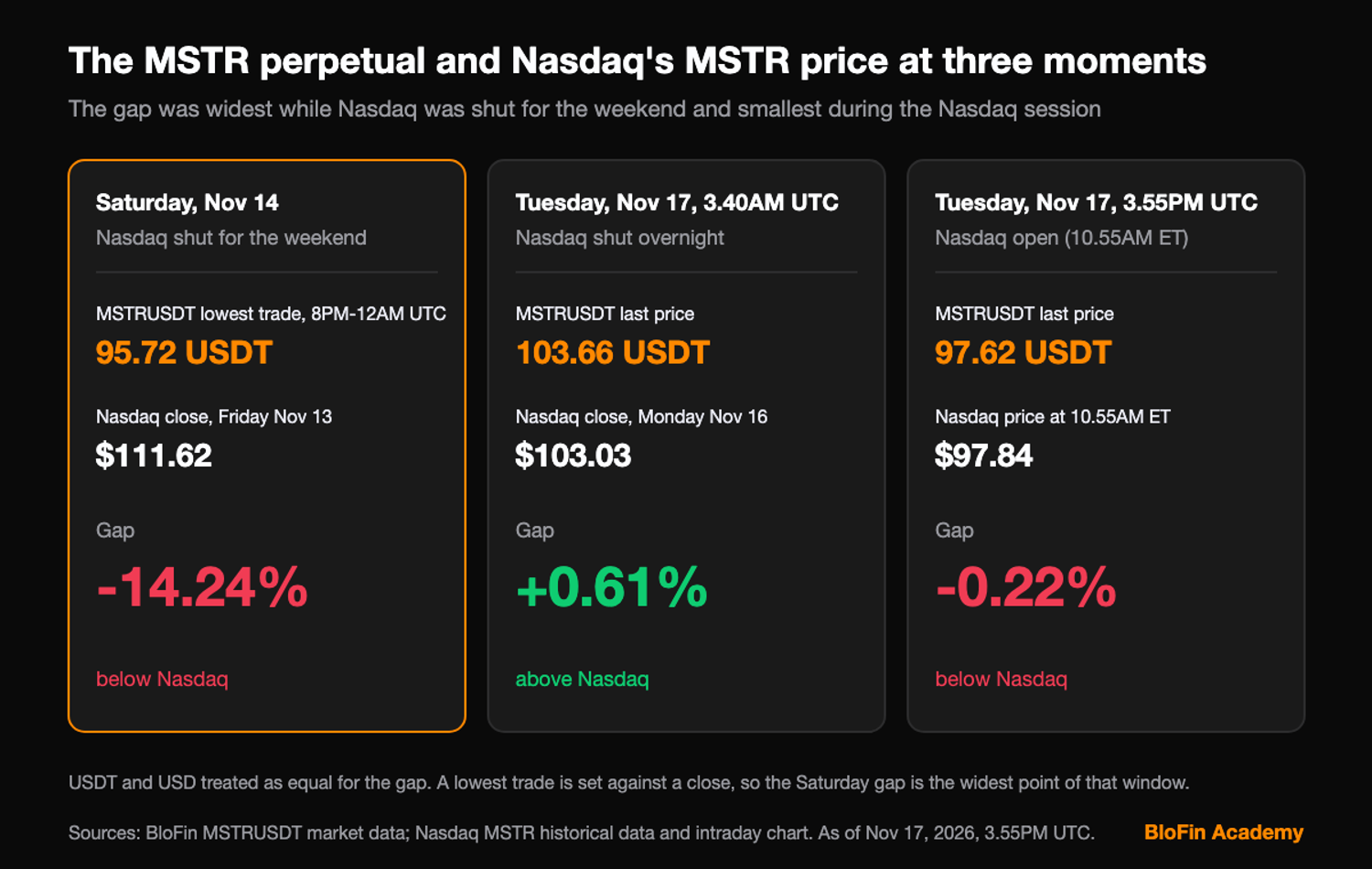
Once Nasdaq opened, the two came back together. At 3.55PM UTC on November 17, which was 10.55AM ET, MSTRUSDT last traded at 97.62 USDT, while Nasdaq's intraday chart had Strategy at $97.84, a gap of 0.22% (source: BloFin MSTRUSDT market data, Nasdaq MSTR quote). With the stock trading, the vendors' prices behind the index move again, and the contract has a live share price to follow.
Outside Nasdaq's regular session of 9.30AM to 4PM ET, including weekends and public holidays when US markets are closed, BloFin's stock futures notice warns that trading "may be limited to reduce-only orders" (source: BloFin stock futures notice). An order placed under that limit can only close a position or make it smaller (source: BloFin MSTU listing notice).
The weekend reading is the one to understand before you hold through a Friday close. Bitcoin, Strategy's main asset, trades all weekend. The contract can therefore move a long way before the stock gets its chance to answer on Monday. How far those gaps have run, and what they do to stops and liquidation, is worked through in MSTR perpetual weekend gap risk.
Funding on the MSTR perpetual
Funding on MSTRUSDT normally settles every eight hours, with settlements at 4PM, 12AM and 8AM UTC, and each rate is capped at 3% either way. Longs pay shorts if the rate is above zero, shorts pay longs if it is below, and each payment is figured on your position's notional value (source: BloFin MSTRUSDT funding rates, BloFin MSTRUSDT market data, IG on funding rates).
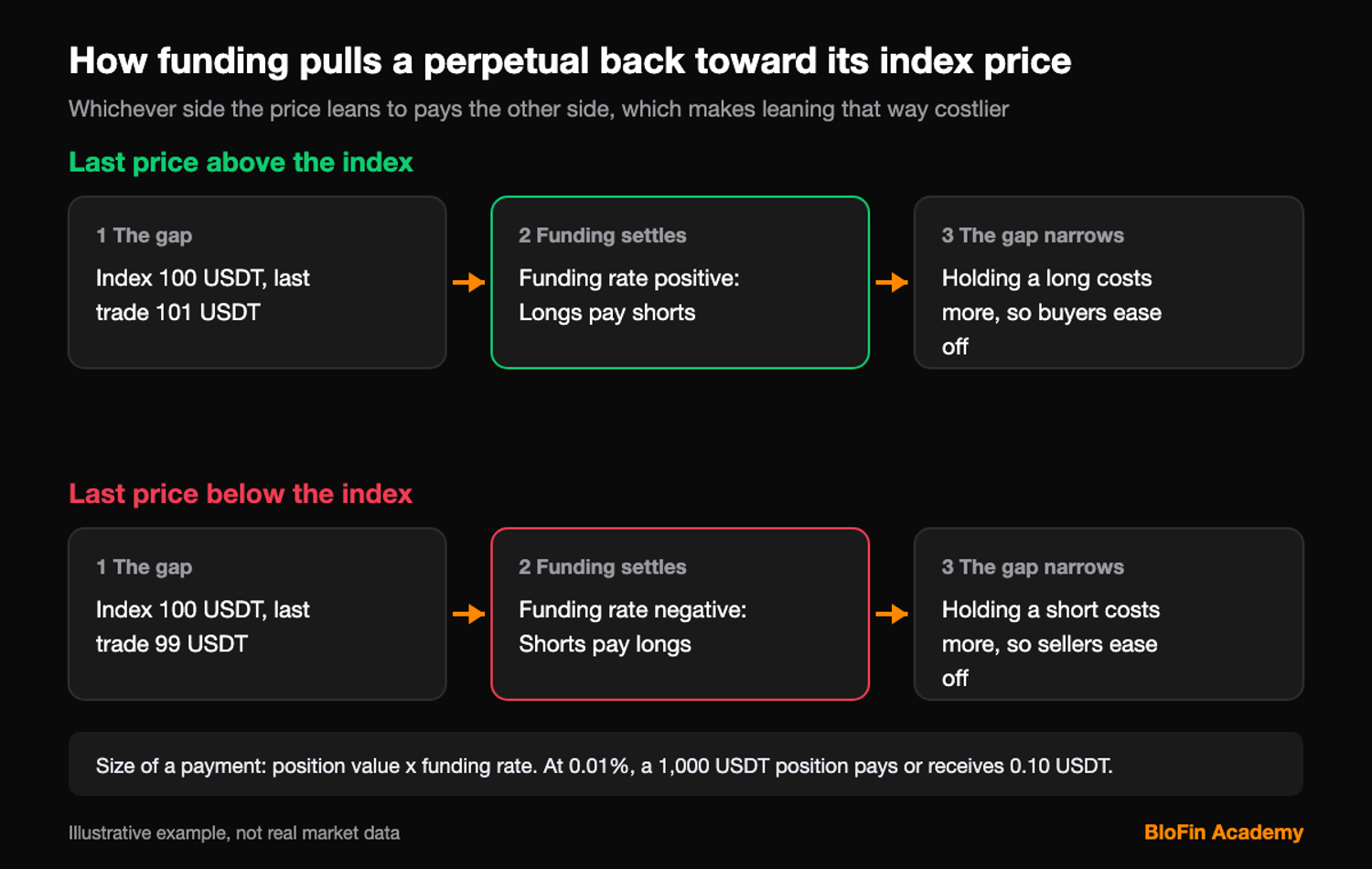
Most settlements are tiny. The 12AM UTC settlement on November 17, 2026 was 0.0073%, so a 1,000 USDT long paid about 0.07 USDT, and a short of equal size collected it. The 12AM UTC settlement on November 16 was 0.0942%, which comes to about 0.94 USDT on the same position (source: BloFin MSTRUSDT funding rates).
The exception came straight after the Saturday sell-off. The settlement at 12AM UTC on Sunday, November 15, 2026, just after the contract traded down to 95.72 USDT, was −0.5316%. Shorts paid longs about 5.32 USDT for every 1,000 USDT of position. A negative rate signals a perpetual trading under its reference price, and here it made staying short more expensive just as the gap was widest (source: BloFin MSTRUSDT funding rates, IG on funding rates).
The 3% cap sets the outer limit. At the cap, a 1,000 USDT position would pay or collect 30 USDT in one settlement, and three settlements a day can turn even small rates into a real cost over weeks. Because the rate applies to notional value, a 10x position pays ten times as much funding, measured against its margin, as a 1x position. The academy explains the general mechanism in its guide to crypto funding rates. What funding adds up to over months, next to the cost of owning shares, is in holding the MSTR perpetual versus owning shares.
Trading fees on MSTRUSDT
BloFin charges a trading fee every time an MSTRUSDT order fills, on top of funding. At the Regular level of BloFin's futures fee schedule, a maker order, meaning one that sits in the book until another trader fills it, pays 0.0200% of its value. A taker order, one that trades against the book straight away, pays 0.0600%, and stock futures have no separate line in the schedule (source: BloFin fee schedule).
On a 1,000 USDT position, one taker fill costs 0.60 USDT, so a round trip of two market orders costs 1.20 USDT. Two limit orders that rest in the book first cost 0.20 USDT each, or 0.40 USDT in total. A limit order priced through the market trades at once, so it is charged as a taker.
The Regular level applies while your 30-day futures volume stays under 10,000,000 USDT, your 30-day spot volume under 1,000,000 USDT and your assets under 50,000 USDT. Five higher levels follow, and the top one charges 0.0000% maker and 0.0350% taker. BloFin recalculates each account's level every day at 1AM UTC (source: BloFin fee schedule), and the guide to the BloFin fee structure covers BloFin's fee levels.
Funding and fees together are the running cost of an MSTRUSDT position, and both apply around the clock, Nasdaq hours or not. Before you trade, BloFin's futures fee schedule shows the rate for every level, so you can work out a round trip on your own position size.
MSTRUSDT liquidity: Volume, open interest and order-book depth
At 3.55PM UTC on November 17, 2026, open positions on MSTRUSDT came to 26,510.44 MSTR, about 2.59 million USDT at the 97.62 USDT last price. Over the previous 24 hours, 3,732.39 MSTR had changed hands, about 364,356 USDT (source: BloFin MSTRUSDT market data). Open interest counts positions still held, and volume counts what traded.
BloFin's market data also counts both in contracts, which is why raw figures can look enormous: 2,651,044 contracts of open interest and 373,239 contracts of volume. Divide a contract count by 100 to get MSTR, since one contract is 0.01 MSTR.
The order book at the same moment shows what a single trade would meet. The best bid was 97.83 USDT for 110.82 MSTR and the best ask 97.88 USDT for 41.25 MSTR, a spread of 0.05 USDT, or about 0.05% (source: BloFin MSTRUSDT market data). The 50 ask levels reached up to 98.42 USDT and held 24,312.93 MSTR between them. The 50 bid levels reached down to 97.25 USDT and held 21,477.21 MSTR.
Set that against the 700 MSTR market-order cap. A 700 MSTR market buy at that moment was about 17 times the size of the best ask, so it would have filled across several price levels. It was still only 2.9% of the size resting on the 50 ask levels, so it would have filled well inside them, at no worse than 98.42 USDT, 0.55% over the best ask. The same order equalled about 18.8% of a whole day's volume. That is why a limit order, or a position opened in pieces, gives you more control over your price. Depth changes by the hour, too, and BloFin's listing notices warn that outside the home market's regular hours the underlying asset may see little price movement and thin liquidity (source: BloFin MSTU listing notice).
Insurance fund and auto-deleveraging
MSTRUSDT has its own insurance fund, which held 35,255.85 USDT at 3.50PM UTC that same afternoon. It pays the difference when a liquidated position can only be closed at a price its remaining margin does not cover. If the fund runs short, BloFin can use auto-deleveraging (ADL) and shut positions held against yours at that moment's mark price (source: BloFin MSTR contract details, BloFin auto-deleveraging FAQ).
According to BloFin, the fund is mainly money it provides, plus the surplus left when liquidations close at better prices than needed. Each USDT perpetual has a pool independent of the others. Every day at 8AM UTC, liquidation losses are paid out of it and any surplus goes in (source: BloFin auto-deleveraging FAQ). At 3.55PM UTC on November 17, the fund equalled about 1.36% of the 2.59 million USDT in open MSTRUSDT positions.
ADL starts when the fund is insufficient, or when it drops quickly, which BloFin sets as the fund losing 30% of its peak value within eight hours. BloFin can adjust that threshold. Positions are then ranked: profitable ones come before loss-making ones, and among them a higher return and a lower margin ratio go first. A five-light indicator shows where your own position stands in that queue (source: BloFin auto-deleveraging FAQ).
In plain terms, ADL means a winning MSTRUSDT position can be shut early on a violent day, such as a weekend when bitcoin falls hard while Nasdaq is closed. You keep the profit up to the mark price at that moment and miss the rest of the move. What liquidation is, and how leverage brings it closer, is covered in the academy's guide to leverage and liquidation.
What holding the MSTR perpetual gives you
Holding MSTRUSDT gives you exposure to Strategy's share price in USDT, long or short, and none of the rights a shareholder has. BloFin's stock futures notice is explicit here: the contracts carry no ownership of the underlying shares, and you get no dividends, votes or other shareholder rights (source: BloFin stock futures notice).
BloFin's stock-futures listing notices add that these contracts have no association with the company whose shares they track or with that company's exchange (source: BloFin MSTU listing notice). Your result is the price change multiplied by your size, less fees, with funding added or taken away. Strategy's news, from its bitcoin purchases to its quarterly results, reaches the contract through what traders think the share is worth, so the contract can react while Nasdaq is still shut. The report that moves it most is read line by line in Strategy earnings explained.
Three names around Strategy confuse new traders on BloFin:
STRK. Strategy's STRK is its 8.00% Series A Perpetual Strike Preferred Stock, listed on Nasdaq (source: Strategy Form 10-Q for the third quarter of 2026). STRK on BloFin is Starknet, a crypto token with no link to Strategy. None of Strategy's preferred shares trade on BloFin.
MSTRX. BloFin lists no Strategy spot pair or token, so MSTRUSDT is how you follow Strategy there. Whether you can buy tokenized MSTR on BloFin sets that answer against owning shares.
MSTU. The MSTUUSDT Perpetual, listed on October 12, 2026, tracks MSTU (T-Rex 2X Long MSTR Daily Target ETF) (source: BloFin MSTU listing notice). That fund aims for 200% of MSTR's daily performance before fees and expenses, one trading day at a time (source: REX Shares MSTU fund page). The MSTU perpetual versus the MSTR perpetual compares the two contracts.
How to use the MSTR perpetual next
The MSTR perpetual lets you follow Strategy's share price with a USDT balance, from 0.01 MSTR and at up to 20x leverage, for a Regular fee of 0.0200% maker or 0.0600% taker plus funding. Before your first order, read the live contract page, pick leverage that can survive a weekend move, and decide how you will get out.
What comes next depends on why you are here. How to trade MSTR on BloFin walks through a first order step by step, from the first deposit until the trade is closed. If you expect Strategy to fall, how to short MSTR stock on BloFin covers the short side.
If you already own the shares, how to hedge MSTR stock with the perpetual shows how a short can offset them. Because Strategy's price leans so heavily on bitcoin, how to trade MSTR against bitcoin looks at the pair together.
Want to follow Strategy's share price while Nasdaq is shut? The MSTRUSDT Perpetual keeps trading through nights and weekends, though outside regular hours BloFin may limit stock futures to reduce-only orders. To get started, you'll need to first create a BloFin account, fund your account with cryptocurrency, and go to the MSTRUSDT Perpetual trading page.

Frequently asked questions
Is the MSTR perpetual a CME future?
MSTRUSDT is BloFin's own contract, with no expiry date and settlement in USDT. A future on a regulated exchange such as CME Group is a dated agreement to trade a set quantity at a price agreed today, on a delivery date written into the contract. Some settle in cash rather than by delivery (source: CFTC futures market basics). A dated future finishes on its last day. MSTRUSDT stays open until you close it, or until it is liquidated.
What is the smallest MSTR perpetual position you can open?
The smallest MSTRUSDT order is one contract of 0.01 MSTR, worth about 0.98 USDT at the 97.68 USDT mark price at about 3.50PM UTC on November 17, 2026 (source: BloFin MSTR contract details). At 20x leverage it needs about 0.05 USDT of margin, plus the fee. A position that small is a cheap way to see how margin, funding and the order panel behave, although fees eat a bigger share of any profit.
Does the MSTR perpetual pay dividends?
Holders of MSTRUSDT receive no dividends from Strategy, whatever the company pays on any class of its shares. BloFin's stock futures notice says holders are not entitled to dividends (source: BloFin stock futures notice). Your return comes only from the price change, fees and funding.
What happens to the MSTR perpetual if Strategy splits its stock?
BloFin's stock-futures listing notices say that a stock split is handled through a separate market notice explaining what happens to the contract. Reverse splits, mergers and spinoffs, the other corporate actions that may materially affect an underlying price, get the same treatment (source: BloFin MSTU listing notice). If Strategy announces one, look for that notice in BloFin's announcements before you hold MSTRUSDT through the event.
Why does the MSTR perpetual's volume look so large?
BloFin's market data reports MSTRUSDT volume and open interest in contracts as well as in MSTR, and one contract is only 0.01 MSTR. In one reading, for example, 3,732.39 MSTR of 24-hour volume showed as 373,239 contracts (source: BloFin MSTRUSDT market data). Divide any contract count by 100 to read it in MSTR, then multiply by the price to see its value in USDT.
Researched and written by the BloFin Academy editorial team with AI-assisted drafting. All facts independently verified. BloFin's sources are its MSTRUSDT contract details, position tiers, funding rates and market data, its parameter adjustments log, its futures fee schedule, its stock futures notice of April 21, 2026, its MSTU listing notice of October 12, 2026, its auto-deleveraging FAQ and its forced liquidation rules. Other sources are Strategy's Form 10-Q for the third quarter of 2026 and its Form 8-K filed November 16, 2026, Nasdaq's MSTR historical data and intraday quote, REX Shares' MSTU fund page, IG's guide to funding rates, the CFTC's futures market basics and CoinMarketCap Academy's guide to cross and isolated margin, current as of November 17, 2026.
Nothing in this article constitutes financial advice, and nothing in it is a recommendation to buy, sell or hold Strategy in any form. The MSTRUSDT Perpetual uses leverage, so a move of a few percent can liquidate a highly leveraged position in isolated margin, or eat into the rest of your futures balance in cross margin, and on the weekend of November 14, 2026 the contract traded 14.24% under Nasdaq's Friday close while the stock was shut. Funding normally settles every eight hours and can cost you money each time, a winning position can be closed early by auto-deleveraging, and outside US trading hours BloFin may accept only orders that reduce a position. Past performance does not indicate future results. Do your own research and consider your risk tolerance before you trade on BloFin.