
Trading with leverage makes every price move count several times over. Put up a tenth of a position's value, and a 1% move in the price becomes a 10% change in your deposit. A short run of bad days can then take the whole deposit before you have made a single decision.
So the leverage setting is really a question about the asset you trade. A multiplier that leaves plenty of room on a calm index can leave almost none on a stock that often moves several percent in a day. Your room is simply the distance the price can travel before your margin is used up.
Single-stock perpetual futures hand that choice to you. You pick the multiplier, and the contract follows a share whose home exchange is open only part of the week. The position has no expiry date, so it lasts until you close it or its margin is gone.
Strategy (MSTR), formerly MicroStrategy, makes the choice harder than most stocks do. Its share price already swings further than bitcoin, the asset the company holds. On BloFin, MSTR's price is tracked by the MSTRUSDT Perpetual, a USDT-settled contract with leverage from 1x to 20x (source: BloFin MSTR contract details).
What is leverage on the MSTR perpetual?
Leverage on the MSTR perpetual is the value of your MSTRUSDT position divided by the margin you post for it, from 1x to 20x. How much leverage a position can carry depends on how far MSTR moves in a day and how closely it follows bitcoin. That is why sizing begins with how much money you can afford to lose.
The CFTC's glossary describes leverage as holding a big position in a commodity or security while putting up only a small part of its value (source: CFTC glossary). Margin is the collateral you lock up for the position. A perpetual involves no loan, because the margin is just the position's value divided by your chosen leverage. One MSTRUSDT contract stands for 0.01 MSTR, and the smallest order is 0.01 MSTR, so a position of 1 MSTR is 100 contracts (source: BloFin MSTR contract details, BloFin MSTRUSDT market data).
Take an illustrative entry of 1,000 USDT, a round number picked to keep the percentages easy. A 1 MSTR long then needs 1,000 USDT of margin at 1x, 200 USDT at 5x and 50 USDT at 20x. A 1% move changes the position by 10 USDT in every case, since the position is the same size. Yet that 10 USDT is 1% of the margin at 1x and 20% of it at 20x.
So leverage and position size do two separate jobs. Size decides how many USDT you make or lose on each 1% move. Leverage decides the margin backing the position, and so the adverse movement it can absorb before it is closed. FINRA's guide to futures warns that the high leverage in futures can produce sudden, large gains and equally sudden, large losses (source: FINRA on futures and commodities).
The 20x ceiling applies only to smaller positions. BloFin's tier table allows 20x up to 600 MSTR, and larger positions get a lower cap (source: BloFin MSTR position tiers).
Why MSTR already carries leverage to bitcoin
MSTR already behaves like a leveraged bitcoin position before you add any leverage. Over the 251 Nasdaq sessions from November 17, 2025 to November 16, 2026, its beta to bitcoin was 1.54. A 1% bitcoin move came with an MSTR move of about 1.54% on average, so a 5x MSTRUSDT position acted roughly like a 7.7x bitcoin position.
Beta measures how strongly an asset's returns move with a benchmark's. It is the covariance of the two sets of returns divided by the variance of the benchmark's returns (source: tastylive on beta). A beta of 1 means the asset moves one for one with the benchmark, and a higher beta means it tends to move further. Here the benchmark is bitcoin.
Each MSTR return is measured from one Nasdaq closing price to the following one. Each bitcoin return covers the same dates, using BloFin's BTC-USDT daily close in UTC. A Monday's MSTR move is therefore matched with bitcoin's whole move from Friday to Monday (source: Nasdaq MSTR historical data, BloFin price data).
The size of the swings tells the same story. Across those 251 sessions, MSTR's daily return had a standard deviation of 5.18% and a median move of 3.46%. Bitcoin's moves over the same spans had a standard deviation of 2.74% and a median of 1.46% (source: Nasdaq MSTR historical data, BloFin price data). Beta also shifts with the window you measure. Over the latest 90 sessions alone, from July 13 to November 16, 2026, it was 1.74.
That is why the leverage you set stacks on top of leverage the stock already has. If you see the trade as a bet on bitcoin, your real exposure is roughly your leverage times MSTR's beta. On that view, 10x on MSTRUSDT has lately behaved more like 15x to 17x on bitcoin itself.
The latest stretch shows what that looks like. MSTR's Nasdaq close fell from $128.93 on November 6, 2026 to $103.03 on November 16, a 20.1% drop in six sessions, while bitcoin fell 14.4%. From Friday's close of $111.62 to Monday's $103.03, MSTR lost 7.70%. On Nasdaq's prices, that was slightly more than the 7.69% fall that takes a 10x isolated-margin long, opened at Friday's close, to its estimated liquidation price (source: Nasdaq MSTR historical data, BloFin price data).

MSTR perpetual liquidation price at 1x to 20x
In isolated margin, a 10x MSTRUSDT long from an illustrative 1,000 USDT entry has an estimated liquidation price of 923.08 USDT, 7.69% lower. A 10x short is liquidated near 1,073.17 USDT, 7.32% higher. At 20x the room shrinks to 2.56% for a long and 2.44% for a short, and at 2x it widens to 48.72% and 46.34% (source: BloFin MSTR position tiers).
A position is closed before its margin reaches zero, because every position must keep a minimum amount of margin, called the maintenance margin. The CFTC's glossary describes maintenance margin as the minimum a margin account has to hold for as long as the position stays open (source: CFTC glossary). BloFin sets it as a rate of the position's value. For MSTRUSDT positions up to 600 MSTR, that rate is 2.50% (source: BloFin MSTR position tiers). BloFin's forced liquidation rules use the mark price as the trigger, and liquidation begins when the mark reaches the position's liquidation price (source: BloFin forced liquidation rules). The academy's guide to mark price and last price compares the two prices.
Each illustrative estimate assumes isolated margin at the 2.50% rate and the formula set out next, which gives a 5x long 17.95% of room (source: BloFin MSTR position tiers). A long is liquidated when its margin minus its loss falls to the maintenance margin. That puts its liquidation price at the entry times (1 − 1 ÷ leverage) ÷ (1 − 2.5%). A short uses (1 + 1 ÷ leverage) ÷ (1 + 2.5%). Fees and funding are left out, and both shift the real figure a little. Cross margin puts the rest of the futures balance to work for the position as well, which pushes its liquidation price further off. For an actual order, check the Liq. Price that the order panel shows.
Leverage | Margin for 1 MSTR at an illustrative 1,000 USDT | Long: estimated liquidation price | Long: fall to liquidation | Short: estimated liquidation price | Short: rise to liquidation |
|---|---|---|---|---|---|
1x | 1,000 USDT | 0 USDT | 100% | 1,951.22 USDT | 95.12% |
2x | 500 USDT | 512.82 USDT | 48.72% | 1,463.41 USDT | 46.34% |
5x | 200 USDT | 820.51 USDT | 17.95% | 1,170.73 USDT | 17.07% |
10x | 100 USDT | 923.08 USDT | 7.69% | 1,073.17 USDT | 7.32% |
20x | 50 USDT | 974.36 USDT | 2.56% | 1,024.39 USDT | 2.44% |
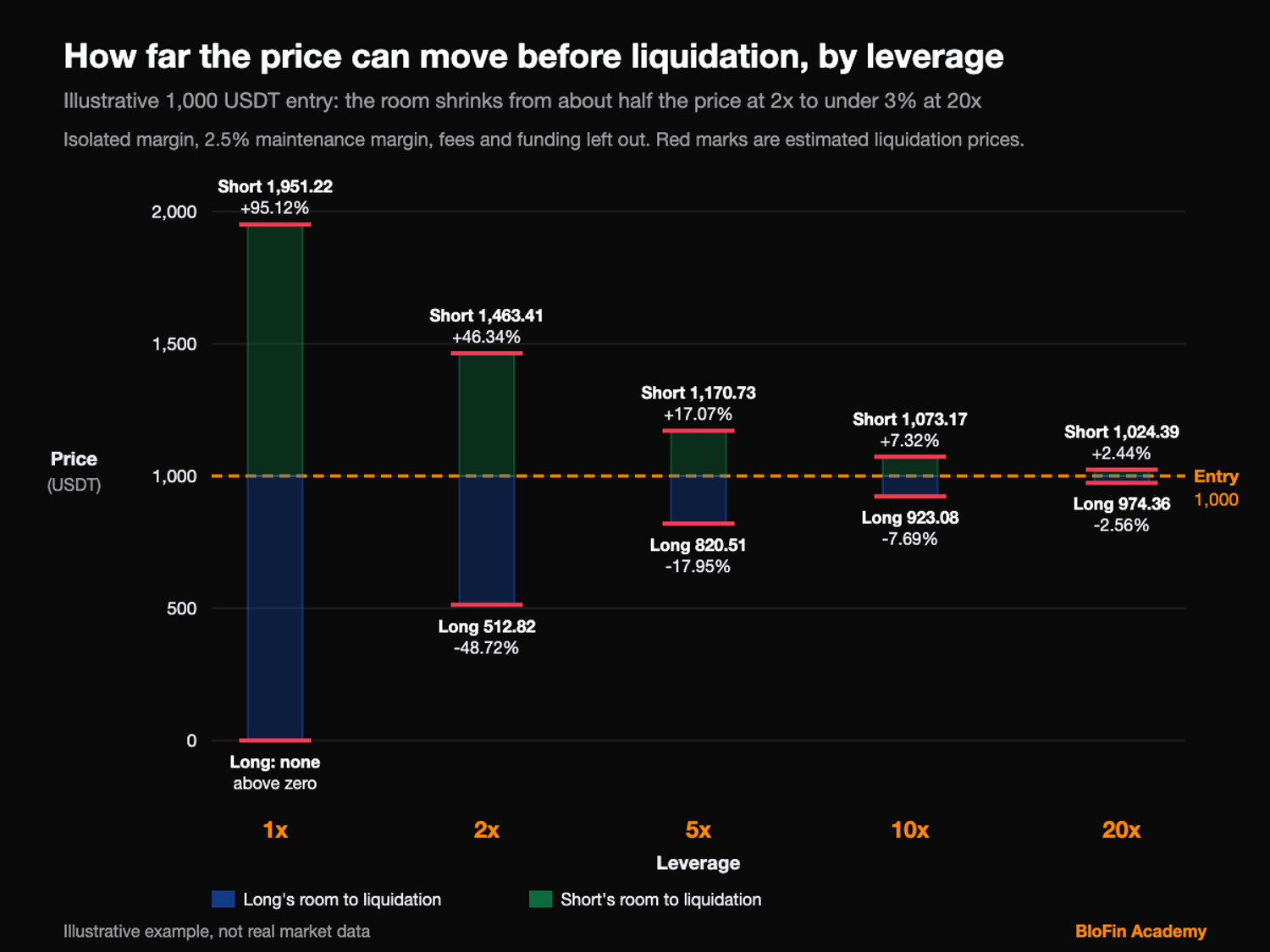
A short is liquidated a little sooner than a long at equal leverage, since its maintenance margin grows as the price rises against it. At 1x in isolated margin, a long's estimated liquidation price sits at zero, so only a near-total fall would reach it once fees count. A 1x short is liquidated on a rise of about 95%, close to a doubling. For the mechanics in general, see the academy's leverage and liquidation guide.
How often MSTR's daily swings reached each liquidation price
Over the 251 sessions to November 16, 2026, MSTR's session low fell 7.69% or more under the previous close 28 times. That is the room a 10x isolated-margin long opened at that close would have had. The session high rose 7.32% or more over the previous close 32 times, the room for a 10x short (source: Nasdaq MSTR historical data).
In isolated margin at 20x, the counts climb to 137 sessions for a long and 128 for a short, more than half of all sessions each time. At 5x, one session went far enough to reach a long's estimated liquidation price and two reached a short's. At 2x, none did. These counts use Nasdaq's share prices and assume an entry at the previous close. A real liquidation follows the perpetual's own mark price, which keeps moving while Nasdaq is shut.
Isolated or cross margin on an MSTR position
Isolated margin limits what an MSTRUSDT position can lose to the margin you assign to it, whereas cross margin puts your entire futures balance behind every open position. On a stock that can move 7% in a session, that choice decides whether one bad day costs one position's margin or eats into the whole account.
CoinMarketCap Academy explains that cross margin puts the whole account behind every open position, so a liquidation can cost all of it. Isolated margin sets aside a fixed amount for one position, and a liquidation there costs only that amount (source: CoinMarketCap Academy on cross and isolated margin). The MSTRUSDT order panel has a margin-mode button, shown as Cross, with the leverage button beside it. The academy's guide to crypto margin trading explains both modes.
Say you hold 1,000 USDT in your futures account and open an illustrative 1 MSTR long at 1,000 USDT. That is a 1,000 USDT position at 10x. In isolated margin, 100 USDT backs it and the estimated liquidation price is 923.08 USDT, so the most you lose at liquidation is that 100 USDT. In cross margin, with nothing else open, the full 1,000 USDT stands behind it. Its estimated liquidation price then drops to zero, and the loss can run to the whole 1,000 USDT (fees and funding left out in both cases).
Under cross margin, the room depends on the position's size against your balance, whatever the leverage button shows. On the same 1,000 USDT balance, a 5,000 USDT long has an estimated 17.95% of room and a 10,000 USDT long has 7.69%. Those match 5x and 10x in isolated margin, and every other open position draws on that same balance. Ways to keep that shared exposure in check are set out in the guide to BloFin futures risk management.
MSTR's daily range and where a stop fits
Over the 251 sessions to November 16, 2026, MSTR's close moved a median 3.46% from the previous close. Its high-to-low range within a session was a median 5.47% of that close. In one session in ten, the low sat 8.06% or more under the previous close, and 71 sessions closed at least 5% away from it.
Those figures show the noise a stop has to sit outside. A stop-loss 3% under an entry at the previous close would have been reached in 117 of the 251 sessions, close to half of them. The extremes run much larger. The deepest low of the period came on February 5, 2026, 19.31% under the previous close, and the next day's high rose 26.81% over the close before it (source: Nasdaq MSTR historical data).
A stop also has to sit closer to your entry than your liquidation price does, or liquidation comes first. For an isolated-margin long, an 8% stop works at 5x, where the estimated liquidation price is 17.95% away. It fails at 10x, where liquidation is 7.69% away. A short passes the same test with the short's distances.
According to FINRA, reaching the stop price converts a stop order into a market order, which then fills at the next price the market offers (source: FINRA on order types). After a jump, that current price can already be past your stop. On BloFin the order panel carries a TP/SL option, and the guide to placing a stop-loss on BloFin shows each step.
How to size an MSTR perpetual position
Position size is the money you will risk divided by the distance to your stop. Risking 100 USDT with a stop 8% from entry gives a 1,250 USDT position, or 1.25 MSTR at an illustrative 1,000 USDT. Leverage does not change that size, since it sets only the margin and where liquidation sits.
Here is the whole calculation in round illustrative numbers. Say the account holds 10,000 USDT, and 1% of it is the most you will accept losing on one trade, which makes the risk 100 USDT. An 8% stop sits just inside the 8.06% session low that MSTR reached or passed in one session in ten over the 251 sessions to November 16, 2026. 100 USDT divided by 8% is 1,250 USDT, which is 1.25 MSTR, or 125 contracts of 0.01 MSTR each.
Leverage | Margin for the 1,250 USDT position | Long: fall to estimated liquidation (isolated) | Which comes first on a fall |
|---|---|---|---|
1x | 1,250 USDT | 100% | The 8% stop |
2x | 625 USDT | 48.72% | The 8% stop |
5x | 250 USDT | 17.95% | The 8% stop |
10x | 125 USDT | 7.69% | Liquidation |
20x | 62.50 USDT | 2.56% | Liquidation |
Wherever the stop comes first, the loss at the stop is the same 100 USDT, plus fees. What changes with leverage is the margin tied up and the space left for the stop to work. At 10x and 20x in isolated margin, liquidation sits nearer than the stop, so the position can be closed for its whole margin before the stop ever triggers. The 1% here is an example, and the share you risk is your own call. The academy's position sizing in crypto guide explains the method for any asset.
Fees come on top of the planned loss. At the Regular tier's 0.0600% taker rate, opening and closing the 1,250 USDT position costs about 1.50 USDT, taking the loss to about 101.50 USDT before slippage or funding (source: BloFin fee schedule). When you fill in an order on the MSTRUSDT trading page, the form displays a Liq. Price under each side, so you can see where liquidation would sit for the exact size and leverage you enter.
Holding an MSTR position over a weekend
A weekend changes the sizing because Nasdaq shuts from Friday's 4PM ET close to Monday's 9.30AM ET open, while bitcoin keeps trading. Over the 251 sessions to November 16, 2026, MSTR's first price after a weekend, long holiday weekends included, opened a median 2.41% from the previous close. After an ordinary weeknight the median was 1.81%.
Of the 53 sessions in the period that followed a weekend, eight opened 5% or more away from the previous close. Only 14 of the 195 sessions that followed a single night did the same. The largest weekend gap opened 7.46% from Friday's close on June 15, 2026 (source: Nasdaq MSTR historical data). At 20x in isolated margin, 13 of those weekend openings were already past a long's estimated liquidation distance, and 11 were past a short's.
MSTR's regular Nasdaq session spans 9.30AM ET to 4PM ET, which is 2.30PM UTC to 9PM UTC while US standard time applies. BloFin's notice warns that outside those hours, and on weekends and holidays when the relevant markets are shut, trading in stock futures may then be limited to reduce-only orders (source: BloFin stock futures notice). Reduce-only means an order may cut a position or close it, but never open or enlarge one, so a trader who wants a bigger position may need to wait until Monday's open. BloFin's four-hour MSTRUSDT candles show the perpetual changing hands all weekend after the Friday, November 13, 2026 close. On Saturday, November 14, it traded as low as 95.72 USDT, roughly 14.2% below the $111.62 that MSTR had closed at on Nasdaq that Friday (source: BloFin MSTRUSDT market data, Nasdaq MSTR historical data). The guide to MSTR perpetual weekend gap risk shows how those weekend prices behave.
An intraday trade closed before the 9PM UTC close only has to survive one session's range, a median 5.47% over the same 251 sessions. A swing held over a weekend has to survive the gap and then Monday's session. At the same risk in USDT, it needs a wider stop, which means a smaller position, or lower leverage to keep liquidation further away. Holidays bring the same problem midweek. Nasdaq is shut for Thanksgiving on November 26, 2026, and shuts early, at 1PM ET, on November 27 (source: Nasdaq Trader holiday calendar).
Position tiers for large MSTR positions
On BloFin, MSTRUSDT positions up to 600 MSTR get up to 20x at a maintenance margin rate of 2.50%, and the cap falls over eight tiers to 1x at a 50% rate beyond 300,000 MSTR. With the mark price at 97.68 USDT (read at 3.50PM UTC on November 17, 2026), 600 MSTR was worth about 58,608 USDT (source: BloFin MSTR position tiers, BloFin MSTR contract details).
The tiers are the same in isolated and cross margin. As a position grows into a higher tier, its leverage cap generally drops and its maintenance margin rate generally rises (source: BloFin MSTR position tiers). A higher rate leaves less room at the same leverage. Estimated with the isolated formula, a 5x long has 17.95% of room at the first tier's 2.50%, 17.24% at the second tier's 3.33%, 15.79% at 5.00% and 11.11% at 10.00% (source: BloFin MSTR position tiers).
Tier | Position size | Value at 97.68 USDT | Maximum leverage | Maintenance margin rate |
|---|---|---|---|---|
1 | Up to 600 MSTR | Up to about 58,608 USDT | 20x | 2.50% |
2 | 600.01 to 3,000 MSTR | Up to about 293,040 USDT | 15x | 3.33% |
3 | 3,000.01 to 10,000 MSTR | Up to about 976,800 USDT | 10x | 5.00% |
4 | 10,000.01 to 30,000 MSTR | Up to about 2.93 million USDT | 5x | 10.00% |
5 | 30,000.01 to 60,000 MSTR | Up to about 5.86 million USDT | 4x | 12.50% |
6 | 60,000.01 to 100,000 MSTR | Up to about 9.77 million USDT | 3x | 16.67% |
7 | 100,000.01 to 300,000 MSTR | Up to about 29.3 million USDT | 2x | 25.00% |
8 | 300,000.01 to 600,000 MSTR | Up to about 58.6 million USDT | 1x | 50.00% |
BloFin also says it adjusts contract parameters to the market without a separate announcement, so the tier table is worth a look before a large order (source: BloFin MSTR contract details). Size matters for filling the order too. A single market order is capped at 700 MSTR and a limit order at 7,000 MSTR (source: BloFin MSTR contract details). Five minutes after that mark reading, the 50 ask levels of BloFin's MSTRUSDT order book held 24,312.93 MSTR between 97.88 and 98.42 USDT (source: BloFin MSTRUSDT market data). The guide to what the MSTR perpetual is covers its volume, open interest and depth.
How fees and funding scale with MSTR perpetual leverage
Trading fees and funding are charged on the full value of an MSTRUSDT position. 1,000 USDT of margin pays five times the 1x costs at 5x and twenty times at 20x. BloFin's futures fee schedule charges the Regular tier 0.0200% for a maker order, which waits on the book, and 0.0600% for a taker order, which fills at once (source: BloFin fee schedule).
Ledger Academy describes funding as a recurring payment that one side of a perpetual futures market makes to the other (source: Ledger Academy on funding rates). Longs pay shorts a share of their position size while the rate is positive, and the flow reverses, from shorts to longs, once it turns negative (source: CoinMarketCap Academy on funding rates). MSTRUSDT funding normally settles on an eight-hour cycle (12AM, 8AM and 4PM UTC), and each settlement is capped at 3% either way (source: BloFin MSTR contract details, BloFin MSTRUSDT market data, BloFin MSTR funding rate history). The academy's guides to BloFin's fee structure and to funding rates explain both costs.
The illustrative figures assume 1,000 USDT of margin, a taker fee to open and to close, and three funding settlements at 0.01% each, which is one day of funding.
Leverage | Position value | Taker fees, open and close | Three funding settlements at 0.01% | Total as a share of the margin |
|---|---|---|---|---|
1x | 1,000 USDT | 1.20 USDT | 0.30 USDT | 0.15% |
5x | 5,000 USDT | 6.00 USDT | 1.50 USDT | 0.75% |
20x | 20,000 USDT | 24.00 USDT | 6.00 USDT | 3.00% |
Real funding can sit far from 0.01%. MSTRUSDT settlements from 12AM UTC on November 15 to 8AM UTC on November 17, 2026 ranged from −0.5316% to 0.0942%. The −0.5316% settlement at 12AM UTC on November 15 moved 106.32 USDT on a 20,000 USDT position, more than a tenth of 1,000 USDT of margin in one go (source: BloFin MSTR funding rate history). Limit orders at the maker rate cut the trading fees to a third. The funding bill, though, depends on the position's size, the rate and how long you hold.
Sizing across MSTR trading approaches
Each way of trading MSTR on BloFin puts the risk somewhere else. A directional trade on bitcoin's moves carries MSTR's beta on top of your leverage. A pair trade and a hedge each have two legs with their own margin, and an event trade or a short faces jumps a stop may not catch.
A directional trade on bitcoin's moves is the simplest case. If your view is really about bitcoin, multiply your MSTRUSDT leverage by MSTR's beta to see the bitcoin exposure you hold. On the 251-session beta of 1.54, 5x works out to about 7.7x. The size still comes from the stop and the money at risk, as in any other trade.
A pair trade holds MSTRUSDT against a BTCUSDT position. Each leg has its own margin and, in isolated margin, its own liquidation price, so one leg can be closed out while the other shows a profit. BTCUSDT allows up to 150x and MSTRUSDT up to 20x, so the two legs can carry very different leverage and very different room (source: BloFin MSTRUSDT market data). The guide to trading MSTR against bitcoin works through the pair.
Event trades around Strategy's earnings and its Monday filings can face a jump at the open. A stop then fills at the first price available. A position sized from the stop distance alone can lose more than planned when the jump goes past the stop. One sized from a plausible jump keeps the loss nearer the plan, and the guide to trading MSTR around earnings and 8-Ks covers those dates.
A hedge for MSTR shares held at a broker needs its own margin on BloFin, because the shares cannot back the short. A rally that lifts the shares can liquidate an isolated-margin hedge with little margin while the holding gains. The guide to hedging MSTR stock with the perpetual shows how the hedge is sized.
A short gets a little less room than a long at equal leverage. In isolated margin at 10x, a short's room is 7.32% against a long's 7.69%, and MSTR's largest session high in the 251 sessions to November 16, 2026 rose 26.81% over the previous close. The guide to shorting MSTR stock on BloFin walks through opening and closing one.
Want to test a leverage plan before it costs you? The MSTRUSDT order panel includes a TP/SL option for setting a take-profit and a stop-loss. To get started, you'll need to first create a BloFin account, fund your account with cryptocurrency, and go to the MSTRUSDT Perpetual trading page.

Frequently asked questions
How much maintenance margin does an MSTR perpetual position need?
For MSTRUSDT positions up to 600 MSTR, BloFin sets the maintenance margin at 2.50% of what the position is worth, and the rate is the same in isolated and cross margin. With the mark price at 97.68 USDT (read at 3.50PM UTC on November 17, 2026), that came to about 2.44 USDT for each MSTR held, or about 24.42 USDT for a 10 MSTR position (source: BloFin MSTR position tiers, BloFin MSTR contract details). Larger positions move into tiers with higher rates, so each USDT of position needs more maintenance margin.
Can an MSTR perpetual loss be larger than the margin?
In isolated margin, a liquidated MSTRUSDT position costs you the margin assigned to it. Losses a liquidation leaves uncovered are met from BloFin's insurance fund, which is built partly from liquidation surpluses, and BloFin can turn to auto-deleveraging when that fund is insufficient (source: BloFin auto-deleveraging FAQ). In cross margin, the whole futures balance can be lost.
How much does a bitcoin move change an MSTR perpetual position?
Over the 251 Nasdaq sessions to November 16, 2026, MSTR's beta to bitcoin was 1.54. A 10% bitcoin move therefore went with an MSTR move of about 15.4% on average. On an illustrative 5x isolated-margin long, a 15.4% fall would take about 77% of the margin, close to the estimated liquidation distance of 17.95%. Beta is an average that changes with the window, and single days can differ widely.
How much margin does the largest 20x MSTR perpetual position need?
The largest MSTRUSDT position that can use 20x is 600 MSTR, the top of the first tier. With the mark price at 97.68 USDT (read at 3.50PM UTC on November 17, 2026), that position was worth about 58,608 USDT and needed about 2,930.40 USDT of margin at 20x. Anything from 600.01 MSTR up falls into the second tier, where the maximum is 15x (source: BloFin MSTR position tiers, BloFin MSTR contract details).
Does lower leverage reduce the risk on an MSTR perpetual position?
Lower leverage moves the liquidation price further away, but what you lose at your stop is set by the position's size and the stop distance. In isolated margin, a 1,250 USDT MSTRUSDT long with an 8% stop loses about 100 USDT at the stop at 2x or 5x, plus fees. At 10x, liquidation sits 7.69% away, nearer than the stop, so the 125 USDT margin can go first (source: BloFin MSTR position tiers). In cross margin, your other futures funds back the position too, so its liquidation price lies further off.
Researched and written by the BloFin Academy editorial team with AI-assisted drafting. All facts independently verified. MSTR's beta, daily moves, session ranges and opening gaps were computed from Nasdaq MSTR historical data and BloFin BTC-USDT price data over the 251 sessions from November 17, 2025 to November 16, 2026. Other sources are the CFTC glossary, FINRA on futures and commodities, FINRA on order types, tastylive on beta, CoinMarketCap Academy on cross and isolated margin, CoinMarketCap Academy on funding rates, Ledger Academy on funding rates and the Nasdaq Trader holiday calendar. BloFin's sources are its MSTR contract details, MSTR position tiers, MSTR funding rate history, MSTRUSDT market data, fee schedule, stock futures notice, forced liquidation rules and auto-deleveraging FAQ, current as of November 17, 2026.
Nothing in this article constitutes financial advice, and nothing in it is a recommendation to buy, sell or hold Strategy in any form. On the MSTRUSDT Perpetual, a single MSTR session has moved more than the room a 10x isolated-margin position has before liquidation, a weekend gap can open past both your stop and your liquidation price, and cross margin puts your whole futures balance behind one position. Fees and funding are charged on the full position, so they grow with every step up in leverage. Past performance does not indicate future results. Do your own research and consider your risk tolerance before you trade on BloFin.