
Many funds copy a stock index instead of picking shares one by one. Each fund holds what its index holds, in the same weights, so the index's rulebook decides what the fund owns. When a company leaves an index, funds built to copy it have to sell, whatever their managers think of the business.
That makes an index decision a dated event for anyone who holds the stock. The index provider names the company, sets a date and lets the funds trade toward it. Holders then have to sort out which part of the news is forced selling with a deadline, while the rest may change nothing about the company itself.
MSCI is one of these providers. Its indexes include the MSCI USA, MSCI World and MSCI ACWI benchmarks that funds around the world follow. In 2026 it adopted a rule that screens out companies whose books look more like an investment fund's than a working business's, and its November review was the first to use it.
The best-known company it caught is Strategy, formerly MicroStrategy, whose shares trade on Nasdaq as MSTR. On BloFin, the stock trades as the MSTRUSDT Perpetual, one of the stocks and other traditional assets on BloFin. A Strategy holder now wants to know three things: what does MSCI's rule test, why did the company fail it, and what changes once the deletion takes effect?
What is the MSTR MSCI exclusion?
The MSTR MSCI exclusion is MSCI's decision to delete Strategy's stock from its Global Investable Market Indexes as of the close of November 30, 2026. MSCI made the call in its November 2026 Index Review. It was the first use of its new rule for non-operating companies, and Strategy is the only large-cap stock on the deletion list.
MSCI announced the review on November 11, 2026. Its summary names "Strategy A (USA)" as one of three deletions from the MSCI ACWI IMI. The other two are Yellow Cake in the UK and Metaplanet in Japan (source: MSCI November 2026 review summary). The ACWI IMI is MSCI's flagship global stock index and covers large, mid-size and small companies. Leaving it means Strategy does not drop down into a small-cap index but leaves all of MSCI's investable indexes.
MSCI's final impact list shows the same result line by line. Strategy A is listed as a current Large Cap member marked "Deleted" for November. It is by far the biggest name there, at about $40.1 billion of company market value at October 20, 2026 prices (source: MSCI final impact list). In practice, Strategy leaves the MSCI USA Index, and with it the wider MSCI World and ACWI indexes that contain it (source: Bitcoin Magazine).
Strategy still runs a software business next to its bitcoin, but MSCI's rule judges a company mainly from its accounts. It reads the balance sheet and the cash flow statement to judge whether the company works like a business or like a fund.
How MSCI's non-operating company test works
MSCI's test first asks whether a company's operating assets make up at least half of its total assets. A company that passes can stay in. A company that fails is checked against five financial ratios, and one flagged on four or more of them can no longer be part of MSCI's Global Investable Market Indexes.
MSCI wrote this rule into its index rules, and it applies from the November 2026 Index Review (source: MSCI GIMI rules, November 2026). MSCI describes operating assets as those "used in the conduct of normal business operations" (source: MSCI GIMI rules, November 2026). The final list gives the outcome for each company MSCI flagged, but not the ratio scores behind it.
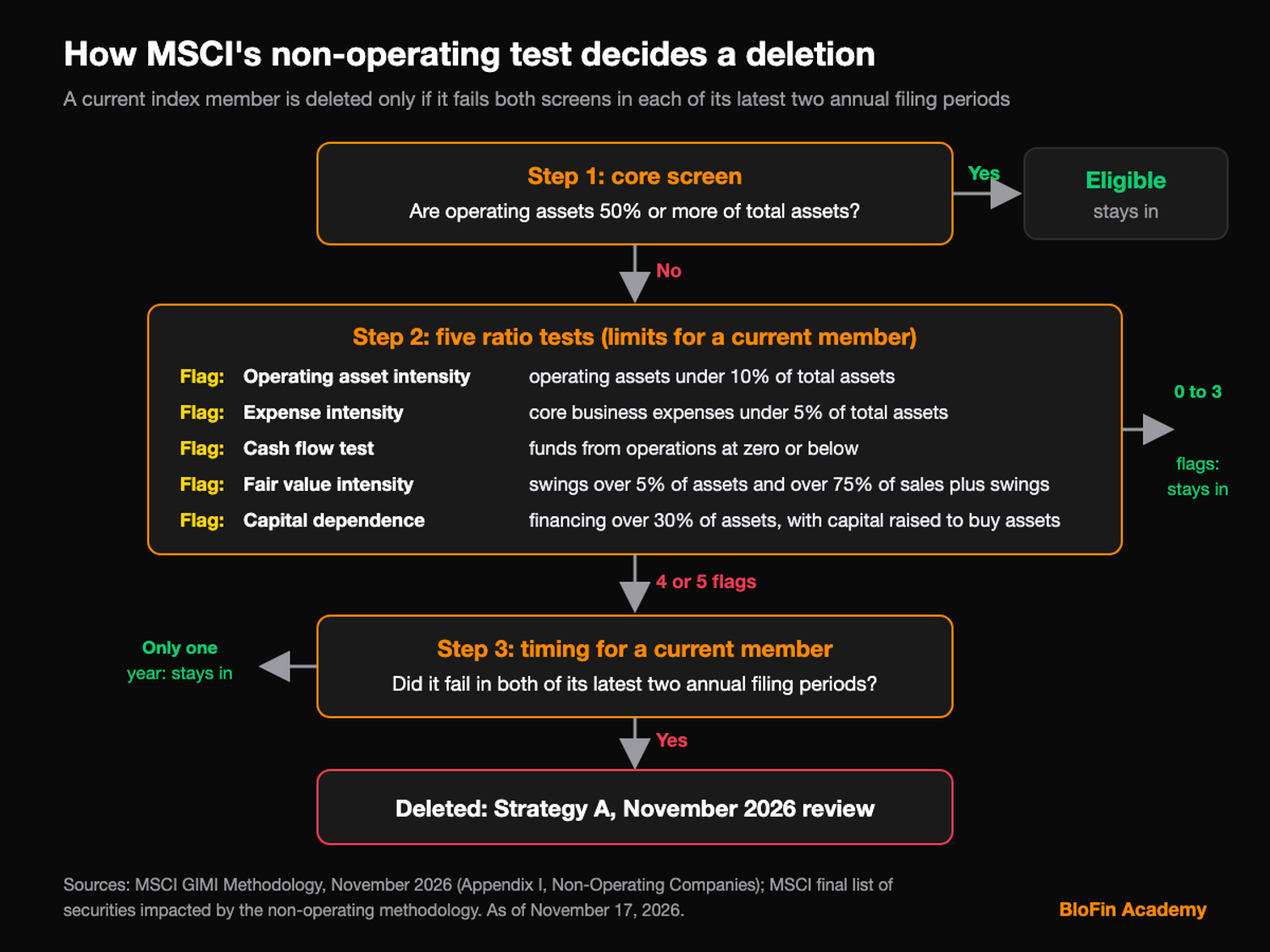
Each of the five ratios measures one way a company can look like a fund. Operating asset intensity is the share of total assets used in the business, and expense intensity compares spending on the core business with total assets. The cash flow test asks whether the company makes cash from its regular work. Fair value intensity measures how much price swings on assets held outside the business move the accounts. Capital dependence measures how far outside financing pays for the company's assets (source: MSCI GIMI rules, November 2026).
Current index members get looser limits than outside companies on three of the five ratios. MSCI's rules set these pass limits:
Ratio test | Pass limit for a current member | Pass limit for a company outside the index |
|---|---|---|
Operating asset intensity | at least 10% of total assets | at least 20% of total assets |
Expense intensity | core business expenses at least 5% of total assets | core business expenses at least 5% of total assets |
Cash flow test | funds from operations greater than zero | funds from operations greater than zero |
Fair value intensity | at most 5% of total assets, or at most 75% of net sales plus fair value changes | at most 5% of total assets, or at most half of net sales plus fair value changes |
Capital dependence | financing cash flow at most 30% of total assets, or no capital raised to build up assets | at most 20% of total assets, or no capital raised to build up assets |
Timing matters as much as the limits. A current member is generally deleted only if it fails both screens in each of its latest two annual filing periods, and MSCI may also look at the latest interim figures (source: MSCI GIMI rules, November 2026). So a deletion means failing in both years checked, and a member that fails in only one of them generally stays in.
The rule never mentions bitcoin (source: Bitcoin Magazine). It applies the same core screen and five ratios to companies in every industry, which is how Yellow Cake in the UK and Metaplanet in Japan ended up on the same deletion list as Strategy. Metaplanet was also on MSCI's 2025 digital asset list.

From the 2025 proposal to the November 2026 decision
MSCI first proposed, in October 2025, to exclude companies whose digital assets make up 50% or more of total assets, with Strategy on its first list (source: MSCI 2025 digital asset consultation). It set that idea aside on January 6, 2026. It then consulted on a broader rule in August, adopted it in October and named the deletions on November 11, 2026.
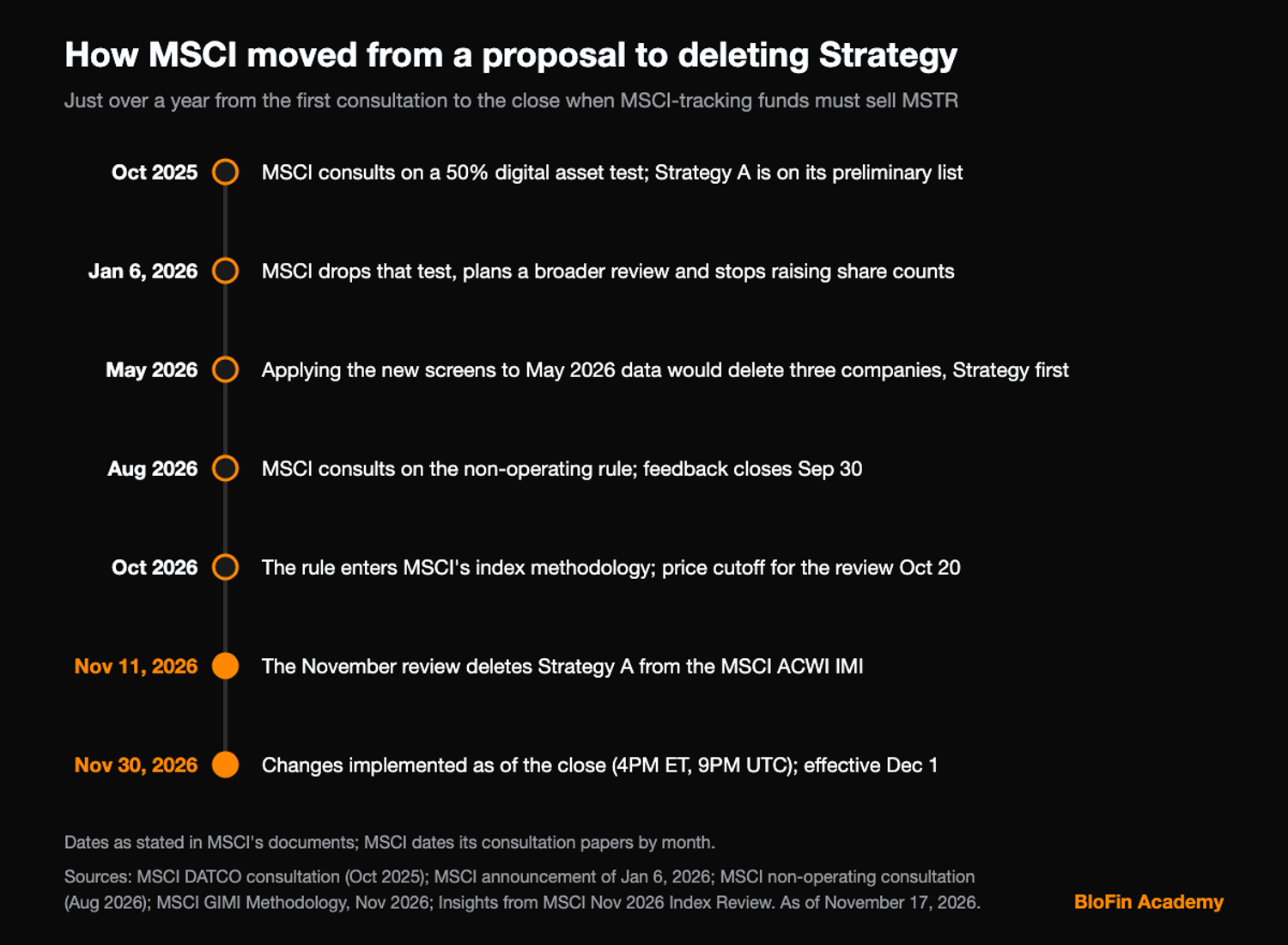
The 2025 plan was aimed at bitcoin and other digital asset treasury companies, and "STRATEGY A" was the first and largest entry on its list of stocks that could be affected (source: MSCI 2025 digital asset consultation). On January 6, 2026, MSCI said it would not apply that plan at the February 2026 review. Instead, it would consult on non-operating companies in general, because companies holding digital assets might belong to a wider group whose main work is investing (source: MSCI announcement of January 6, 2026).
That broader consultation arrived in August 2026. It set out the core screen and the five ratios. It also showed what they would do to the ACWI IMI as of May 2026: three companies would be deleted, with Strategy first among them (source: MSCI August 2026 consultation). Feedback closed on September 30, 2026. MSCI added the method to its index rules in October. The Block reported on October 15 that MSCI would adopt it from the November review (source: MSCI GIMI rules, November 2026, The Block).
The November review then turned the method into a list. MSCI used prices up to an October 20, 2026 cutoff and announced the changes on November 11. It set them for the close of November 30, so funds and other investors had a known date to trade toward (source: MSCI November 2026 review summary).
Strategy's case against the rule
Strategy opposed the rule all through the consultation and asked MSCI to withdraw it. It set out its case on its own MSCI page, and said the rule would make little difference to Strategy itself.
The page sets out four objections (source: Strategy's MSCI page). First, Strategy calls the proposal a pretext for targeting digital asset treasury companies, since it reaches the 2025 test's result by another route. Second, it says MSCI never defines "operating" and "non-operating", and that the terms have no footing in US or international accounting standards or in law. Third, it says it reports its bitcoin business as an operating segment under US accounting rules, which it has discussed with SEC staff. Fourth, it argues that writing MSCI's own policy views into an index weakens the neutrality that index users count on.
Strategy also played down the size of the effect. It said the shares held by funds tracking MSCI's global indexes came to less than one day's trading volume in MSTR (source: Strategy's MSCI page). Bitcoin Magazine reported that the company's letter to MSCI said a deletion would make no real difference to its business (source: Bitcoin Magazine).
Those are Strategy's arguments and Strategy's estimates. MSCI went ahead anyway, and the deletion list it published on November 11, 2026 is what index funds now follow.
What the deletion forces, and what it leaves alone
The deletion forces one group to act: funds that track MSCI's affected indexes must sell their MSTR shares by the November 30, 2026 close. It leaves Strategy's Nasdaq listing, its share count and its bitcoin untouched, and it puts no duty on Strategy itself to do anything.
An index provider only decides what goes into its own indexes. The removal does not delist the stock (source: Bitcoin Magazine), and MSTR has traded on Nasdaq in every session since the decision (source: Nasdaq MSTR price history). Nothing in MSCI's rule makes Strategy sell bitcoin either. The pressure falls on the shares: funds built to copy an MSCI index hold what that index holds.
Picture a fund built to copy the MSCI USA Index. Until the November 30 close, MSTR sits in that index and the fund holds it at its index weight. MSTR leaves the index at that close, so the fund sells its shares by then and spreads the money across the other members. MSCI says it announces each review early, so investors can adjust before the changes take effect (source: MSCI November 2026 review summary).
Other index families run on their own rules. Nasdaq added MSTR to the Nasdaq-100 effective December 23, 2024, under its own index rules (source: Nasdaq's annual changes to the Nasdaq-100). S&P Dow Jones Indices applies its own rules too, and they decide whether MSTR is in the S&P 500.
How much selling the removal could bring
Two estimates frame the selling. In its consultation response, written before MSCI's decision, Strategy put the shares held by MSCI-tracking funds at about 13 million, or 3.1% of its basic shares (source: Strategy's MSCI page). Strategy has sold more Class A shares since then (source: Strategy Form 8-K filed November 16, 2026). JPMorgan had earlier estimated that an exclusion could lead to about $2.8 billion of selling (source: Cointelegraph).
JPMorgan's figure is the larger one, and Cointelegraph repeated it on the evening MSCI announced the review. Bitcoin Magazine reported that JPMorgan's analysts made it in November 2025, based on MSCI's first digital asset test. It added that MSCI has published no figure of its own (source: Cointelegraph, Bitcoin Magazine).
You can size Strategy's own figure with a dated price. MSTR closed on Nasdaq at $103.03 on November 16, 2026, which puts 13 million shares at about $1.3 billion (source: Nasdaq MSTR price history). That day, 21,260,890 MSTR shares traded on Nasdaq, so 13 million shares were about 0.61 of one day's volume. Fund holdings and daily volume both change from week to week, so this gives a scale for the selling, not a final count.
MSTR's price since the November 11 decision
MSTR closed at $122.35 on November 11, 2026, the day MSCI announced the review. By November 16 it had closed at $103.03, a fall of 15.8% over three trading sessions. The forced selling is set for the November 30 close, so all of these sessions came before the funds' deadline.
Cointelegraph reported that Strategy's shares fell 1.65% in after-hours trading on November 11, once the decision was public (source: Cointelegraph). The next sessions closed at $114.41 on November 12, $111.62 on November 13 and $103.03 on November 16 (source: Nasdaq MSTR price history). Many things move MSTR at once, bitcoin's price among them. The fall over these sessions cannot be pinned on the index decision alone.
Part of that move happened outside Nasdaq's regular session, when the MSTRUSDT Perpetual on BloFin kept trading. From 12AM UTC on Saturday, November 14 to 12PM UTC on Monday, November 16, its 4-hour candles ranged from 95.72 to 110.32 USDT (source: BloFin MSTRUSDT market data). The last of those candles closed at 103.39 USDT, about 7.4% lower than Friday's Nasdaq close, before Nasdaq opened on Monday and closed the session down 7.7%.
Holding a position through a fast stretch like this means paying to get in and out, and BloFin's futures fee schedule lists the rate charged on each trade.
Can Strategy get back into MSCI's indexes?
Strategy can return only by passing MSCI's test as a newcomer. A newcomer is judged on its latest two annual filings against stricter limits, and failing in either year keeps it out. Strategy would need to pass the core screen, or trip no more than three of the five ratios, in both years.
The rules spell out that difference (source: MSCI GIMI rules, November 2026). Unlike a current member, a newcomer is shut out if it fails in either year. MSCI runs the non-operating review four times a year, at its February, May, August and November reviews, so each new annual report gives the test fresh figures to read.
Newcomers also face tighter limits on three of the five ratios: operating assets, fair value swings and financing cash flow (source: MSCI GIMI rules, November 2026). A company that clears the bar for staying in can still fall short of the bar for getting in.
None of this says when, or whether, Strategy would get back in. That depends on future balance sheets, on how Strategy funds itself and on MSCI's own reviews. MSCI publishes the result only after each one.
What the November 30 close means for MSTRUSDT traders
MSCI's changes take effect as of the close on Monday, November 30, 2026. On Nasdaq that is 4PM ET, which is 9PM UTC during US standard time. Funds tracking MSCI's indexes have until that close to sell, and the MSTRUSDT Perpetual keeps trading after it, though orders may be limited.
The last week before the deadline is a short one on Nasdaq, because the exchange is shut on Thursday, November 26 for Thanksgiving. On Friday, November 27 it closes early, at 1PM ET (6PM UTC), and no session follows until Monday (source: Nasdaq's 2026 holiday schedule). BloFin's notice covers the hours when Nasdaq is shut. Outside regular hours, and on weekends and holidays, stock futures trading on BloFin "may be limited to reduce-only orders" (source: BloFin stock futures notice). In those windows you can cut or close what you hold, but a new position may need to wait for the next Nasdaq session.
The MSTRUSDT Perpetual tracks Strategy's share price, uses USDT as margin and allows leverage from 1x to 20x (source: BloFin MSTR contract details). Like other BloFin futures perpetuals, it has no expiry date. A sharp move around the close can reach a leveraged position fast, so know your liquidation price before the date.
If you plan to hold through it, see how a stop-loss works on BloFin. Position size matters as much as the leverage you pick, and both sit at the core of futures risk management.
Index dates are one kind of dated MSTR event. Earnings reports and 8-K filings also arrive on known days, and the same checks apply before each one.
Following MSTR through the MSCI deletion at the November 30 close? To get started, you'll need to first create a BloFin account, fund your account with cryptocurrency, and go to the MSTRUSDT Perpetual trading page.

Frequently asked questions
Which other companies did MSCI remove under the non-operating rule?
MSCI's final impact list marks six stocks as deleted. They are Strategy A and Upexi in the US, Yellow Cake and Agronomics in the UK, Metaplanet in Japan and Skel Fjárfestingafélag in Iceland (source: MSCI final impact list). Strategy is the only large-cap stock among them. Agronomics and Upexi are micro-cap members, and Skel is listed in Iceland, which MSCI classes as a frontier market (source: MSCI final impact list, MSCI GIMI rules, November 2026). The list covers MSCI's ACWI All Cap and Frontier Markets IMI indexes, while the review summary counts only the three ACWI IMI deletions. Another 19 companies, including SharpLink, are "on Watchlist". MSCI's August 2026 consultation used the watchlist for members that fail on their latest filing but not yet for two years in a row (source: MSCI August 2026 consultation).
What was MSCI's 50% digital asset test?
It was MSCI's October 2025 plan to exclude digital asset treasury companies, such as bitcoin holders, once digital assets made up 50% or more of total assets. Its first list, compiled from data as of October 29, 2025, valued Strategy A at about $90.4 billion at September 30, 2025 prices, with MARA Holdings, Hut 8 and Metaplanet also on it (source: MSCI 2025 digital asset consultation). MSCI planned results by January 15, 2026, then set the test aside.
What did MSCI freeze for Strategy in January 2026?
When MSCI set the digital asset test aside on January 6, 2026, it kept the companies on its first list in the indexes, provided they still met its other inclusion rules, but froze how it treated them. It stopped raising their share counts and their foreign and domestic inclusion factors, and it put off any additions or moves between size segments (source: MSCI announcement of January 6, 2026). MSCI's November 2026 review summary says the interim measures for digital asset treasury companies, which it describes as announced on October 10, 2025, are discontinued (source: MSCI November 2026 review summary).
Which filings does MSCI use in its non-operating review?
Each quarterly review generally uses financial filings published by a cutoff date. For the February review it is the last business day of December. The cutoffs for May, August and November are the last business days of March, June and September (source: MSCI GIMI rules, November 2026). The capital dependence test is judged across the two filing periods together, while the other four ratios are checked for each period on its own.
What is a free float-adjusted market cap?
Free float-adjusted market cap is the value of only the shares open to outside investors, leaving out stakes that are locked up or held for strategic reasons, such as large insider holdings. MSCI's indexes weight each stock by this figure. On MSCI's final list, Strategy A had a company market cap of about $40.1 billion at October 20, 2026 prices and a float-adjusted market cap of about $37.3 billion (source: MSCI final impact list). That means MSCI counted about 93% of the company as investable.
Researched and written by the BloFin Academy editorial team with AI-assisted drafting. All facts independently verified. Primary sources include MSCI's November 2026 review summary, final impact list and GIMI rules of November 2026. They also include its two consultations and its announcement of January 6, 2026. Other sources are Strategy's MSCI response page and its Form 8-K filed November 16, 2026, Nasdaq's Nasdaq-100 announcement, holiday schedule and MSTR historical data, Bitcoin Magazine, Cointelegraph and The Block. BloFin's sources are its MSTR contract details, market data and stock futures notice, current as of November 17, 2026.
Nothing in this article constitutes financial advice, and nothing in it is a recommendation to buy, sell or hold Strategy in any form. Forced selling by index funds is set for one close, and the price can move sharply before, during and after it. On the MSTRUSDT Perpetual, a fast move at leverage can liquidate your margin, and funding payments can cost you money while you hold. Outside Nasdaq hours you may only be able to reduce a position. Past performance does not indicate future results. Do your own research and consider your risk tolerance before you trade on BloFin.