
A company that borrows money to buy a volatile asset raises one question first: what happens if the asset falls while the loans are still out? The answer depends on the fine print of each loan. The dates, the interest rate and the collateral decide whether a falling price ever turns into a bill that has to be paid.
That fine print rarely makes the headlines. Posts about a "debt wall" or a coming margin call tend to quote one total and skip the terms. Yet two loans of the same size can behave in very different ways when the borrower's shares or assets drop.
Strategy (MSTR), formerly MicroStrategy, is the clearest public example. It has borrowed billions of dollars through convertible notes and spent the money on bitcoin. On BloFin, you can trade MSTR's price through the MSTRUSDT Perpetual, one of the stock contracts in BloFin's tradfi markets.
How much debt does Strategy have?
Strategy owed $6.8 billion of debt principal on September 30, 2026. Almost all of it, $6.7 billion, sits in six series of convertible notes, and the remaining $39.9 million is two small secured loans (source: Strategy Form 10-Q for Q3 2026). The first date on which noteholders can demand cash is September 15, 2027, when the $1.0 billion of 2028 notes can be put back (source: Strategy Form 10-Q for Q3 2026).
Investor.gov describes a convertible security as a bond or preferred share that can be swapped for a different security, most often the company's common stock (source: Investor.gov on convertible securities). For Strategy's notes, the share price at which that swap happens is called the conversion price. The notes are unsecured, which means no asset is pledged behind them. The 10-Q ranks them effectively behind the secured loans, to the extent of the assets backing those loans.
The two secured loans are an $11.1 million term loan from June 2022 and a facility of up to $31.1 million from June 2025. Both are backed by company assets other than bitcoin (source: Strategy Form 10-Q for Q3 2026). On the balance sheet, the debt shows up at a carrying value of $6.7 billion. Of that, $1.0 billion is the current portion, mostly the 2028 notes, and $5.7 billion is long-term debt (source: Strategy Q3 2026 earnings release).
The notes are only part of what ranks ahead of MSTR shareholders. Strategy's perpetual preferred stock carried a liquidation preference of $14.1 billion on the same date (source: Strategy Q3 2026 earnings release). The preferred series and their dividends work differently from debt, because their principal never falls due.
Strategy's convertible notes, tranche by tranche
Each of Strategy's six notes has two dates that matter. The holder put date always comes first: on it, each holder can make Strategy buy the note back for cash at full face value plus accrued interest. The maturity date comes later and is when any remaining principal is finally due. Coupons run from 0% to 2.25% a year (source: Strategy Form 10-Q for Q3 2026).
The largest series is the $2.0 billion of 2030B notes, the 2029 notes are down to $1.5 billion, and the 2030A and 2032 notes are $800.0 million each. The 2028 and 2030A notes both pay 0.625% (source: Strategy Form 10-Q for Q3 2026).
Holder put date | Note | Coupon | Conversion price | Maturity year | Principal |
|---|---|---|---|---|---|
September 15, 2027 | 2028 notes | 0.625% | $183.19 | 2028 | $1.0 billion |
March 1, 2028 | 2030B notes | 0% | $433.43 | 2030 | $2.0 billion |
June 1, 2028 | 2029 notes | 0% | $672.40 | 2029 | $1.5 billion |
September 15, 2028 | 2030A notes | 0.625% | $149.77 | 2030 | $800.0 million |
September 15, 2028 | 2031 notes | 0.875% | $232.72 | 2031 | $603.7 million |
June 15, 2029 | 2032 notes | 2.25% | $204.33 | 2032 | $800.0 million |
Every conversion price sits well over the share price. MSTR closed at $103.03 on Nasdaq on November 16, 2026 (source: Nasdaq MSTR historical data). Even the lowest conversion price, $149.77 on the 2030A notes, was 45.4% higher than that close. The 2029 notes would need MSTR to rise more than sixfold before converting paid off.
Four of the six put dates fall in 2028. Together they carry $4.9 billion, or 73.0% of the convertible principal. The 2031 notes are $603.7 million, which the Strategy debt dashboard rounds to $604 million (source: Strategy debt dashboard). The dashboard also lists the first date on which Strategy itself can call each note. Its call dates match the 10-Q, and the indenture for each note is the binding text (source: Strategy Form 10-Q for Q3 2026).
Why buyers accept a 0% coupon
A convertible note is two things: a bond that repays its principal, and an option to swap that principal for shares. The option is worth more when the share price swings widely, since big swings raise the chance the stock ends far past the conversion price. So investors lend to a volatile company at little or no interest (source: Wikipedia on convertible bonds).
MSTR swings hard. Its 30-day historical volatility stood at 74.7% on Strategy's dashboard at 12.14PM ET on November 17, 2026 (source: Strategy dashboard). That helps explain how $3.5 billion of its outstanding notes, the 2029 and 2030B series, can carry no regular interest at all. Bitcoin's own swings feed into MSTR's, and BloFin's guide to why bitcoin is so volatile explains where they come from.
Many note buyers never plan to keep the shares. A common hedge fund trade, called convertible arbitrage, buys the note and sells the company's stock short against it (source: Wikipedia on convertible bonds). The short sale offsets much of the share-price risk, which makes it a cousin of the delta-neutral strategies crypto traders use. Short sales of this kind can show up in MSTR's short interest, so part of the reported figure may be hedging rather than a bet against the company.

Can Strategy's debt force it to sell bitcoin?
Strategy's convertible notes carry no margin call, because no bitcoin is pledged behind them. A fall in the bitcoin price gives noteholders no right to take coins or to demand early payment. The 10-Q calls the notes senior unsecured obligations, and the terms of the 2030B notes say they are unsecured and rank behind any secured debt (source: Strategy Form 10-Q for Q3 2026, Strategy Form 8-K of February 24, 2025).
Strategy has borrowed against bitcoin before, which is where the margin-call idea comes from. A Silvergate Bank loan to its subsidiary MacroStrategy was backed by bitcoin until March 24, 2023. On that day MacroStrategy prepaid about $161.0 million, and the bank released the bitcoin that had served as collateral (source: Strategy Form 8-K of March 27, 2023). Strategy then redeemed all $500 million of its 6.125% senior secured notes on September 26, 2024, at 103.063% of principal. It paid with money raised by the 2028 convertible notes (source: Strategy Q3 2024 earnings release, October 30, 2024).
One narrow lien can still appear. The firms that carry out Strategy's bitcoin purchases can give it short-term trade credit, and while that credit is unpaid they can hold a first-priority lien on some of the bitcoin. The 10-Q reports no such credit outstanding at September 30, 2026 (source: Strategy Form 10-Q for Q3 2026).
What can force cash out is the calendar. At each put date, a holder can hand the note back for its full principal in cash, and at maturity whatever is left is due. While MSTR trades under a note's conversion price, swapping into shares is worth less than face value. A holder who wants out then has every reason to take the cash. If MSTR is over the conversion price instead, Strategy chooses whether to settle a conversion in cash, in class A shares, or in a mix of both (source: Strategy Form 10-Q for Q3 2026).
Other ways the notes can demand cash early
Three other clauses can bring a payment forward: a fundamental change, Strategy's own call, and an event of default. After a fundamental change, holders can make Strategy buy back their notes for cash at full principal plus accrued interest. For the 2030B notes, the term covers certain business combinations and "certain de-listing events" for the class A shares (source: Strategy Form 10-Q for Q3 2026, Strategy Form 8-K of February 24, 2025).
So the trigger is tied to where the shares are listed and who controls the company. Being dropped from a stock index changes which funds hold MSTR, while the shares stay listed on Nasdaq.
Strategy's call works the other way. From each note's first call date, which for the 2029 notes is December 4, 2026, Strategy can redeem the notes at principal plus accrued interest. It can do so only after MSTR's price has been at least 130% of the conversion price for a set run of trading days (source: Strategy Form 10-Q for Q3 2026). Because a call can only come when the shares are that high, a holder who receives one can usually convert and get more than face value.
Events of default are the last route. The 2030B notes list seven, among them failing to pay, failing to deliver on a conversion within five days, a default on other borrowed-money debt of at least $200 million, and bankruptcy. After most defaults, holders of at least 25% of a series can declare the whole amount due at once. A bankruptcy of Strategy itself makes the principal due straight away (source: Strategy Form 8-K of February 24, 2025). Strategy's glossary warns that its own BTC Rating does not account for cross-defaults of this kind (source: Strategy dashboard notes).
What Strategy's debt costs each year
Strategy's convertible notes cost about $34.6 million of cash interest a year, applying each coupon to its principal. The bill is small because the 2029 and 2030B notes, 52.1% of the principal, pay no regular interest. The other four pay 0.625% to 2.25% a year. From January through September 2026, Strategy paid $25.6 million of cash interest (source: Strategy Form 10-Q for Q3 2026).
The larger yearly bill belongs to the preferred stock. Strategy's credit dashboard gives a BTC Breakeven ARR of 2.59%. Strategy defines that as its yearly interest and dividends divided by the value of its bitcoin, which it calls the BTC Reserve (source: Strategy dashboard notes). On November 17, 2026, the credit dashboard showed the BTC Reserve as $55.2 billion, worked out at a bitcoin price of $64,900 (source: Strategy credit dashboard). The main dashboard gave the yearly bill itself, which Strategy calls Annual Int + Div, as $1.4 billion at the same update, so note interest is only about 2.4% of it (source: Strategy dashboard).
Strategy sets cash aside for that bill. Its USD Reserve is money that management has set aside to help pay preferred dividends and interest on its debt (source: Strategy dashboard notes). The reserve stood at $4.8 billion on November 15, 2026 (source: Strategy Form 8-K of November 16, 2026).
Adding $151.2 million of USD Cash, Strategy's USD Assets came to $4.9 billion on November 15, 2026 (source: Strategy Form 8-K of November 16, 2026). Strategy's dashboard put their coverage of dividend and interest obligations, which it calls USD Duration, at 3.4 years (source: Strategy dashboard). Its glossary adds that USD Duration assumes none of the money goes to repaying notes at a put date or at maturity. The 3.4 years describes the yearly bill alone (source: Strategy dashboard notes).
How Strategy repaid half of the 2029 notes in May 2026
Strategy's last buyback is the clearest guide to how it handles a put date. On May 14, 2026, it agreed with certain holders to buy back about $1.5 billion of its 0% 2029 notes for an estimated $1.4 billion in cash. It named three possible ways to pay: available cash reserves, at-the-market sales of its securities and bitcoin sales (source: Strategy Form 8-K of May 15, 2026).
The deal closed on May 19, 2026. Strategy paid $1.4 billion including costs, about 92 cents per dollar of principal, and booked a gain of about $113.9 million in the second quarter. That left $1.5 billion of the 2029 notes outstanding (source: Strategy Form 10-Q for Q3 2026).
Its release of May 26, 2026 described the payment as a use of cash reserves. It said total convertible principal had fallen from $8.2 billion to $6.7 billion (source: Strategy release of May 26, 2026). The same release gave the USD Reserve as $871 million on May 25, with a plan to replenish it over time.
The repurchase shows the trade-off on both sides. Holders who wanted cash before their June 2028 put date accepted an 8% discount to get it early. Strategy retired debt for less than face value, but it drew its reserve down to do so. It later rebuilt the reserve, which stood at $4.8 billion by November 15, 2026.
What each put date means in bitcoin
At bitcoin's November 16, 2026 UTC daily close of $64,865.40, all six notes together equal about 103,501 BTC (source: BloFin BTC-USDT market data). That is 12.2% of the 850,849 BTC Strategy held on November 15, 2026. The first put, the $1.0 billion of 2028 notes that holders can put back on September 15, 2027, equals about 15,571 BTC at that close (source: BloFin BTC-USDT market data, Strategy Form 8-K of November 16, 2026).
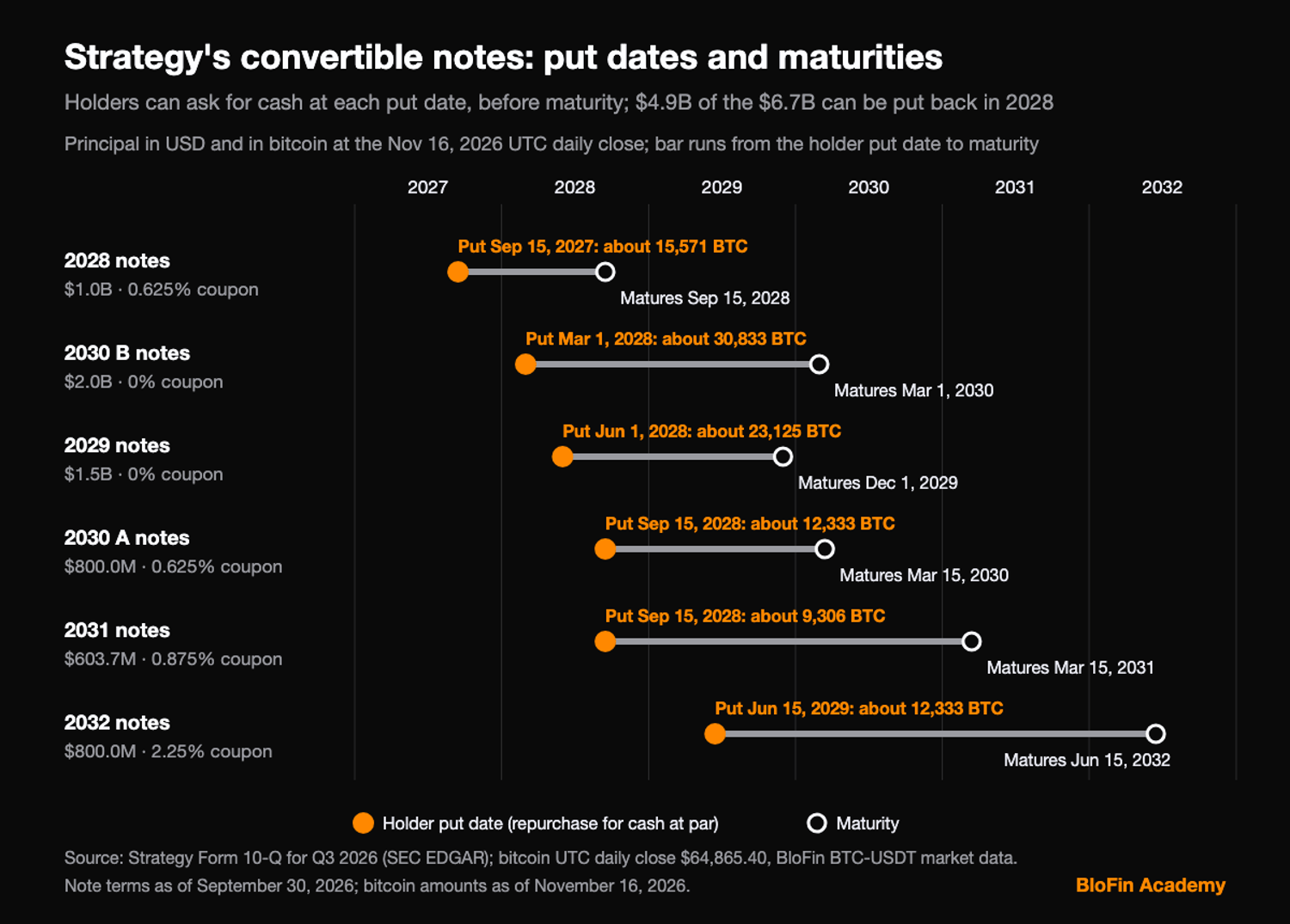
The heaviest single date is March 1, 2028. On it, the $2.0 billion of 2030B notes can be put back, about 30,833 BTC at the same close. These bitcoin figures move with the price, while the dollar amount owed stays fixed. A lower bitcoin price means more coins would be needed to raise the same cash, and a higher one means fewer.
Paying at a put does not have to involve bitcoin. For the 2029 buyback, Strategy named cash reserves, sales of its securities and bitcoin sales as possible sources, and its release then described the payment as a use of cash reserves. You can follow where MSTR trades against its conversion prices on the MSTRUSDT Perpetual trading page, the contract that tracks Strategy's share price on BloFin.
Strategy's leverage ratio
On the 10-Q's figures, Strategy's $6.8 billion of debt principal was 9.5% of the value of its bitcoin on September 30, 2026. Its 847,666 BTC were worth $70.8 billion at that day's UTC daily close of $83,576.90. Adding the preferred stock's $14.1 billion liquidation preference lifts the claims ahead of shareholders to $20.9 billion, or 29.4% of the bitcoin's value (source: Strategy Form 10-Q for Q3 2026, Strategy Q3 2026 earnings release, BloFin BTC-USDT market data).
The ratio moves with bitcoin. With the same debt and 850,849 BTC at the November 16, 2026 close, the bitcoin was worth $55.2 billion (source: BloFin BTC-USDT market data). The debt then equalled 12.2% of it, because bitcoin had fallen 22.4% in the meantime.
Strategy publishes its own coverage figure, the BTC Rating. For a debt instrument, its glossary defines this as the BTC Reserve divided by the notional value of that instrument plus everything senior to it and any equal-ranking instrument due sooner. For debt, it first subtracts a matching share of Strategy's USD Assets from that total (source: Strategy dashboard notes). On November 17, 2026, the credit dashboard, computed at a bitcoin price of $64,900, showed a BTC Rating of 30.4x for total debt. Once the preferred stock is included, the figure falls to 3.8x (source: Strategy credit dashboard). Because the dollar reserve is netted off first, the BTC Rating comes out much higher than the plain measure. At the November 16 close, bitcoin covered the full debt principal 8.2 times (source: BloFin BTC-USDT market data).
What Strategy's BTC credit metrics measure
Strategy's credit metrics are its own illustrative models. The dashboard says BTC Rating is not a rating from any rating agency and is not the same as a rating in the usual financial sense. It also says none of BTC Rating, BTC Credit or BTC Risk measures financial results or liquidity, and that actual results may vary materially (source: Strategy credit dashboard).
BTC Risk is the chance, under a lognormal model of bitcoin's price, that an instrument's BTC Rating falls under 1 by the end of its duration. BTC Credit is the yearly credit spread that would offset that risk, assuming nothing is recovered (source: Strategy dashboard notes). The dashboard's November 17, 2026 table used a bitcoin price of $64,900, 40% bitcoin volatility and a 10% yearly bitcoin return. On those inputs, every convertible note showed a BTC Risk of 0.00% and a BTC Credit of 0 basis points. The preferred series showed a BTC Credit of 8 to 121 basis points (source: Strategy credit dashboard). Those zeros come from Strategy's assumptions, and a lower return or a higher volatility input raises the modeled risk.
Two of the metrics turn into numbers a beginner can picture. The BTC Floor is the bitcoin price at which an instrument's BTC Rating equals 1.0x. It was $321 for the 2028 notes and $2,132 for all six notes together. The BTC Breakeven ARR of 2.59% is the yearly rise in bitcoin at which, in Strategy's words, it "can fund interest and dividend obligations through BTC capital gains in perpetuity" (source: Strategy credit dashboard, Strategy dashboard notes).
Strategy also defines a BTC Hurdle ARR, which it calls its "current effective cost of credit". A BTC Floor ARR is the lowest steady bitcoin return that keeps an instrument fully covered after paying interest and dividends over its duration (source: Strategy dashboard notes).
What Strategy's debt means for MSTRUSDT traders
Strategy's borrowing is one reason MSTR tends to swing more than bitcoin. Part of its bitcoin was paid for with borrowed money and preferred stock, both of which get paid before MSTR shareholders. The MSTRUSDT Perpetual allows leverage from 1x to 20x, which adds a second layer of leverage and liquidation risk on top (source: BloFin MSTR contract details).
How to size a leveraged MSTR position starts from that stacked risk, and BloFin's guide to placing a stop-loss on BloFin covers the order that caps a loss.
The debt calendar also produces news. A repurchase, a call or a new note issue is announced in an 8-K, and the perpetual can react before Nasdaq opens. BloFin's notice says that outside regular US hours, on weekends and on holidays, these contracts "may be limited to reduce-only orders", which matters if a filing lands in one of those windows (source: BloFin stock futures notice). BloFin's guide to event risk covers trading around scheduled news. Strategy's wider bitcoin strategy and capital stack show where the notes fit among its other ways of raising money.
Want to trade MSTR knowing what Strategy's debt can and cannot force it to do? To get started, you'll need to first create a BloFin account, fund your account with cryptocurrency, and go to the MSTRUSDT Perpetual trading page.

Frequently asked questions
Does Strategy pay interest on all of its convertible notes?
Four of Strategy's six convertible notes pay interest twice a year. The 2028, 2030A and 2031 notes pay on March 15 and September 15, and the 2032 notes pay on June 15 and December 15. The 2029 and 2030B notes pay no regular interest. Strategy paid $8.3 million of cash interest in the third quarter of 2026 (source: Strategy Form 10-Q for Q3 2026).
How much of Strategy's debt comes due each year?
Strategy's 10-Q schedules its debt principal in 12-month periods ending September 30, placing each note in the period of its first put date. The period to September 30, 2027 holds $1.0 billion, made up of the 2028 notes and the two secured loans, one of which matures in the fourth quarter of 2026. The next two periods hold $4.9 billion and $800.0 million. Nothing is scheduled after September 2029, because every note's put date falls by June 2029 (source: Strategy Form 10-Q for Q3 2026).
What happens if MSTR rises above a convertible note's conversion price?
Before each note's free-conversion date, holders can convert only under set conditions, such as MSTR trading at or above 130% of the conversion price on at least 20 of 30 trading days. When a holder converts, Strategy decides whether to pay in cash, class A shares or both. A conversion paid in shares adds to the share count (source: Strategy Form 10-Q for Q3 2026).
Does Strategy have a credit rating from S&P?
S&P Global Ratings assigned Strategy a B- corporate credit rating on October 27, 2025 and affirmed it in December 2025, after Strategy set up its USD Reserve, according to Strategy's third-quarter 2026 10-Q. B- is a speculative grade. The Block reported a stable outlook and S&P's concern about low dollar liquidity and the mismatch between bitcoin assets and dollar debts. Strategy's October 30, 2025 release noted that ratings may be changed or withdrawn at any time (source: Strategy Form 10-Q for Q3 2026, The Block, Strategy Q3 2025 earnings release).
When did Strategy borrow money to buy bitcoin in 2020?
Strategy, then called MicroStrategy, borrowed for bitcoin in December 2020. It sold $650 million of 0.75% convertible notes due December 15, 2025 and said it intended to invest the net proceeds in bitcoin. A later series, the 2027 notes, was fully redeemed or converted into class A shares in the first quarter of 2025 (source: MicroStrategy Form 8-K of December 11, 2020, Strategy Form 10-Q for Q3 2026).
Researched and written by the BloFin Academy editorial team with AI-assisted drafting. All facts independently verified. Note terms come from Strategy's Form 10-Q for the third quarter of 2026, its Forms 8-K of December 11, 2020, March 27, 2023, February 24, 2025, May 15, 2026 and November 16, 2026, its earnings releases for the third quarters of 2024, 2025 and 2026, and its release of May 26, 2026, all on SEC EDGAR. Strategy's credit metrics and definitions come from its dashboard, debt dashboard, credit dashboard and dashboard notes. Prices are Nasdaq MSTR historical data and BloFin BTC-USDT market data; every ratio, bitcoin amount and interest figure was computed from those sources. Other sources are Investor.gov, Wikipedia and The Block. BloFin's sources are its MSTR contract details and stock futures notice, current as of November 19, 2026.
Nothing in this article constitutes financial advice, and nothing in it is a recommendation to buy, sell or hold Strategy in any form. Strategy's notes, preferred dividends and bitcoin holdings mean its shares can fall faster than bitcoin, and a put date, a call or a new filing can move MSTR sharply. On the MSTRUSDT Perpetual, leverage can liquidate your margin in a move of that kind, and gaps while Nasdaq is closed can open before you are able to act. Past performance does not indicate future results. Do your own research and consider your risk tolerance before you trade on BloFin.