
Most companies are valued for what they make and sell. A few are valued mainly for what they hold, and their shares behave differently. When a company keeps most of its value in one asset and borrows to buy more of it, the shares tend to rise faster than the asset in good years and fall harder in bad ones.
That makes the usual way of judging a stock less useful. Sales and profit margins tell you little when the share price follows a coin. A good year for the coin can even be a poor year for the shares, if the company's own funding gets more expensive at the same time.
Companies built this way are often called bitcoin treasury companies. The better test for one is a short list of conditions you can check yourself. They cover what the coin does, what the market pays for the company's coins, how new shares change your slice, and whether the bills get paid.
Strategy (formerly MicroStrategy), which trades on Nasdaq as MSTR, is one of these companies, and in November 2026 several of those conditions turned against it at once. Its reported profit also swings with the bitcoin price, as Strategy's earnings show each quarter, so a price-to-earnings ratio says little here. On BloFin, the share price is tracked by the MSTRUSDT Perpetual.
Is MSTR stock a good investment?
Whether MSTR stock is a good investment depends on four conditions. Bitcoin has to rise, and the shares must keep a premium to their bitcoin. Share sales must add bitcoin per share, and Strategy has to keep paying about $1.4 billion a year in interest and preferred dividends (source: Strategy dashboard). When these weaken, MSTR tends to fall faster than bitcoin.
Each condition can be checked against a public figure, and each one turns against the shares when it breaks. Bitcoin is the engine, so a fall in the coin hits the stock first. The premium decides whether selling new stock helps or hurts the people who already own it. New share sales decide whether your slice of Strategy's bitcoin grows or shrinks, so they matter as much as the coin's price. The yearly bill for interest and dividends is the one cost that keeps running whatever bitcoin does.
These conditions are what decide the outcome for a shareholder. Each one has a current reading that you can compare with the next filing.
MSCI's removal of Strategy and MSTR's 2026 fall
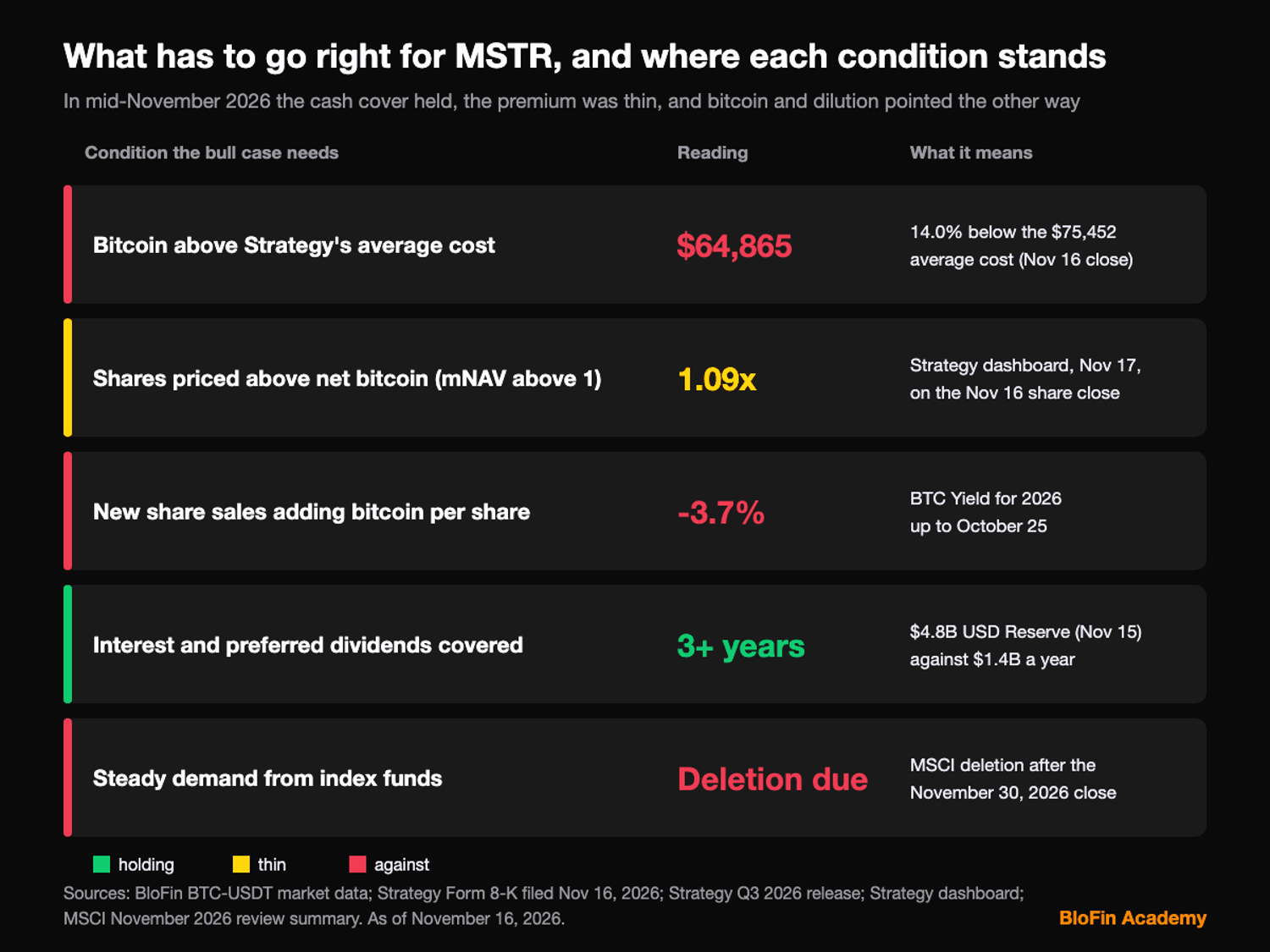
MSCI ruled on November 11, 2026 that Strategy A comes out of the MSCI ACWI IMI, a global index of large, mid and small companies, under a new screen for non-operating companies. The deletion takes effect after the November 30, 2026 close (source: MSCI November 2026 review summary). The first use of that screen removed three companies from the index: Strategy A, Yellow Cake and Metaplanet (source: MSCI November 2026 review summary).
The news hit a stock that was already falling. MSTR closed at $122.35 on November 11 and at $103.03 on Monday, November 16, a drop of 15.8% in three sessions. It ended 2025 at $151.95, so it is down 32.2% for 2026 to the November 16 close (source: Nasdaq MSTR historical data). Over the same dates, bitcoin fell 25.9%, from $87,590.80 to $64,865.40 on BloFin's BTC-USDT daily closes (source: BloFin BTC-USDT market data).
A portfolio that copies an index buys the stocks that join it and sells the ones that leave, so the deletion means selling of MSTR by funds that track the MSCI ACWI IMI (source: MSCI November 2026 review summary). The likely size of that selling, and the timetable behind it, are worked through in the full breakdown of MSTR's MSCI exclusion.

The bull case for MSTR stock
The bull case needs all four conditions to hold together. If bitcoin rises, Strategy's 850,849 bitcoin gain value. A premium then lets it sell shares that buy more bitcoin than they dilute, while a cash reserve keeps the interest and dividend bill paid without selling the coin.
Strategy paid an average of $75,452 for each of those bitcoin, fees included. Its filing of November 16, 2026 also reported 485 bitcoin bought in the week to November 15, and no sales (source: Strategy Form 8-K filed November 16, 2026). The rest of the bull case is a chain, and each link has to hold.
Bitcoin rising over time
Bitcoin's price sets the value of most of what Strategy owns, so it comes first, and it is the one condition the company has no control over. At BloFin's November 16 daily close of $64,865.40, bitcoin traded 14.0% below Strategy's average cost (source: BloFin BTC-USDT market data). In other words, the holdings were worth less than Strategy paid for them. A rise back above $75,452 would put the purchase record in profit again. The bull case needs bitcoin to climb well past that over the years you would hold it, because every other condition gets easier when it does.
The premium holding above 1
Strategy measures its premium with a ratio it calls mNAV. That is the share price divided by net bitcoin per share, after debt and preferred stock and net of its cash (source: Strategy dashboard notes). On November 17, Strategy's dashboard showed mNAV at 1.09x, using the November 16 closing share price, so the shares were priced 9% above the net bitcoin behind each one (source: Strategy dashboard). Strategy's notes say that, if prices hold still, selling common stock to buy bitcoin above an mNAV of 1 would be expected to add net bitcoin per share (source: Strategy dashboard notes). The way MSTR's mNAV is calculated, and how it has changed, sits behind every reading.
Share sales adding bitcoin per share
In the first nine months of 2026, Strategy paid for its bitcoin mainly by selling new class A shares, which raised $13.6 billion, and a preferred stock, STRC, which raised $7.5 billion (source: Strategy Form 10-Q for the third quarter of 2026). The test is whether each holder ends up with more bitcoin per share afterwards. Strategy's class A and class B share count rose 47.0% in a year, from 287,353,735 shares at October 30, 2025 to 422,354,607 at October 25, 2026 (source: Strategy Form 10-Q for the third quarter of 2026, Strategy Form 10-Q for the third quarter of 2025). Strategy's own BTC Yield, the percentage change in its bitcoin per share, was minus 3.7% for 2026 up to October 25 (source: Strategy third-quarter 2026 earnings release). This year's issuance has thinned each share's bitcoin, which is the opposite of the bull case. When issuance helps and when it hurts depends on MSTR's share count and dilution.
The preferred bill covered
Strategy owes interest on its convertible notes and dividends on five preferred stocks: STRF, STRC, STRE, STRK and STRD (source: Strategy credit dashboard). Its main dashboard put that yearly bill at $1.4 billion on November 17 (source: Strategy dashboard). Against it sits a USD Reserve of $4.8 billion at November 15, 2026, set aside for those payments (source: Strategy Form 8-K filed November 16, 2026). That reserve alone covers a little over three years of the bill at its current size. Strategy's own measure, which also counts its smaller USD Cash balance, shows 3.4 years and assumes none of the money goes to convertible-note put rights or maturities (source: Strategy dashboard, Strategy dashboard notes). The choices Strategy would face once the reserve runs low are covered in Strategy's options if bitcoin falls further.
The bear case for MSTR stock
The bear case reads the same figures the other way. Bitcoin sits below the average cost, the premium is thin and bitcoin per share is shrinking. The reserve set aside for the bill shrinks as it is used unless Strategy adds to it. Together they give the stock less support, and the MSCI removal adds sellers on a fixed date.
Bitcoin falling further
A lower bitcoin price cuts the value of the holdings, while the debt and preferred claims stay the same size in dollars. So the shareholders' slice shrinks faster than the coin. That leverage shows in the past year. From the November 14, 2025 close to the November 16, 2026 close, MSTR fell 48.4% while bitcoin fell 31.4% on the same dates (source: Nasdaq MSTR historical data, BloFin BTC-USDT market data).
The premium slipping below 1
Below an mNAV of 1, Strategy's notes say such a sale would be expected to reduce net bitcoin per share, on the same assumption that prices hold still (source: Strategy dashboard notes). The Block reported that on June 26, 2026, Strategy's enterprise mNAV, a version that also takes in debt, cash and preferred stock, dipped under 1 for a while (source: The Block on Strategy's enterprise mNAV). Strategy changed its own mNAV definition on July 23, 2026, and says older readings cannot be compared with the current one (source: Strategy dashboard notes). At 1.09x on November 17, the premium had little room left.
Dilution outpacing the bitcoin
A 47% rise in the share count in one year means each existing holder owns a smaller part of the company. That pays off only when the new money buys more bitcoin per share than it gives away. The minus 3.7% BTC Yield for 2026 shows the reverse happened this year. While the premium stays close to 1, further sales have little room to add bitcoin per share.
More index removals
MSCI's removal is confirmed and takes effect after the November 30 close. If another index provider adopted a similar screen for companies that mainly hold financial assets, funds that track it would face the same kind of selling. Demand from passive funds would then shrink again. The wider list of dangers, including what short sellers and critics argue, is gathered in the main MSTR stock risks.
How MSTR has moved against bitcoin
MSTR has moved further than bitcoin in every calendar year since 2023, in both directions. It gained 346.2% in 2023 and 358.5% in 2024, against 153.3% and 122.5% for bitcoin, then fell 47.5% in 2025 while bitcoin lost 6.4% (source: Nasdaq MSTR historical data, BloFin BTC-USDT market data, CoinMarketCap bitcoin historical data). That is the pattern a leveraged holder of one asset tends to show.
MSTR's figures use Nasdaq's split-adjusted closes, and bitcoin's use BloFin's BTC-USDT daily closes (UTC days) for the same dates, with 2026 counted to the November 16 close. The December 30, 2022 bitcoin price predates BloFin's data and comes from CoinMarketCap.
Period | MSTR change (Nasdaq closes) | Bitcoin change (BloFin daily closes) |
|---|---|---|
2023 (Dec 30, 2022 to Dec 29, 2023) | +346.2% | +153.3% |
2024 (Dec 29, 2023 to Dec 31, 2024) | +358.5% | +122.5% |
2025 (Dec 31, 2024 to Dec 31, 2025) | −47.5% | −6.4% |
2026 (Dec 31, 2025 to Nov 16, 2026) | −32.2% | −25.9% |
From its record close of $473.83 on November 20, 2024, MSTR has fallen 78.3% to $103.03. Bitcoin is 31.2% lower than on that day (source: BloFin BTC-USDT market data). Longer periods, and spot bitcoin funds, come into the comparison in MSTR versus bitcoin.
Why Strategy says it differs from a bitcoin ETF
Spot bitcoin funds such as BlackRock's iShares Bitcoin Trust (IBIT) also give stock-market investors exposure to bitcoin, and Strategy itself draws a line between its shares and those funds. In a presentation filed on August 3, 2026, Strategy says its share price is not designed to follow its bitcoin, unlike a spot fund's. A fund can create and redeem shares under regulatory relief to stay close to the bitcoin it holds, and Strategy lacks that relief. Strategy also pays corporate income tax, carries the risks of an operating business and does not report its holdings or net asset value daily (source: Strategy free writing prospectus of August 3, 2026). For you, the result is that MSTR can trade well above or below its bitcoin for long stretches, which a spot fund is built to avoid.
If you want to see how far the stock can swing in a single day before you decide anything, watch the live chart on the MSTRUSDT trading page.
Is MSTR still a strong buy on analyst ratings?
Stock Analysis listed 16 analyst ratings for November 2026 from S&P Global Market Intelligence data. Of those, 13 were strong buy, 2 were buy and 1 was hold, with no sell rating in that count (source: Stock Analysis MSTR forecast page). Most of the analysts in that count rate the stock positively.
A rating is one analyst's view of the coming months, and the analyst's firm may have business with the company it rates. The SEC tells investors to avoid relying solely on an analyst's recommendation. It lists conflicts such as investment-banking ties and analysts owning the stocks they cover (source: SEC guide to analyst recommendations). The same Stock Analysis page shows 12 or 13 strong-buy ratings in every month from June to November 2026. Over that time, MSTR fell 35.2%, from its May 29 close of $159.09 to $103.03 (source: Nasdaq MSTR historical data). A count of ratings says little about the next move.
Who MSTR stock can suit, and who it fits poorly
MSTR can suit an investor who wants bitcoin exposure with extra leverage, plans in years, and could hold through a fall of more than 75% without being forced to sell. It fits poorly anyone who needs a steady value or a price that follows bitcoin closely.
Risk tolerance comes first. MSTR has fallen 78.3% from its record and moved further than bitcoin in every year since 2023, so it suits only money that could stay invested through a deep fall. Time horizon comes next, because the bull case needs bitcoin and the premium to recover over a span nobody can date.
The last test is what you actually want to own. MSTR is a share in a company with debt and preferred stock as well as its common shares. Control is also concentrated. Michael Saylor held 32.9% of the total voting power as of September 15, 2026, mostly through class B shares that carry ten votes each (source: Strategy proxy statement filed October 5, 2026).
Traders who want to act on MSTR's moves over days or weeks have a different route. BloFin lists Strategy as the MSTRUSDT Perpetual, a contract that follows the share price without delivering shares, so a position carries no dividends and no votes (source: BloFin stock futures notice). Leverage on the contract makes each move larger, and the margin rules behind that are explained in leverage and liquidation. The steps from funding an account to closing a position are laid out in a step-by-step guide to trading MSTR on BloFin.
A beginner's checklist for MSTR stock
A beginner's checklist for MSTR stock covers six readings: bitcoin against Strategy's average cost, the mNAV premium, BTC Yield, the reserve against the yearly bill, index news and your own loss limit. Each one changes with every filing and every bitcoin swing, so compare the latest figures before you decide.
The six readings to check:
Bitcoin's price against Strategy's average cost, which was $75,452 in the November 16, 2026 filing.
mNAV on the Strategy dashboard, and whether it sits above or below 1.
BTC Yield in the latest quarterly release, and whether it is positive or negative for the year.
The USD Reserve against the yearly interest and dividend bill, a little over three years of cover at the latest figures.
Index news, starting with MSCI's removal after the November 30, 2026 close.
Your own limit: how much of a fall like the 2025 one you could sit through without selling.
When more of those readings point against the shares than for them, MSTR carries more risk than the bitcoin price alone suggests.
Want to act on MSTR's price moves rather than own the shares? To get started, you'll need to first create a BloFin account, fund your account with cryptocurrency, and go to the MSTRUSDT Perpetual trading page.

Frequently asked questions
What does a strong buy rating mean?
It means what the firm that issues it says it means, because rating terms are not standard. The SEC points out that one firm's strong buy need not mean the same as another's, so each research report's own definitions are the ones to check (source: SEC guide to analyst recommendations). Stock Analysis reports one consensus rating drawn from the 16 analysts in S&P Global's count, and in November 2026 that consensus for MSTR was strong buy (source: Stock Analysis MSTR forecast page).
Is MSTR stock more volatile than bitcoin?
MSTR's daily moves were almost twice the size of bitcoin's in the year to November 16, 2026. Measured from one Nasdaq trading day to the next, the standard deviation of MSTR's daily change was 5.18%, against 2.73% for bitcoin on the same dates (source: Nasdaq MSTR historical data, BloFin BTC-USDT market data). Its worst day in that year was February 5, 2026, when it closed 17.1% lower.
Is Strategy's bitcoin worth more than it paid?
At bitcoin's November 16, 2026 close, Strategy's 850,849 bitcoin were worth about $55.2 billion. Strategy paid $64.2 billion for them, fees included, so the holdings were about $9.0 billion below cost on that day (source: Strategy Form 8-K filed November 16, 2026, BloFin BTC-USDT market data). The gap closes only if bitcoin rises back above the $75,452 average cost.
Does a long holding period make MSTR safer?
Not on its own, because the four conditions have to hold in every year you own the shares, and the interest and dividend bill keeps running. By late October 2026, Strategy had sold about $431.8 million of bitcoin that year to pay part of its preferred dividends and to buy back STRC shares (source: Strategy third-quarter 2026 earnings release). A longer horizon gives bitcoin and the premium more time to recover, if they do, and it also gives the bill more years to draw on the reserve.
How far is MSTR below its 52-week high?
MSTR's highest close in the 52 weeks to November 16, 2026 was $206.80, on November 18, 2025. Its November 16, 2026 close of $103.03 is 50.2% lower (source: Nasdaq MSTR historical data). Someone who bought at that high had lost about half of what they put in by that close.
Researched and written by the BloFin Academy editorial team with AI-assisted drafting. All facts independently verified. Primary sources include Strategy's Forms 10-Q for the third quarters of 2025 and 2026, its Form 8-K filed November 16, 2026, its third-quarter 2026 earnings release, its free writing prospectus of August 3, 2026 and its proxy statement filed October 5, 2026, all on SEC EDGAR, plus Strategy's dashboard, credit dashboard and notes, MSCI's November 2026 review summary, Nasdaq MSTR historical data, BloFin BTC-USDT market data, CoinMarketCap bitcoin historical data for one 2022 price, Stock Analysis, the SEC's guide to analyst recommendations, The Block and BloFin's stock futures notice, current as of November 19, 2026.
Nothing in this article constitutes financial advice, and nothing in it is a recommendation to buy, sell or hold Strategy in any form. MSTR has fallen 78.3% from its 2024 record close, and a stock that depends on bitcoin, a share premium and continued share sales can keep falling while those conditions stay weak. On the MSTRUSDT Perpetual, leverage magnifies MSTR's daily swings, a move against you can liquidate your margin, and funding payments can cost you money while you hold. Past performance does not indicate future results. Do your own research and consider your risk tolerance before you trade on BloFin.