
Most companies make their profit by selling something, so a strong quarter usually means more customers, higher prices or lower costs. A company that holds a large amount of a traded asset has a second source of profit: the change in that asset's price over the quarter. When the accounting rules make it revalue the holding every three months, its profit can jump or collapse while the business underneath barely moves.
That breaks the usual way of reading results, since on earnings day headlines compare earnings per share (EPS) with what analysts expected and call the result a beat or a miss. For a company built around one volatile asset, that comparison mostly shows how the asset's price moved between two dates. You could have read that off a price chart before the report came out.
Strategy (MSTR), formerly MicroStrategy, is the clearest example: its shares trade on Nasdaq, and bitcoin makes up most of what it owns. Crypto traders can follow the shares on BloFin through the MSTRUSDT Perpetual, a contract on Strategy's share price that sits among the tradfi assets available on BloFin.
Strategy's investor relations page lists no date yet for its next report, on the fourth quarter of 2026 (source: Strategy investor relations page). Its fourth-quarter 2025 results came out on February 5, 2026 (source: Strategy Q4 2025 earnings release).
How do you read Strategy's earnings?
Reading MSTR earnings starts with the gain or loss on digital assets. Strategy values its bitcoin at the quarter-end price and books the change as profit or loss, so this one line drives the result. After that, look at the steadier figures: software revenue, the number of coins, BTC Yield and the cash set aside for dividends.
Each report comes in three parts, and the company posts the results release first, attached to a Form 8-K report at the SEC. The release carries the headline figures and Strategy's own bitcoin measures, and a live video webinar follows that evening. The full quarterly filing, the Form 10-Q, lands a few days later, with notes that explain each line, including the tax charge and the record of bitcoin bought and sold (source: Strategy Form 10-Q for the third quarter of 2026).
The headline profit and the business tell two different stories. The software arm brings in about $110 million to $130 million of revenue a quarter, while the value of the coins can change by tens of billions of dollars. If MSTR stock is new to you, keep that gap in mind for every figure that follows.
When are MSTR earnings released?
Strategy releases its quarterly results after the US stock market closes at 4PM ET, then discusses them on a live video webinar at about 5PM ET the same day. In 2026 it reported on February 5, May 5, July 30 and October 29, each about four to five weeks after the end of the quarter it covered (source: Strategy investor relations page).
In 2026, Strategy named its second- and third-quarter dates three weeks ahead: it announced the second-quarter date on July 9, for results on July 30, and the third-quarter date on October 8, for results on October 29 (source: Strategy investor relations page). The October 8 announcement said the results would come after the US markets closed on Thursday, October 29, with the webinar at 5PM ET (source: Strategy Q3 2026 date announcement, Business Wire release, via Investing News). The first-quarter release of May 5 gave the same webinar time (source: Strategy Q1 2026 earnings release). In US winter time, 5PM ET is 10PM UTC.
Because the numbers land after the close, the shares first react in after-hours trading and at the next day's open, which matters if you hold a position through MSTR earnings and 8-K filings.

Why Strategy's profit swings with the bitcoin price
Strategy's profit swings with bitcoin because of fair-value accounting. Fair value is the price an asset would fetch in the market on a given date. Since January 1, 2025, Strategy has carried its bitcoin at that price. At the end of every quarter, the rise or fall in the coins' value goes straight into net income.
The rule comes from the Financial Accounting Standards Board, which sets US accounting standards. Its update ASU 2023-08, which came out in December 2023, makes companies carry crypto assets that meet its tests at their market value, so every rise or fall in that value shows up in profit for the period. It took effect for fiscal years beginning after December 15, 2024 (source: FASB ASU 2023-08). Strategy measures its bitcoin at quoted prices on the Coinbase exchange (source: Strategy Form 10-Q for the third quarter of 2026). Its annual report gives that market price at 4PM ET on the last day of each period in its holdings tables (source: Strategy Form 10-K for 2025).
Most of that gain or loss is unrealized. An unrealized gain is a rise in the value of coins the company still holds. It adds to profit without bringing in any cash, and it can reverse the next quarter if the price falls.
The old rule worked in one direction only. Until 2025, bitcoin counted as an intangible asset with no set life. A company wrote it down when the price fell under its carrying amount and could never write it back up (source: FASB ASU 2023-08). Under that model, Strategy built up $4.1 billion of these write-downs through December 31, 2024. When it switched, it added $12.8 billion to its retained earnings, the running total of past profits kept in the company (source: Strategy Form 10-K for 2025).
The first quarter under the new rule ended in a loss. For the first quarter of 2025, Strategy reported a net loss of $4.2 billion, or $16.49 per diluted share, after $5.9 billion of unrealized losses on its digital assets (source: Strategy Q1 2025 earnings release). Most stocks are judged on sales and margins against forecasts, the way they are read in earnings season, while Strategy's result is set mainly by one price on one day.
Strategy's Q3 2026 results, line by line
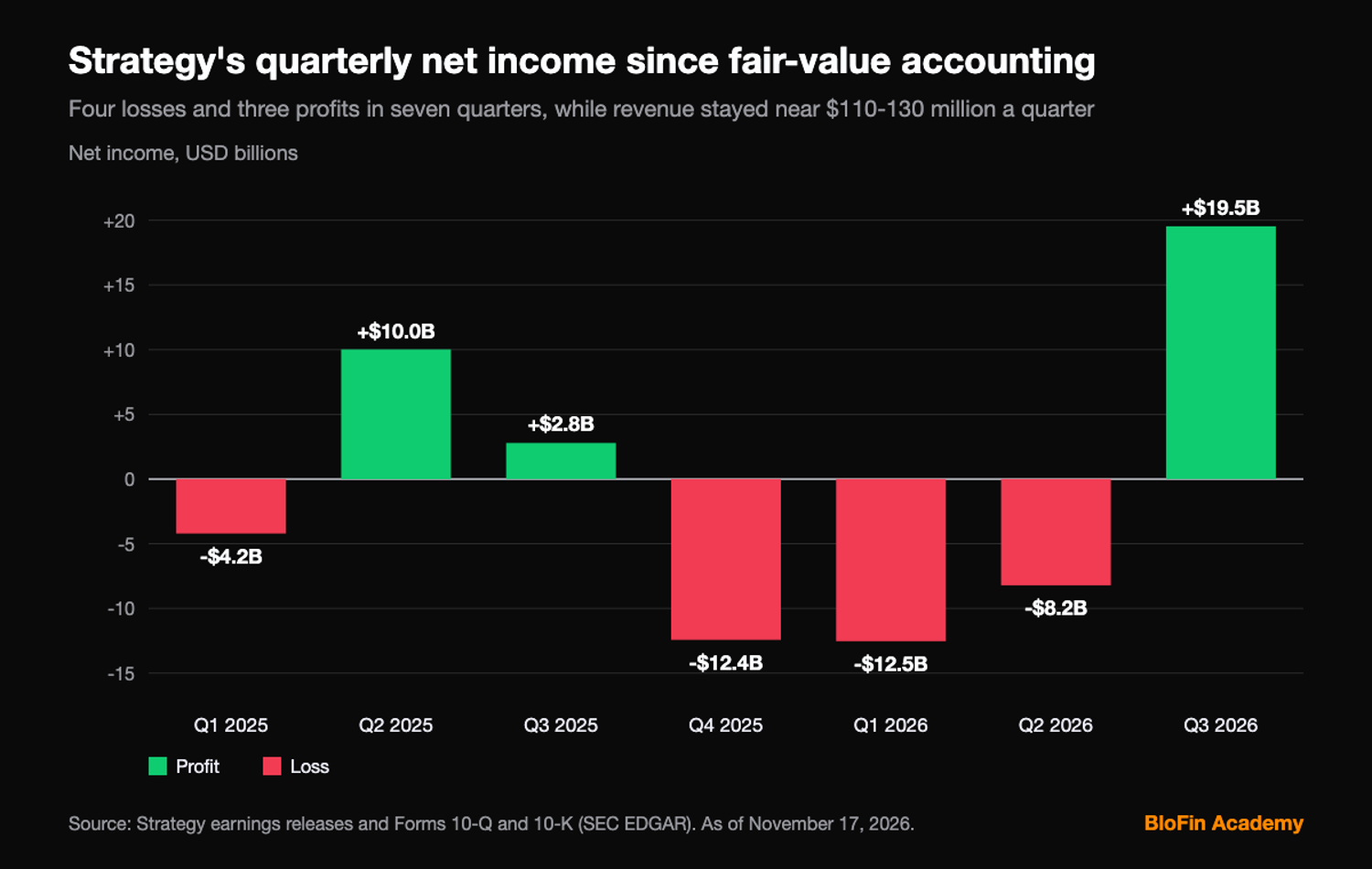
Strategy's third quarter of 2026 produced net income of $19.5 billion, or $44.75 per diluted share, on revenue of $125.4 million. Nearly all of that profit came from a $20.9 billion gain on digital assets. That gain was the rise in the value of its bitcoin between June 30 and September 30, 2026 (source: Strategy Q3 2026 earnings release).
The release headline put operating income at $21 billion. Take out the $20.9 billion gain, and the company's other operating lines netted to a $2.6 million loss (source: Strategy Form 10-Q for the third quarter of 2026). That is a gross profit of $89.6 million less $92.2 million spent on sales and marketing, research and development, and general and administration. So income from operations came in slightly under the gain itself. The gain made up 99.9% of the quarter's pretax income (source: Strategy Form 10-Q for the third quarter of 2026). The 10-Q reports two segments, Software and Bitcoin, with all of the revenue in Software. Its segment note charges part of those costs, including the fees for holding the bitcoin in custody, to the Bitcoin segment. The $2.6 million loss is therefore not the software business's own result (source: Strategy Form 10-Q for the third quarter of 2026).
That is the largest quarterly profit since the rule changed. In July 2025, Strategy had called its second-quarter 2025 net income of $10.0 billion a record (source: Strategy Q2 2025 earnings release). The third quarter of 2026 came in at 1.95 times that figure. It was also about seven times the $2.8 billion of the third quarter of 2025 (source: Strategy Form 10-Q for the third quarter of 2026).
The share price did not follow the profit up: in Nasdaq's daily closes, MSTR ended at $141.62 on October 29, the day of the release. It closed at $130.51 the next day, a fall of 7.8% (source: Nasdaq MSTR historical data). On November 16 the close was $103.03, or 27.2% under the October 29 level. The profit was measured at September 30, and the price kept moving after that date, so a report on a closed quarter cannot explain why MSTR stock is down since.
Net income and net income to common shareholders
Net income is the profit of the whole company, while common shareholders get what is left once the preferred shareholders are paid. In the third quarter, $419.6 million of dividends on Strategy's preferred stock came off first (source: Strategy Form 10-Q for the third quarter of 2026). A $5.5 million item on preferred stock, which the 10-Q calls a deemed contribution, was added back, which left $19.1 billion for common shareholders.
Diluted earnings per share use a larger share count, one that includes the shares that convertible notes, convertible preferred stock and employee awards could add. The profit figure changes too. Interest on the notes and dividends on the convertible preferred stock are added back, because those costs would stop if the holders converted. Strategy's diluted count averaged 428.0 million shares in the quarter, against 400.1 million basic shares. That is why diluted EPS was $44.75 while basic EPS was $47.78 (source: Strategy Form 10-Q for the third quarter of 2026).
Strategy's Q2 2026 net loss
Three months earlier, the same accounting produced a loss: Strategy reported a net loss of $8.2 billion for the second quarter of 2026, or $24.45 per diluted share. It followed an $8.3 billion unrealized loss on its digital assets. Revenue that quarter rose 6.9% from a year earlier, to $122.4 million (source: Strategy Q2 2026 earnings release).
Between the two quarters, net income swung by $27.8 billion while revenue changed by $3.1 million. The difference was the coins: Strategy's bitcoin was worth $49.7 billion on June 30, 2026, about $58,700 a coin. On September 30 it was worth $70.8 billion, about $83,550 a coin (source: Strategy Form 10-Q for the second quarter of 2026, Strategy Form 10-Q for the third quarter of 2026).
Side by side, the seven quarters since the rule changed show four losses and three profits. Added together, Strategy lost $5.1 billion over that stretch. Quarterly revenue stayed between $111.1 million and $128.7 million the whole time.
If you trade the MSTRUSDT Perpetual on a report night, the profit line will not tell you what a position costs. Check the trading fee before the release on BloFin's fee page.
Deferred tax and the CAMT question
A deferred tax liability is tax a company expects to pay later on gains it has booked but not yet been taxed on. Strategy's unrealized bitcoin gains create one. On September 30, 2026, its 10-Q showed a $2.0 billion deferred tax liability on those gains. The quarter's pretax income carried a $1.4 billion tax charge (source: Strategy Form 10-Q for the third quarter of 2026).
The tax line moves with bitcoin as well. The 10-Q says the tax charge or benefit for the first nine months of 2026 mainly reflected the tax effects of changes in the coins' fair value. In the first half of 2026, Strategy set up a $4.6 billion valuation allowance, an accounting reserve against tax benefits a company might never use. Strategy released it in the third quarter after the bitcoin price rose (source: Strategy Form 10-Q for the third quarter of 2026).
The bigger tax question was the corporate alternative minimum tax, or CAMT. It is a minimum tax worked out from a large company's book profit, called adjusted financial statement income (AFSI), so unrealized gains on bitcoin could have counted toward it. IRS Notice 2025-49 lets a company adjust AFSI to leave out gains and losses that are unrealized for regular tax purposes. It says this may apply to digital assets measured at fair value, provided they are not marked to market for regular tax purposes (source: IRS Notice 2025-49).
Strategy's annual report says the Treasury and the IRS issued this interim guidance on September 30, 2025. On that guidance, Strategy expects its unrealized bitcoin gains not to make it pay CAMT, though it warns the picture could change if the IRS withdraws the guidance or writes final rules without the same relief (source: Strategy Form 10-K for 2025). These are Strategy's own tax positions. How gains on MSTR are taxed for you depends on your country and your situation, so check with a tax adviser.
What to read in a Strategy report instead of EPS
Instead of EPS, read the figures that show how much bitcoin stands behind each share and what the company owes against it. Those are the coin count, BTC Yield, the USD Reserve, preferred dividends and any targets for Strategy's key performance indicators (KPIs). Most of them appear in the release itself.
The coin count is the simplest: the third-quarter release gave 848,517 bitcoin as of October 25, 2026 (source: Strategy Q3 2026 earnings release). Strategy updates the count in Form 8-K filings, usually on Mondays. The latest one reported 850,849 coins as of November 15, 2026 (source: Strategy Form 8-K filed November 16, 2026).
BTC Yield is Strategy's own measure, which the company defines as the percentage change in bitcoin per share over a period. The release put it at negative 3.7% for 2026 up to October 25, meaning each share stood for slightly less bitcoin than at the start of the year. The same release says these measures are not measures of financial performance, valuation or liquidity (source: Strategy Q3 2026 earnings release). The figure turns negative when the number of shares grows faster than the number of coins, which is how Strategy's BTC Yield fell below zero in 2026.
The money side shows what the company has to pay. The release put the USD Reserve at $4.83 billion and USD Cash at $242.4 million, together $5.1 billion. Strategy said that gave 3.4 years of cover for its dividend and interest bills (source: Strategy Q3 2026 earnings release). By November 15, the USD Reserve stood at $4.75 billion (source: Strategy Form 8-K filed November 16, 2026). Preferred dividends came to $400.7 million in the second quarter and $419.6 million in the third (source: Strategy Form 10-Q for the second quarter of 2026, Strategy Form 10-Q for the third quarter of 2026).
Targets have changed too. In 2025, Strategy raised its BTC Yield target from 15% to 25% with its first-quarter results and again, to 30%, with its second-quarter results (source: Strategy Q1 2025 earnings release, Strategy Q2 2025 earnings release). On December 1, 2025 it cut that target to a range of 22% to 26%, and 2025 ended with a BTC Yield of 22.8% (source: Strategy Q4 2025 earnings release). Its four releases of 2026 give no BTC Yield or BTC $ Gain target and no earnings guidance. They say only that the company sets its targets from its history and future goals (source: Strategy Q4 2025 earnings release, Strategy Q1 2026 earnings release, Strategy Q2 2026 earnings release, Strategy Q3 2026 earnings release).
The same inputs, bitcoin held, debt and preferred claims, are where people start when they value MSTR stock. A report can show the coin count rising and still leave the risks of MSTR stock in place, from bitcoin's price to the dividend bill.
So a single quarter seldom settles whether MSTR stock is a good investment for you. It shows where the company stood on one date.
The Strategy earnings call
Strategy's earnings call is a live video webinar at about 5PM ET on report day. It runs on Zoom and streams at the same time on X and YouTube. A replay goes into the Events and Presentations section of Strategy's investor relations site about two hours after the call ends (source: Strategy Q3 2026 date announcement, Business Wire release, via Investing News, Strategy Q3 2026 earnings release).
For the third quarter, the webinar recording and the earnings presentation are both posted in that Events and Presentations section, dated October 29, 2026 (source: Strategy investor relations page). The call adds what the release leaves out: management's view of its funding plans and a question-and-answer session with analysts. On the October 29, 2026 call, Chief Executive Phong Le stated a goal of doubling bitcoin per share over the next seven years. The call gave no numerical guidance for 2026 (source: Motley Fool transcript of the Q3 2026 call). Treat a goal like that as a stated aim, the same way the release treats its targets, since it is not a forecast of what the company will report.
How to estimate a quarter's fair-value gain or loss
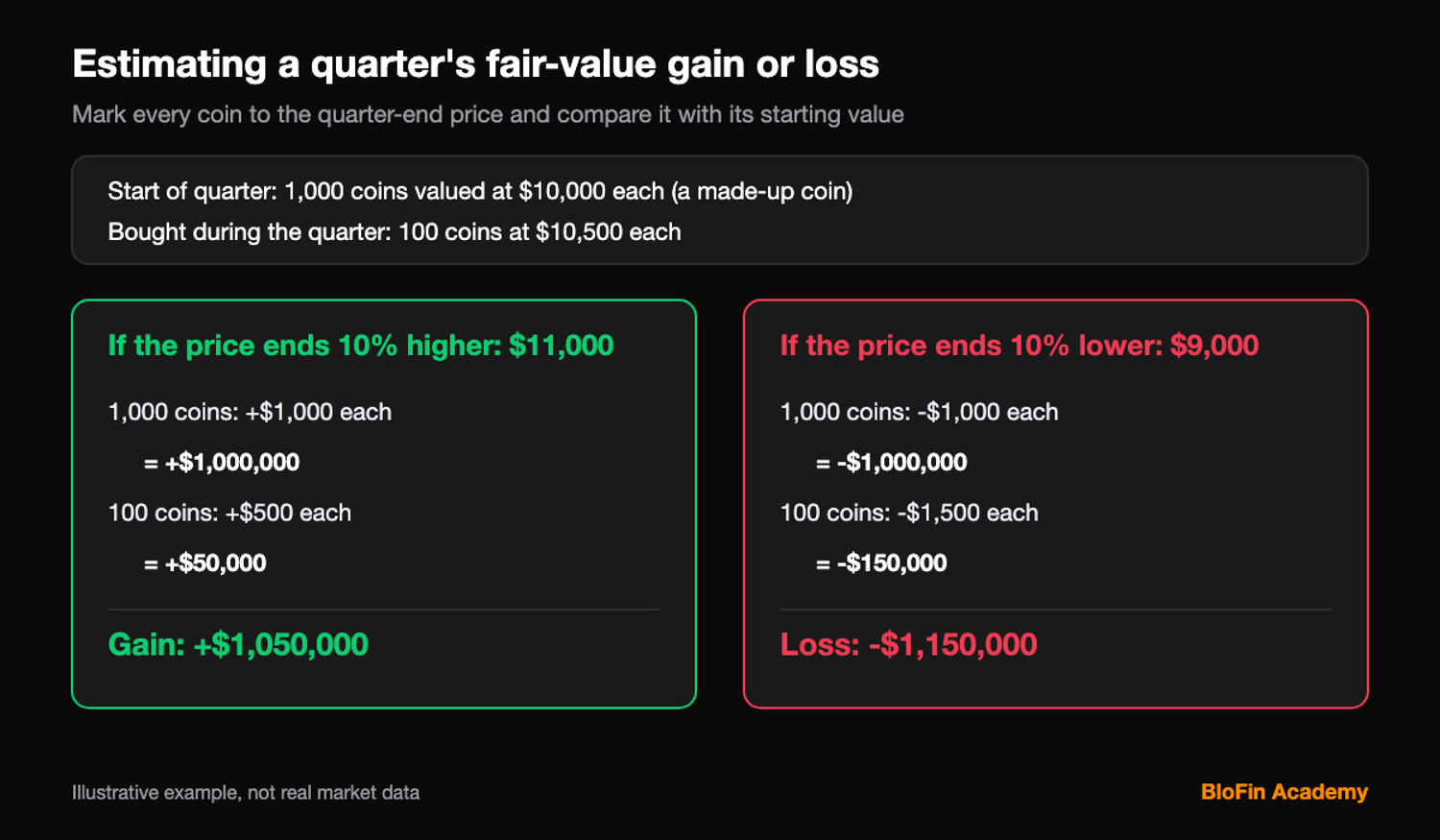
You can estimate a quarter's fair-value gain or loss from three inputs: the coins held at the start, valued at the last quarter-end price; the coins bought during the quarter, at cost; and the bitcoin price at quarter-end. Value both groups at that price, and the change from their starting value is the gain or loss.
Here is an illustrative example with made-up round numbers: say a company starts the quarter with 1,000 coins valued at $10,000 each and buys 100 more at $10,500. If the coin's price ends the quarter 10% higher, at $11,000, the first 1,000 coins gain $1 million and the new 100 gain $50,000, a $1.05 million gain in total. If it ends 10% lower, at $9,000, the same coins lose $1 million and $150,000, a $1.15 million loss.
Strategy's own figures follow the same arithmetic, with coins sold coming off at the price received. Its bitcoin was worth $49.67 billion on June 30, 2026. Add $588.1 million of purchases, take off $348.6 million of sales and add the $20.91 billion gain. The result is the $70.82 billion it held on September 30 (source: Strategy Form 10-Q for the second quarter of 2026, Strategy Form 10-Q for the third quarter of 2026).
For the quarter now running, you can check the same inputs yourself. The starting point is 847,666 coins worth $70.8 billion on September 30, about $83,550 each. The Monday 8-Ks add the coins bought since, a net 3,183 more by November 15, each batch with its cost (source: Strategy Form 8-K filed November 16, 2026). The last input is bitcoin's quoted price on Coinbase on December 31, 2026. Your figure will still differ from Strategy's, because sales and exact prices only show up when the company files.
What Strategy's earnings mean for MSTRUSDT traders
For MSTRUSDT traders, a Strategy report is mostly a bitcoin event that lands outside Nasdaq's regular hours. Results arrive after Nasdaq's 4PM ET close. BloFin's notice says stock futures trading outside regular hours may be limited to reduce-only orders. In that case you could only cut a position, not add to it, until Nasdaq opens again at 9.30AM ET.
The MSTR perpetual on BloFin has no expiry date and takes USDT as margin and pays out in USDT. You can pick leverage between 1x and 20x, and funding normally settles every eight hours (source: BloFin MSTR contract details). The hours notice covers all of BloFin's stock futures and applies on weekdays outside Nasdaq's session as well as on weekends and holidays (source: BloFin stock futures notice).
A report can move MSTR sharply overnight, and with leverage a gap of that size can reach your liquidation price before Nasdaq reopens.
Following Strategy into its fourth-quarter report? To get started, you'll need to first create a BloFin account, fund your account with cryptocurrency, and go to the MSTRUSDT Perpetual trading page.

Frequently asked questions
Did MSTR beat earnings in the third quarter of 2026?
Yes, against analysts' estimates: Strategy's diluted EPS of $44.75 for the third quarter of 2026 was about twice the $22.61 estimate listed on Public.com's earnings page (source: Public.com MSTR earnings page). A year earlier, diluted EPS had been $8.42. Nearly all of the quarter's profit came from the $20.9 billion gain on digital assets, so the beat says little about the software business (source: Strategy Form 10-Q for the third quarter of 2026).
When does Strategy file its 10-Q after an earnings release?
Strategy files its Form 10-Q a few days after each release. In 2026, the first-quarter 10-Q came on May 6, the day after the release. The second-quarter one came on August 3, and the third-quarter one on November 2, each four days after the release (source: SEC EDGAR filing index for Strategy). The 10-Q carries the notes on taxes, debt and bitcoin purchases that the release only sums up.
Did Strategy make a profit in 2025?
No, Strategy made a net loss of $3.8 billion in 2025. That came to a loss of $15.23 per common share once preferred dividends were counted (source: Strategy Q4 2025 earnings release). Its unrealized loss on digital assets for the year was about $5.4 billion. It also recorded a $1.7 billion income tax benefit on a pretax loss of $5.5 billion (source: Strategy Form 10-K for 2025).
How did MSTR stock perform against bitcoin in the third quarter of 2026?
Strategy's third-quarter release reported a 76% rise in the MSTR share price, against a 43% rise in the bitcoin price over the quarter (source: Strategy Q3 2026 earnings release). In Nasdaq's daily closes, MSTR went from $86.93 on June 30, 2026 to $153.09 on September 30, a gain of 76.1% (source: Nasdaq MSTR historical data). Over that stretch, the shares moved more than the coin in percentage terms.
Who presents Strategy's earnings?
On the third-quarter 2026 call, Strategy's head of investor relations hosted. Chief Financial Officer Andrew Kang, Chief Executive Phong Le and Executive Chairman Michael Saylor spoke before analysts asked questions (source: Motley Fool transcript of the Q3 2026 call). The release said Kang would step down on November 5, 2026, with Le serving as principal financial officer during the transition, and Reza Virasteh becomes Chief Financial Officer on January 1, 2027 (source: Strategy Q3 2026 earnings release).
Researched and written by the BloFin Academy editorial team with AI-assisted drafting. All facts independently verified. Primary sources include Strategy's earnings releases for the first and second quarters of 2025 and for the fourth quarter of 2025 and the first three quarters of 2026, its Form 10-Q filings for the second and third quarters of 2026, its Form 10-K for 2025, its Form 8-K filed November 16, 2026 and the SEC EDGAR filing index for Strategy. Other sources are Strategy's investor relations page, FASB Accounting Standards Update 2023-08, IRS Notice 2025-49, Strategy's Q3 2026 date announcement (Business Wire release, via Investing News), the Public.com MSTR earnings page, the Motley Fool transcript of the Q3 2026 call and Nasdaq MSTR historical data. BloFin's sources are its MSTR contract details and stock futures notice, current as of November 17, 2026.
Nothing in this article constitutes financial advice, and nothing in it is a recommendation to buy, sell or hold Strategy in any form. Strategy's reported profit can turn into a multibillion-dollar loss in the next quarter if bitcoin falls, and a strong report does not stop the share price from falling afterward. On the MSTRUSDT Perpetual, a gap after a report can liquidate leveraged margin before Nasdaq reopens, funding payments can cost you money while you hold, and outside Nasdaq hours you may only be able to cut a position. Past performance does not indicate future results. Do your own research and consider your risk tolerance before you trade on BloFin.