
NVIDIA trades with the volatility of a growth stock rather than the steadiness its market value implies. If you want to trade NVIDIA with leverage on BloFin, you do it through NVDAUSDT, a perpetual contract that tracks NVIDIA without requiring you to own the shares: you post margin in USDT, choose your leverage multiplier up to 20x, and take a long or short position 24/7.
A single earnings call can move a company of its size by double digits overnight, and the reaction lands in the hours after the US close, when the shares themselves have stopped trading. That makes leveraged exposure attractive and dangerous in equal measure, especially for active crypto and stock traders who are comfortable using margin and want a synthetic way to trade NVIDIA outside traditional brokerage hours. Owning the stock means a brokerage account, a market that shuts at 4PM New York time, and capital tied up one-for-one.
NVDAUSDT quotes around the clock in USDT and lets you put up a fraction of the position's value as margin, but you own no share at any point. The dividend and the vote stay with the shareholder, while the contract introduces funding costs, liquidation risk, and sizing decisions that shares avoid. Opening one takes about five minutes; choosing a multiple that survives an NVIDIA earnings reaction takes rather more thought. That is the ground this guide covers: how perpetuals differ from owning the stock, how leverage changes P&L, when long or short setups make sense, and how to manage risk around earnings and other sharp moves.
What the NVDAUSDT perpetual is and how it differs from NVIDIA stock
When you trade the NVDAUSDT perpetual you are speculating on the price of NVIDIA stock without buying actual shares. The position strips out the share certificate, the vote and the dividend. In their place you post a margin deposit in USDT and control a larger notional exposure to NVIDIA.
Three differences matter in practice. The contract carries no expiry date, so a position can stay open as long as it stays margined. It quotes 24/7, while NVIDIA shares trade during Nasdaq hours only. And it can be sold short as easily as bought, with no stock to locate or borrow. In exchange you accept a funding payment while the position is open and a liquidation price that shares do not have.
BloFin offers two NVIDIA instruments: NVDAX/USDT for spot (tokenized) and NVDAUSDT for the perpetual. If you want to hold NVIDIA for months, free of funding costs and a liquidation price, the spot side is the simpler instrument, and tokenized NVIDIA (NVDAX) explains what you own there.
How leverage works on NVDAUSDT
A perpetual works differently from a margin loan, and the difference matters more than it sounds. On a broker's margin account you borrow cash against your shares, pay interest on the balance, and face a call for more collateral if the position sours, though brokers can raise house margin requirements without notice. On the perpetual you post USDT as collateral, you pay or receive a funding payment while the position is open, and if your margin falls to the maintenance level the risk engine closes the position outright.
The arithmetic is worth doing before you set the slider. If you post 10 USDT at 10x leverage, you control 100 USDT of NVIDIA exposure. A 5% move in your favor returns 50%, while a 5% move against you costs just as much.
Stepping through the multiples shows how quickly the room disappears. At 2x, 50 USDT of margin controls 100 USDT of exposure, and a 10% adverse move costs 20% of your margin. At 5x, 20 USDT controls the same 100 USDT, and that same 10% move takes half. At 10x, 10 USDT controls 100 USDT, and a 10% adverse move wipes out the margin entirely — in practice sooner than that, because liquidation triggers at the maintenance margin level rather than at zero. The higher the multiple, the more of the move happens after you have lost control of the outcome.
A 10% move is well within NVIDIA's earnings-day range, so in volatile market conditions, high volatility increases risk when trading with leverage and should be treated as the working case, not the tail. For a swing trade held across a catalyst, 2x to 3x leaves room to be early without being liquidated. Higher multiples only make sense intraday, where you are watching the position and the distance to liquidation is measured in hours, not weeks.
Going long or short: Expressing an NVIDIA view
A long position expresses a view on price movements and profits when the reference price rises, while a short profits when it falls, and on a perpetual (one of the available leveraged instruments), the two are equally available. That symmetry is the main thing leverage buys you beyond size. Holding tokenized NVIDIA or real shares gives you one direction; the perpetual gives you both.
Shorting is where the asymmetry hides. A stock in a strong uptrend can squeeze upward faster than it falls, and NVIDIA has repeatedly gapped up double digits on results. A short carried into earnings therefore needs materially more margin buffer than the same-sized long, even though the leverage number on the screen is identical.
How to start trading NVDAUSDT with leverage on BloFin
Before you start: Create a BloFin account
Trading the NVDAUSDT perpetual needs the same two prerequisites as any BloFin market: a verified account and margin in your derivatives wallet. Both apply to every BloFin market, so this guide points to the dedicated walkthroughs.
Create and verify your account. Sign up, complete identity verification, and enable two-factor authentication before you deposit. The full walkthrough is in create a BloFin account.
Fund your derivatives wallet. Deposit USDT or another supported stablecoin to serve as margin collateral. The complete process, including networks and test transfers, is in the BloFin deposit guide.
If perpetuals themselves are new to you, perpetuals versus futures covers why these contracts have no expiry date, and margin in perpetual contracts sets out how isolated and cross margin differ; these products are intended for knowledgeable investors.
Reading the contract specs
On the NVDAUSDT Perpetual contract page, you will see the chart with timeframe selectors, the order panel with limit, market and conditional order types, a leverage slider, and a margin mode toggle for isolated against cross.
Three specifications shape every trade you place. Each contract represents 0.01 of the NVIDIA reference price in USDT, so contract counts translate to notional exposure at a hundredth of the quote. The tick size is 0.01 USDT, which is what your stop and target prices round to. And maximum leverage is 20x, stepping down through a tiered maintenance-margin schedule as your position grows, so a large position cannot hold the same multiple a small one can. Reading contract specifications explains how those tiers are laid out.
Placing your first NVDAUSDT trade
Decide your target, your maximum acceptable loss, your time horizon, and your investment objective before you touch the order panel. A leveraged position moves too fast to form those views once it is open.
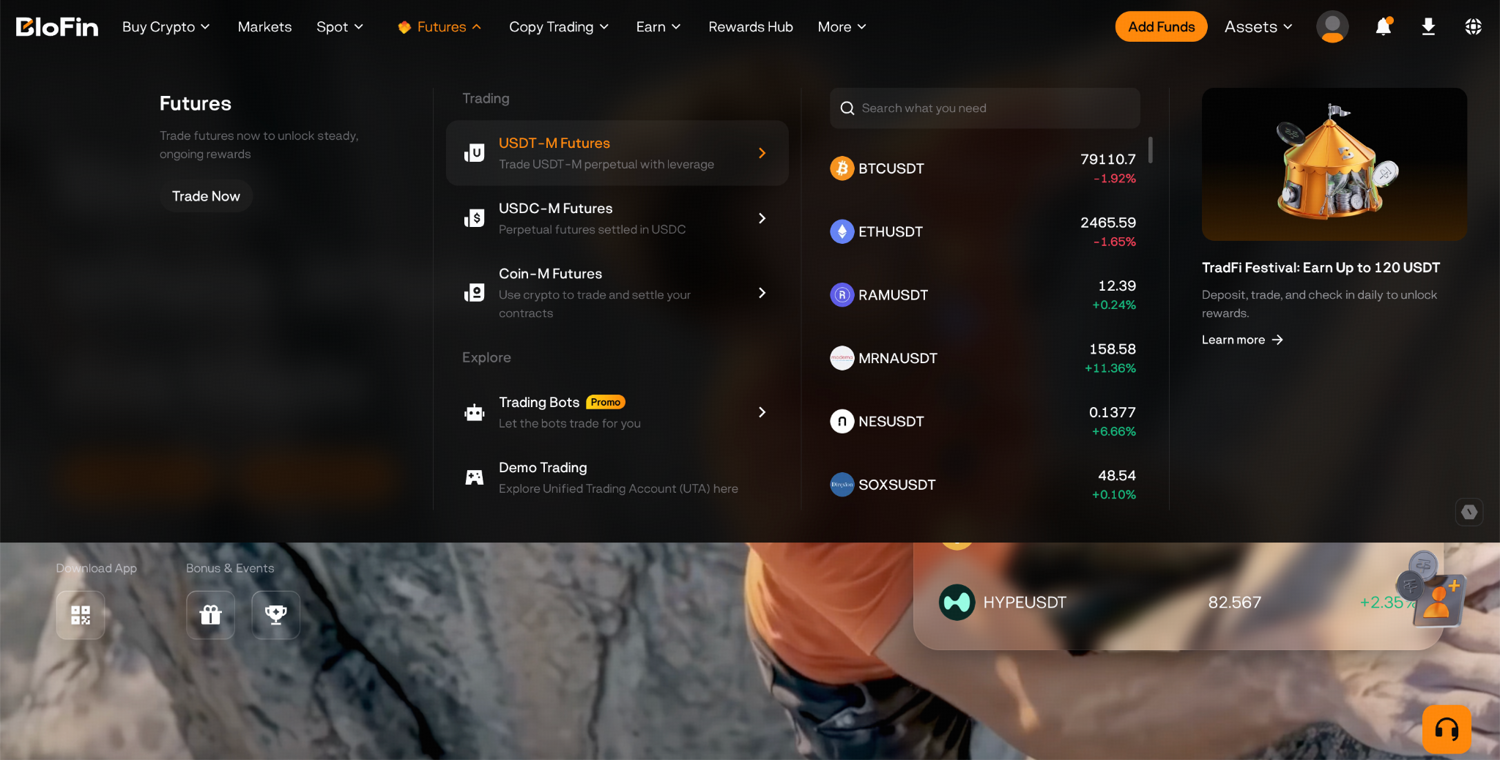
Step 1: Log in to your BloFin account and hover your cursor over the Futures tab. Then, click USDT-M Futures.
Step 2: Hover your cursor over the BTCUSDT Perpetual pair and a pop-up window will appear. Type NVDA in the search bar.
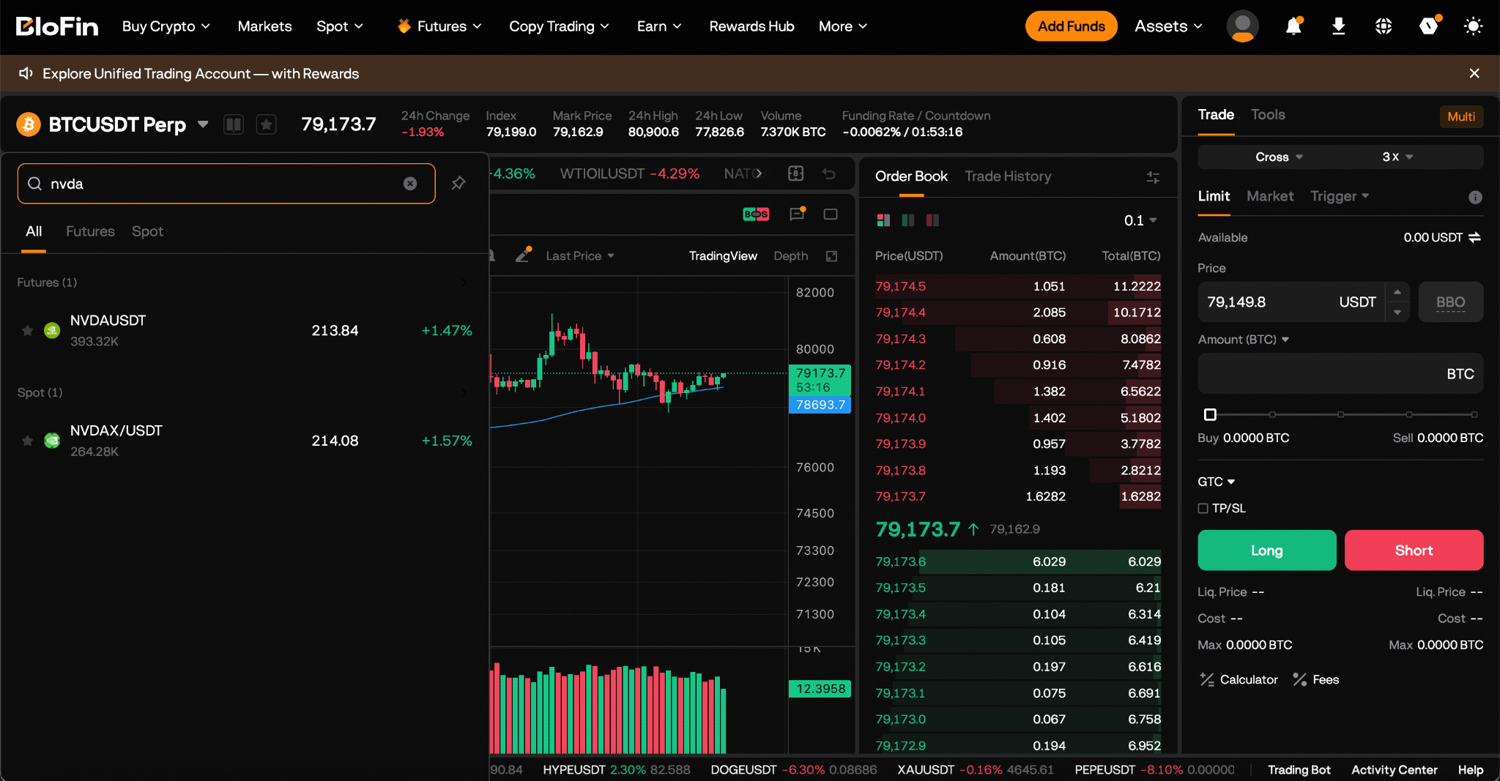
Step 3: Select the NVDAUSDT Perpetual contract from the results.
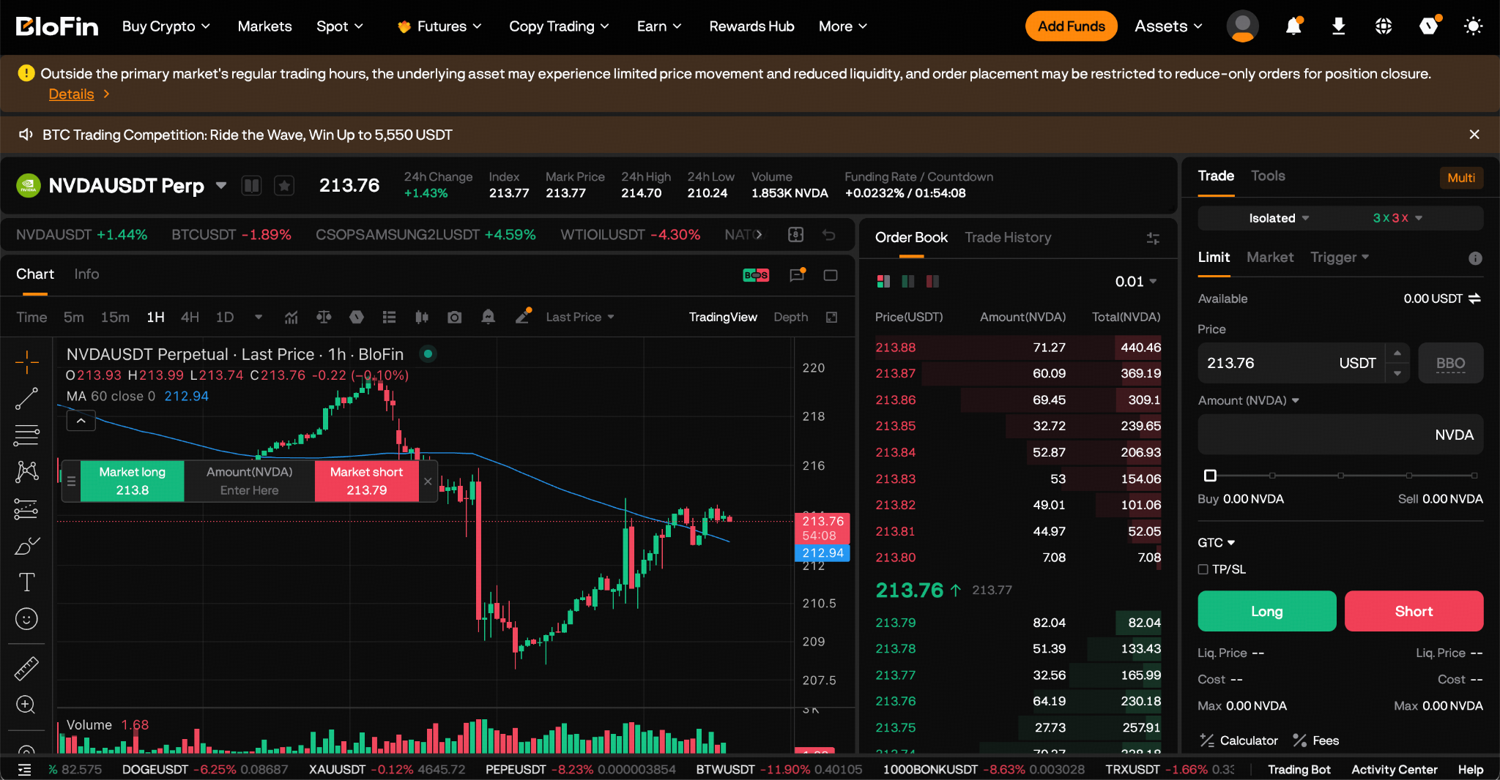
Step 4: Review the contract specs and tick side. Then, choose isolated margin (risk limited to the position) or cross margin (shared collateral), and select your leverage multiplier conservatively.
Step 5: Choose between a limit order and market order. Use limit orders for price control or markets orders for immediate execution. Enter quantity, set optional stop loss and take profit levels, and choose your direction: Long or Short. Make sure the money you post as margin matches the size of the risk you are willing to take.
Funding, margin and liquidation
Three mechanics decide what an open position costs and when it ends.
Funding is the periodic payment between longs and shorts that keeps the perpetual tethered to the underlying price. When the contract trades above the reference price, longs pay shorts, and when it trades below, shorts pay longs. BloFin does not settle this on a fixed clock: since December 2025 the settlement frequency has been adjusted automatically between 1, 2, 4 and 8 hours based on volatility, funding-rate trends and liquidity (source: BloFin to Update Perpetual Contract Funding Rate Settlement Frequency). A position held for a week can therefore pay funding far more often than a fixed eight-hour assumption would suggest, and on a crowded directional move the rate itself widens. Over periods longer than a single day, the contract’s daily performance can diverge from the underlying stock's performance because of funding and path effects, which can alter overall performance. How funding rates work sets out the calculation.
Maintenance margin is the floor your position equity has to stay above. It is expressed as a ratio of position value and it rises with position size, so scaling into a winning trade tightens the floor underneath the whole position rather than just the addition, though results remain subject to volatility and changing market conditions while the position is open.
Liquidation happens when equity reaches that floor. The risk engine closes the position at the prevailing price, and in a fast move that price can sit well below your stated liquidation level. Expect the close to arrive without warning, which is why the distance between entry and liquidation, more than the leverage number itself, is the figure worth watching. Leverage and liquidation works through how far a given multiple lets price travel before that happens.
Fees and the cost of holding a leveraged NVIDIA position
BloFin futures charge 0.0200% maker and 0.0600% taker, calculated on notional size rather than on your margin (source: BloFin fee schedule). That distinction matters at high leverage: a 10x position pays fees on ten times the capital you actually posted, so the round trip on a 20,000 USDT notional costs the same whether you funded it with 2,000 USDT or 10,000.
Funding is the larger cost on anything held overnight, and unlike a commission it recurs. A position that pays 0.01% per settlement and settles four times a day costs 0.04% daily, or roughly 1.2% a month, before the trade has moved at all. Owning NVIDIA shares avoids that charge, which is why a multi-week directional view is usually cheaper to express on tokenized spot than on the perpetual.
Risk management around earnings and gaps
Most leveraged NVDAUSDT positions cluster around catalysts, such as quarterly results, data-center revenue updates, earnings announcements, or shifts in US-China export controls. NVIDIA reports after the US market close, typically in the final week of February, May, August and November, which means the reaction arrives in a window when the underlying exchange is shut and the perpetual is still quoting.
That asymmetry is the specific risk of holding leverage on a stock perpetual. The contract quotes 24/7 but Nasdaq does not, and BloFin's listing notices say the underlying "may experience limited price movement and reduced liquidity" outside exchange hours, with the price index remaining fixed at its most recently calculated value when no external data is available (source: Updates to BloFin Stock Futures Trading). The contract is especially vulnerable when market conditions are unstable and prices fluctuate sharply outside exchange hours. A position drifting toward trouble against a mark that is sitting still gives you far less warning than usual, and a stop-loss has almost nothing to fire against. When the reference reprices, it does so in one step.
The practical consequence is about sizing. A position carried across an earnings release or a weekend needs enough margin buffer to survive a gap it cannot react to, because for that window you are effectively unhedged. Size so that the distance from entry to your stop costs a fixed, small share of the account — one to two percent of total capital per trade is the common convention. Track important events before deciding to hold leverage through them. That convention caps the damage a single loss can do, and it says nothing about position size on its own: at high leverage a small notional position breaches it easily. Position sizing works through the arithmetic in both directions, and NVIDIA price gaps in 24/7 trading covers the same gap effect on the tokenized side.
The same view at two multiples
Two traders each deposit 2,000 USDT with a bullish view on NVIDIA. The direction call is identical; the leverage decides how much room each has to be early.
Conservative | Aggressive | |
Leverage | 2x | 10x |
Position size on 2,000 USDT margin | 4,000 USDT | 20,000 USDT |
Stop-loss | 8% below entry | 2% below entry |
A 5% price rise | +10% on margin | +50% on margin |
A 3 to 4% price drop | A manageable loss, far from liquidation | Triggers the stop or approaches liquidation |
Round-trip fee at 0.06% taker | 4.80 USDT | 24 USDT |
The aggressive trader earns more per point of movement and has far less margin for error, and an ordinary NVIDIA session is more than enough to close that gap. A 2% stop on a stock that routinely moves 3% in a day functions as a coin flip dressed up as a risk control. Leverage and stop placement decide the outcome here, since the direction call is held constant.
Common mistakes, how traders lose money, and how to avoid them
Using maximum leverage on a first trade removes your room for error. Start low and increase once you have watched the contract behave through a full session.
Averaging down on a losing position drags your liquidation price toward the market. Define the maximum loss before you enter and hold to it.
Ignoring funding on a multi-day hold quietly erodes a winning trade. Estimate the cost before entering, using the current rate and settlement frequency.
Reading the leverage number instead of the liquidation price. The multiple means little on its own; the distance to liquidation decides whether you survive.
Carrying an earnings position at intraday size. The gap risk is the whole reason to reduce leverage before a release.
How the perpetual compares to other NVIDIA exposures
The perpetual is one of several ways to take a leveraged or synthetic view on NVIDIA for both trading and investing, and the comparison worth making for different investors is against the two most readers will actually weigh: tokenized spot on the same platform, and a leveraged ETF in a brokerage account.
Method | Leverage | Ownership | Hours | Main cost or risk |
NVDAUSDT perpetual | Up to 20x | None | 24/7 | Funding while open, liquidation if margin fails |
NVDAX/USDT Spot | None | Tokenized claim | 24/7 | Issuer and custodian risk, no leverage |
Leveraged ETF | Typically 1.5x or 2x | Fund shares | Exchange hours | Daily rebalancing; fund objective targets a multiple of the daily return of the underlying stock or underlying index over a single trading day |
Broker margin loan | Around 2x | Actual shares | Exchange hours | Interest on the balance, margin calls |
The leveraged ETF row carries the trap most readers underestimate. These funds are built to deliver a multiple of a single day's return, and they rebalance daily to do it. Held across a choppy fortnight in which the stock finishes flat, a 2x fund can finish down, because the compounding of daily resets works against you whenever direction alternates. That means day's returns compounded over the same period can produce investment results that differ from the underlying stock's performance, especially over periods longer than a single day. The perpetual escapes that decay entirely, tracking the price continuously, and its holding cost shows up as funding. Investors can lose money, including principal or even full principal value, so review the fund prospectus: possible loss is not limited to what you might expect when the underlying stock's performance increases. Tokenized NVIDIA versus an NVIDIA ETF compares the fund route in detail.
If you are weighing NVIDIA against another leveraged single-stock position, Tesla versus NVIDIA compares the two most active stock perpetuals, and trading Tesla with leverage follows the same mechanics on the other contract.
The bottom line and clarifying your investment objective
Trading NVIDIA with leverage on BloFin comes down to four decisions, and only the first concerns the platform. You select NVDAUSDT and set a margin mode. You choose a multiple low enough that a normal NVIDIA move stays clear of your liquidation price. You size the position so a stop costs a small, fixed share of your capital. And you decide, before entering, what price proves you wrong.
The exchange supplies the leverage, the order types and the 24/7 access. Everything that determines the outcome happens in those four decisions, and most of it around earnings, when the stock is most likely to move further than the position was built to survive. If you want NVIDIA exposure with less machinery, tokenized spot gives you the price while leaving funding and liquidation behind, and it suits a view measured in months.
Frequently asked questions
What is the maximum leverage on NVDAUSDT?
The maximum is 20x, and it applies only up to a point. BloFin uses a tiered maintenance-margin schedule, so as a position grows the maximum leverage available to it steps down and the maintenance margin ratio rises. The full multiple is available to small positions only. The leverage slider in the order panel shows the ceiling that applies to the size you are entering, and that ceiling, not the headline 20x, is the figure to work from. Check it again after any increase in position size, because scaling in can move you into a stricter tier than the one you opened under.
Does trading NVDAUSDT make me an NVIDIA shareholder?
No. The perpetual is a contract that references NVIDIA's price, so it carries none of what ownership confers: no share certificate, no voting rights, no dividend. Your counterparty is the exchange and its risk engine. If you want an instrument that tracks NVIDIA without leverage or a liquidation price, tokenized NVIDIA on the spot side is the closer equivalent, though it too remains a claim on the issuer. Real share ownership requires a brokerage account, and it comes with exchange hours and one-for-one capital commitment attached.
Can you hold a leveraged NVDA position for the long term?
Yes. The perpetual has no expiry date, so a position can stay open indefinitely as long as it remains adequately margined. But it is generally for traders seeking daily leveraged exposure rather than for long holds. The cost of doing so is funding, which is charged or received while the position is open and settles at intervals BloFin adjusts automatically between 1, 2, 4 and 8 hours depending on volatility and liquidity (source: BloFin to Update Perpetual Contract Funding Rate Settlement Frequency). Over weeks that accumulates, and it accumulates fastest when the market is crowded on your side of the trade. You also need to review portfolios frequently if leverage stays open that long. A multi-week directional view often costs less to express on tokenized spot, where funding and liquidation prices both fall away.
Can you short NVIDIA on BloFin?
Yes. The NVDAUSDT perpetual supports short positions on the same terms as longs, which is one of the clearer advantages over holding tokenized spot or shares. You sell contracts you have never held and profit if the reference price falls. The risk profile is asymmetric, though: a stock in a strong uptrend can squeeze upward faster than it falls, and NVIDIA has repeatedly gapped up double digits on results. A short carried into earnings needs materially more margin buffer than the same-sized long would, for the same reason.
What happens if NVIDIA gaps while Nasdaq is closed?
The perpetual keeps quoting, but its reference index can sit still when no external price data is available, and it reprices in one step when the underlying exchange reopens. A stop-loss is powerless across that jump, since it has almost nothing to trigger on, and your liquidation price is calculated against the same mark. The defense lies in sizing, not order placement: carry less leverage across a weekend or an earnings release than you would intraday, or close the position before the gap window and re-enter afterwards.
How does NVIDIA relate to crypto markets?
NVIDIA is driven by semiconductor demand, data-center revenue and the trajectory of AI capital spending more than by crypto cycles, so the link between them is circumstantial. By contrast, traders who use options trading on NVIDIA instead of the perpetual need to account for time decay, which causes contracts such as call options to lose value over time. Covered calls are one income-focused approach, but options strategies generally require more analysis than a directional perpetual trade. What connects them is shared sensitivity to macro risk appetite: when liquidity tightens, high-beta assets sell off together whatever drives them individually. For a leveraged trader that means concentration risk, since a leveraged NVDA position alongside a leveraged crypto book is less diversified than it looks during exactly the drawdowns that matter.
Researched and written by the BloFin Academy editorial team with AI-assisted drafting. All facts independently verified. Primary sources include the BloFin fee schedule, BloFin support documentation on funding-rate settlement and stock futures trading, and market prices current as of August 26, 2026.
This article is not investment advice. Trading leveraged products involves substantial risk, including the loss of your entire margin. Prices can move sharply and no strategy can guarantee a profit. Read BloFin's terms and risk disclosures, understand how isolated and cross margin differ before choosing between them, and only trade with capital you can afford to lose.