
Palantir filed its third-quarter results minutes after the Nasdaq close on November 2, 2026, and the stock opened sharply lower at the next regular session. Anyone with savings in stablecoins who wants to trade a move like that needs a way in from a crypto balance, and a token looks like the obvious one.
A search for that token turns up PLTRx and PLTRon, two issuers' products under nearly the same name. Both carry Palantir's name without giving you a shareholder's vote, and which of them you can reach depends on your exchange and your country.
That money can reach Palantir's price in three other ways: change stablecoins into dollars and buy shares through a stockbroker, buy a fund that holds those shares, or post USDT on a perpetual futures contract. They differ on what you own, when you can trade, how much leverage you can use and what it costs to stay in.
On BloFin there is no Palantir token to buy: the spot market lists none from any issuer, and the one Palantir market is the PLTRUSDT Perpetual, a futures contract on Palantir's share price that you trade with USDT.
What is tokenized Palantir?
Tokenized Palantir is a crypto token that tracks Palantir's share price. Two well-known versions, Backed's PLTRx and Ondo's PLTRon, are backed by shares held with custodians and brokers, but they are debt instruments rather than shares and are closed to US persons (source: xStocks legal overview; Ondo, legal terms). BloFin lists neither token.
PLTRx is one of the xStocks issued by Backed Assets (JE) Limited (source: Backed, PLTRx). Each is a tracker certificate, a debt instrument whose value follows another asset, and it gives price exposure while conferring no shareholder vote (source: xStocks legal overview). PLTRon appears on Ondo's list of stock tokens (source: Ondo Stocks). Its issuer, Ondo Global Markets (BVI) Limited, calls each token a structured note, and you get no voting, information or other shareholder rights (source: Ondo, legal terms).
The SEC's innovation exemption for tokenized stocks, granted on September 17, 2026, is temporary and conditional. It lets permissioned on-chain venues trade tokenized stocks, and each venue must verify that a token gives holders the same rights as ordinary shares of the same class (source: SEC release). PLTRx and PLTRon come with fewer rights than a share, so they are built differently from the tokens that exemption describes.
Palantir markets on BloFin
BloFin lists one Palantir market, the PLTRUSDT Perpetual, a futures contract that settles in USDT and lets you choose leverage between 1x and 20x (source: BloFin PLTR contract details). Its spot market carries neither PLTRx nor PLTRon, or any other Palantir token, so every Palantir position you can open on BloFin is a perpetual futures position.
Stock tokens on BloFin are listed company by company. Its spot market does carry an xStock for Meta, the METAX token, so the token route exists on BloFin for some companies. Palantir is absent from that list, and one company's token tells you little about the next company's.
Perpetual futures have no expiry date, so you stay in until you close the position, a stop fires or you are liquidated. BloFin listed PLTRUSDT on February 9, 2026 (source: BloFin PLTRUSDT market data), with its own contract size, tick and order limits. BloFin's stock futures notice says these contracts are based on a basket of tokenized stock indices already circulating in the market (source: BloFin stock futures notice). You never hold a token on this contract.
How to buy Palantir stock with crypto
To buy Palantir exposure with crypto, you have three main routes: change stablecoins into dollars and buy shares at a broker, buy a fund that holds Palantir the same way, or post USDT on the PLTRUSDT Perpetual. You own Palantir shares yourself only on the first, and only the third skips the broker.
Brokers usually take dollars, so the first two routes start with selling your USDT and moving the money through a bank. That step costs time and sometimes a fee, which is the friction the perpetual removes. Set side by side, the three routes compare like this.
Feature | Palantir shares at a broker | Fund holding Palantir | PLTRUSDT Perpetual on BloFin |
|---|---|---|---|
What you hold | Class A stock | Shares of the fund | A futures position settled in USDT |
Vote at Palantir | One per whole share | The fund holds the stock | None |
Palantir exposure per 1,000 put in, at 1x | $1,000 | $18.20 in QQQ | 1,000 USDT |
Trading hours | 9.30AM ET to 4PM ET (2.30PM to 9PM UTC in US standard time), plus pre-market and after-hours sessions at some brokers | Exchange hours | Reduce-only orders may apply outside regular hours |
Leverage | About 2x on margin | About 2x on margin | 1x to 20x |
Running cost | Nothing once bought | Annual fund expense | Funding every eight hours |
Regular trading on Nasdaq lasts from 9.30AM ET until 4PM ET, and after-hours trading runs until 8PM ET (1AM UTC in US standard time) at brokers that offer it (source: Nasdaq trading hours). Shares and Nasdaq-listed funds such as QQQ (source: Stock Analysis, QQQ) trade in Nasdaq's sessions, while stock futures on BloFin can be held to reduce-only orders outside regular hours (source: BloFin stock futures notice).
What you own on each route
A Palantir share bought through a broker is Class A common stock, listed on Nasdaq under PLTR, with one vote per share. Palantir has never paid a dividend and says it has no plans to pay one (source: Palantir Form 10-Q for the third quarter of 2026). For now, then, a Palantir holder loses no income by choosing a route that excludes dividends.
A fund gives you shares of the fund, and the fund holds Palantir alongside everything else. Palantir made up 1.82% of the Invesco QQQ Trust in holdings data updated November 3, 2026 (source: Stock Analysis, QQQ holdings). So $1,000 of QQQ carries about $18.20 of Palantir, and it would take about $55,000 of QQQ to hold $1,000 of Palantir. Funds built around Palantir give you far more of it.
The perpetual gives you the price and nothing else. BloFin's notice rules out any ownership interest, dividends, voting rights and other shareholder rights on stock futures, and it adds that the contracts have no affiliation with the company they track (source: BloFin stock futures notice).
Leverage on each route
A cash purchase of shares or a fund is 1x: you put up the whole price. In a margin account, brokers can generally lend as much as half of a share's purchase price, which works out at about 2x when you buy (source: FINRA margin accounts).
The PLTRUSDT Perpetual runs from 1x to 20x, and the 20x limit applies up to 700 PLTR, with lower limits on larger positions (source: BloFin PLTR position tiers). At 20x you post margin equal to 5% of the position's value, and the first tier's maintenance margin is 2.5%, so a fall of about 2.5% can reach liquidation before fees (source: BloFin PLTR position tiers). BloFin then reduces or liquidates the position, which can close part or all of it, and liquidation runs on the mark price.
What each Palantir route costs
A broker can be close to free once you have dollars. Schwab, for one, offers fractional shares of most US-listed stocks and ETFs commission-free online (source: Schwab fractional shares), and a share costs nothing to hold after that, so your real costs are the spread and the trip from USDT to dollars. A fund adds an annual expense: QQQ's 0.18% is $1.80 a year on $1,000 (source: Stock Analysis, QQQ).
The perpetual charges a fee each way and funding while you stay in. BloFin's futures fees are 0.0200% for a maker and 0.0600% for a taker on the regular level (source: BloFin fee schedule), so a market order in and out of a 1,000 USDT position costs about 1.20 USDT. Funding payments pass between the two sides, normally due each day at 12AM, 8AM and 4PM UTC (source: BloFin PLTRUSDT funding history). The rate's sign decides who pays: longs pay shorts when it is positive.
BloFin's PLTRUSDT funding history shows how uneven that cost can be. The 100 settlements from October 3 to November 5, 2026, spread over 33 days, add up to +0.55%. A long position held at a steady 1,000 USDT would have paid about 5.49 USDT over those 33 days, and a same-sized short would have collected it (source: BloFin PLTRUSDT funding history).
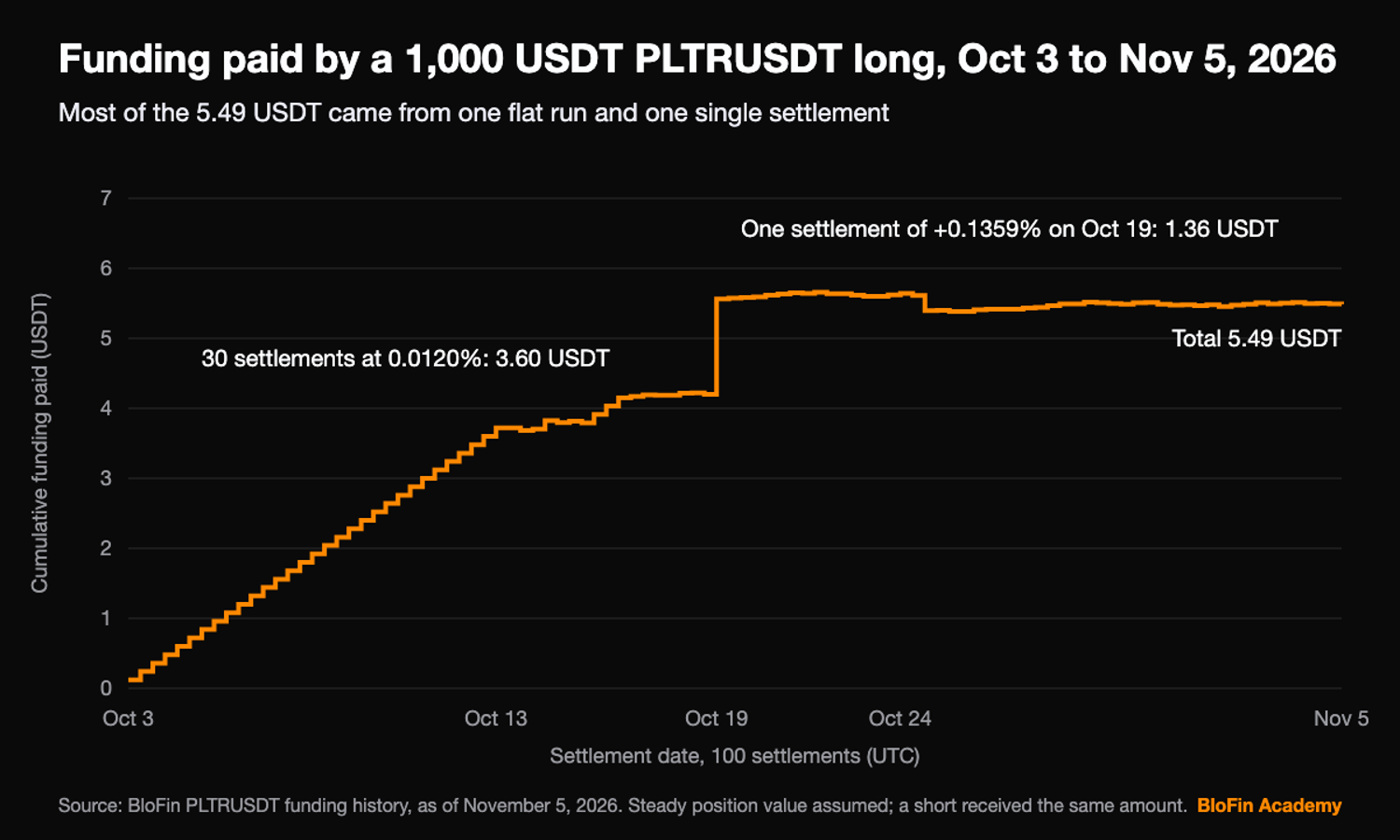
About 3.60 USDT of that came from the 30 settlements of October 3 to 12, all at 0.0120%, and 1.36 USDT came from one settlement of +0.1359% on October 19. The 51 settlements after that one add up to -0.0075%, close to nothing (source: BloFin PLTRUSDT funding history). Over a longer hold, funding keeps settling every eight hours, in either direction, while a share costs nothing to hold.
The three routes cost different amounts over the same 33 days. A 1,000 USDT long, with a taker order each way, cost about 6.69 USDT before any price change, while $1,000 of shares cost only the spread and the trip into dollars. Reaching $1,000 of Palantir through QQQ takes about $55,000 of the fund, and 33 days of its 0.18% expense on that sum is about $8.94, although that money also buys everything else in the fund.
How to buy a fraction of Palantir with crypto
The smallest Palantir position you can take with crypto on BloFin is 0.01 PLTR, one contract on the PLTRUSDT Perpetual. At the 170.57 USDT mark price at 2.19AM UTC on November 5, 2026, that was worth about 1.71 USDT. You hold a contract on that fraction of the price, never the share (source: BloFin PLTRUSDT market data).
Positions step up in whole contracts, so a USDT budget rarely lands on an exact figure. Using that mark price at 1x, where your margin equals the position's value, here is what three budgets buy after the opening fee and what a taker fee in and out would cost at an unchanged price.
USDT budget | Contracts | PLTR | Position value (USDT) | Taker fees in and out (USDT) |
|---|---|---|---|---|
10 | 5 | 0.05 | 8.53 | 0.01 |
100 | 58 | 0.58 | 98.93 | 0.12 |
1,000 | 585 | 5.85 | 997.83 | 1.20 |
Say you put in 100 USDT. A 5% move in the mark price changes the position by about 4.95 USDT in either direction, the same as holding 0.58 of a share would. Raise the leverage to 3x and the margin falls to about 32.98 USDT, while the same 5% move is still 4.95 USDT, now about 15% of what you put up. You place that order on the PLTRUSDT trading page.
A broker sells fractions too, in dollars. Schwab's minimum is $1 (source: Schwab fractional shares), and at Palantir's $171.70 close on November 4, 2026, $100 buys about 0.58 of a share (source: Nasdaq PLTR historical data). That slice is real stock with zero funding to pay, but Schwab says anyone holding less than one whole share is shut out of shareholder votes (source: Schwab fractional shares). If your reason for owning a sliver of Palantir is the vote, the budget has to reach a whole share first.
You can see the live mark price, funding rate and order book for the contract on the PLTRUSDT Perpetual page.
Choosing a Palantir route
Choose by what you want from Palantir. To own the stock and keep it for years, a broker gives you shares and spares you funding. To hold Palantir as a small part of a wider basket, a fund does that. To trade its price in either direction from a USDT balance, the PLTRUSDT Perpetual is the route.
Say your whole plan is to hold Palantir for three years. Each eight-hour settlement over those years can be a payment to or from you on the perpetual, while the share simply sits in your account. Say instead you expect a fall after a report and want to act on that from the USDT you already hold. On the perpetual, a sell order opens a short position from the same balance, something a plain fund purchase cannot give you.
Palantir's third-quarter report shows the timing gap between routes. The release put revenue at $2.3 billion, 96% higher than a year before (source: Palantir Q3 2026 results), and EDGAR accepted the filing at 4.06PM ET (9.06PM UTC) on November 2, 2026, minutes after the close (source: SEC EDGAR filing index). A shareholder with no after-hours access next saw a regular-session price at 9.30AM ET (2.30PM UTC) on November 3, when the stock opened at $168.18, 5.7% below its $178.34 close (source: Nasdaq PLTR historical data).
PLTRUSDT kept trading after the Nasdaq close. From 178.76 USDT at 9PM UTC it reached 187.21 USDT and stood at 171.83 USDT at 11PM UTC, 3.9% lower, with 1,709.37 PLTR traded (source: BloFin PLTRUSDT market data). BloFin may limit orders to closing a position in those hours, and its trading page warns of reduced liquidity outside regular hours.
Now say you only want Palantir to be part of a technology holding. A bad day for the stock barely registers in a broad fund, and a good day hardly more, so a fund is a weak way to act on a view about Palantir itself.
The perpetual has costs that a share does not. Leverage can liquidate you on a move the stock later reverses, and funding runs for as long as you stay in. If you specifically want a token, BloFin has none for Palantir.
Looking to trade Palantir? To get started, you'll need to first create a BloFin account, fund your account with cryptocurrency, and go to the PLTRUSDT Perpetual trading page.
Frequently asked questions
How much does one Palantir share cost in USDT?
On the PLTRUSDT Perpetual, one PLTR is 100 contracts, worth 170.57 USDT at the mark price at 2.19AM UTC on November 5, 2026 (source: BloFin PLTRUSDT market data). At 1x you post all of that, and at 20x you post about 8.53 USDT, with liquidation about 2.5% away before fees (source: BloFin PLTR position tiers). Either way you hold a contract on the price, so you own no share.
Can you trade Palantir in dollars on BloFin?
BloFin's PLTRUSDT order panel prices the contract in USDT and takes its amount in PLTR, so you size a position in PLTR and fund it from a USDT balance. Dollars come into it only if you sell USDT for them and go to a broker.
Do you need a broker to trade Palantir with crypto?
For the perpetual you need no broker, because the contract settles in USDT (source: BloFin PLTR contract details). USDT you deposit lands in your BloFin Funding Account, and you move it to the trading account under Assets with an instant, free transfer.
Does the PLTRUSDT price match Palantir's share price?
The two can differ. On November 2, 2026, the stock closed at $178.34 and PLTRUSDT stood at 178.76 USDT at 9PM UTC, about 0.24% higher (source: Nasdaq PLTR historical data; BloFin PLTRUSDT market data). The contract is also quoted in USDT rather than dollars.
Can you swap a Palantir perpetual for real shares?
PLTRUSDT settles in USDT, so closing a position returns your margin plus or minus the result in USDT (source: BloFin PLTR contract details). To own stock, you would withdraw that USDT, change it into dollars and buy through a broker. Moving later between brokers has its own limit: at Schwab, only whole shares can be transferred, and any fraction is sold (source: Schwab fractional shares).
Researched and written by the BloFin Academy editorial team with AI-assisted drafting. All facts independently verified. Primary sources include BloFin's PLTR contract details, position tiers, funding history, fee schedule, market data and stock futures notice, Palantir's third-quarter 2026 results and Form 10-Q, the SEC's September 17, 2026 release and EDGAR filing index, Backed's PLTRx page, the xStocks legal overview, and Ondo's stock list and legal terms. They also include FINRA's margin page, Nasdaq's trading hours and PLTR history and Schwab's fractional shares page, with fund data from Stock Analysis, current as of November 5, 2026.
Nothing in this article constitutes financial advice, and nothing in it is a recommendation to buy, sell or hold Palantir in any form. The PLTRUSDT Perpetual leaves you with zero claim on Palantir, and at 20x a fall of about 2.5% can liquidate a long position. Funding is charged or paid every eight hours, and outside US trading hours you may only be able to reduce a position, so adding to a trade when a report lands may not be possible. Past performance does not indicate future results. Do your own research and consider your risk tolerance before you trade on BloFin.