
A handful of stock market indexes decide where trillions of dollars in fund money sit. When a company joins one, every fund that copies that index has to buy its shares on a set day, and the fund's managers get no say in it.
The details are easy to mix up, because the index provider announces a change on one date and makes it count on another. The rules a company must meet sit in a long rulebook, and the exchange a company lists on can decide which indexes it may join at all.
Putting the dates, the rules and the share price side by side makes the process easy to follow. The provider's release names the company and the day. The company's filings show which rules it had met, and a daily price table shows what traders did in between.
Palantir Technologies (PLTR) went through three index additions and one exchange move in a little over six months, from September 2024 to March 2025, and each one is on the public record. BloFin's PLTRUSDT Perpetual follows Palantir's price every day of the week, with profit and loss paid in USDT and risks of its own.
What is Palantir's S&P 500 inclusion?
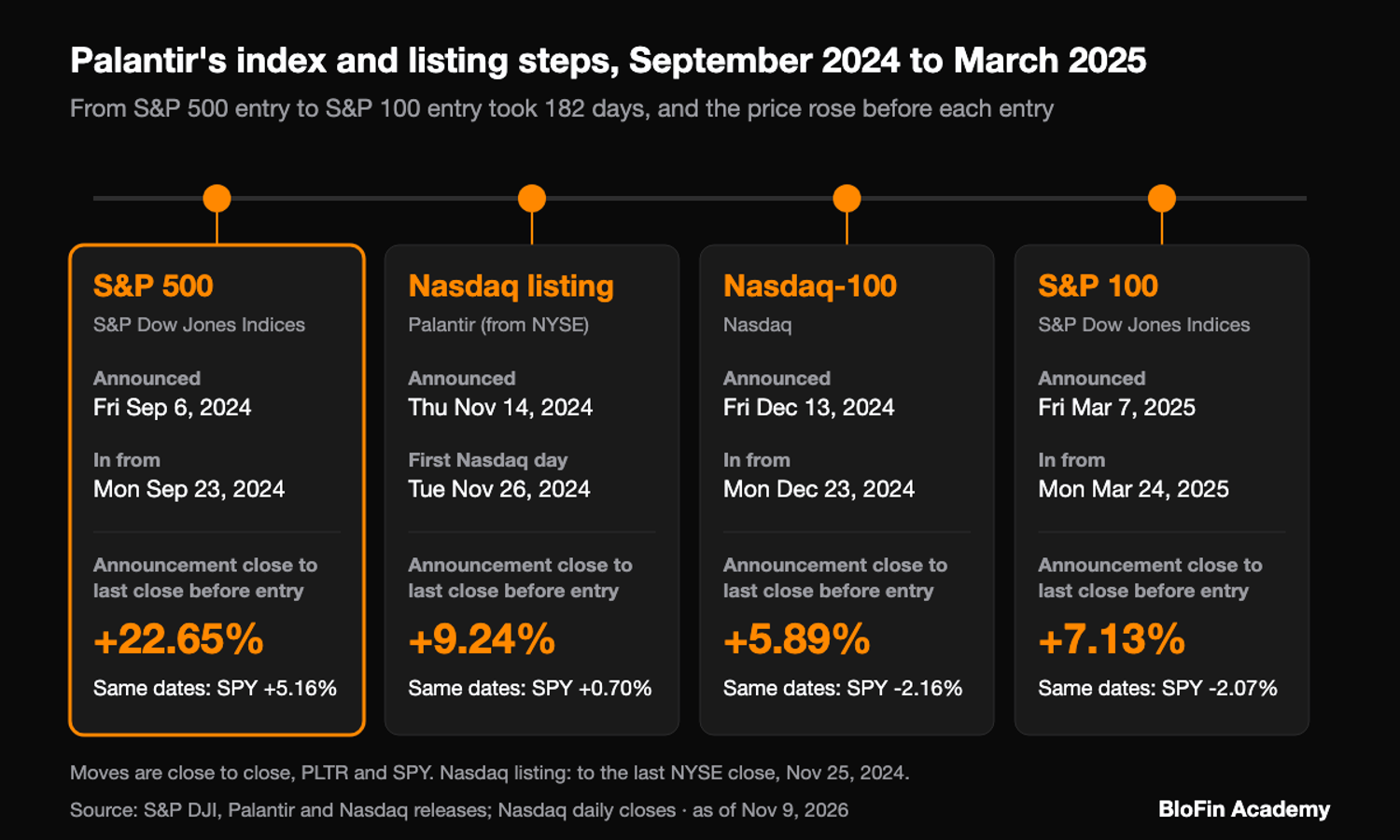
Palantir's S&P 500 inclusion is its addition to the S&P 500 index. S&P Dow Jones Indices announced it on Friday, September 6, 2024, and it took effect before the market opened on Monday, September 23, 2024 (source: S&P Dow Jones Indices, September 6, 2024). From that day, funds that track the index held Palantir shares.
S&P Dow Jones Indices, often shortened to S&P DJI, runs the index. It timed the change to match its quarterly rebalance, the regular date when it updates its indexes. Palantir was one of three companies added that quarter, and the release placed it in the information technology sector.
Three more steps followed. Palantir switched its stock listing to Nasdaq on November 26, 2024. It joined the Nasdaq-100 on December 23, 2024 and the S&P 100 on March 24, 2025, and each date comes from the company's or the index provider's own release.
Palantir's index weights in November 2026
After the November 9, 2026 close, Stock Analysis listed Palantir as the 24th-largest weight in the S&P 500, at 0.60% of the index (source: Stock Analysis S&P 500 list). It was 15th in the Nasdaq-100, at 1.78% (source: Stock Analysis Nasdaq-100 list). The site works out both weights from the holdings of two funds that track the indexes.
Those funds are an S&P 500 exchange-traded fund (SPY) and the Invesco QQQ Trust (QQQ), which tracks the Nasdaq-100. In money terms, $1,000 spread across the S&P 500 at those weights held about $6.00 of Palantir. The same $1,000 in the Nasdaq-100 held about $17.80.
Each fund issuer publishes its own holdings, and how a fund's slice of Palantir compares with a position in the PLTRUSDT Perpetual comes down to cost, leverage and ownership.
On October 30, 2026, S&P DJI said Okta would replace Kenvue in the S&P 500 before the open on Wednesday, November 4. Kimberly-Clark, already a member, was buying Kenvue (source: S&P Dow Jones Indices, October 30, 2026).
Okta moved up from the S&P MidCap 400, a smaller index in the same family, while Palantir took a different path. The 2024 release calls Erie Indemnity an S&P MidCap 400 member and gives Palantir no such label, so Palantir came straight into the S&P 500 rather than moving up from the S&P MidCap 400.
How does a company get into the S&P 500?
A company gets into the S&P 500 when a committee at S&P Dow Jones Indices picks it from the companies that pass a set of published rules. The rules cover profit, the share of stock the public can trade, trading volume (liquidity), how long the shares have traded and size. The committee then adds companies as places open up.
The profit rule is the one people quote most. It uses GAAP net income from continuing operations, meaning profit measured by generally accepted accounting principles, the standard US rules. In S&P DJI's words, that figure "must be positive for: the most recent quarter, and the sum of the most recent four consecutive quarters" (source: S&P Dow Jones Indices, June 4, 2026).
So the adjusted profit figures that many companies highlight in their results do not count. Only the GAAP line does, and it has to pass both tests at once.
The same release sets two rules about the shares. A stock needs an investable weight factor (IWF) of at least 0.10. In plain terms, at least a tenth of its shares must be open to public trading. A newly listed company should also have traded for at least 12 months.
Size is another test. When Palantir was added, Fortune reported a minimum market value of $18 billion, alongside standards for profit, liquidity and float, "per August's methodology" (source: Fortune, September 6, 2024). Fortune tied that figure to the August 2024 rulebook, so it belongs to its date.
Passing the rules makes a company eligible, and the timing stays with the committee. Morningstar, reporting on S&P DJI's research, said decisions come from a committee of S&P employees who meet monthly (source: Morningstar, September 28, 2021).
In June 2026, after asking the market for views, S&P DJI kept its profit, trading-history and float rules for very large new companies. It said exceptions should not be granted just because a company is big (source: S&P Dow Jones Indices, June 4, 2026).

Why Palantir joined the S&P 500 in 2024
Palantir joined the S&P 500 in 2024 because two hurdles fell away only shortly before. S&P DJI dropped its ban on companies with more than one class of shares in April 2023. Then Palantir's results for the third quarter of 2023 completed its first run of four profitable quarters under GAAP, the measure the rule uses.
The share-class ban began on July 31, 2017, when S&P DJI said its S&P Composite 1500, the group that includes the S&P 500, "will no longer add companies with multiple share class structures" (source: S&P Dow Jones Indices, July 31, 2017).
The ban ended on April 17, 2023, when S&P DJI ruled that companies with several share classes "will be considered eligible candidates for addition" if they meet every other rule (source: S&P Dow Jones Indices, April 17, 2023).
Palantir has three share classes, and on October 26, 2026 its latest quarterly report counted about 2.3 billion Class A shares, with 101.8 million in Class B and roughly 1.0 million in Class F (source: Palantir Form 10-Q, third quarter 2026). Only Class A trades on an exchange, under the ticker PLTR.
Profit came next: under GAAP, Palantir lost $101.4 million, $179.3 million and $123.9 million in the first three quarters of 2022. It then earned $30.9 million in the fourth quarter (source: Palantir 2022 Form 10-K, Palantir Q1 2023 Form 10-Q, Palantir Q2 2023 Form 10-Q, Palantir Q3 2023 Form 10-Q). That last figure is the full-year loss minus the nine-month loss. CNBC also dated the turn to profit to the final quarter of 2022 (source: CNBC, September 9, 2024).
Profits of $16.8 million, $28.1 million and $71.5 million followed in the first three quarters of 2023. That put the four quarters to September 2023 at $147.3 million (source: Palantir Q1 2023 Form 10-Q, Palantir Q2 2023 Form 10-Q, Palantir Q3 2023 Form 10-Q). Palantir reported those results on November 2, 2023, during that quarter's earnings season, and from then on it met both parts of the profit rule.
S&P DJI announced the addition 309 days after that report, and it took effect at the September 2024 rebalance, 326 days after it. S&P DJI's release gives no reason for picking that quarter. That fits a process where a committee, rather than a formula, decides when an eligible company comes in.
Why Palantir moved from the NYSE to Nasdaq
In November 2024, Palantir took its listing away from the New York Stock Exchange (NYSE) and over to Nasdaq, and its own announcement tied the switch to one index. "Upon transferring, Palantir anticipates meeting the eligibility requirements of the Nasdaq-100 Index®," the release said, and that index takes only Nasdaq-listed companies (source: Palantir release, November 14, 2024).
Palantir's filing that day set the dates. Its last day on the NYSE was November 25, 2024, ending at the close. Trading on the Nasdaq Global Select Market began at the open on November 26, and the ticker stayed PLTR (source: Palantir Form 8-K, November 14, 2024).
The release gave no quote from an executive about the move. A board member, Alexander Moore of the venture firm 8VC, gave his own view on X. He suggested the switch "will force" billions of dollars in buying by exchange-traded funds, NBC Los Angeles reported, carrying a CNBC story (source: NBC Los Angeles, November 15, 2024).
The same report said that changing listing sites does nothing to alter a company's fundamentals. It added that Moore appeared to have deleted his X account afterward. The business stayed the same, and what the switch changed was the set of indexes Palantir could join.
Nasdaq-100 addition in December 2024
Palantir joined the Nasdaq-100 at the index's yearly reshuffle, which Nasdaq announced on Friday, December 13, 2024. The change took effect before the market opened on Monday, December 23, 2024. Palantir, MicroStrategy and Axon Enterprise came in, while Illumina, Super Micro Computer and Moderna left (source: Nasdaq, December 13, 2024).
Nasdaq describes the index as 100 of the largest non-financial companies listed on its exchange. Financial companies such as banks sit outside it.
The wait was short, as the announcement came 17 days after Palantir's first Nasdaq session, and the addition took effect 27 days after it. That matched the company's statement that it expected to meet the index's rules once it had moved.
QQQ follows the Nasdaq-100 and holds its members at their index weights. That is how Stock Analysis can read Palantir's 1.78% weight from the fund's holdings.
Palantir's place in the S&P 100
Palantir joined the S&P 100 before the open on Monday, March 24, 2025, after S&P DJI announced the change on Friday, March 7, 2025. It took the place of Dow Inc. in that index, while Intuitive Surgical and ServiceNow came in at the same time, replacing Kraft Heinz and Ford (source: S&P Dow Jones Indices, March 7, 2025).
The S&P 100 is a smaller group drawn from inside the S&P 500. The release said all three companies leaving the S&P 100 would stay in the S&P 500. It described the newcomers as "more representative of the mega-cap market space."
Mega-cap means the very largest listed companies. Palantir reached that group 182 days after its first session in the S&P 500, the last of its four steps.
How index-fund buying affects a stock
Index-fund buying affects a stock because every fund that copies an index must hold the new member at its weight. Much of that buying tends to land on one day. Morningstar, describing S&P DJI's research, called it the effective date, "the last market close prior to inclusion," when index funds tend to buy or sell (source: Morningstar, September 28, 2021).
The money behind those trades has grown a great deal. In that research, assets tracking the S&P 500 rose from US577billionin1996toUS5.4 trillion in 2020, about 9.4 times as much. CNBC put the reason simply: fund managers who track the index regularly update their portfolios to mirror the additions (source: Morningstar, September 28, 2021, CNBC, September 9, 2024).
Palantir's trading volume shows that day clearly: on Friday, September 20, 2024, its last session before joining the S&P 500, 450,290,500 shares changed hands (source: Nasdaq PLTR historical data). That was 8.45 times its average over the prior 20 sessions. It is the busiest day in Nasdaq's Palantir table since the September 30, 2020 listing.
The Nasdaq-100 step drew less, and on December 20, 2024, the last session before that entry, 281,230,800 shares traded, 3.45 times the 20-session average. Before the S&P 100 entry, on March 21, 2025, volume was about normal, at 1.01 times average. Funds tracking the wider S&P 500 already held Palantir by then.
The price effect has shrunk over the decades. S&P DJI's study, as Morningstar reported it, looked at the move between the announcement and the effective date. Companies joining the S&P 500 from 1995 to 1999 had a median excess return of 8.32% over that window, but from 2011 to 2021 the median was -0.04% (source: Morningstar, September 28, 2021).
In that study, excess return means the stock's gain beyond the index over the same dates. How big a stake index funds now hold, next to the founders and other large investors, is part of who owns Palantir stock. Crypto has its own version of the idea, index investing in a basket of coins.
Palantir's stock price around each index date
Palantir's share price rose between each announcement and the last close before each entry, by between 5.89% and 22.65%, based on Nasdaq's daily closes (source: Nasdaq PLTR historical data). The first session after each announcement was mixed, with two rises and two falls. The SPY fund's moves over the same dates show how much the whole market moved.
Step | Announced | First session after announcement | Announcement close to last close before entry | SPY, same dates |
|---|---|---|---|---|
S&P 500 | September 6, 2024 | +14.08% | +22.65% | +5.16% |
Nasdaq listing | November 14, 2024 | +11.14% | +9.24% (to the last NYSE close) | +0.70% |
Nasdaq-100 | December 13, 2024 | -0.42% | +5.89% | -2.16% |
S&P 100 | March 7, 2025 | -10.05% | +7.13% | -2.07% |
The SPY figures come from Nasdaq's daily table for the fund (source: Nasdaq SPY historical data). The S&P 500 jump began after hours on the Friday, when shares rose as much as 8.4% (source: Fortune, September 6, 2024). CNBC tied the next session's 14% rise to the announcement (source: CNBC, September 9, 2024).
After the listing news, Palantir rose 11.14% to a record close of $65.77 on November 15, 2024, on a day SPY fell 1.28% (source: NBC Los Angeles, November 15, 2024, Nasdaq PLTR and SPY historical data). The Nasdaq-100 news came with a 0.42% fall on December 16, 2024, while SPY rose 0.43% (source: Nasdaq PLTR and SPY historical data).
The S&P 100 news met a falling market. On March 10, 2025, Palantir closed 10.05% lower as SPY fell 2.66%. 24/7 Wall St. described a stock market rout driven by tariff fears that day (source: 24/7 Wall St., March 10, 2025, Nasdaq PLTR and SPY historical data). The stock still rose 7.13% from the March 7 close to the March 21 close.
Over a longer stretch, Palantir closed at $37.20 on September 20, 2024 and at $169.20 on November 9, 2026, a rise of 354.84%, while SPY rose 32.46% over the same dates (source: Nasdaq PLTR and SPY historical data). On those closes, $1,000 in Palantir shares became about $4,548. Those returns show what happened after the entry, and they say nothing about what caused it.
Index membership and PLTRUSDT
Index membership belongs to Palantir's shares, and the PLTRUSDT Perpetual tracks their price without being a share. BloFin lists the contract in its stocks class with leverage of up to 20x. It began trading on February 9, 2026 at 10.30AM ET (3.30PM UTC), after all four of those steps had happened (source: BloFin PLTRUSDT market data).
Under BloFin's stock futures notice, holding one of these contracts means owning no part of the company. It says their prices rest on a basket of indices of tokenized stocks that already circulate in the market (source: BloFin stock futures notice). An index fund's rebalance buys Palantir shares, and the contract is a separate product.
Index funds tend to trade at the share's last close before an entry, at 4PM ET (9PM UTC in standard time). That is the end of Nasdaq's regular hours, which begin at 9.30AM ET (2.30PM UTC). Outside those hours, BloFin's trade page warns of "limited price movement and reduced liquidity" in the underlying asset. It adds that orders may be limited to reduce-only, meaning orders that only close a position (source: BloFin PLTRUSDT Perpetual page).
A perpetual contract has no expiry date, and you can trade it long or short. Leverage multiplies every move, so at 5x a 10.05% fall like that of March 10, 2025 would equal 50.25% of a Palantir long position's margin. BloFin liquidates a position once the mark price hits the position's liquidation price, which comes before all of the margin is gone.
To trade Palantir on BloFin, you choose Cross or Isolated margin, set the leverage and pick a limit or market order.
The PLTRUSDT Perpetual page puts the latest trade, the mark price and the 24-hour high and low on one screen.
How to follow Palantir's index changes yourself
You can follow Palantir's index status from four free public sources. They are S&P DJI's press releases, Nasdaq's Nasdaq-100 releases, the holdings of the SPY and QQQ funds, and Palantir's results on SEC EDGAR. Together they show any change in membership, the current weight and whether the profit rule is still met.
Step 1: Search S&P DJI's press release page for Palantir or PLTR. For both of Palantir's S&P changes, the release came 17 days before the change took effect.
Step 2: Read Nasdaq's Nasdaq-100 announcements, which name every company added or removed and the date each change takes effect.
Step 3: Find the holdings list on the SPY or QQQ fund issuer's website for Palantir's current weight, and note the date the issuer gives.
Step 4: Check the net income line in each quarterly report on EDGAR. Add up the last four quarters to see where Palantir stands against the profit rule.
A weight moves every day with the share price, so any weight you read carries its own date. Membership itself changes only when S&P DJI or Nasdaq publishes a release, which makes the releases the first place to look.
Looking to trade Palantir? To get started, you'll need to first create a BloFin account, fund your account with cryptocurrency, and go to the PLTRUSDT Perpetual trading page.

Frequently asked questions
Is Palantir part of the Dow Jones Industrial Average?
Palantir is outside the Dow Jones Industrial Average. Its 30 members, listed after the November 9, 2026 close, did not include Palantir (source: Stock Analysis Dow Jones list). S&P DJI runs the Dow as a price-weighted index, so a higher share price means a larger weight (source: S&P Dow Jones Indices, November 1, 2024). A stock split that cut a member's price would cut its weight too. The latest change put Alphabet in place of Verizon on June 29, 2026 (source: S&P Dow Jones Indices, June 23, 2026).
Is Palantir one of the Magnificent Seven?
Palantir sits outside the Magnificent Seven, a label for Apple, Microsoft, Alphabet, Amazon, Nvidia, Tesla and Meta Platforms. The Week reported in January 2024 that Bank of America analyst Michael Hartnett coined the name in 2023, citing Investopedia (source: The Week, January 19, 2024).
Which companies were added with Palantir in September 2024?
Dell Technologies and Erie Indemnity joined the S&P 500 with Palantir on September 23, 2024. The three replaced American Airlines, Etsy and Bio-Rad Laboratories. American Airlines moved down to the S&P MidCap 400 in place of TEGNA (source: S&P Dow Jones Indices, September 6, 2024).
What happens to a stock's price when it leaves the S&P 500?
Leaving the S&P 500 once pulled a stock's price down, and by 2021 that effect had all but faded. Morningstar, reporting S&P DJI's study, put the change between announcement and departure at -9.58% in the late 1990s and 0.06%, barely any impact, in the decade to 2021. It called the story for removals similar to that for additions, which the study measured as median excess returns (source: Morningstar, September 28, 2021).
When does the Nasdaq-100 change its members?
Nasdaq reviews the Nasdaq-100 every December, timed to the quarter's quadruple witching Friday, the day several kinds of options and futures expire together, which in 2024 was December 20 (source: Nasdaq, December 13, 2024). Under its current rules, rebalances in March, June and September remove members ranked outside the top 125, and the June 2026 one added five companies and removed five, effective June 22, 2026 (source: Nasdaq-100 methodology, Nasdaq, June 11, 2026). Shopify replaced MongoDB between reviews, on May 19, 2025 (source: Nasdaq Shopify release).
Researched and written by the BloFin Academy editorial team with AI-assisted drafting. All facts independently verified. Primary sources include S&P Dow Jones Indices' index announcements, Nasdaq's Nasdaq-100 methodology and releases and Palantir's filings and releases on SEC EDGAR. Price data comes from Nasdaq's daily tables for Palantir and SPY, with index weights from Stock Analysis and reporting from CNBC, Fortune, NBC Los Angeles, Morningstar, 24/7 Wall St. and The Week. BloFin facts come from its stock futures notice, its PLTRUSDT Perpetual page and its PLTRUSDT market data, current as of November 10, 2026.
Nothing in this article constitutes financial advice, and nothing in it is a recommendation to buy, sell or hold Palantir in any form. Index membership describes Palantir's shares, and the weeks around those index and listing steps included sharp moves both ways, among them a 10.05% one-day fall on March 10, 2025. The PLTRUSDT Perpetual carries leverage of up to 20x, and orders may be limited to reduce-only outside regular US hours. Past performance does not indicate future results. Do your own research and consider your risk tolerance before you trade on BloFin.