
A stock exchange shuts every afternoon and stays shut all weekend, yet the news keeps coming. Company results often land after the closing bell, and anything that happens on a Saturday has to wait until Monday morning before the shares can react to it.
For someone who simply owns the shares, that wait is mostly a nuisance, because the price at the next open is the first one that counts. A trader using leverage is in a different spot, because a move of a few percent can eat a large share of the margin behind the trade before there is a chance to act.
Perpetual futures on stocks change that timetable, because they keep trading while the exchange is closed. Their prices go on moving through the night and the weekend, often on thin trading. So the gap a share shows at the open has already been lived through, hour by hour, by anyone holding the contract.
Palantir Technologies (PLTR) is one of those stocks. On BloFin, its share price is tracked by the PLTRUSDT Perpetual. This USDT-settled contract trades through the evenings, the weekends and the hours after Palantir reports its results.
What is PLTR perpetual gap risk?
PLTR perpetual gap risk is the risk that the PLTRUSDT Perpetual moves sharply while Nasdaq is closed, hitting a leveraged position with a move the share has not traded yet. The largest moves have come after Palantir's results, which arrive after the 4PM ET close (9PM UTC in standard time, 8PM UTC in US summer time). Smaller ones build up across weeknights and weekends.
A gap, in the sense chart readers use, is a blank space on a price chart where no shares traded, so the next open sits away from the last close. StockCharts' ChartSchool notes that gaps often form from buying or selling interest that builds while the market is closed. Its example is an earnings report released after the close (source: StockCharts ChartSchool).
Palantir's November 2, 2026 report shows the share's side of it. The stock closed at $178.34 that afternoon and opened the next morning at $168.18, a gap of 5.70% lower (source: Nasdaq PLTR historical data). It then climbed back to close November 3 at $175.40. A shareholder saw the close, after-hours trades, then the open.
Someone holding the PLTRUSDT Perpetual saw every hour in between. That is the whole difference, and it cuts both ways: you can react during the night, and your position can also be reduced or liquidated during the night, before the share's next regular session.
What happens to a PLTRUSDT position when Nasdaq is closed
When Nasdaq closes, your PLTRUSDT position stays open, and its value keeps changing with the contract's price. The share has stopped trading, but the contract has not, and BloFin's notice warns that outside regular hours, at weekends and on public holidays, PLTRUSDT trading "may be limited to reduce-only orders" (source: BloFin stock futures notice).
That kind of order exists to cut or close an open position, never to start one or add to it. Regular hours in the notice are 2.30PM to 9PM UTC in standard time, or 1.30PM to 8PM UTC when the US is on daylight saving time. Either way, that is 9.30AM to 4PM ET.
"May be limited" is BloFin's own wording, and it matters for planning. A plan that relies on opening or adding to a position during the closed hours may not work, while closing what you hold stays possible. The notice does not say how resting orders or take-profit and stop-loss triggers behave inside a reduce-only window.
The trade page carries a second warning. It says that when the main market is shut, the stock behind the contract may face "limited price movement and reduced liquidity" (source: BloFin PLTRUSDT Perpetual page). On the night of November 2, PLTRUSDT traded between about 10 and 21 PLTR an hour from 8PM to 4AM ET (1AM to 9AM UTC), against 643 and 1,067 PLTR in the two hours after the report (source: BloFin PLTRUSDT market data).
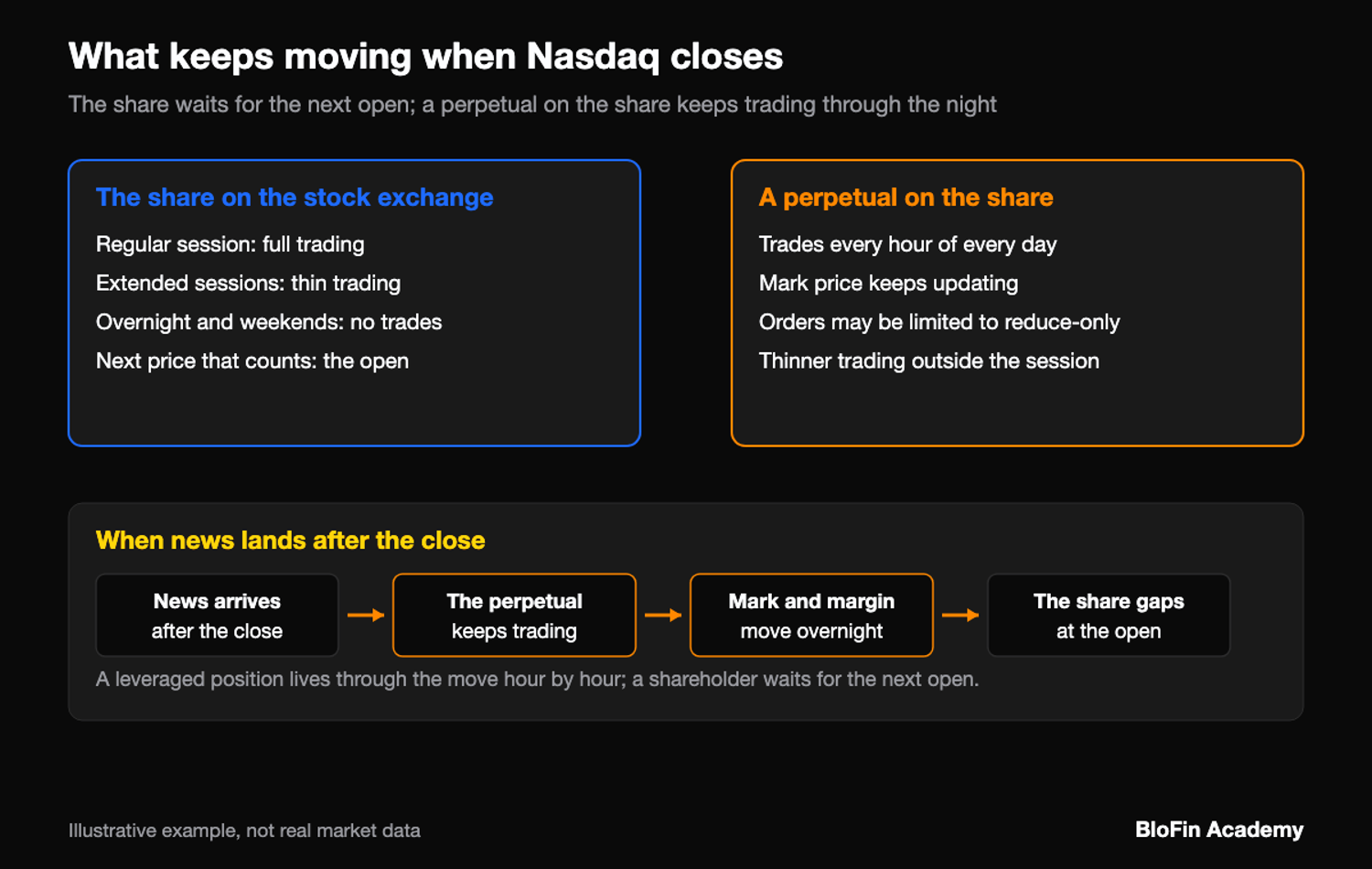
Two prices matter for your position while Nasdaq is shut. Last price means the latest trade printed on BloFin. The mark price is BloFin's fair price for the contract, and BloFin uses it for liquidation and for your unrealized profit or loss. On a quiet night the two can drift apart for a while, which is why a brief spike in trades does not by itself liquidate a position.
Margin keeps working while Nasdaq is closed, too. In isolated margin, only the margin you gave the position is at risk. In cross margin, the whole futures balance backs it, as the guide to crypto margin trading explains. A Palantir position falling at the weekend then draws on the same balance as any crypto position you hold.
Before a Friday close or an evening report, it helps to compare the mark with your estimated liquidation price on the PLTRUSDT trading page. The page lists last, mark and index prices together.

How big Palantir's weekend gaps have been
Over the 31 weekends from February 20 to November 6, 2026 that can be compared on both series, the PLTRUSDT Perpetual moved a median 1.43%. That move runs from Friday's 4PM ET close (8PM UTC in daylight saving time, 9PM in standard time) to 9AM ET on Monday (1PM or 2PM UTC) (source: BloFin PLTRUSDT market data). The share's own weekend gap had a median of 1.11% (source: Nasdaq PLTR historical data).
The two figures come from separate price series. For the contract, Friday's price is the last trade in the hour that ends at the Nasdaq close. Monday's price is the first trade in the hour that starts 30 minutes before the open. In UTC, the Friday hour begins at 8PM in standard time (February, and again since November 1) and 7PM in daylight saving time, and the Monday hour at 2PM and 1PM. For the share, the figures are Nasdaq's Friday close and Monday open. The set leaves out six holiday weekends and two weekends when the clock change moved the Monday hour.
Over those 31 weekends, the contract moved 1% or more over 17, 2% or more over seven and 3% or more over four. The share's weekend gap reached 1% or more 16 times and 2% or more eight times, and its largest was 2.96% (source: Nasdaq PLTR historical data). Moves up outnumbered moves down on both: 19 up and 12 down for the contract, and 20 up and 11 down for the share.
Weekend (Friday date, 2026) | PLTRUSDT, Friday 4PM ET to Monday 9AM ET | Palantir share, Friday close to Monday open |
|---|---|---|
February 27 | +3.36% | +2.61% |
May 1 | +2.23% | +2.55% |
May 29 | +3.11% | +2.20% |
June 26 | +3.42% | +2.92% |
July 31 | +3.03% | +2.96% |
These are the five weekends with the biggest contract moves (source: BloFin PLTRUSDT market data, Nasdaq PLTR historical data). All five went up on both series.
The Monday reading can hide a larger swing during the weekend itself. Over a typical weekend, the contract's trades between Friday's close and 9AM ET on Monday spanned a median 2.92% from low to high (source: BloFin PLTRUSDT market data). The widest span was 6.10% over the May 29 weekend, when trades reached 5.69% above Friday's close before settling lower by Monday morning. A leveraged position has to survive that whole range, and the Monday price alone does not show it.
BloFin's liquidation formula uses the first tier's 2.5% maintenance margin rate and a liquidation fee rate, assumed here to equal the standard 0.0600% taker fee (source: BloFin liquidation price calculation, BloFin PLTRUSDT position tiers). On those inputs, a 20x long's estimated liquidation sits 2.50% below its entry, and a 20x short's 2.38% above it. At 10x the distances are 7.64% and 7.25% (source: BloFin liquidation price calculation). Weekend trades crossed the 20x long's estimate on three weekends and the 20x short's on eight. They never reached a 10x estimate on either side (source: BloFin PLTRUSDT market data). Candles record trades, while BloFin liquidates on the mark price, so a crossing in trades shows the risk without proving a liquidation happened.
The newest weekend was a quiet one. From the Friday, November 6 close to 9AM ET (2PM UTC) on Monday, November 9, the contract rose 0.27%. Its weekend range ran from 1.62% below to 1.50% above Friday's price. The big move came after the opening bell, when the share opened 0.55% above Friday's $160.38 close and finished the day 5.50% higher at $169.20 (source: Nasdaq PLTR historical data). MarketBeat put the rebound down to a broader tech rally (source: MarketBeat, November 9, 2026).
Weeknight and weekend gaps in Palantir stock
Most of Palantir's large opening gaps since February 2026 came after weeknights. From February 10 to November 10, 2026, the share's median weeknight gap was 0.98%, against 1.11% over 33 ordinary weekends from February 20 to November 6 (source: Nasdaq PLTR historical data). Weeknights produced 28 gaps of 2% or more and those weekends eight, because there are so many more weeknights.
Nasdaq's main session is shut for 17.5 hours on a weeknight, from the 4PM ET (9PM UTC) close to the 9.30AM ET (2.30PM UTC) open. From Friday's close to Monday's open it is shut for 65.5 hours. Pre-market trading starts at 4AM ET (9AM UTC), and after-hours trading lasts until 8PM ET (1AM UTC) (source: Nasdaq trading hours). Those extended sessions fill part of the gap, on thinner trading.
The share's 151 weeknight gaps include the three mornings after Palantir's reports since the contract listed. Measured from each report day's close, the share opened 3.93% lower on May 5, 15.52% higher on August 4 and 5.70% lower on November 3 (source: Nasdaq PLTR historical data). Leave those three out and the weeknight median barely changes, at 0.97%. A report-sized gap is rare, and it sits far from an ordinary night.
So the length of the closure does less than the news inside it. A weekend gives more time for something to happen, yet since February 9, 2026 the share's largest weekend gap was 2.96%, while one report night produced a gap more than five times larger. The six long weekends around US holidays had a median gap of 1.06%, close to the ordinary weekends (source: Nasdaq PLTR historical data).
Trading halts and limit up-limit down pauses
Nasdaq can also pause trading in the share during the day, which opens a short closed window inside regular hours. Under the limit up-limit down rule, a stock that moves outside its price band and stays there for 15 seconds is paused for five minutes. The exchange can extend the pause by another five minutes.
The size of the band depends on the stock and its price. For a stock in the S&P 500 or Russell 1000 priced above $3, the band is 5% for most of the session. It doubles between 3.35PM and 4PM ET (8.35PM to 9PM UTC in standard time). The rule applies only in regular trading hours, from 9.30AM to 4PM ET, so it plays no part overnight (source: FINRA, Guardrails for Market Volatility).
Exchanges can also halt a single stock so the market can digest significant news about the company. Above all of these sit market-wide circuit breakers: a 7% or 13% drop in the S&P 500 before 3.25PM ET (8.25PM UTC in standard time) stops trading in every listed stock for 15 minutes. A 20% drop ends trading for the day (source: FINRA, Guardrails for Market Volatility).
A halt that lasts the rest of the day has the same effect on the share as an early close, with the next trade at the following open. BloFin's stock futures notice ties its reduce-only rule to the hours outside regular trading on weekdays, and to weekend days and public holidays while those markets are shut, and it does not mention trading halts (source: BloFin stock futures notice). A news halt gives the market time to absorb new information, so the share's first trade after it can come at a very different price.
The November 2 report gap on the PLTRUSDT mark price
Palantir's third-quarter report reached the SEC six minutes after the November 2, 2026 close. On BloFin's mark price, the PLTRUSDT Perpetual went from 178.63 USDT at the 4PM ET (9PM UTC) close to 9.00% lower by 6AM ET (11AM UTC) the next day (source: BloFin PLTRUSDT market data). By the November 3 close it had recovered to 175.64 USDT.
The filing record shows the 8-K accepted at 4.06PM ET (9.06PM UTC) on November 2 (source: SEC EDGAR filing index). The results were strong on paper. Quarterly revenue was $2.3 billion, up 96% on a year earlier, with 148% growth in US commercial revenue, to $984 million (source: Palantir Q3 2026 results). The share had already closed 3.13% lower that day, before anyone had seen them (source: Nasdaq PLTR historical data).
On the share's side, Investing.com reported that the shares fell in after-hours trading that evening (source: Investing.com, Palantir Q3 2026 transcript). Nasdaq's table then shows the November 3 open at $168.18, a low of $165.25 and a close of $175.40 (source: Nasdaq PLTR historical data). After-hours prints differ between data providers.
On the contract's side, BloFin's hourly mark candles show the night in four stages.
First hour after the close (4PM to 5PM ET, 9PM to 10PM UTC): the mark swung from 5.18% above its 178.63 USDT close-time level to 3.07% below it, and ended the hour at 180.90 USDT (source: BloFin PLTRUSDT market data).
The rest of the after-hours session (to 8PM ET): the mark slid to 173.26 USDT by 8PM ET (1AM UTC), 3.01% below the close.
Overnight (8PM to 4AM ET, 1AM to 9AM UTC): trading was thin, and the mark stood at 171.25 USDT by 4AM ET, 4.13% down.
Pre-market (4AM to 9AM ET, 9AM to 2PM UTC): the mark hit its low of 162.55 USDT in the hour from 6AM ET (11AM UTC), 9.00% down. It stood at 167.67 USDT at 9AM ET, half an hour before the share opened.
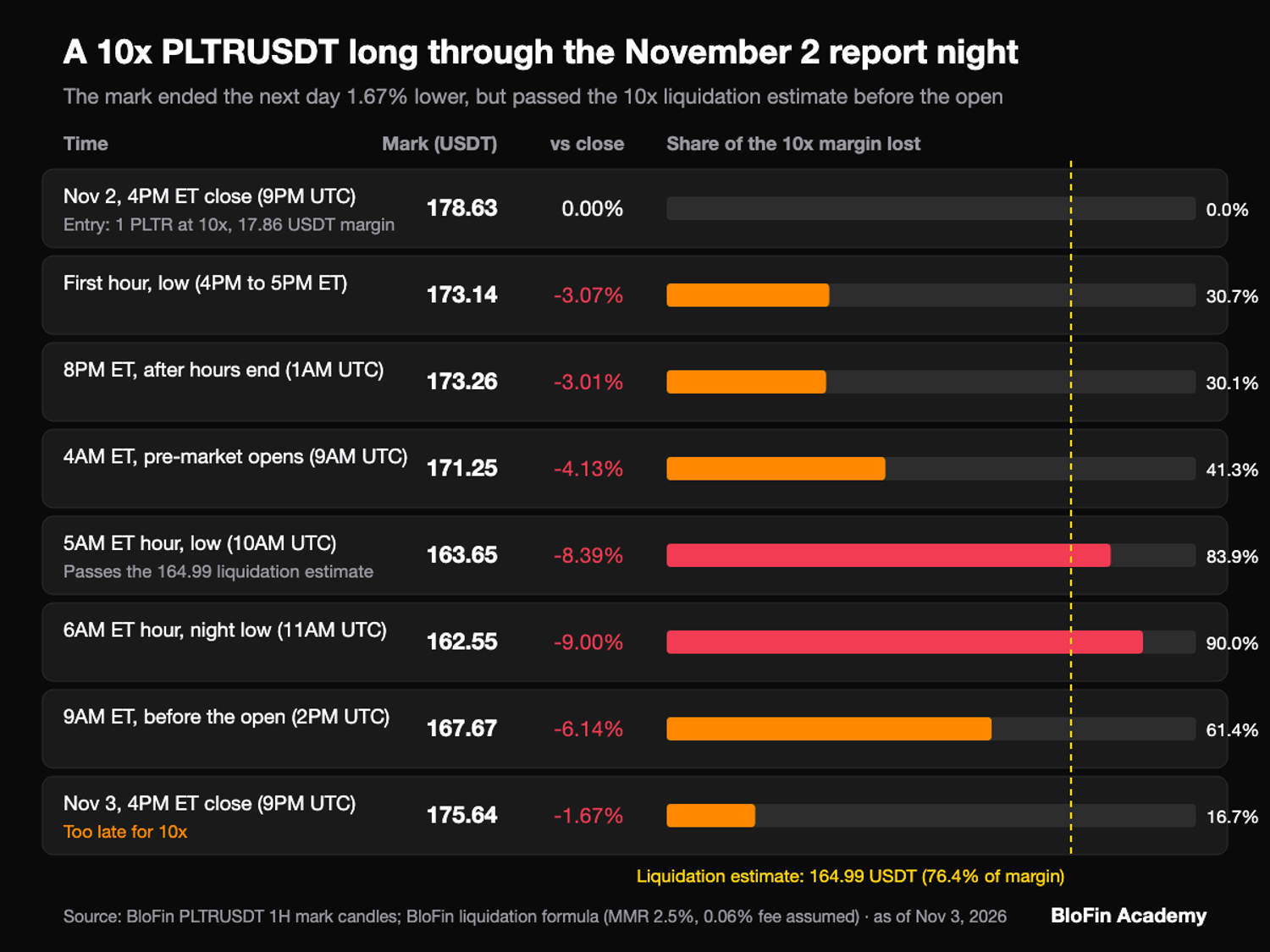
That path is the gap risk in one night. The share's close-to-close fall was 1.65%, and the contract's mark ended November 3 just 1.67% below its November 2 close. Judged by those two numbers, the night looks mild. A leveraged position had to live through a fall of 9.00% first, in hours when BloFin can restrict PLTRUSDT to orders that only cut a position.
Gap liquidation at 20x, 10x, 5x and 3x leverage
Leverage decides whether a gap is a loss you can wait out or a liquidation. From the 178.63 USDT mark at the 4PM ET (9PM UTC) close, a 10x long's estimated liquidation price, assuming a 0.0600% liquidation fee, was 164.99 USDT. The mark passed it in the hour from 5AM ET (10AM UTC) on November 3. Longs at 5x and 3x survived.
The estimates use BloFin's formula for isolated margin, with the first position tier's 2.5% maintenance margin rate. Tier 1 runs from 0 to 700 PLTR, with leverage of up to 20x (source: BloFin liquidation price calculation, BloFin PLTRUSDT position tiers). The formula also needs a liquidation fee rate, which BloFin's page names without giving a figure. These numbers assume the standard 0.0600% taker fee. BloFin's order panel shows its own estimated Liq. Price for your real position, and that is the number to watch.
Say you bought 1 PLTR of the contract at 10x at the close. That position was worth 178.63 USDT and was backed by 17.86 USDT of margin. By the 6AM ET low of 162.55 USDT, the fall of 16.08 USDT was 90.0% of that margin, already past the liquidation estimate. BloFin's rules say a position is reduced or liquidated once the mark reaches the liquidation price, and an estimated liquidation price is for reference only (source: BloFin forced liquidation rules).
Leverage | Long: estimated liquidation (USDT) | Long: first reached on the mark | Short: estimated liquidation (USDT) | Short: first reached on the mark |
|---|---|---|---|---|
20x | 174.16 | 4PM ET (9PM UTC) hour, November 2 | 182.88 | 4PM ET (9PM UTC) hour, November 2 |
10x | 164.99 | 5AM ET (10AM UTC) hour, November 3 | 191.59 | Not reached |
5x | 146.66 | Not reached | 209.01 | Not reached |
3x | 122.22 | Not reached | 232.23 | Not reached |
At 20x, both a long and a short opened at the close would have hit their estimates in the first hour. The mark went up 5.18% and down 3.07% before 5PM ET (10PM UTC) (source: BloFin PLTRUSDT market data). A 20x position has about 2.5% of room on a long and 2.4% on a short, less than the mark moved in that single hour.
A 5x long survived the night, but it was badly hurt at the low. The same 16.08 USDT fall was 45.0% of the 35.73 USDT of margin behind a 5x position, and 27.0% of the margin at 3x. By the November 3 close the mark was back at 175.64 USDT. The 5x long was then down 8.4% of its margin, and a 10x long that had somehow survived would have been down 16.7%. The recovery came too late for the 10x position.
When gap-night liquidations are large, the losses first fall on the contract's insurance fund. That fund is made up mainly of money provided by BloFin and surpluses from earlier liquidations. If it runs short, auto-deleveraging can close positions on the profitable side at the mark price (source: BloFin auto-deleveraging FAQ), a backstop explained with the rest of the PLTR perpetual's contract rules.
The ±3% price-limit band during a gap
BloFin's ±3% price band limits the prices you can enter on an order, measured from the index price. The band does not cap how far the mark price can move. On November 2, the mark fell 9.00% from its 4PM ET (9PM UTC) close-time level by the next morning, three times the width of the band.
The contract's rules apply the band to one side per order. In the first ten minutes after the contract was created, a buy limit order could sit no more than 3% above the index and a sell limit no more than 3% below it. After that, the rule adds the average premium of the previous two minutes to the 3% band (source: BloFin PLTRUSDT contract details). Leaving that premium aside, with the index at 100 a sell limit cannot go below 97 and a buy limit cannot go above 103.
Because the limits are tied to the index, they move whenever the index moves, so the band never holds the price at one level. What it does is keep your own orders near the current price. During a thin hour, a sell limit has to stay inside the band, so a mistyped order cannot fill at an extreme price.
Stop-loss orders and slippage in a gap
A stop-loss order closes your position when the price reaches a trigger you set. In a gap, it fills as a market order at whatever price is there, which can be far past your level. That difference between the expected and actual fill is called slippage, and gaps are where it is largest.
On BloFin, you tick TP/SL (take profit and stop loss) on the order panel. Each trigger box has a dropdown that starts on Last and can be switched to Mark or Index, and the academy walk-through on setting a stop-loss on BloFin shows each step. Set this way, the stop fills as a market order. A stop's planned loss is the size of the position times the distance from entry to trigger, and leverage does not change it.
The two prices crossed a stop level at different times on November 2. A stop 3% below the 178.63 USDT close-time mark sat at 173.27 USDT. The mark crossed that level in the first hour after the 4PM ET (9PM UTC) close, when it dipped to 173.14 USDT. Trades crossed it only in the next hour, falling to 171.33 USDT after going no lower than 173.98 USDT in the first (source: BloFin PLTRUSDT market data). BloFin's notice does not spell out how stop triggers behave in hours when trading may be limited to reduce-only orders.
Neither trigger guarantees the fill. An hourly candle cannot show where inside the hour your order would have filled, and in a thin hour the first price after the trigger can be well below it. On a 1 PLTR position, the planned loss at that stop was 5.36 USDT, and a fill at the next hour's low would have cost more.
Sizing a PLTRUSDT position for overnight and weekend gaps
The simplest protection against a gap is a position small enough, at a leverage low enough, that the largest recent gap leaves it open. On November 2, a 9.00% mark fall took 90.0% of a 10x position's margin and 27.0% of a 3x position's. The leverage you hold into a closure matters more than any order you set.
Start from the size of past closed-market moves. Palantir's weekend moves in 2026 stayed mostly under 3% on both series. Report nights reached 9.00% on the mark in November and 15.52% on the share's August open. A 10x position loses about 10% of its margin for every 1% the mark moves against it. BloFin reduces or liquidates a position before all of that margin is gone, once the mark reaches the liquidation price.
Volatility tells you how much room a position needs. Palantir's typical daily move is the figure to compare with the size you plan. A position size set from the loss you can accept, rather than from the leverage on offer, keeps a gap from deciding the trade for you.
Four checks follow from the November 2 night, before a Friday close or a Palantir report.
Leverage against the gap: divide 100% by your leverage to see the move that would take your whole margin. Compare it with the 9.00% November 2 mark fall.
Margin mode: in cross margin, a weekend move in Palantir and a crypto position share one balance.
Stop trigger: choose between Last and Mark, knowing the fill can slip in a gap.
Order access: BloFin can restrict trading to reduce-only orders until the next session. A cut you want to make is easier to plan before the close than during the night.
Closing the position before Nasdaq shuts is the only way to have no gap exposure at all, and holding at a lower leverage keeps the position while giving it room. Gap-risk guides for other markets make the same point: tastyfx notes that some traders lower exposure and position sizes when risk is high, for example by winding positions down before a weekend (source: tastyfx, gap risk).
Looking to trade Palantir? To get started, you'll need to first create a BloFin account, fund your account with cryptocurrency, and go to the PLTRUSDT Perpetual trading page.

Frequently asked questions
Can the PLTR perpetual's weekend price predict Monday's open?
It has pointed the right way almost every time. Over the 31 weekends from February 20 to November 6, 2026 that can be compared on both series, the PLTRUSDT Perpetual's weekend move had the same sign as the share's weekend gap 30 times (source: BloFin PLTRUSDT market data, Nasdaq PLTR historical data). The contract's move runs from Friday's 4PM ET close (8PM UTC in daylight saving time, 9PM in standard time) to 9AM ET Monday. The exception was the weekend after Friday, August 14, when the contract slipped 0.60% and the share opened 0.01% higher. The record says nothing about any weekend still to come.
Do holiday weekends make Palantir stock gaps bigger?
Not since the PLTR perpetual listed. The share's six gaps across long weekends and holiday closures from February to November had a median of 1.06%, against 1.11% for 33 ordinary weekends (source: Nasdaq PLTR historical data). All six opened lower, the largest by 2.13%, from the Thursday, June 18 close to the Monday, June 22 open after the Juneteenth closure (source: Nasdaq PLTR historical data, Nasdaq trading hours).
Did Palantir stock gap over the weekend before its November 2 report?
Yes, it gapped up and then gave the gain back. Palantir closed Friday, October 30 at $184.11 and opened Monday, November 2 at $186.52, 1.31% higher, then fell as low as $178.13 during that session, 3.25% below Friday's close (source: Nasdaq PLTR historical data). The results reached the SEC only after that session ended, at 4.06PM ET (9.06PM UTC) (source: SEC EDGAR filing index).
Do Palantir's weekend gaps fill on Monday?
Fewer than half did in 2026. A gap fills when the price trades back to the previous close. Of 26 ordinary weekends from February to November when the share opened at least 0.5% away from Friday's close, it traded back to that close during Monday's session 12 times (source: Nasdaq PLTR historical data). The other 14 Monday sessions ended without reaching Friday's price.
What was Palantir's largest weekend gap since the PLTR perpetual listed?
Since the PLTRUSDT Perpetual listed on February 9, 2026, the share's largest was the weekend after Friday, July 31, when Palantir closed at $123.06 and opened Monday, August 3 at $126.70, 2.96% higher (source: Nasdaq PLTR historical data). On the PLTRUSDT Perpetual, the largest Friday-to-Monday move came the weekend after June 26, up 3.42% from 113.10 to 116.97 USDT by 9AM ET Monday (1PM UTC) (source: BloFin PLTRUSDT market data).
Researched and written by the BloFin Academy editorial team with AI-assisted drafting. All facts independently verified. Primary sources include Palantir's third-quarter 2026 results release and its SEC EDGAR filing index, Nasdaq's daily price table and trading-hours page for Palantir, FINRA's guide to market volatility rules, StockCharts' ChartSchool, and reporting from Investing.com and MarketBeat. BloFin facts come from its stock futures notice, contract details, position tiers, liquidation and auto-deleveraging help pages, and its own PLTRUSDT market data, current as of November 11, 2026.
Nothing in this article constitutes financial advice, and nothing in it is a recommendation to buy, sell or hold Palantir in any form. A PLTRUSDT position held while Nasdaq is closed can be reduced or liquidated overnight or at a weekend: on November 2, 2026, the mark fell 9.00% before the next open and passed a 10x long's liquidation estimate. Trading may be limited to reduce-only orders in those hours, and a stop can fill far past its level in a gap. Past performance does not indicate future results. Do your own research and consider your risk tolerance before you trade on BloFin.