
Big companies and government agencies hold more data than they can use. Orders sit in one system and repair logs in another, while supplier dates often live in a spreadsheet. So a simple question, such as why a shipment is late, can take a team days to answer. The facts are spread across places that do not talk to each other.
More storage or one more dashboard rarely fixes this, because the hard part is joining the records up and turning the answer into a decision someone can act on. Governments face the same problem with higher stakes: in spy work, war planning and public safety, the data is also secret and split across many offices.
A small group of software firms sells tools built for this joining-up work. Their tools link a client's data, label what each record refers to and let AI models work on the result. Investors tend to file these firms under data software or business AI. Their sales show how many large buyers will pay to have the problem solved.
Palantir Technologies (PLTR) is the best-known name in that group. It reported its third-quarter results on November 2, 2026 (source: Palantir Q3 2026 results), and its business update for the quarter named clients ranging from the chipmaker Nvidia to the US Army (source: Palantir Q3 2026 Business Update).
What does Palantir do?
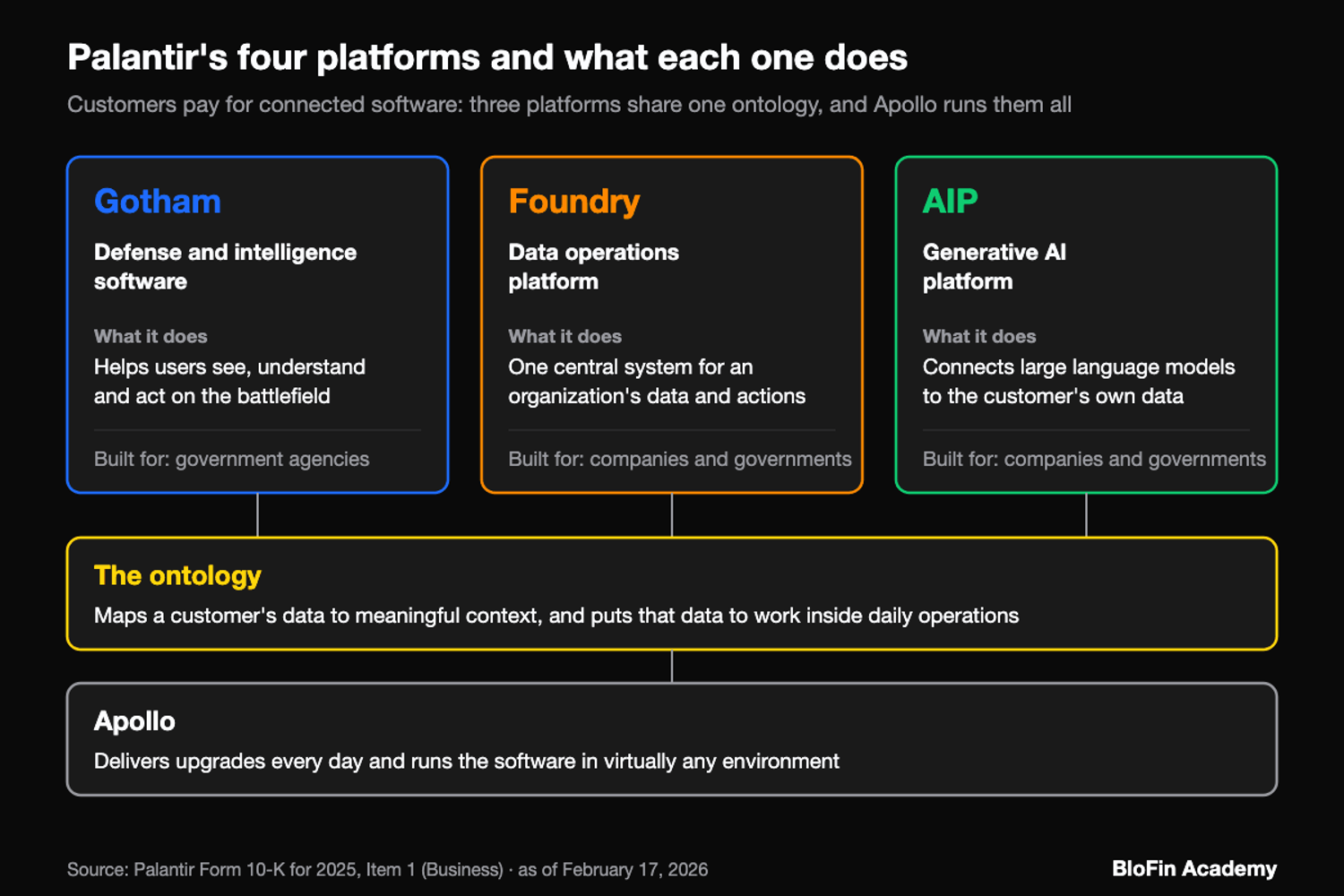
Palantir does one thing: it sells software that links up a customer's data, maps it to the real things it describes and lets staff and AI models act on it. Its clients are government agencies, such as defense and spy agencies, and large companies. They pay for four platforms called Gotham, Foundry, AIP (its Artificial Intelligence Platform) and Apollo.
Palantir was founded in 2003 and began by building software for US spy agencies, known as the intelligence community. It later started working with businesses too. For over a decade, its Gotham platform has served defense and spy agencies and disaster relief groups. Government work is still a large part of the business (source: Palantir Form 10-K for 2025).
Palantir's shares trade on Nasdaq under the ticker PLTR, so anyone who buys Palantir stock owns a small slice of the company that runs these platforms.
Palantir's platforms: Gotham, Foundry, AIP and Apollo
Palantir's platforms are the products its clients pay for. Gotham is built for defense and spy work, while Foundry runs a firm's data, from sales to supply. AIP brings AI language models onto that data, and Apollo installs and updates the software wherever a client runs it, from a public cloud to a secure military network.
What Palantir Gotham does
Gotham is Palantir's platform for defense and spy agencies. The firm says it lets users "see, understand, and act in the modern battlespace," and that it is used widely across government (source: Palantir Form 10-K for 2025). Put simply, Gotham pulls military and spy data into one shared view. Analysts and commanders then work from the same picture when they decide what to do.
What Palantir Foundry does
Foundry is the platform Palantir's business clients build on, and Palantir calls it its foundational data operations platform. It says clients use it to build a central operating system for their data, their rules and their actions (source: Palantir Form 10-K for 2025). A retailer, for example, could link its sales, stock and shipping records in Foundry. A planner could then see in one place which store will run short of which product, and when.
What Palantir AIP does
AIP is Palantir's tool for putting generative AI to work, which it started rolling out in 2023. It gives clients secure links to large language models built by other firms. Palantir sells it with Foundry, Gotham and Apollo, so the models work on data the client has already linked up (source: Palantir Form 10-K for 2025).
What Palantir Apollo does
Apollo is the least visible of the four, and it is the one that keeps the others running. Palantir calls it a delivery platform that rolls out upgrades every day. It lets clients run their software in almost any setting (source: Palantir Form 10-K for 2025). That matters when a client's systems sit where a normal cloud app cannot reach, such as a secure military network or a factory. Each update still has to arrive safely and on time.

What is the Palantir ontology?
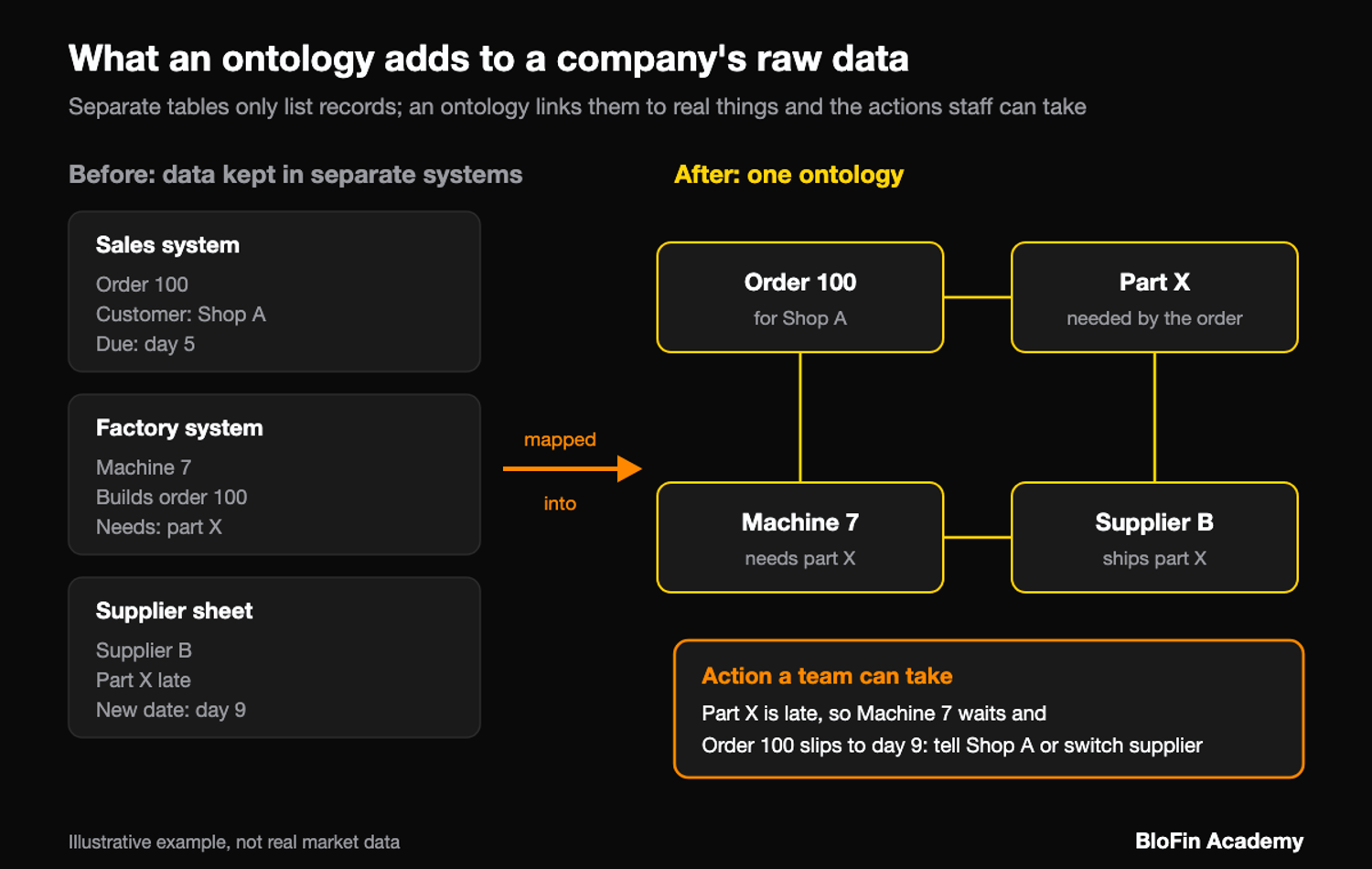
The Palantir ontology is a map of what a client's data stands for, such as the orders, machines, planes or suppliers behind each record, and how they link up. Its annual report defines ontology as mapping data to meaningful context. It calls the ontology the heart of its platforms, because it puts data to work in daily tasks (source: Palantir Form 10-K for 2025).
An everyday example helps: a spreadsheet of orders and a spreadsheet of parts each list records. Neither one knows that order 100 needs part X, that part X comes from one supplier, or that the supplier is running late. Once those links are mapped, a planner can see that a late part will delay a specific order. The planner can then decide what to do, such as warning the customer or switching supplier.
The ontology is also where Palantir's AI work happens. In its third-quarter business update, the firm said Nvidia trains open AI models on its own supply chain data inside the ontology (source: Palantir Q3 2026 Business Update). The aim is that the know-how of Nvidia's experts builds up in a system Nvidia controls.
How Palantir works with its customers
Palantir works with its customers by sending its own engineers to them, so each buyer gets help building its first working tools on its own data. Its careers listings call these staff forward deployed software engineers. They work with clients, often on site, to grasp their biggest problems and build fixes that use data (source: Palantir careers listing).
A project often starts with an open question, and the same listing gives "Why are we delaying so many flights?" as one example. The engineer's task is to find the data that answers it and turn the answer into a tool that staff use every day. The annual report says the same thing in its own terms. Palantir embeds with clients in many fields and aims at large projects that are hard to deliver (source: Palantir Form 10-K for 2025).
Generative AI also gave Palantir a faster way in: short AIP bootcamps, which its annual report says deliver real workflows on a client's actual data in days (source: Palantir Form 10-K for 2025). A company can try the software on one of its own problems in a short session before it commits to a wider rollout.
That hands-on style goes with a fairly short client list and large deals. Palantir counted 1,090 customers in the year to the end of September 2026. In the third quarter alone it closed 212 deals worth at least $1 million each, and 64 of them were worth at least $10 million (source: Palantir Q3 2026 Business Update).
Palantir's customers in government and business
Palantir's customers fall into two groups that it reports on separately: government agencies and commercial firms. From July to September 2026, US firms paid it $984 million and US agencies paid $953 million. It was the first quarter in which the business side came out ahead (source: Palantir Q3 2026 results).
Over the whole of 2025, government work still brought in 54% of Palantir's revenue and firms 46% (source: Palantir Form 10-K for 2025). Compared with a year earlier, Palantir's US commercial sales grew faster than its US government sales in the third quarter. That is how the business side caught up (source: Palantir Q3 2026 results).
Government customers
On the government side, the US military is the largest name. Palantir's business update says the US Army gave it a prime deal, meaning Palantir is the lead contractor, to build eight TITAN systems. TITAN is the Army's new AI-enabled ground station, and it turns sensor data, from space down to the ground, into targeting data (source: Palantir Q3 2026 Business Update). The same update says the Federal Aviation Administration (FAA) uses AIP to join up siloed safety systems into one national picture of risk. That way, new problems show up before they turn into incidents.
Commercial customers
Business clients range from chipmakers to chemical plants. Hexion, a chemical firm about 170 years old, has teamed up with Palantir to rebuild its business around a single ontology. It uses AI agents that turn customer signals into joined-up action across the firm (source: Palantir Q3 2026 Business Update). Hexion's chief executive said in the same update that the ontology lets the firm carry decisions across the whole business, from sensing demand to buying and pricing.
In energy, when Databricks and Palantir announced a tie-up in March 2025, the release named the oil firm bp among clients already using the two together. The head of technology at bp called the pair vital partners for the next phase of its digital change (source: Databricks announcement).
Palantir's technology partners
Palantir's partners are other tech firms whose products its software links to or runs beside, and several are named in dated press releases. Partners matter to clients because they decide where Palantir's platforms can run and which data they can reach. They matter to investors because each one can open a new path to buyers.
In December 2024, Palantir and the defense firm Anduril announced a consortium, a joint effort to help the US government turn AI advances into military tools. Under the plan, Anduril's Lattice software and Menace devices would gather data in the field. Palantir's AIP would then sort, label and prepare it for AI training at every level of secrecy (source: Anduril announcement). The same release describes Maven Smart System, powered by Palantir's platform, as a program the military already uses for joint missions such as intelligence.
The Databricks deal from March 2025 works for both firms and government. It joins Palantir's ontology and AIP with Databricks' platform for data storage and AI. Through Databricks' Unity Catalog and Delta Sharing tools, joint clients can govern and secure their data across both systems. The release listed the Department of Defense, the Treasury and the Department of Health and Human Services among the users (source: Databricks announcement).
A partner is different from one of Palantir's competitors, which try to win the same buyers, although two large software firms can be both at once.
Why Palantir is controversial
Palantir draws criticism mainly because of who uses its software and what they use it for. Its clients include armed forces, spy agencies, immigration authorities and national health services, all of which hold sensitive data about people. Palantir's annual report says these ties have brought public criticism from political and social activists, unfavorable media coverage and protests at its sites (source: Palantir Form 10-K for 2025).
Two contracts show where that criticism lands. In April 2025, Business Insider reported that US Immigration and Customs Enforcement (ICE) was paying Palantir $29.8 million for a prototype called ImmigrationOS, and an ICE spokesperson called the deal a change to an existing contract (source: Business Insider via Yahoo). In the UK, Reuters reported in June 2026 that the government was reviewing Palantir's £330 million ($441 million) National Health Service (NHS) contract. The concerns it cited were patient confidentiality, public trust and reliance on a US supplier (source: Reuters via The Star).
Palantir's answer is that it builds tools for data its customers already hold, and that it does not collect or sell data itself. It also runs a Privacy and Civil Liberties Engineering team, advised by an outside council of experts in privacy law, policy and ethics (source: Palantir Form 10-K for 2025). The same filing warns that the criticism could drive away customers and investors, which makes it one of the Palantir stock risks behind the share price.
How Palantir's products show up in its earnings
Knowing which clients use which platform helps you read the firm's earnings report. Gotham is built for government work, so news about it mostly touches the government segment. Foundry and AIP sell to both groups, which makes commercial revenue the clearest sign of how fast firms are taking up Palantir's software.
In practice, a new Army system such as TITAN shows up in government revenue, while a chemical maker rebuilding around the ontology, like Hexion, shows up in commercial revenue. The quarterly results release also reports deals closed and remaining deal value. That is what is still left on signed contracts if clients use all their options and none ends early (source: Palantir Q3 2026 results). Those figures point to sales that have yet to show up in revenue.
A full report holds many more lines, from margins to guidance and the call. Palantir's earnings reports are easier to follow once you know which platform and which type of client sits behind each line.
On BloFin, Palantir's price trades as the PLTRUSDT Perpetual, a contract that never expires and moves with Palantir's share price. Its gains and losses are paid in USDT, a stablecoin built to stay at one US dollar. Leverage of up to 20x lets you hold a position up to 20 times the money you put down, so gains and losses on that money grow by the same multiple. The PLTRUSDT trading page shows the live price.
Where Palantir announces its products and customers
Palantir announces new products, clients and partners in a few regular places, and knowing them helps you check a claim at the source. Each quarter, its results release states the revenue figures, and a separate business update adds the named client stories. Its annual report on Form 10-K describes each platform in its business section.
Partnerships usually come as press releases. The Anduril and Databricks deals each appear on the partner's own news page, so you can read the terms in the partner's words. When a headline says Palantir has won a new client, the quickest check is whether Palantir or the client has said so in a release of its own. That check matters if you trade Palantir on BloFin, because news of a big client can move the share price.
Looking to trade Palantir? To get started, you'll need to first create a BloFin account, fund your account with cryptocurrency, and go to the PLTRUSDT Perpetual trading page.

Frequently asked questions
Does Palantir sell or own the data it works on?
Palantir's annual report says the company is not in the business of collecting, mining or selling data. It says Palantir builds platforms that let customers bring in and combine their own data (source: Palantir Form 10-K for 2025). The third-quarter business update makes the same point in sales terms, saying Palantir helps customers own their data, their models and their advantage (source: Palantir Q3 2026 Business Update).
What is the difference between Palantir Gotham and Foundry?
Gotham is Palantir's defense and spy platform, while Foundry is its general data platform for any large firm or agency. The annual report adds that all of its commercial customers now use Foundry, as do many of its government customers. That makes Foundry the more widely used of the two (source: Palantir Form 10-K for 2025).
How many people work at Palantir?
Palantir had 4,429 full-time employees at December 31, 2025, and 28% of them, about 1,240 people, were based outside the United States (source: Palantir Form 10-K for 2025). One Palantir careers listing for a forward deployed engineer says it prefers candidates who can travel to client sites 25% to 50% of the time. It adds that this varies by team and location (source: Palantir careers listing).
Is Palantir a consulting company?
Palantir sells software, and it also sends its own engineers to work with clients and build tools on their data (source: Palantir careers listing). On top of that, it uses outside firms to install its platforms. In June 2025 it named Accenture Federal Services a preferred partner for setting up its software at US federal agencies. The plan was to train and certify 1,000 Accenture Federal staff on Foundry and AIP (source: Accenture announcement).
Does Palantir's software run on Microsoft's cloud?
Yes, for some government work. Impact levels are US Defense Department security grades, and Microsoft's August 2024 release uses them for its Azure clouds. It said Palantir's Federal Cloud Service, with Gotham, Foundry, AIP and Apollo, was authorized to run on Azure at Impact Level 5 (IL5). It also said Palantir would deploy those products in Azure Government's Secret cloud, which it labels Impact Level 6, and in its Top Secret cloud. That plan was subject to approval by the relevant government agencies (source: Microsoft announcement).
Researched and written by the BloFin Academy editorial team with AI-assisted drafting. All facts independently verified. Primary sources include Palantir's Form 10-K for 2025, its third-quarter 2026 results release and business update, a Palantir careers listing, partnership announcements from Anduril, Databricks, Accenture and Microsoft, and reporting from Business Insider and Reuters. BloFin facts come from its own PLTRUSDT market data, current as of November 11, 2026.
Nothing in this article constitutes financial advice, and nothing in it is a recommendation to buy, sell or hold Palantir in any form. Palantir's sales rely on large contracts with governments and companies, so a delayed budget, a lost customer or a slower quarter can move the share price sharply. The PLTRUSDT Perpetual is a leveraged contract settled in USDT that gives you no ownership of Palantir shares, and a leveraged position can be liquidated. Past performance does not indicate future results. Do your own research and consider your risk tolerance before you trade on BloFin.